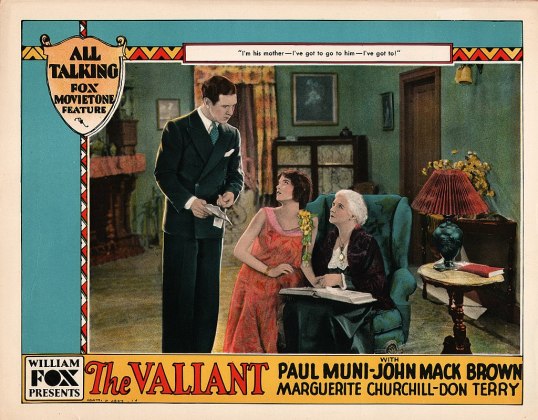
Film Review: The Valiant (dir by William K. Howard)


In the days after World War I, a man (Paul Muni) stumbles out of an apartment building and then walks down to the local police station.  He informs the officer on duty that he just shot a man.  He refuses to explain why he shot the man and, when asked for his name, he identifies himself as James Dyke.  The office notices a poster for “Dyke & Co.” on the wall and realizes that the man made up his name.  The man is convicted and sentenced to be executed.

The years pass as the man waits for his execution date.  He is a model prisoner, working hard in the garden and writing editorials for the newspapers in which he warns young readers about pursuing a life of crime.  The money he makes, he puts into Liberty Bonds.  He continues to refuse to tell anyone his first name.

In a small town, an old woman (Edith Yorke) sits in her rocking chair and has visions of all the men who went to war and never returned.  When the woman sees a picture of James Dyke in a newspaper, she thinks that he looks like her son, Joe, who long ago went missing.  The woman’s daughter, Mary (Marguerite Churhill), realizes that her mother is planning to make the trip to the prison to see him before he is executed.  Mary decides to go herself.  She tells her fiancé (John Mack Brown) that she could never get married if it turned out her brother was a murderer.  Meanwhile, the old woman continues to have visions of soldiers marching to war.

At the prison, James Dyke tells Mary that he has no family and he has no past.  But he did serve in World War I and during that time, he met her brother and he saw him die heroically in battle.  Dyke tells her to write to the army for the details of her brother’s death but to be aware that they might not even know whether or not he actually served because the war was such a confusing time that “they don’t know what happened to half the men out there.”  Dyke and Mary continue to talk as the hour of execution draws near….

An adaptation of a one-act play, The Valiant was released in 1929, at a time when America was still coming to terms with the horror of the Great War and Hollywood was still trying to adjust to the arrival of sound.  Though many had assumed that sound films would just be a fad, it turned out that audiences really did like to hear the dialogue as opposed to just reading it.  The Valiant is the type of melodrama that was popular during the silent era and the film does feature title cards that appear between scenes.  “A city street — where laughter and tragedy rub elbows,” one card reads.  Another one announces, “Civilization demands its toll.”  At the same time, it is a sound picture.  The first five minutes of the film are just the Man walking through the city and listening to the sound of cars honking and people talking.  Like many of the early sounds films, it’s obvious that the majority of the cast was not quite sure how they should handle delivering their dialogue.  Some people talk too loudly.  Some talk too softly.  Quite a few deliver their dialogue stiffly and without emotion.  Others use way too much emotion.

The only actor who seems to be fully confident in his ability to perform with sound is Paul Muni, making his screen debut in the lead role.  Muni gives a strong and empathetic performance, one that makes even the most melodramatic of dialogue feel naturalistic.  Muni shows an instinctive knowledge of how to deliver his lines with emotion without going over the top, which was a skill that many of the actors who tried to make the transition to sounds films never learned.  Paul Muni was the first great actor of the sound era, as well as one of the first screen actors to use what would eventually become known as the Method.  Among the actors who were directly inspired by Muni were John Garfield, Montgomery Clift, and Marlon Brando.  Much of modern acting owes a huge debt to the work of Paul Muni.

Seen today, the contrast between Paul Muni’s performance and the film’s staginess can make The Valiant seem like a rather surreal film.  While Muni captures the screen and confidently delivers his lines, everyone else seems hesitant and unsure of how to reply.  The end result is that, to modern audiences, The Valiant can almost seem like a filmed dream.  From the shot of Muni walking down the noisy city street to the sudden appearance of a swing band playing in the prison cafeteria, the film can seem almost Lynchian in its oddness.

The Valiant was a box office success and, according to the notes in the Academy archives, Paul Muni was among the actors considered for the second Best Actor Oscar.  (That year, there were no official nominations and only the winners were announced.)  The Oscar went to Warner Baxter for In Old Arizona but Muni would go on to have an amazing career.

30 More Days Of Noir #1: Bunco Squad (dir by Herbert I. Leeds)


Welcome to Noirvember!

Yeah, yeah, I know.  That sounds kinda silly, doesn’t it?  However, November is traditionally the month that classic film bloggers tend to concentrate on writing about film noir.  It provides a bit of grit and cynicism in between the horror fun of October and the holiday schmaltz of December.

I have to admit that I’m a little bit torn when it comes to taking part in Noirvember.  On the one hand, I love a good film noir and there’s quite a few obscure and underrated ones available on YouTube right now.  On the other hand, as a natural-born contrarian, I don’t like the idea of hopping on any bandwagons.

In the end, my love of film noir won out.  So, welcome to my first entry in 30 More Days of Noir.

The 1950 film, Bunco Squad, tells the story of Tony Weldon (Ricardo Cortez), a con man who specializes in using a phony psychic routine to swindle rich people out of their money.  He runs a fake enlightenment center and he claims that he can speak to the dead.  His latest target is the wealthy Jessica Royce (Elisabeth Risdon).  After he finds out that her son was killed during the invasion of Normandy, he and his associates go out of their way to trick her into believing that Tony can contact her son and that her son wants her to leave all of her money to Tony’s organization.  It’s actually kind of interesting watching as Tony and his gang manage to track down information about Jessica and her son, asking the most mundane of questions to find out things that Jessica believes only her son would know.  Watching Tony operate, I was reminded of those documentaries and news reports that you see about phony faith healers and other people who claim they can speak to the dead but who actually just go on very vague fishing expeditions.  (“I’m sensing something about the letter L.  Does that mean anything to you?”)

Tony is not just a con artist.  He’s also a murderer, one who specializes in cutting brake lines on cars.  If you try to expose Tony, you’re probably going to end up driving off of a cliff.  I guess you can get away with that when you’re a con artist in California.  Myself, I live in North Texas where the land is totally flat.  Someone could cut my brake lines and I would probably just keep going forward until I eventually ran out of gas.  Once that happened, someone would probably pull over and offer to give me a lift to the nearest gas station.  That’s one reason why someone like Tony Weldon could never pull off any of his crimes in my home state.

Fortunately, the detective of the LAPD’s Bunco Squad know what Tony’s doing.  The only problem is that they have to get some proof that Tony is swindling Ms. Royce and they have to manage to do it before Tony gets a chance to tamper with all of their brakes.  Leading the Bunco Squad is Steve Johnson (Robert Sterling) and you better believe that there’s no way someone named Steve Johnson is going to be anything other than honest and upright.  Working with a real-life magician named Dante, Johnson attempts to expose all of Tony’s tricks.

It’s probably open for debate whether or not Bunco Squad is a true noir.  On the one hand, Tony and his schemes are very noirish.  On the other hand, Steve and the members of the Bunco Squad are so upright that there’s none of the ambiguous morality that you find in the best film noirs.  I guess I would call this a half-noir.

The best thing about Bunco Squad is that it’s only 67 minutes long, which is all the time that it needs to tell a compact and occasionally interesting story.  There’s no excessive padding to try to force the story out to an unwieldy 90 minutes.  Instead, Bunco Squad jumps right into its story and it doesn’t let up until things come to an end.  The other good thing about Bunco Squad is that you’ve got Ricardo Cortez, giving a charmingly evil performance as Tony Weldon.  The film’s heroes are a pretty dull bunch but Cortez brings a nice charge of danger to the proceedings.

Bunco Squad is an obscure film but it moves quickly and the story is interesting enough to hold your attention for an hour.  It can be found on YouTube.

Horror Film Review: The Walking Dead (dir by Michael Curtiz)


In this 1936 film (which has absolutely no relation to the AMC zombie show), Boris Karloff plays John Ellman.  John Ellman is perhaps one of the unluckiest guys ever.  Seriously check this out:

John Ellman was once an acclaimed concert pianist.  However, he was wrongly convicted of killing his wife and spent ten years in prison.  Now that he’s finally been paroled, he can’t get anyone to hire him.  Meanwhile, the judge who originally sent him to prison is in the news for having defied the mob and sentenced a well-known gangster to prison.  The mob is out for revenge but, rather than take the fall themselves, they’d rather frame a patsy.  And who could be a better patsy than a man who everyone already knows has a grudge against the judge?

Nolan (Ricardo Cortez), a crooked lawyer, arranges for Ellman to be given a job.  Ellman is told that he simply has to spy on the judge for a few nights to determine whether the judge is having an extramarital affair.  Ellman agrees and soon finds himself being set up.  The gangsters kill the judge and plant the body in Ellman’s car.  Ellman is arrested and sentenced to die.  It doesn’t matter that there are witnesses who know that Ellman’s innocent.  No one is willing to cross the mafia.

Ellman is convicted and promptly executed but his story isn’t over.  A scientist named Dr. Beaumont (Edmund Gwenn, who later played the man who might be Santa Claus in Miracle on 34th Street) knows that Ellman is innocent.  He takes Ellman’s body and, through an artificial heart and a bunch of other science-y things, he manages to revive Ellman.  John Ellman lives again!  Of course, he’s a bit of a zombie now and he doesn’t have any memory of his former life.  And yet, he instinctively knows who set him up to be executed and he sets out for revenge.

What’s interesting is that Ellman doesn’t kill anyone.  Even after he’s revived and presumably has no concept of right and wrong, John Ellman remains a rather passive zombie.  For the most part, the racketeers die because of how they react to the sight of the previously dead Ellman coming towards them.  For that matter, Beaumont isn’t the typical mad scientist that you might expect to turn up in a film like this.  He’s a benevolent man who was simply doing what he thought was the right thing.  Though the film ends with a warning about playing God, one can’t hep but get the feeling that, unlike Frankenstein, the film is overall very supportive of the idea of reviving the dead.

Directed by Michael Curtiz (who also did Casablanca, Mildred Pierce, The Adventures of Robin Hood, and countless other classic films), The Walking Dead is a combination horror/gangster film.  The film’s plot is a bit too convoluted for its own good but, overall, The Walking Dead works because of Boris Karloff’s performance.  He’s poignantly pathetic as the living John Ellman and then rather chilling as the vengeance-driven, recently revived Ellman.  The film’s most effective scenes are the ones where he just stares at his enemies, fixing them with a gaze that takes no prisoners and offers no hope.  It’s a great performance that elevates an otherwise uneven film.