International Horror Film Review: The Sister of Ursula (dir by Enzo Milioni)


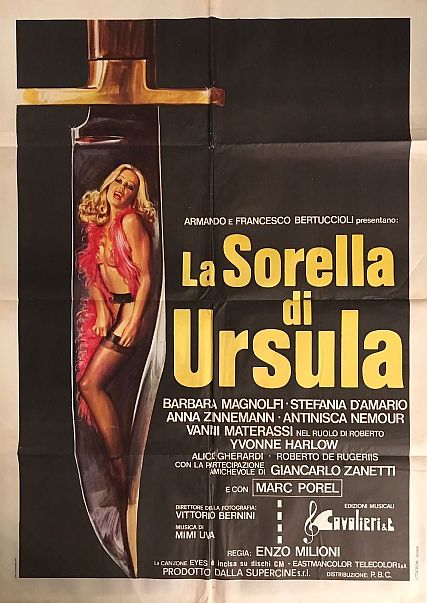
This 1978 Italian giallo tells the story of two sisters.  Ursula (Barbara Magnolfi, who is best-known for playing Olga in Argento’s Suspiria) is high-strung and prone to nightmares.  She claims that she can see people for who they really are.  Dagmar (Stefania D’Amario) is a year or two older.  She looks after her sister and makes sure that Ursula takes her pills.  Still, it’s hard to escape the feeling that Dagmar would like to be free of having worry about Ursula.

After the death of their father, Ursula and Dagmar check into a hotel in an Italian resort town.  Ursula wants to find their mother, a prostitute who left their father shortly after Ursula was born.  Dagmar, for her part, seems to just want to take a vacation and maybe meet a few men.  Ursula gives Dagmar a hard time for being promiscuous.  Dagmar gives Ursula a hard time for being neurotic and not having any fun.  It’s a typical family vacation.

Unfortunately, there’s also a homicidal lunatic on the loose, one that kills the promiscuous.  In typical giallo fashion, he wears black gloves and, often, all we see of him is his madness-filled eyes.  Unlike a lot of other giallo killers, he does not use a knife.  Nor does he strangle his victims.  Instead, he uses a big wooden dildo to beat people to death.  Believe me, I’m probably making it sound more interesting than it actually is.  For a film that wallows in sleaze, The Sister of Ursula doesn’t focus too much on the killer’s use of a dildo as a murder weapon, beyond showing its shadow on a wall at one point.  It’s an odd piece of directorial restraint that feels at odds with the rest of the movie.

Describing The Sister of Ursula as being a sleazy film doesn’t begin to describe just how sleazy this film is.  There’s not a single character to be found in the film who is not, in some way, perverse and the frequent soft-core sex scenes seem to exclusively take place in locations that don’t appear to have been cleaned anytime recently.  (One such scene features a picture of Donald Duck hanging on the wall over the bed.  That’s one of those weird but fun decorating choices that always seems to occur in giallo films.)  There are many films that leave you feeling like you need to take a shower afterwards.  This is one of the few films that I can think of that will leave you feeling like you need to take a shower every fifteen minutes or so.  

As for the film’s mystery, it plays out at a languid pace.  The story gets bogged down with a subplot about drug dealers.  One would be tempted to say that the film cultivates an atmosphere of ennui but I think that’s giving The Sister of Ursula too much credit.  This film was not made by a subversive artist like Jean Rollin or Jess Franco.  Instead, it’s just a poorly directed and paced giallo film.  That said, the Italian scenery is often lovely to look at and Barbara Magnolfi and Stefania D’Amario are believable as sisters.  This is a minor giallo that’s not so much terrible as it’s just forgettable.  
International Horror Film Review: The Psychic (a.k.a. Seven Notes In Black) (dir by Lucio Fulci)


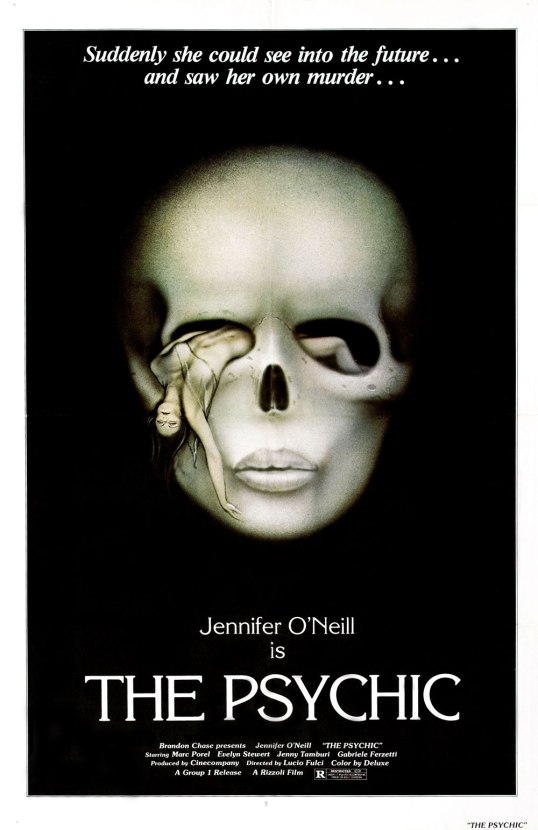
Also known as Seven Notes In Black, The Psychic is an Italian paranormal thriller that was made and released in 1977, shortly before the film’s director, Lucio Fulci, reinvented Italian horror with Zombi 2.

For years, Virginia (Jennier O’Neill) has been haunted by visions.  When she was a child, she saw a vision of her mother jumping off a cliff.  It turned out that, at the same time Virginia had her vision, her mother was doing exactly that.  18 years later, Virginia is living in Rome and she’s married to a wealthy businessman named Francesco Ducci (Gianni Garko, who also starred in several Spaghetti westerns).  Virginia would seem to have the perfect life but she’s still haunted by disturbing visions.  She sees an old woman murdered.  She sees a wall being ripped apart.  She sees a discarded letter.  Is she seeing the past, the present, or the future?  She does not know.  Ducci insists that her visions mean nothing but Virginia is convinced that something is reaching out to her.

While Ducci is away on business, Virginia visits an abandoned house that her husband has recently bought.  Virginia wants to renovate it but, as soon as she sees it, she realizes that the house previously appeared in her visions.  When she investigates, she discovers a skeleton in one of the walls.  With the police now convinced that Ducci is a murderer, Virginia tries to figure out the meaning behind her visions and looks for a way to clear Ducci’s name.  Strangely, Ducci still doesn’t seem to be that concerned about any of it….

Along with Lizard In A Woman’s Skin and Don’t Torture A Duckling, The Psychic is a film that gets a lot of attention as an example of Fulci’s pre-Zombi 2 horror output.  After Zombi 2, Fucli would become best known for making films that were full of gore and that often seemed to be deeply angry with the world.  The fact that Fulci was also a brilliant stylist who created some of the most dream-like images ever to be captured on film would often be overlooked in all the controversy over the often violent content of his movies.  One thing that makes The Psychic interesting is that, visually, it’s clearly a Fulci film.  The cinematography is lush and vibrant.  The visions are surreal and disturbing.  However, there’s very little of the gore that came to define Fulci’s later films.  Instead, the emphasis is on the atmosphere and the mystery.  This is one of the few Fulci films that you could safely show an older relative.

Fulci was often (a bit unfairly, in my opinon) portrayed as being a cinematic misanthrope, as a director who little use for the characters that populated his films.  That’s certainly not the case with The Psychic, though.  Virginia is probably one of the most sympathetic characters to ever appear in a Fulci film and Jennifer O’Neill does a good job in the lead role.  Even more importantly, Fulci seems to like her and, from the start, it’s clear that the film is fully on her side.  The entire story is told through her eyes and she’s a character who you immediately root for.  Like Fulci himself, she’s a visionary whose visions are often underappreciated until it’s too late.  Though the film ends on a characteristically downbeat note (happy endings were rare even in Fulci’s pre-Zombi 2 films), Virginia is still allowed her triumph with one final and rather clever little twist.

The Pyschic is a bit slowly-paced but it’s still a far better film that many Fulci critics seem to be willing to acknowledge.  (One gets the feeling that many critics resent any film that indicates that there was more to Fulci than eye damage and zombies.)  It’s an entertaining and intriguing latter-era giallo and proof that there was more to Fulci than just blood.

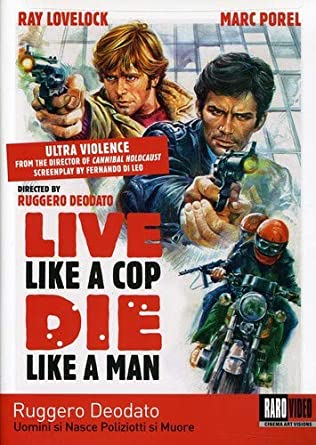
The TSL’s Grindhouse: Live Like A Cop, Die Like A Man (dir by Ruggero Deodato)


The 1976 film, Live Like A Cop Die Like A Man, takes place during the Christmas season.

We know this because the film opens with a man dressed like Santa Claus standing on a street corner in Rome and impotently watching as a woman is dragged behind a motorcycle by two men who were attempting to snatch her purse.  When she doesn’t let go of her purse, one of the men hops off the motorcycle and proceeds to kick her in the face until she stops moving.  Suddenly, two other men — our heroes, as it were — came driving up on a motorcycle of their own.  A chase ensues, through the streets of Rome, during which a blind man’s dog is graphically run over.  The chase which, it must be said, is very well-shot and directed, lasts for over 10 ten minutes and it ends with the two thieves being executed by, once again, our nominal heroes.

A lot of people are executed over the course of Live Like A Cop, Die Like A Man.  That’s because Detectives Fred (Marc Porel) and Tony (Ray Lovelock) have been given a license to kill anyone who breaks the law.  The film is a bit vague on just how exactly the license works and why, apparently, it’s only been given to Fred and Tony.  One major set piece features several dozen cops all waiting outside a house, powerless to get the three criminals within, until Fred and Tony arrive.  Fred and Tony, of course, solve the problem by killing everyone.  Why couldn’t the other cops have done that?  The film doesn’t really make that clear.

Admittedly, Fred and Tony aren’t the first movie cops to get results through unorthodox means.  The French Connection was a popular film in the 70s and it inspired a whole genre of Italian rip-offs, of which Live Like A Cop Die Like A Man is a definite example.  What sets Fred and Tony apart from cops like Popeye Doyle and Dirty Harry is the amount of joy that Fred and Tony seem to get out of killing people.  Early on, they show up at a party and proceed to set all of the cars on fire. They also set two criminals on fire, with Fred doing a happy little dance as the two men go up in flames.  It’s disturbing but there’s also a strange integrity to the film’s shameless embrace of violence.  Live Like A Cop, Die Like A Man doesn’t pretend to be about anything other than satisfying the vigilante fantasies of its audience.

And indeed, it should be considered that Live Like A Cop, Die Like A Man was released during the so-called Years of Lead, when a combination of political terrorism and open crime had made violence an almost daily part of Italian life.  When you’re living day-to-day with the knowledge that you could be blown up at any minute by the Red Brigade, the Ordine Nero, or the Mafia, I imagine that there would be something appealing about watching two young men who are perfectly willing to just shoot anyone who appears to be up to no-good.  It’s easy to imagine that, for audiences in 1976, the random violence of this episodic film mirrored the random violence of everyday life.  Though Live Like A Cop, Die Like A Man was obviously inspired by The French Connection, it perhaps has more in common with the original Death Wish, with the main difference being that Live Like A Cop’s vigilantes are officially sanctioned.

The film also places a good deal of importance on just how close Tony and Fred are supposed to be.  They live together in a ramshackle flat, they apparently spend all of their free time together, and, towards the end of the film, the only thing that keeps the two of them from taking part in a threesome is the sound of someone else being shot.  Unfortunately, Ray Lovelock and Marc Porel did not get along in real life and, as a result, there was never a Live Like A Cop Die Like A Man Part IILive Like A Cop would also be director Ruggero Deodato’s only stab at the polizieschi genre.  He went on, of course, to direct Cannibal Holocaust and The House on the Edge of the Park.  (Interestingly, Tony and Fred’s relationship is mirrored, to sinister effect, by the relationship between the characters played by David Hess and Giovanni Lombardo Radice in House On The Edge of the Park.)  Live Like A Cop, Die Like A Man has gone on to become a bit of a cult film and, as offensive as some will find it to be, it’s also so over-the-top in its violence and its celebration of officially sanctioned bad behavior that it becomes rather fascinating to watch.  It’s so without shame or apology that it’s hard to look away from it, even though you may want to.

Lisa Cleans Out Her DVR: Secret World (dir by Paul Feyder and Robert Freeman)


(I’m currently cleaning out my DVR!  It’s going to take forever but I take like 20 capsules of Dexedrine a day so I’m pretty sure I’ll be able to stay awake until I’ve watched everything.  Anyway, I recorded the 1969 film, Secret World, off of FXM on February 1st.)

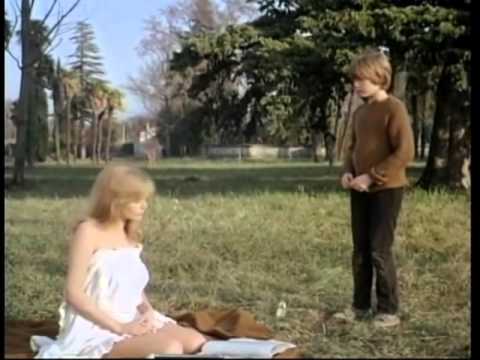
Poor Francois (Jean-Francois Vlerick)!  This eleven year-old has already experienced more tragedy than most people will have to deal with in a lifetime.  He was recently in a car accident, one that resulted in him being pinned underneath his mother’s body for several hours.  He now lives with his grandparents (Pierre Zimmer and Giselle Pascal) on their beautiful estate.  It’s a lonely life.  Francois spends most his time with his pet rabbit or, at least, he does until Wendy Sinclair (Jacqueline Bisset) shows up.

Wendy used to be his grandfather’s mistress.  She may still be.  The film is deliberately ambiguous about the current state of their relationship.  Grandma, of course, is not happy to see her.  Francois, on the other hand, becomes obsessed with her, watching her while she sleeps and even clipping off a lock of her hair.  For her part, Wendy good-naturedly tolerates Francois and his attention.

Then Olivier (Marc Morel) shows up.  Olivier is Francois’s uncle, a handsome and wealthy rogue.  The attraction between Olivier and Wendy is obvious, leading to both Francois and his grandfather growing jealous.  With all three of the men in love with Wendy, she eventually does have sex with one of them but the film deliberately declines to reveal whether she’s with Olivier or the grandfather.  (We only see a man’s hand and that man is wearing a glove as he approaches the naked Wendy.)

Secret World is a creepy little French movie, one of the many movies from the late 60s that featured boys and men lusting after Jacqueline Bisset.  Almost everything about this movie screams 1969, from the fashion to the cars to the oddly pretentious tone of the entire film.  Naturally, there’s the occasional jump cut and a few unnecessary close-ups.  There are hints of psychedelia in the shots where the sun shines over Olivier’s shoulder.  It even has a rather melancholy and ambiguous ending.  It’s a frequently gorgeous film, full of haunting shots of the French countryside.

And yet, the film adds up to almost nothing.  The movie was obviously trying to be a bittersweet coming-of-age story but it doesn’t work because the characters, as written, are almost all ciphers.  Francois is weird when we first meet him and he’s weird when we see him for the last time.  He’s one of those kids who is either going to grow up to be a writer or a serial killer.  Unfortunately, the film doesn’t seem to know which is true.

At first, I was expecting Secret World to turn out to be a horror film, mostly because little Francois was so creepy with the way that he was always staring at Wendy.  I’ve been stared at like that and it made my skin crawl.  As soon as Francois started wandering around with the scissors, I was like, “Merde!  Everyone in that château is about learn that there are worse things in the world than just ennui!”  But no, Secret World never followed up on any of those implications.  Instead, it just became a series of pretty and rather empty images.  There’s a lot of beauty but not much depth to be found in Secret World.