Ah, speed.
I have to admit that I always find films about amphetamines to be fascinating because I take them for my ADD. I’ve been taking Dexedrine since I was in middle school and it has always amused me how people who don’t have ADD seem to think that the meds will give you super powers. For instance, every season of Big Brother, there’s people online who get outraged over certain houseguests taking Adderall. “She had an unfair advantage!” someone will say, “Because she’s taking Adderall!” What can I say? People who don’t have ADD just don’t get it. Yes, if you have ADD, the meds can help you focus but it’s not like they’re going to give you any sort of special power that’s not available to any other person.
(I will admit that there is a slight difference between me on my meds and me off my meds. Actually, my family says that there’s a huge difference but I think they’re exaggerating. It is true that I’m a lot more focused when I take my Dexedrine. My mind wanders a bit less than usual and I’m also usually in better control of my frustrations. When I take my meds, I can finish any project. When I don’t take them, I can talk about finishing any project.)
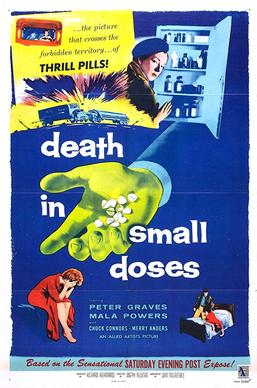
Dexedrine focuses me but apparently, it does the opposite for those who don’t have ADD. The 1957 film, Death in Small Doses, features a truck driver named Mink Reynolds who, despite not having ADD, pops too many capsules and ends up playing really loud music and trying to force a waitress to dance with him. He also hallucinates seeing a car and then grabs a knife and tries to kill another truck driver. To be honest, that seems a bit extreme to me. In fact, I’d almost argue that Mink’s behavior would indicate that the filmmakers really didn’t know much about amphetamines. Making things even stranger is that Mink is played by Chuck Connors, who was a remarkably inexpressive actor. Watching Connors, with his stone face, trying to dance and jump around is an interesting experience. Mink is supposed to be a jazz-crazed, speed-abusing hepcat but instead, he comes across like an animatronic mannequin. You can almost hear the gears shifting whenever he has to move across the screen.
Mink’s fellow truck driver is Tom Kaylor (Peter Graves), a seemingly upright man who is usually seen wearing a tie and who looks like he would be more comfortable working behind a desk than driving a truck. Of course, that’s because Tom is actually an FBI agent! He’s working undercover, pretending to be a truck driver so that he can smash a ring of drug dealers! Of course, the problem here is that everything about Peter Graves’s screen presence shouts out, “Narc!” With his square jaw and his perfect haircut and his stiff but authoritative delivery of his dialogue, he seems like he was created in a lab that specifically set out to develop the most stereotypical FBI agent imaginable. There’s not a single rough edge to him and it’s hard to buy that the other truck drivers wouldn’t see straight through him.
While Tom tries to bust the ring, he also finds time to possibly fall in love with two different women, both of whom seem as if they might know more than they’re letting on. Amy (Merry Anders) is the waitress who has developed a drug habit of her own. Val (Mala Powers) owns the boarding house when Tom and Mink live. Can Tom trust either one of them? And will Tom not only undercover the identity of the head of the drug ring but also survive long enough to bring the dealers to justice?
So, here’s the thing. During its worst moments — i.e., whenever Chuck Connors is jumping all over the place and talking about how much he loves his friend “benny” — this is a campy and rather silly film that makes Reefer Madness look subtle by comparison. However, during its best moments, this is a tough and entertaining noir that features good performances from Merry Anders and Mala Powers. Both Anders and Powers manage to transcend the film’s sillier moments and they actually bring a charge of reality to the story. And while director Joseph M. Newman may not have known much about drugs, he did know how to shoot a fight scene. Making good use of its desolate locations (the truck drivers spend a lot of time driving through the desert) and setting many of the film’s best moments at night, Newman overcomes some of the script’s weaker moments. In the end, it makes for a rather uneven but entertaining viewing experience. Despite the film’s cluelessness about drugs and the miscasting of both Graves and Connors, this lesser-known noir is worth tracking down.

 Through the Shattered Lens