Horror On The Lens: Summer of Fear (dir by Wes Craven)


Today’s horror on the lens is a 1978 made-for-TV movie that was directed by Wes Craven.  Originally entitled Stranger In Our House, it was retitled Summer of Fear when it was released into theaters in Europe.  Personally, I think Summer of Fear is a better title.  It has a fun R.L. Stine feel to it.

As for the film itself, it tells the story of what happens when the recently orphaned Julia (Lee Purcell) moves in with her distant relations in California.  At first, Julia fits right in with her new family but, slowly and surely, her cousin Rachel (Linda Blair) comes to suspect that Julia might be a witch.  And hey, who can’t relate to that?  Seriously, everyone has that one cousin…


Retro Television Review: Fantasy Island 4.17 “Also Rans/Portrait of Solange”


Welcome to Retro Television Reviews, a feature where we review some of our favorite and least favorite shows of the past!  On Tuesdays, I will be reviewing the original Fantasy Island, which ran on ABC from 1977 to 1984.  Almost the entire show is currently streaming on Daily Motion.

Smiles, everyone, smiles!  It’s Tattoo’s birthday!

Episode 4.17 “Also Rans/Portrait of Solange”

(Dir by Leslie H. Martinson, originally aired on February 28th, 1981)

It’s hard to know where to start with this episode, it’s so odd.

The first fantasy features Larry Linville as Jerome Pepper, who works in the “women’s shoes department” at Latham Department Store.  He has a crush on his co-worker, Delia (Joan Prather).  Delia is also the daughter of Emmett Latham (Don Porter), the owner of the store.  The shy Jerome has only one fantasy.  He just wants Delia to notice him.

Well, it turns out that Delia and Emmett are on the Island!  They keep their horse at the Fantasy Island Stables.  Delia has challenged the owner of Selby’s Department Store, widow Amelia (Arlene Dahl), to a race.  The only problem is that Delia is having trouble training her horse.  The horse is fast but it always stops before crossing the finish line.

Mr. Roarke arranges for Jerome to bring a horse named The Professor to the stables.  The Professor is such a charismatic horse that all other horses want to hang out with him.  If The Professor is standing at the finish line, Delia’s horse will have no trouble running across it.  Delia has definitely noticed Jerome now.

The day of the race, The Professor disappears!  So, Jerome steals an ice cream truck (“Fantasy Island Ice Cream” is written on the side of vehicle) and drives around the island announcing, “Professor!  Tutti Frutti!  Professor!  Tutti Frutti!”  Luckily, Professor loves Tutti Frutti and escapes from the stable where Amelia’s people were holding him prisoner.

Jerome and the Professor show up at the finish line, just in time to help Delia’s horse win the race.  Jerome and Delia fall in love.  Amelia confesses that she’s in love with Emmett and the two decide to combine their stores.  So, I guess we’re just going to ignore the fact that Amelia tried to steal The Professor!

Good Lord, this fantasy!  The whole thing just felt like a combination of random plot devices that had probably been snipped out of other episodes.  Perhaps it would have worked better if Jerome had been a young, nerdy guy but Larry Linville appeared to be in his 50s and far too old to require a fantasy in order to talk to a co-worker.

The second fantasy is a little bit more interesting, if just because Mr. Roarke is actually nice to Tattoo for once.  Tattoo’s birthday is approaching so Roarke decides to give him a fantasy as a gift.  Knowing that Tattoo is a fan of Toulouse-Lautrec (and Herve Villechaize was an acclaimed painter in real life, as well), Mr. Roarke arranges for the Traditional Dance Company of Paris to come to Fantasy Island to rehearse and so Tattoo can paint them.

While Tattoo enjoys sketching all of the dancers, his favorite subject is Solange Latienne (Elissa Leeds), who takes care of the company’s costumes but who dreams of dancing herself.  We’re told that Solange is French, though she doesn’t speak with an accent and she uses an American pronunciation for her last name.  Tattoo falls for Solange but the company’s arrogant choreographer, Mark Ellison (David Groh), goes out of his way to try to keep Solange away from Tattoo.  Knowing that Tattoo is watching from a distance, Mark kisses Solange.  Thinking that Solange has rejected him, Tatoo throws away a sketch he had done of her.  Awwwwww!

Mr. Roarke informs Tattoo that an emergency meeting of the “Island Council,” has been scheduled for the night.  (This is the first time we’ve ever heard of this Island Council.)  Tattoo agrees to go in Roarke’s place but it turns out that the meeting is a surprise party!  The owner of the Traditional Dance Company, Alfred Gerrard (MacDonald Carey), buys Tattoo’s sketches.  Then Solange dances as a part of the birthday celebration and Alfred is so impressed that he makes her a part of the company.  Take that, Mark!

So, both Solange and Tattoo’s fantasies come true.  Though Solange still leaves the Island so, once again, Tattoo’s heart is broken.  Again, awwwwww!

Elissa Leeds was convincing neither as a French girl nor as a dancer but the second fantasy was still enjoyable, if just because it gave Herve Villechaize a rare chance to do something more than announce the plane and ask Mr. Roarke to explain everyone’s fantasies.  Villechaize did a good job in this episode and it was nice to see he and Montalban pretending to like each other.

It was an uneven episode but at least Tattoo had a nice birthday.

Retro Television Reviews: Fantasy Island 3.13 “The Inventor/On The Other Side”


Welcome to Retro Television Reviews, a feature where we review some of our favorite and least favorite shows of the past!  On Tuesdays, I will be reviewing the original Fantasy Island, which ran on ABC from 1977 to 1986.  Almost entire show is currently streaming is on Youtube!

This week’s trip to Fantasy Island is sadly forgettable.  Let’s find out why.

Episode 3.13 “The Inventor/On The Other Side”

(Dir by Earl Bellamy, originally aired on December 15th, 1979)

This week, there is no banter between Tattoo and Mr. Roarke before they head off to meet their guests.  In fact, Ricardo Montalban and Herve Villechaize barely look at each other.  It’s a shame because this is actually a pretty dire episode.  It could have used some passive-aggressive Tattoo/Roarke interaction.

The first fantasy features Arte Johnson as Professor Dwayne Clebe and Marcia Wallace as his assistant, Martha Meeks.  Professor Clebe is tying to develop a solution that, when sprayed on metal, will make it impervious to damage.  When he first arrives at Fantasy Island, the solution is called 2X76409, with the 9 signifying the 9 labs that have been blow up by Clebe’s experiments.  By the time he and Martha perfect the solution, it has become the 2X76411.  Fear not, no one is injured when the labs blow up.  Even though Clebe and Martha are both standing in the middle of these explosions, they always just end up with soot on their face.

Anyway, once the formula is perfected, leaders of both industry and the world’s trade unions travel to Fantasy Island to try to destroy it.  The industrialists think that it will drive down prices.  The unionists think that it will put people out of work.  Eventually, the Russians show up because they want the formula for themselves.  It all leads to a big chase and Prof. Clebe realizing that he loves Martha.

The whole fantasy was way too cartoonish and overwritten for its own good and it featured some of the worst acting that I’ve ever seen on Fantasy Island.  Let’s move on!

Unfortunately, the other fantasy really isn’t that great either.  Irma Gideon (Jeanette Nolan) was the wife of a medium.  When he died, he promised that he would contact her from the other side.  He hasn’t done so and Irma’s fantasy is to go to the other side, see her husband, and then return.  Mr. Roarke arranges for a séance but, when he suspects that Irma is planning on just going to the other side and staying there, he cancels the fantasy.  After Irma swears that she won’t stay in “the other side,” Mr. Roarke allows her to enter a death-like trance in a Fantasy Island laboratory.  When Irma goes to the Other Side and is tempted to cross a bridge and stay permanently, her grandson (Keith Gordon) enters into a trance of his own so that he can beg her to come back.

It all sounds like it should be interesting but the execution is lacking, with one scene featuring a painting of Irma’s husband speaking to her being so badly done that it makes it impossible to take the rest of the fantasy seriously.  Jeanette Nolan and Keith Gordon both give marginally better performances that Arte Johnson and Marcia Wallace did in the other fantasy but, in the end, the whole thing just falls flat.

Well, not every trip to Fantasy Island can be a winner.

Who Is The Black Dahlia? (1975, directed by Joseph Pevney)


In 1947 Los Angeles, the body of 22 year-old Elizabeth Short is discovered in an empty lot.  Short, who was nicknamed The Black Dahlia because she always wore black, was an aspiring actress who was violently tortured before being chopped in half.  Her murder remains one of Hollywood’s most infamous unsolved crimes.

In this made-for-television movie, Ronny Cox and Efrem Zimbalist, Jr. play the two detectives who are assigned to investigate Short’s murder.  Though they struggle to find any clues identifying who could have killed Short, they do learn about her life and how she went from being a naïve innocent who came to Hollywood with stars in her eyes to being a hardened and cynical woman who may have been supporting herself through sex work when she was murdered.  The film makes use of frequent flashbacks, in which Elizabeth Short is played by Lucie Arnaz.  Her friends and acquaintances are played by familiar television faces like Henry Jones, Mercedes McCambridge, June Lockhart, Brooke Adams, Donna Mills, and Tom Bosley.  Also be sure to keep an eye out for Sid Haig, playing a tattoo artist.

What Elizabeth Short went through over the course of her short time in Hollywood was probably too graphic to be put on television in the 70s but this movie still does a good job of recounting the basic facts of her life and murder.  Because the film is based on fact, no one is ever arrested for Short’s murder.  The only suspect is a doctor who turns out to have an alibi.  The movie instead focuses on Short trying make it in Hollywood and discovering that it’s a cruel town.  Lucie Arnaz was far better than I was expecting in the role of Elizabeth and brought a lot of vulnerability to the role.  The film ended with a title card, asking anyone who had information about the murder of Elizabeth Short to call the LAPD.  The case remains open to this day.

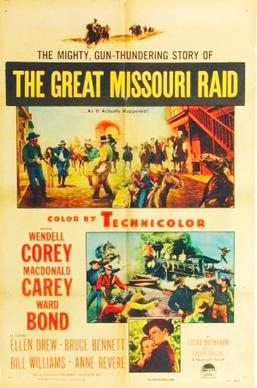
The Great Missouri Raid (1951, directed by Gordon Douglas)


During the Civil War, brothers Frank (Wendell Corey) and Jesse James (Macdonald Carey) leave the family farm and fight as Confederate guerillas under the leadership of the infamous William Quantrill.  When the war ends with the Confederacy’s defeat, Frank, Jesse, and their friend Cole Younger (Bruce Bennett) return home to Missouri and discover that their town is being ruled over the tyrannical Major Towbridge (Ward Bond).  With their farms in ruin and having little opportunity to make honest money, the James Brothers and the Younger Brothers soon resort to robbing banks and trains.  It’s their revenge against not only the soldier occupying their land but also the bankers and land barons who have been taking advantage of their friends and family members.  The James-Younger Gang become heroes to economically oppressed people everywhere.

From the minute that they arrive home, Towbridge is determined to imprison the James brothers.  Not only does he distrust them because of their past with Quantrill but he also blames them for the death of his own brother.  Towbridge becomes so obsessed that he even leaves the army so that he can pursue Frank and Jesse as a private detective.  Even as it appears that Jesse might be on the verge of settling down and abandoning his criminal life, he still has to deal with unexpected visitors like the Ford brothers.

The story of Frank and Jesse James inspired several films, some of which were better than others.  Directed with a good eye for detail by Gordon Douglas, The Great Missouri Raid tells the familiar story with enough skill to be watchable but it never reaches the classic status of Walter Hill’s The Long Riders. 

The main problem is that both Wendell Corey and Macdonald Carey come across as being almost too civilized as the James brothers.  The film is obviously sympathetic to the James brothers and, as westerns tended to do in the 50s, it ignores some of the less heroic details of their lives of outlaws.  (The film, for instance, doesn’t mention that the James brothers were probably already outlaws before the Civil War started and it’s doubtful that a modern film would be as sympathetic to two men who left home to fight for the Confederacy.)  Usually, though, even the most sympathetic film portrayals of the James brothers still portray them as being the type of people who you wouldn’t necessarily want to meet while riding the trail.  Wendell Corey and Macdonald Carey play Frank and Jesse as being so nice that it’s hard to believe that they could have even rode with Quantrill, let along the Younger brothers.  They’re the most reasonable outlaws this side of the Mississippi.  Bruce Bennett and Bill Williams are more believable as the rough and tough Cole and Jim Younger.

Not surprisingly, the film is stolen by Ward Bond.  Bond usually played reasonable authority figures for John Ford and Frank Capra.  As Major Towbridge, though, he’s cast as a martinet who allows his obsession with James brothers to turn him into a fanatic.  For those who are used to only seeing Bond cast as a fair cop or a tough-but-fair military officer, his performance in The Great Missouri Raid is a revelation.

The Long Riders is the best movie about the James Gang but, for western fans, The Great Missouri Raid should be entertaining if not definitive.

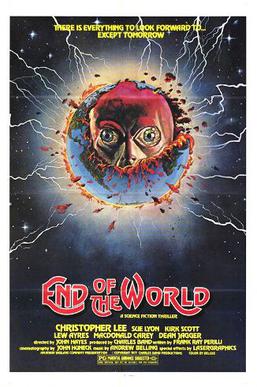
The TSL’s Horror Grindhouse: End of the World (dir by Charles Band)


http://www.youtube.com/watch?v=jXmvGqlp8NY

The 1977 film End of the World has got a great opening scene.  An obviously distraught priest (played by none other than Christopher Lee!) steps into an isolated diner.  He tells the counterman that he needs to use the phone.  The counterman says, “Sure, father.”  And then suddenly, everything in the dinner starts blowing up.  The phone, the coffee, the pinball machine, everything explodes.  The counterman ends up trying to unsuccessfully throw himself through a window.  The priest, looking rather confused, steps outside of the diner and he runs into …. his exact double!  Christopher Lee meets Christopher Lee!

Again, that’s a great opening and it’s really not a surprise that the rest of the film can’t live up to it.  Once the two Christopher Lees disappear into the darkness, the focus of the story shifts to a scientist named Andrew (Kirk Scott) and his wife, Sylvia (Sue Lyon, who years previously played Lolita).  Andrew spends a lot of time sitting in front of a boxy computer and staring at the screen.  He’s picking up strange transmissions from space and he’s trying to translate them.  Andrew goes home.  He and his wife got a party.  Andrew sits in front of the computer a while longer.  Andrew goes home.  Andrew goes to work.  Andrew keeps staring at the computer….

“Wait,” you’re saying at this point, “isn’t this is a Christopher Lee movie?”

Yes, it is.  Christopher Lee is indeed top-billed and he’s hardly in the movie at all.  I’d like to think that, when asked why by an intrepid reporter why he agreed to star in End of the World, Lee laughed and replied, “For the money, of course.”  But, according to Lee’s autobiography, he did the film because he was told that he would be appearing with a cast of distinguished actors like Jose Ferrer, Dean Jagger, and John Carradine.  Now, Dean Jagger does have a small cameo in the film but Ferrer and Carradine are nowhere to be seen.  Either they left the production or someone lied to Sir Christopher!

Anyway, back to the plot.  Eventually, Andrew figures out that the space transmissions are predicting natural disasters.  We don’t actually see any of these disasters because, after all, this is the end of the world on a very low budget.  But we are assured that the disasters are happening.  Andrew and Sylvia discover that the transmissions are coming from a convent in the middle of the desert.  Andrew and Sylvia go to investigate and they discover that the nuns are….

ALIENS!

Now, this is actually a pretty good twist and there are some vaguely humorous scenes of the the nuns working in a space lab.  It turns out that the nuns (and one of the Christopher Lees) are stranded on this planet because their spaceship broke down.  They don’t really like Earth, considering it to be an ugly and polluted place.  They’re planning on ending the world but they need to leave before the whole place blows up.  They demand that Andrew help them fix their transporter and they’re going to hold Sylvia hostage until he does so….

It’s all a bit silly but, as you’re watching the film, you can’t help but wish that it had been even sillier.  I mean, alien nuns and Father Christopher Lee?  That sounds like the makings of a certain type of classic!  But, unfortunately, the film never fully embraces the full potential of its absurdity.  It takes forever for Andrew and Sylvia to actually reach that convent and even the alien nuns become rather passé after a few minutes.  Christopher Lee is fun to watch as always and his character’s irritation with being stuck on Earth was obviously mirrored by Lee’s irritation with being in the film.  And, despite all else, let’s give credit where credit it is due — the title lives up to its promise.  The world may end in a pile of stock footage but an end is an end.

Anyway, this one is pretty much for Christopher Lee completists only.  Watch the opening and then fast forward to the end.

Enjoy The Miracle on 34th Street!


Now, before anyone asks, this is not the Oscar-nominated original with Edmund Gwenn and Natalie Wood.  Nor is it the 90s remake with Richard Attenborough and that girl who gives a hundred interviews a year about how she doesn’t care about being famous.

Instead, this is a 46-minute made-for-TV production from 1955!  It stars the one and only Thomas Mitchell (you’ll remember him as Uncle Billy from It’s A Wonderful Life) as the man who might be Santa Claus!

Even though this version may not be quite the holiday masterpiece that the original is, I still like it.  You really can’t go wrong with Thomas Mitchell as Santa.

Enjoy!

And remember….

THERE IS A SANTA CLAUS!

Horror on the Lens: Summer of Fear (dir by Wes Craven)


Today’s horror on the lens is a 1978 made-for-TV movie that was directed by Wes Craven.  Originally entitled Stranger In Our House, it was retitled Summer of Fear when it was released into theaters in Europe.  Personally, I think Summer of Fear is a better title.  It has a fun R.L. Stine feel to it.

As for the film itself, it tells the story of what happens when the recently orphaned Julia (Lee Purcell) moves in with her cousins in California.  At first, Julia fits right in with her new family but, slowly and surely, her cousin Rachel (Linda Blair) comes to suspect that Julia might be a witch.  And hey, who can’t relate to that?  Seriously, everyone has that one cousin…

And, it’s actually pretty good.  Working within the confines of what could and could not be shown on TV in the late 70s, Craven managed to make an effective little thriller.

http://www.youtube.com/watch?v=m89fH0w2kc0

Horror on TV: Thriller 1.29 “The Devil’s Ticket”


Down here in Dallas, channel 133 is the local Me-TV affiliate.  Me-TV specializes in showing old TV shows from the 50s, 60s, and 70s.  The network sells itself as a nostalgic refuge for people who are several decades older than me, a place where they can go to escape from Seth McFarlane cartoons and Maury Povich conducted DNA tests.

But you know what?

I like Me-TV and I’m glad that it exists.  It probably has something to do with me being a history nerd at heart.  I love the chance to see what the world was once like.  Add to that, some very good shows were produced in the 50s and 60s.  Just because a lot of us weren’t there to experience them firsthand doesn’t mean that we can’t appreciate them in rerun syndication.

Case in point: Thriller.

Thriller aired for two seasons in the early 60s.  It was an anthology series, in the tradition ofThe Twilight Zone.  Whereas The Twilight Zone was hosted by Rod Serling, Thriller was hosted by horror icon Boris Karloff, who always introduced the macabre material with a bemused gleam in his eyes.

The Devil’s Ticket was the 29th episode of Thriller and it originally aired on April 18th, 1961.  It’s an effectively creepy little story about an artist (MacDonald Carey) who sells his soul to the Devil.  It was directed by Jules Bricken and written by Robert Bloch.