(For those following at home, Lisa is attempting to clean out her DVR by watching and reviewing 38 films by the end of this Friday. Will she make it? Keep following the site to find out!)
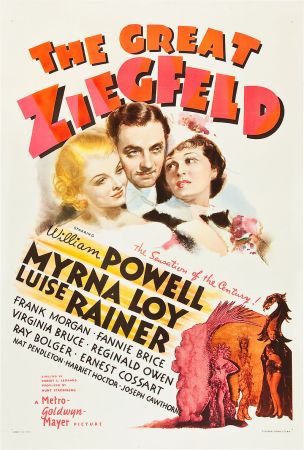
Do you know who Florence Ziegfeld was?
Don’t feel bad if you don’t because, until I saw the 1936 film The Great Ziegfeld, I had no idea and history is my number one obsession. Florence Ziegfeld was a theatrical producer who, in the early days of the 20th Century, produced huge spectacles. He was a showman who understood the importance of celebrity and gossip. He produced a show called The Ziegfeld Follies, which was considered quite risqué at the time but which looks remarkably tame today. Florence Ziegfeld was so famous that he even got his own Oscar-winning biopic.
The Great Ziegfeld features the always smooth William Powell as Ziegfeld. When we first meet him, he’s promoting a strongman and a belly dancer and nobody takes him seriously. But through hard work, good luck, and his own instinct for showmanship, he becomes famous and his shows gets bigger and bigger. The film follows Ziegfeld as he gets married, both times to someone he is grooming to be a star. His first wife is Anna (Luise Rainer), who loves him but divorces him when it becomes obvious that Ziegfeld’s life will always revolve around his work. His second wife is Billie Burke and we know that she is Ziegfeld’s true love because she’s played by Myrna Loy. Whenever you see William Powell and Myrna Loy in the same film, you know that they belong together.
The majority of The Great Ziegfeld is taken up with recreations of Ziegfeld’s stage shows. In fact, the film almost feels more like a musical variety show than a real biopic. (Judging from the credits, quite a few of Ziegfeld’s stars played themselves and recreated their acts on the big screen.) I can understand why this was attractive to audiences in the 1930s. With no end in sight to The Great Depression and Ziegfeld himself recently deceased, this movie was their only opportunity to see one of his spectacles. The film made sure that they got their money’s worth.
However, for modern audiences, all of the acts just add to what is already an oppressive running time. My main impression of The Great Ziegfeld was that it was really, really long. The movie itself is well-produced and William Powell and Myrna Loy are always fun to watch but the movie just goes on and on. As well, this biopic is so worshipful of Ziegfeld — the title is meant to be taken literally — that, as a result, he comes across as being one-dimensional. I did appreciate the film as a historical artifact but otherwise, it didn’t do much for me.
However, it did something for the Academy. The Great Ziegfeld was named the best picture of 1936! Luise Rainer won best actress despite only being on-screen for a handful of scenes. So many people were critical of Rainer’s award that, the very next year, the Academy introduced the award for best supporting actress.
As for why Ziegfeld won that Oscar — well, if you look at its competition and some of the other 1936 films that received nominations, you’re struck by the lack of truly memorable films. It would appear that, in a weak year, the Academy decided to give the award to the biggest production they could find.
And that was The Great Ziegfeld.
(Incidentally, if Flo Ziegfeld were alive today, he would probably be a reality TV producer.)
 Through the Shattered Lens