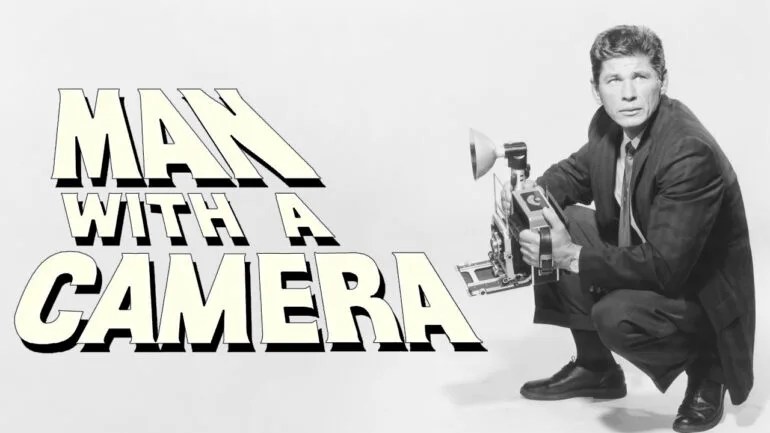
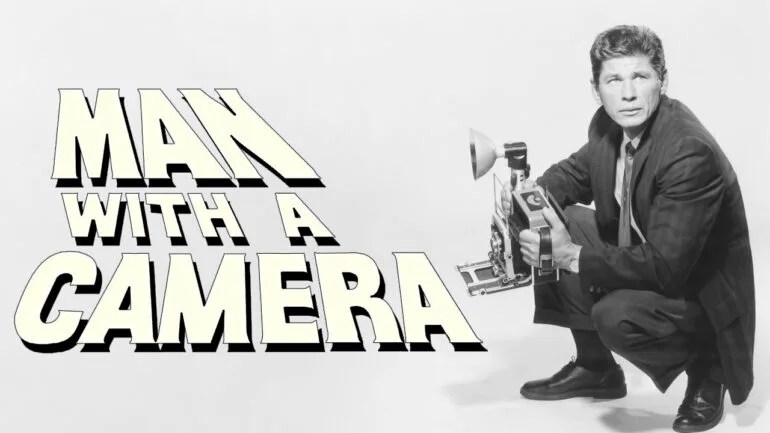
MAN WITH A CAMERA (TV Series) – starring Charles Bronson – S1, E8: Blind Spot 


First, I want to say Happy Thanksgiving to all of you who read this review! I’m so thankful for The Shattered Lens and the opportunity to share my love of movies, TV and pop culture with all of you! Now on with the show…

Originally airing on December 5th, 1958, “Blind Spot” opens with free-lance photographer, Mike Kovac (Charles Bronson), receiving a phone call from his best friend Terry Ross (Norman Alden), who is in Lisbon, Portugal. A very nervous Terry tells Kovac that he will be airmailing him some very important negatives for something “dynamite” that he’s working on. While they’re on the phone, an imposing man with a wide-brimmed, boater hat steps into Terry’s room and shoots him dead. Hearing the shots, Kovac is on the next plane to Lisbon to talk to the police and try to find out what happened. Apparently this is big news as the Lisbon paper even reports that Kovac is on his way. The killer, who we soon learn is named Al Alviella (Mario Alcalde), is waiting on Kovac in front of the police station and through a variety of events, is able to convince him that he was Terry’s friend and can help him in his investigation. It seems the police believe that Terry was working for an underworld espionage organization and that he got killed for it. Kovac doesn’t believe there’s any possibility that his old wartime photographer buddy could be involved in anything dirty. But with the killer Al’s false stories and leads, as well as Kovac’s discovery of Terry’s wife Renee (Chana Eden), when he didn’t even know Terry was married, Kovac begins to question how well he really knew his old friend. When the truth finally all comes to light, will Kovac be able to get out of Lisbon alive?!

After the disappointing melodrama of the previous episode, MAN WITH A CAMERA gets back on track with “Blind Spot.” First, we get a somewhat intriguing crime storyline in this episode. While we know from the beginning that Kovac’s friend was murdered and who the killer is, the story still has a few surprises up its sleeve. The final reveal and fight scenes are very well handled, with Bronson continuing to prove that no one can throw a punch quite like him. Second, the episode has an appealing theme of “friendship forged by fire,” in this case by serving together in World War II. With the circumstantial evidence mounting, Kovac begins to doubt his old friend, and it’s here that the new wife steps in and says “Terry said you were his friend… his best friend!” Kovac knows in his heart that his friend just couldn’t have done these things, no matter how bad it looks, and he keeps pushing to find out the truth. I want to have friends like that! 

Finally, “Blind Spot” contains some solid performances and an interesting guest appearance. Bronson himself is quite emotional and demonstrative in this episode. He yells at the police when they tell him they believe his old buddy is dirty. He yells at the shadowy underworld “man” who tells him that his buddy was on his payroll, and then proceeds to start punching henchmen until they get the upper hand on him. And I’ve already mentioned the coolness of the final fight scenes where he clearly does his own stunts! I also found Mario Alcalde to be charismatic as the killer Al Alviella. There’s something about him, maybe it was his voice, that kind of reminds me of Andy Garcia, an actor I really like. Alcalde appeared on most of the good TV shows of the late 50’s and 60’s, but unfortunately died at the young age of 44 in 1971. One last thing about the casting that I found interesting involves character actor Frank DeKova, who has one scene here as a shadowy, Lisbon underworld figure credited only as “The Man.” DeKova would play one scene as a shadowy underworld figure known only as “The Man” 14 years later in Bronson’s action classic THE MECHANIC! 

“Blind Spot” isn’t a perfect episode, as it does have a fairly slow build up after its entertaining opening scene. However, the excitement of the ending scenes, the more interesting storyline, and the good performances from its main players are more than enough to get a recommendation from me. 
MAN WITH A CAMERA (TV Series) – starring Charles Bronson – S1, E5: Turntable  


This episode opens with Mike Kovac (Charles Bronson) visiting an illegal gambling den operated by Walter Bradman (Dennis Patrick). Kovac takes a picture of Bradman with a small camera he’s placed inside of a cigarette lighter. You see, an honest lawyer named John Payson (Logan Field) is running for governor on a platform of shutting down these types of criminal establishments, and Kovac thought this might make for an interesting story in the current political environment. But Bradman catches him taking the picture, and just when it looks like he might forcibly take the camera and film from Kovac, Bradman decides to let him go. It seems that Bradman has bigger plans for Kovac as he happens to know that Kovac is going to the Payson’s household to take family pictures the very next day. Bradman has an inside person in the Payson household, his girlfriend Miss Hollis (Phyllis Avery), and he plans to steal the negatives. They will then use Miss Hollis’ ex-con dad Clyde Bosser (Addison Richards) to create fake composite pictures that pretend to show Payson in the gambling den and hanging out with women other than his wife. He’s hoping that a little blackmail might get Payson off his back, but as you might imagine with Mike Kovac on the case, the plan falls apart and nobody is safe! 

“Turntable” is a solid episode of MAN WITH A CAMERA. There are several reasons I enjoyed it. The presence of Charles Bronson in the lead is always at the top of the list. His down-to-earth charisma anchors the series and this episode in such a way that there’s always something worth watching on screen. He does get to beat up a couple of guys and that’s very fun for me. Dennis Patrick is good as the den boss. He’s very confident and cocky until his plan starts falling apart. Once he begins to panic, things really start to get interesting. The story is also intriguing, as it deals with doctoring photos for nefarious purposes, a novel concept in 1958, but something that’s all too common these days. The composite pictures created as part of this episode are actually kind of funny to look at, and it makes you wonder how some of them could have fooled anyone! I’ve mentioned before that I like episodes where Kovac’s dad Anton (Ludwig Stossel) has an important part. In this episode, he helps his son put together an important piece of the puzzle so I liked that. On the negative side, I didn’t like the political angle. John Payson’s gubernatorial candidate is made to look like an angel, and we all know how that usually works out in the political arena. Honestly, I’m sick of politics in general, and I like to watch TV and movies to get away from that kind of stuff.

Overall, “Turntable” is a solid episode with an intriguing story, a few good performances, and a scene that actually caught me by surprise. That doesn’t happen very often! 

MAN WITH A CAMERA (TV Series) – starring Charles Bronson – S1, E4: Close-up on Violence 


Mike Kovac (Charles Bronson) is taking pictures at a tenement fire in New York City. After getting his pictures of the fire, he gets a few shots of some of the people hanging around, including Norma Delgado (Angie Dickinson). A group of young men see him taking the pictures, so they take the camera away from him. It seems Norma is the daughter of Marty Delgado (Robert Armstrong), a mobster who’s just finished off a six year stretch in prison. Prior to going to prison, Marty stashed a lot of cash away and the boys are planning on taking it away from him. They’re afraid if anyone knows his daughter is around, they’ll be on their way to take the money for themselves. When the boys show back up at Kovac’s house, take his pictures and smash him on the head, he’s determined to figure out what the hell is going on. The first step is finding Norma. Once he finds her, everything else should become clear. 

Aside from Charles Bronson as Mike Kovac, the most interesting thing about this episode is the presence of the lovely Angie Dickinson. At this point in her career she was mostly guesting on TV shows or doing smaller parts in movies. She’s so beautiful, but she really doesn’t have a lot to do here. The next year she would play John Wayne’s love interest in RIO BRAVO (1959) and she’d be on her way to stardom. It’s a treat seeing her and Bronson on screen together. 

Bronson does have one decent tough guy exchange with the young thugs:

Kovac – “…a real tough bunch. You’re tough like a coat of cheap paint. First stretch of bad weather comes along and it peels right off!”

Thug – “Maybe you’re the paint remover?!”

Kovac – “You don’t get that boy out the darkroom, we’ll soon find out!”

As soon as Kovac says this he gets knocked out cold, so Bronson’s not always as tough as he seems at this point in his career. 

One other thing, I am finding that I like the episodes where Kovac’s “Pop” Anton (Ludwig Stossel) shows up. Pop is also a photographer, and he’s so proud of his son and the way his pictures are always in magazines and in the papers. During the middle part of this episode he just has one slight criticism of his son’s work, “you need more lighting.” When Kovac gets the money shot at the end and Pop sees it in a magazine, he’s so proud… he just thinks there needed to be more lighting! It’s a lighthearted and fun way for the episode to end. 

MAN WITH A CAMERA (TV Series) – starring Charles Bronson – S1, E2: The Warning


This episode opens with Mike Kovac (Charles Bronson) receiving an anonymous phone call to come to the corner of Myers St. and Brooklyn Ave., and he’s told to bring his camera! When he gets there, he’s forced at gunpoint by two masked man to take a picture as they kill another man. After the killers drive off, Kovac immediately calls the police. We meet Lt. Abrams (Robert Ellenstein), who tells Kovac that the dead man is a new merchant in town named Sam Bartlett (Bill Erwin) who has been refusing to pay the head of the local protection racket, Glenn Markey (Berry Kroeger). Lt. Abrams asks Kovac to let them plant a story in the paper that says they have an eyewitness to the murder, ace photographer Mike Kovac. Worried that he might be the next man to get killed, Kovac turns him down. Not feeling good about refusing to help the police, Kovac goes to see his dad Anton and tells him the story. Shocked to hear that his son has refused to help the police, especially since it could help put an end to Marky’s reign of terror, Anton asks his son if it’s because he’s afraid. Somewhat shamed into it, Kovac finally agrees and calls Lt. Abrams and tells him they can run the story saying he witnessed the murder. Wouldn’t you know it, the next night Glenn Markey and his funky bunch kidnap Anton in order to force Kovac’s hand. Will Kovac be able to save his dad, and his own skin in the process? Will the police be any help? 

“The Warning” seems to be built upon an irrational request from the police of Mike Kovac… let us plant a fake story and put your life in danger so we can hopefully catch the killer as he tries to kill you. When Kovac refuses to be used that way, as any other rational human being would, Lt. Abrams tells him he’d been told that “Mike Kovac doesn’t scare easily. Guess I heard wrong.” It’s bad enough when anyone implies you’re a coward, but when Mike’s own dad seems disappointed that he’s not helping the police out of fear, Mike is almost forced to help. This is not how it would go down if I found myself in this position, and my dad would be on my side! Even though the premise is somewhat flimsy, there are definitely some good moments in the episode. Once Markey has kidnapped his “Pop,” Kovac turns into the badass Bronson we’ve been waiting for. I enjoyed this tough guy exchange as Markey tries to force Kovac to come with him at gunpoint, not knowing Kovac has brought his own gun:

Markey – “This gun says you’re coming along with me.”

Kovac – “This gun says I’m not.”

Markey – “You’re bluffing, Kovak.”

Kovac – “You just think about that when these slugs start ripping into your body. Maybe it’ll be a comfort to you.”

I also like it when Anton admits he was wrong at the end. After somewhat shaming his son into helping the police, and then having to be rescued later, Anton says, “You were right Michael, these things are dangerous. The next time the police ask for your help, you say NO!” It’s a funny, and more realistic, conclusion to the episode! 

Overall, I enjoyed the episode very much, mainly because of Bronson’s strong central performance. I’m looking forward to seeing where the series goes from here! 

Film Review: The Man I Married (dir by Irving Pichel)


In 1940’s The Man I Married, Joan Bennett stars as Carol Cabbott Hoffman.

Carol is a New York-based art critic.  She is young, sophisticated, wealthy, and politically naive.  Because she has been married to a German for seven years, she has been keeping up with what has been happening in Germany but it’s clear that she doesn’t really understand the full story of what she’s hearing.  As she says, at one point, she has heard bad things about the Nazis but she also tries to keep an open mind and not get drawn in by “propaganda.”

Her husband, Eric Hoffman (Francis Lederer), has not been back to Germany in ten years and he says that he has little interest in ever returning.  But, when he receives a letter from his father (Otto Kruger), Eric announces that he has to return home for a visit.  Before Carol, Eric, and their son, Ricky (Johnny Russell), leave for Germany, they are approached by their friend, Dr. Hugo Gerhardt (Ludwig Stossel).  He explains that his brother has been imprisoned in a concentration camp and he asks Carol and Eric to deliver money to him and to appeal to the American embassy for help.  Carol agrees to do so.  Eric is noticeably reticent.

As soon as they arrive in Germany and Eric learns that his father wants him to take over the family’s factory, Eric starts to change.  He and a former schoolmate named Freida (Anna Sten) are a bit too happy to see each other again.  Eric insists on listening to the nightly radio broadcasts from Dr. Goebbels.  When Freida mentions that it is illegal to joke about Hitler, Eric surprises Carol by defending the law.  With Eric spending all of his time with Freida and dismissing Carol’s understandable suspicions by saying that she’s just being jealous, Carol meets an American correspondent named Keith (Lloyd Nolan) who reveals to her the truth of life in Nazi Germany.  Carol discovers that, rather than being the economically-strong paradise that Eric and Freida claim it to be, Germany is a place where many citizens live in fear of being heard saying the wrong thing and, as a result, they’ve chosen to close their eyes to what is going on around them.

The Man I Married is an interesting film.  It’s an anti-Nazi film that was released at a time when America was still technically a neutral nation.  Indeed, the film almost feels like it was made to prepare Americans for the inevitability of war with Germany.  When Keith mocks Carol for trying to be neutral about the Nazis, it’s clear that he’s meant to be speaking to the audience watching the film.  Eric begins the film as an erudite and seemingly charming man but, as soon as he arrives in Germany and is reunited with Freida, he reveals himself to be a fervent Nazi.  The film warns the audience not to trust those who were trying to excuse or dismiss Germany’s actions.

This is also one of the few films made before World War II that really acknowledged just how central anti-Semitism was to the Nazi ideology, acknowledging the concentration camps at a time when many in the West were refusing to admit they existed, either because they were in denial or because they just didn’t care.  Towards the end of the film, a major character is discovered to have had a Jewish mother and the reaction to the news reveals the hate that was at the heart of the Third Reich.

The Man I Married, with its portrayal of a populace that has convinced itself that their government is never to be questioned and that all dissent must be punished, is a film that feels just as relevant today as it did in 1940.  It’s a film that warns viewers of the risk of disbelieving their own eyes.

Film Review: Underground (dir by Vincent Sherman)


1941’s Underground tells the story of two brothers on opposite sides in Nazi Germany.

Kurt Franken (Jeffrey Lynn) is a patriotic German who believes that the country got a raw deal at the end of World War I and who is a strong supporter of the Nazis.  He served in the army, fighting on the front.  When he returns home to Berlin, he’s missing an arm.  Whenever his friends and his family say that they’re sorry that he lost his arm, he replies that he was happy to make the sacrifice for his country.  When someone starts to mourn for his son who was killed in the fighting, Kurt accuses the man of being a traitor for doubting the wisdom of the government.  Kurt is a true believer, just the type to be recruited by the SS and tasked with helping to investigate who is behind a series of anti-Nazi radio broadcasts.  Kurt believes that, if the government says it, it must be right.  Laws must be obeyed and orders followed without question.  Kurt, in other words, is a very familiar type.

What Kurt doesn’t realize is that the man behind the broadcasts is his own brother, Eric (Phillip Dorn).  As Kurt investigates, he falls in love with Sylvia (Kaaren Verne) without realizing that she is also a part of the resistance.  While Kurt tries to discover who is behind the underground radio station, Eric and his fellow resistance members attempt to stay one step ahead of the Gestapo.

For a film made in 1941, the film’s doesn’t flinch from showing the brutality of the Gestapo.  Like all authoritarian dictatorships, The Third Reich is determined to quash any and all signs of dissent and they investigate the underground radio station with a ruthlessness that even takes Kurt by surprise.  Witnessing first hand the brutality and sadism of the government for which he gave his arm, Kurt starts to doubt his previous beliefs.  But will Kurt’s doubts come in time to save the lives of Eric and his fellow resistance members?

Made at a time when the United States was still officially neutral in the violent conflict that was sweeping the rest of the world and released just a few months before the U.S. officially declared war on the Axis Powers, Underground is a powerful look at life under a dictatorship.  Shot in a noir style, the film’s black-and-white imagery perfectly captures the harshness of life in Germany while the shadows in the background perfectly capture the paranoia of knowing that saying the wrong word could lead to arrest, torture, and death.  The film’s final minutes involve a guillotine sitting ominously in the background, a reminder that Nazi Germany was not the first authoritarian regime and that it would not be the last.

The film is well-acted, with Jeffrey Lynn epitomizing the otherwise intelligent people who allow themselves to get caught up in the madness of the majority.  His discovery of the truth about Germany was obviously meant to mirror the awakening of the Americans who previously supported a policy of neutrality.  By the end of the film, both Karl Franken and the audience understand that the time for neutrality has passed.

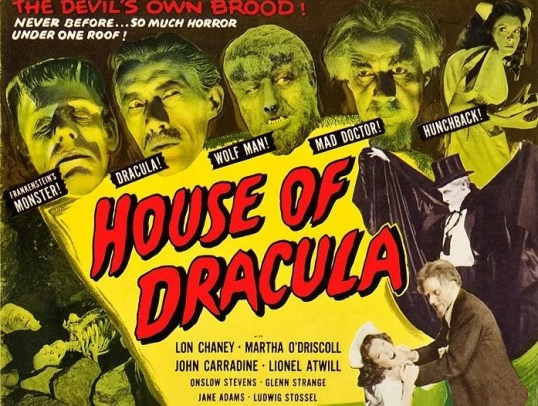
Horror Film Review: House of Dracula (dir by Erle C. Kenton)


When last we saw Dracula, the Wolf Man, and Frankenstein’s Monster, they were all coming to an untimely end in House of Frankenstein.

Dracula (John Carradine) was caught out in the sun by a group of angry villagers and ended up turning back into a skeleton while desperately trying to climb into his coffin.  The Wolf Man, also known as Larry Talbot (Lon Chaney, Jr.), was shot, presumably with a silver bullet, and finally, the world was free of having to listen to Larry whine about his unfortunate condition.  The Monster (Glenn Strange) was last seen drowning in quicksand.

Despite all of that, all three of them return in 1945’s House of Dracula.  The Monster is at least found in an underground lair, preserved in a state of suspended animation by the quicksand.  Dracula and Larry Talbot, however, just show up with neither looking the worst for wear.  I supposed that Larry could have survived being shot but Dracula’s return is bizarre because he was literally exposed to sunlight.  In the past, reviving Dracula has always required the stake to be removed from his heart.  Did someone remove the sunlight from Dracula’s skeleton?

All three of the cursed beings show up at the castle of Dr. Franz Edelmann (Onslow Stevens).  Working with two nurses, the beautiful and religious Milizia (Martha O’Driscoll) and a compassionate hunchback named Nina (Janes Adams), Edlemann is researching blood transfusions.  He believes that blood transfusions can cure just about anything.  Edelmann is so convinced that he can cure Dracula of his vampirism that he allows Dracula to move his coffin into the castle’s cellar.  Edelmann is also convinced that he use the spores of a special plant to cure Larry of his lyncanthropy.  As usual, Larry Talbot is skeptical and spends the entire movie boring everyone with the details of how much it sucks to be a werewolf.  As for Frankenstein’s Monster, he’s in the castle because Edelmann happend to come across him in an underground chamber.  Quite a coincidence, that.

Unfortunately, all of the blood transfusions in the world can’t stop Dracula from being Dracula and soon, the Lord of the Vampires is trying to turn Milizia into his queen.  Larry is also in love with Milizia, to the extent that he doesn’t realize that Nina is falling in love with him.  Meanwhile, Edelman ends up infecting himself with some of Dracula’s blood and soon, his reflection is no longer showing up in mirrors and he’s feeling the temptation to revive Frankenstein’s Monster.  A violent murder upsets the villagers, who refuse to listen to Inspect Holz (Lionel Atwill) when he begs them to let the police take care of things as opposed to laying siege on the castle with a bunch of torches.  That’s what happens when you allow your house to become the House of Dracula.

House of Dracula is a clear and marked improvement on House of Frankenstein.  While Larry Talbot is just as whiny as ever (and Lon Chaney, Jr.’s sad sack performance is a bit dull) and Frankenstein’s Monster is a bit underused, John Carradine makes for a perfect Dracula, mixing old world charm with cunning cruelty.  Director Erle C. Kenton directs the film as if it were a film noir, filling the castle with ominous shadows and giving us a cast of morally conflicted characters.  Though I think most modern viewers are a bit too jaded to be truly scared by the old horror films, the scene where Edelmann watches as his reflection disappears from the mirror is effectively creepy.  I can only imagine how audiences in 1945 reacted to it.

When first released, House of Dracula was not a hit and, as a result it was one of the final “serious” films to feature the Universal monsters.  (Chaney and Strange would reprise their signature roles in a few comedies while Carradine would play Dracula in several other non-Universal productions.)  Seen today, it seems like the perfect final chapter for the monsters that, for 20 years, defined Universal.

Previous Universal Horror Reviews:

  1. Dracula (1931)
  2. Dracula (Spanish Language Version) (1931)
  3. Frankenstein (1931)
  4. Island of Lost Souls (1932)
  5. The Mummy (1932)
  6. The Invisible Man (1933)
  7. The Bride of Frankenstein (1935)
  8. Dracula’s Daughter (1936)
  9. Son of Frankenstein (1939)
  10. The Wolf Man (1941)
  11. Ghost of Frankenstein (1942)
  12. Frankenstein Meets The Wolf Man (1943)
  13. Son of Dracula (1943)
  14. House of Frankenstein (1944)
  15. Creature From The Black Lagoon (1954)

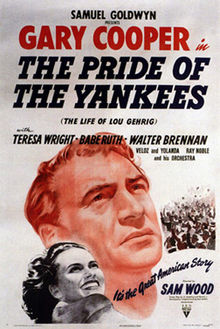
Lisa Reviews An Oscar Nominee: The Pride of the Yankees (dir by Sam Wood)


220px-The_Pride_Of_The_Yankees_1942

“People all say that I’ve had a bad break. But today … today, I consider myself the luckiest man on the face of the Earth.”

— Lou Gehrig (Gary Cooper) at the end of The Pride of the Yankees (1943)

After airing Foreign Correspondent earlier tonight, TCM followed up by showing the 1943 best picture nominee, The Pride of the Yankees.  Knowing that Pride of the Yankees was going to be a baseball film and that I know next to nothing about baseball, I recruited my sister, the Dazzling Erin, to watch the movie with me.  Erin loves baseball and I knew that she would be able to explain anything that went over my head.

Well, I absolutely loved watching this movie with my sister but it turns out that The Pride of the Yankees isn’t really much of a baseball movie.  True, it’s about a real life baseball player.  Several actual players appeared as themselves.  About 85% of the film’s dialogue deals with baseball and probably about 70% of the film features characters playing some form of the game.  But the film never goes into any great detail about baseball or how it’s played.  There’s no talk of strategy or rules or deeper meaning or anything else.  Going into the film, I knew that baseball was a game that involved throwing, swinging bats, and running.  And it turns out that was all that I needed to know.

The Pride of the Yankees is less about baseball and more about celebrity.  It’s a biopic of Lou Gehrig, who today is best known for his battle with ALS, a disease that is also known as Lou Gehrig’s disease.  Lou Gehrig died on June 2, 1941 and The Pride of the Yankees was released just a year later.  Watching the film, it’s obvious that Gehrig was a beloved figure, the type of celebrity who, if he were alive today, would probably be the center of stories like, “Lou Gehrig Did Something This Weekend And It Was Perfect.”  Watching the film, it easy to imagine how traumatic it must have been for the nation when a beloved athlete like Lou Gehrig died at the age of 37.

As a result, The Pride of the Yankees is less a biopic and more a case for canonization.  From the minute that the film’s Lou Gehrig appears on-screen, he is presented as being the type of saintly athlete who, by promising to hit two home runs in one game, inspires a crippled child to walk.  Lou is modest, kind, unpretentious, and never gets angry.  Over the course of the film, he takes care of his mother, displays a worthy work ethic, and marries Eleanor.  He and Eleanor have a perfect marriage without a single argument or a hint of trouble, except for the fact that Lou sometimes gets so busy playing baseball with the local children that he’s late coming home.  There’s not a hint of sadness in their life, until Lou suddenly gets sick.

And really, it should not work.  If ever there’s ever been a film that should be painfully out-of-place in our more cynical times, it would be The Pride of the Yankees.  However, the film still works because Lou is played by Gary Cooper and Eleanor is played by Teresa Wright.  These two excellent performers bring their considerable talents to making overly sentimental scenes feel credible.  Gary Cooper was 40 years old when he made The Pride of the Yankees and there’s a few scenes — especially the ones where Lou is supposed to be a student at Columbia University — where Cooper is clearly too old for the role.  But, for the most part, Gary Cooper did a great job as Lou Gehrig.  Cooper is especially memorable when Lou first starts to show signs of being ill.  Watching Lou struggle to swing a bat, I was reminded of a horse struggling to stand on an injured leg.  It was almost painfully poignant.

The Pride of the Yankees was nominated for 11 Academy Awards, including best picture.  However, it lost to another sentimental film that featured Teresa Wright, Mrs. Miniver.