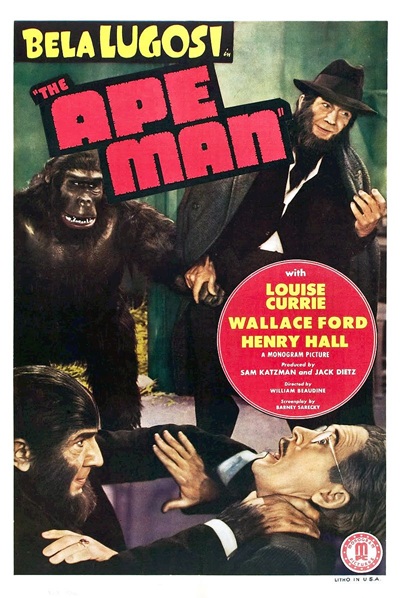
In this 1943 film, a mysterious man suggests to reporter Jeff Carter (Wallace Ford) that he should go out to the mansion of Dr. James Brewster (Bela Lugosi) and look into the recent disappearance of the doctor. Dr. Brewster’s sister (Minerva Urecal) is a well-known ghost hunter and Carter’s editors likes the idea of Carter and photographer Billie Mason (Louise Currie) heading out to the mansion and getting a picture of a ghost.
Carter is upset because he’s having work with a — gasp! — woman. Bliie is not impressed by the fact that Carter is still in America while all the other men his age are fighting overseas. Carter explains that he’ll be enlisting in the Navy in a week. Billie realizes that Carter is not an unpatriotic coward and we, the viewers, are reminded that this film was made during World War II. I like the fact that America was so unified during World War II that even fictional characters were expected to explain what they were doing for war effort.
For the record, Dr. Brewster’s mansion is not haunted by ghosts. Instead, the problem is that Dr. Brewster’s experiments have turned him into a man-ape hybrid. He has a beard, he walks like a monkey, and he fears that he’s turning more into an ape everyday. He spends almost all of his time locked up in a cage with a gorilla. Dr. Brewster has (somehow) discovered that the only way to reverse the process is to get regular injections of spinal fluid. However, it’s impossible to extract the spinal fluid without also killing the donor. Dr. Brewster’s colleague, Dr. Randall (Henry Hall), refuses to be a party to murder but he still wants to help Brewster. Unfortunately, Brewster is beyond saving and he’s also losing his mind as he finds himself slowly becoming more and more of an ape.
The Ape Man was directed by William Beaudine, a filmmaker who directed 179 movies over the course of his long career. Beaudine worked in all genres, starting off as a major director during the silent era before then becoming a prolific B-movie maker during the sound era. As a B-movie director, Beaudine was famous for rarely doing second take. If someone flubbed a line or a piece of scenery nearly fell over, that was too bad. Of course, it should be noted that Beaudine was working for various Poverty Row production companies and he probably didn’t have the budget to do multiple takes. His job was to get the film shot quickly and for as little money as possible.
That certainly seems to be the philosophy between The Ape Man, which is only a little over an hour long and which features all of the usual plot holes and continuity eras that one might expect to find in a film that was tossed together in just a few days. That said, The Ape Man is kind of a fun movie. Bela Lugosi does his best, even when he’s wearing a totally ludicrous beard. Wallace Ford and Louise Currie deliver their lines in the rat-a-tat fashion that seemed to be popular with journalists in the films of the 30s and 40s. The plot’s cheeful lack of coherence actually becomes rather charming and the story ends with a nice moment of 4th wall breaking, as the film itself is saying, “Hey, we had fun, didn’t we?”
 Through the Shattered Lens