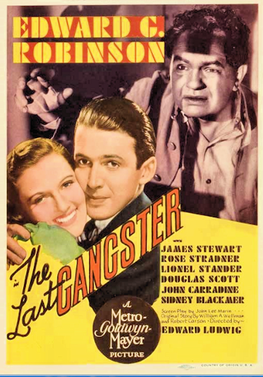
In 1937’s TheLastGangster, Edward G. Robinson plays Al Capone.
Well, actually, that’s not technically true. The character he’s playing is named Joe Krozac. However, Joe is a ruthless killer and gangster. He’s made his fortune through smuggling alcohol during prohibition. Despite his fearsome reputation, Joe is a family man who loves his wife Tayla (Rose Stradner) and who is overjoyed when he learns that she’s pregnant. To top it all off, Joe is eventually arrested for and convicted of tax evasion. He gets sent to Alcatraz, where he finds himself being bullied by another inmate (John Carradine) and waiting for his chance to regain his freedom.
In other words, Edward G. Robinson is playing Al Capone.
Krozac does eventually get out of prison but, by that point, Tayla has moved on. She’s married Paul North (James Stewart), a former tabloid reporter who was so outraged by how his newspaper exploited Tayla’s grief that he resigned his position. Joe Krozac’s son has grown up with the name Paul North, Jr. and he has no idea that his father is actually a notorious gangster.
Krozac wants to get his son back but his gang, now led by Curly (Lionel Stander), has other ideas. They want Krozac to reveal where he hid the money that he made during his gangster days. As well, an old rival (Alan Bazter) not only wants to get revenge on Krovac but also on Krovac’s son. Joe Krovac, fresh out of prison, finds himself torn between getting his revenge on his wife and protecting his son. This being a 30s gangster film, it leads to shoot-outs, car chases, and plenty of hardboiled dialogue.
Edward G. Robinson and Jimmy Stewart in the same movie, how could I n0t watch this!? I was actually a bit disappointed to discover that, even though both Robinson and Stewart give their customarily fine performances, they don’t spend much time acting opposite each other. Indeed, it sometimes seem like the two men are appearing in different pictures.
Robinson is appearing in one of the gangster films that made him famous. (Indeed, the film’s opening credits feature footage that was lifted from some of Robinson’s previous films.) He gives a tough and snarling performance but also one that suggests that, as bad as he is, he’s nowhere near as bad as the other gangsters that are working against him. His gangster is ultimately redeemed by his love for his son, though the Production Code still insists that Joe Krozac has to pay for his life of crime.
Stewart, meanwhile, plays his typical romantic part, portraying Paul as being an incurable optimist, a happy go-getter who still has a sense of right-and-wrong and a conscience. Stewart isn’t in much of the film. This is definitely Robinson’s movie. But still, there’s a genuine charm to the scenes in which Paul romances the distrustful Tayla. Not even being forced to wear a silly mustache (which is the film’s way of letting us know that time has passed) can diminish Stewart’s natural charm.
If you like 30s gangster films, like I do, you should enjoy TheLastGangster. I would have liked it a bit more if Robinson and Stewart had shared more scenes but regardless, this film features these two men doing what they did best. This is an offer that you can’t refuse.
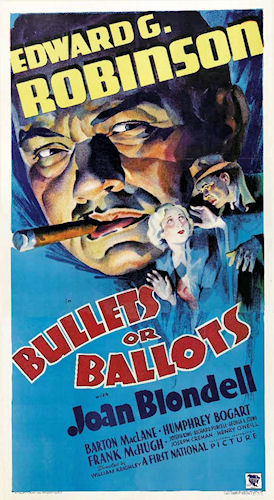
Johnny Blake (Edward G. Robinson) was one of the toughest cops in New York City, until he punched out his new captain (Joe King) and was kicked off the force. That punch was witnessed by racketeer Al Kruger (Barton McLane). Kruger has long wanted to get Blake to join his organization and, with Blake now out of work, Kruger makes an offer. Blake goes to work for Kruger, much to the consternation of Kruger’s second-in-command, Bugs Fenner (Humphrey Bogart). Bugs says that anyone who was once a cop will always be a cop. Bugs is right. Blake is working undercover, trying to expose and take down the mob from the inside.
Bullets or Ballots is an entertaining if predictable gangster film from the 1930s. After making his career playing bad guys, Robinson makes the transition to the side of law and order without losing any of his trademark attitude. Bogart plays one of the many remorseless killers that he played before Casablanca reinvented him as a hero. Bullets or Ballots may be predictable but it’s impossible not to enjoy watching Robinson and Bogart snarl hard-boiled insults at each other.
Second-billed Joan Blondell does not have much screen time but her role is still an interesting one, as a tough businesswoman who runs a numbers racket with her former maid (played by Louise Beavers). I would have enjoyed seeing a full movie just about Blondell’s character but she mostly takes a back seat to Robinson and Bogart.
Unfortunately, unlike Little Caesar, The Public Enemy, and Scarface, Bullets or Ballots was made after Hollywood started to enforce the infamous Production Code and, as a result, Bullets or Ballots never reaches the gritty, violent heights of those earlier films. Still, fans of Robinson, Bogart, and Blondell will find much to enjoy here.
If you’re a regular reader of this site, it will not take you by surprise to learn that the 1933 Best Picture Nominee, 42nd Street, is one of my favorite films of all time.
I mean, how couldn’t it be? Not only is it a pre-Code film (and we all know that pre-Code films were the best) and one the features both Ginger Rogers and Dick Powell in early roles but it’s also a film that depicts the backstage world of a stage musical with such a combination of love and snark that it will be familiar to everyone from community theater nerds to Broadway veterans. 42nd Street is a classic musical, though I have to admit that I think the majority of the songs are a bit overrated. Even more importantly, 42nd Street is the ultimate dance film. The film’s big production number, choreographed and filmed in the brilliant and flamboyant Busby Berkeley style, is such an iconic moment that it’s still being imitated and lovingly parodied to this day.
Every dance movie owes a debt to 42nd Street but few have come close to matching it. Remember how much we all hated Smash? There were a lot of reasons to hate Smash but the main reason was because it tried to be 42nd Street and it failed. There can only be one 42nd Street.
It’s hard to estimate the number of show business clichés that currently exist as a result of 42nd Street. Then again, it can be argued that they were clichés before they showed up in 42nd Street but 42nd Street handled them in such an expert fashion that they were transformed from being urban legends to immortal mythology.
42nd Street takes place in the backstage world, following the production of a Broadway musical through casting to rehearsals to opening night. It’s an ensemble piece, one populated by all the usual suspects. Julian Marsh (Warner Baxter) is the down-on-his-luck producer who desperately needs a hit. Dorothy Brock (Bebe Daniels) is the celebrated star who is dating a rich, older man (Guy Kibbee, who made quite the career out playing rich, older men) while secretly seeing her ex, a down-on-his-luck Vaudevillian (George Brent). From the minute that we first see Dorothy, we know that she’s eventually going to end up with a boken ankle. It’s just a question of which chorus girl will be promoted to take her place. Will it be “Anytime” Annie (Ginger Rogers) or will it be the naive and wholesome Peggy (Ruby Keeler)? You already know the answer but it’s still fun to watch.
If you had any doubts that this was a pre-code film, the fact that Ginger Rogers is playing a character named “Anytime” Annie should answer them. 42nd Street is often described as being a light-hearted camp spectacle but there’s a cynicism to the film, a cynicism that could only be expressed during the pre-code era. The dialogue is full of lines that, just a few years later, would never have gotten past the censors.
(This is the film where it’s said that Anytime Annie “only said no once and then she didn’t hear the question!” This is also the film where Guy Kibbee cheerfully tells Annie that what he does for her will depend on what she does for him. Just try to get away with openly acknowleding the casting couch in 1936!)
The menacing shadow of the Great Depression looms over every glossy production number. Julian needs a hit because he lost all of his money when the Stock Market crashed and if the show is not a hit, everyone involved in the production will be out on the streets. The chorus isn’t just dancing because it’s their job. They’re dancing because it’s an escape from the grim reality of the Great Depression and, for the audience watching, the production numbers provided a similar escape. 42nd Street said, “Yes, life is tough. But sometimes life is fun. Sometimes life is sexy. Sometimes, life is worth the trouble.” Someday, 42nd Street promises, all the misery will be worth it.
Ultimately, 42nd Street is all about that iconic, 20-minute production number:
42nd Street was nominated for best picture but it lost to the nearly forgotten Cavalcade.
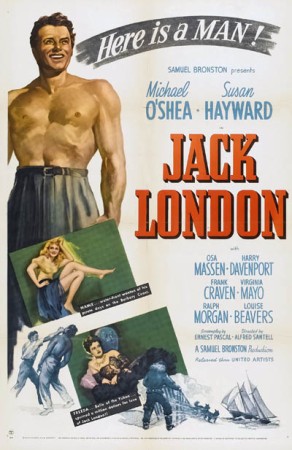
The 28th Film in Mill Creek’s Fabulous Forties box set was a 1943 biopic about the writer, Jack London. Not surprisingly, the title of the film was Jack London.
Now, I should start this review off by mentioning that I know very little about Jack London. I don’t think that I have ever read any of his short stories or his novels. I know that he wrote a novel called White Fang but that’s largely because there’s been so many different film versions of the book. (Long before directing Zombi 2, even Lucio Fulci made a version of White Fang.) Here’s what I do know about Jack London:
He was a prominent writer at the turn of the century.
He was reportedly an alcoholic.
He was a Socialist who even ran for mayor of Oakland, California on the party’s ticket.
He was an atheist.
In 1916, depending on the source, he either committed suicide, died of alcohol poisoning, or simply passed away as the result of 40 years of hard living.
Of those 5 facts, 4 are totally ignored in Jack London. The film does acknowledge that Jack London eventually became a prominent writer, even going so far as to open with stock footage of a U.S. warship being named after him.
As for his alcoholism, we never see London drunk. Indeed, the film’s version of Jack London is so earnest that it’s hard to believe he’s ever had a drink in his life.
As for his Socialism, we are shown that London grew up in a poor family. When, after serving at sea, he takes a writing class, he argues with a professor over London’s desire to write about the poor. However, we never hear London express any specific ideology. We certainly don’t see him running for mayor of Oakland.
As for his atheism — yeah right. This film was made in 1943! There’s no way that Jack London was going to be portrayed as talking about why he didn’t believe in God.
As for his death — well, Jack London ends with the writer very much alive. There’s not even a title card informing us that London eventually died.
Instead, Jack London is much more concerned with Jack (played by Michael O’Shea) dealing with the Japanese. Oh sure, we get some scenes of Jack London watching a shootout and breaking up a bar fight in Alaska. And Susan Hayward shows up as Jack London’s always supportive wife. (For that matter, Louise Beavers also shows up as Jack London’s always supportive house keeper.)
But, in the end, the majority of the film features Jack London as a war correspondent covering the turn of the 20th century war between Russia and Japan. When he’s captured by the Japanese, he observes the harsh way they treat prisoners and is shocked when he witnesses several prisoners being ruthlessly executed. When he talks to a Japanese commandant, he’s outraged as the commandant explains how the Empire of Japan is planning to take over the world. When Jack finally gets back to America, he’s less concerned with writing White Fang and more concerned with warning the American people to remain vigilant…
Jack London is basically wartime propaganda disguised as a biopic. The entire point of the film seems to be that if Jack London was still alive, he would want the men in the audience to enlist and the women to buy war bonds. None of it is subtle and, beyond its value as a time capsule of how Americans viewed the Japanese in 1943, none of it is particularly interesting as well.
In the end, Jack London plays out like one of those earnest but dull educational films that tend to show up on PBS when no one’s watching.
Louise Beavers and Fredi Washington in Imitation Of Life
The 1934 film Imitation of Life opens with Delilah Johnson (Louise Beavers) standing on the back porch of a house owned by widowed mother Bea Pullman (Claudette Colbert). Delilah says that she’s come for the housekeeping position. Bea tells her that there is no housekeeping position and quickly figures out that Delilah has the wrong address. As Delilah wonders how she’s going to get to the other side of town in time to interview for the job, Bea hears her toddler daughter falling into the bathtub upstairs. After Bea rescues her daughter, she agrees to hire Delilah as a housekeeper.
The rest of the film tells the story of their friendship. It turns out that, because she knows an old family recipe, Delilah can make the world’s greatest pancakes. Bea decides to go into business, selling Delilah’s pancakes and using Delilah as the product’s mascot. Soon Delilah’s smiling face is on billboards and she’s known as Aunt Delilah. When it comes time to incorporate the business, Bea and her partner, Elmer (Ned Sparks), offer Delilah 20% of the profits. They tell Delilah that they’re all going to be rich but Delilah protests that she doesn’t want to be rich. She just wants to take care of Bea and help to raise Bea’s daughter.
Delilah, incidentally, is African-American while Bea is white.
Despite the fact that Imitation of Life is considered to be an important landmark as far as Hollywood’s depiction of race is concerned, I have to admit that I was really uncomfortable with that scene. First off, considering that Delilah was the one who came up with recipe and her face was being used to sell it, it was hard not to feel that she deserved a lot more than just 20%. Beyond that, her refusal felt like it was largely included to let white audiences off the hook. “Yes,” the film says at this point, “Delilah may be a servant but that’s the way she wants it!”
It was a definite false note in a film that, up to that point and particularly when compared to other movies released in the 30s, felt almost progressive in its depiction of American race relations. Up until that scene, Bea and Delilah had been portrayed as friends and equals but, when Delilah refused that money, it felt like the film had lost the courage of its convictions.
However, there’s a shot that occurs just a few scenes afterwards. Several years have passed. Bea is rich. Delilah is still her housekeeper but now the house has gotten much larger. After having a conversation about Delilah’s daughter, Bea and Delilah walk over to a staircase and say goodnight. Bea walks upstairs to her luxurious bedroom while, at the same time, Delilah walks downstairs to her much smaller apartment. It’s a striking image of these two women heading different directions on the same staircase. But it also visualizes what we all know. For all of Delilah’s hard work, Bea is the one who is sleeping on the top floor. It’s a scene that says that, even if it couldn’t openly acknowledge it, the film understands that Delilah deserves more than she’s been given. It’s also a scene that reminds us that even someone as well-intentioned and kind-hearted as Bea cannot really hope understand what life is truly like for Delilah.
The film itself tells two stories, one of which we care about and one of which we don’t. The story we don’t care about deals with Bea and her spoiled child, Jessie (Rochelle Hudson). Jessie develops a crush on her mom’s boyfriend, Steve (Warren William). It’s really not that interesting.
The other story is the reason why Imitation of Life is a historically important film. Delilah’s daughter, Peola (Fredi Washington), is of mixed-race ancestry and is so light-skinned that she can pass for white. Throughout the film, Peola desperately denies being black and, at one point, stares at herself in a mirror and demands to know why she can’t be white. When Peola goes to school, she tells her classmates she is white and is mortified when Delilah shows up at her classroom. When Peola gets older, she attends an all-black college in the South but, eventually, she runs away.
When Delilah tracks her daughter down, Peola is working as a cashier in a restaurant. When Delilah confronts her, she is almost immediately confronted by the restaurant’s owner, who angrily tells her that the restaurant is a “whites only” establishment. Peola pretends not to know her mother.
Beyond the confrontation between Peola and Delilah, that scene in the restaurant is important for another reason. It’s the only time that the film provides any direct evidence as to why Peola wants to pass for white. Oh, don’t get me wrong. We all know why Peola thinks that society will treat her differently if it believes that she’s white. (And we also know that she’s right.) But this scene is the first time that the film itself acknowledges the fact that, in America, a white girl is going to have more opportunities than a black girl. Up until that point, white audiences in 1934 would have been able to dismiss Peola as just being selfish or unappreciative but, with this scene, the film reminds viewers that Peola has every reason to believe that life would be easier for her as a white girl than as an African-American. It’s a scene that would hopefully make audiences consider that maybe they should be angrier with a society that allows a restaurant to serve only whites than they are with Peola. It’s a scene that says to the audience, “Who are you to sit there and judge Peola when you probably wouldn’t even allow Delilah to enter the theater and watch the movie with you?”
Imitation of Life was nominated for best picture of the year and, though it lost to It Happened One Night, Imitation of Life is still historically important as the first best picture nominee to attempt to deal with racism in America. (Despite a strong pre-nomination campaign, Louise Beavers failed to receive a nomination. It would be another 5 years before Hattie McDaniel would be the first African-American nominee and winner for her role as Mammy in Gone With The Wind. Interestingly enough, McDaniel got the role after Beavers turned it down.)
Following the box office success of Imitation of Life, there were several films made about “passing.” The majority of them starred white actresses as light-skinned African-American characters. Imitation of Life was unique in that Fredi Washington, who played Peola, actually was African-American. As will be obvious to anyone who watches Imitation of Life, Fredi Washington had both the talent and the beauty to be a major star. However, she was considered to be too sophisticated to play a maid or to take on any of the comedy relief roles that were usually given to African-American performers. (And, as an African-American, no major studio would cast her in a lead or romantic role.) As such, her film career ended just three years after Imitation of Life and she spent the next 50 years as a stage performer and a civil rights activist. (For an interesting look at the history of African-Americans in the film industry, I would suggest checking out Donald Bogle’s Bright Boulevards, Bold Dreams: The Story of Black Hollywood.)
Like Peola, Washington herself could have passed for white. She was often asked if she was ever tempted to do so. I’m going to end this review with the answer that she gave to a reporter from The Chicago Defender:
“I have never tried to pass for white and never had any desire, I am proud of my race. In ‘Imitation of Life’, I was showing how a girl might feel under the circumstances but I am not showing how I felt. I am an American citizen and by God, we all have inalienable rights and wherever those rights are tampered with, there is nothing left to do but fight…and I fight. How many people do you think there are in this country who do not have mixed blood, there’s very few if any, what makes us who we are, are our culture and experience. No matter how white I look, on the inside I feel black. There are many whites who are mixed blood, but still go by white, why such a big deal if I go as Negro, because people can’t believe that I am proud to be a Negro and not white. To prove I don’t buy white superiority I chose to be a Negro.”
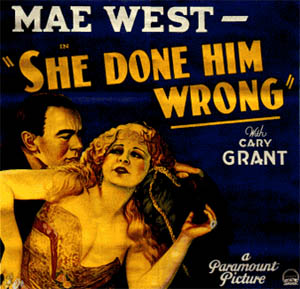
When watching the 1933 film She Done Him Wrong, it helps to know a little something about American history.
It helps to know that the film was made at the tail end of the failed progressive experiment known as prohibition, an attempt to ban liquor in the U.S. which only served to make people idolize criminals and feel nostalgic for the time when you could just safely hang out in a saloon and get drunk with bunch of shady characters.
It helps to know that this film was made at a time when America was struggling through the Great Depression and, more than ever, movies were seen as an escape from reality. The Depression also created a situation where, much like today, most Americans felt as if they were on the outside of the good life and, as a result, the most successful films of the time deal with outsiders getting something over on the smug and judgmental insiders.
It also helps to know that She Done Him Wrong was one of the last of the pre-Code films. Though, by modern standards, the film may seem outwardly tame, the innuendo and subtext is anything but. In fact, She Done Him Wrong was considered to be so racy that some people were actually scandalized when it became the biggest box office success of 1933. (These were largely the same people who, 13 years before, celebrated the passage of prohibition.) The infamous production code was largely instituted to make sure that a film like She Done Him Wrong could never be given another chance to corrupt filmgoers.
What exactly made She Done Him Wrong so controversial?
Well, it took place in a saloon in 1890s. The saloon is owned by Gus (Noah Beery), who uses it as a front for prostitution and counterfeiting. This is a film that features a lot of people drinking a lot of alcohol and it’s also a film that goes so far as to suggest that having a drink or two is not necessarily the worst thing in the world. Captain Cummings (Cary Grant) runs a city mission that has opened up next to the bar and the film devotes a lot of time to poking fun at Cummings’s upright morality. (Of course, Cummings has a secret of his own, one which suggests that his crusading attitude is just a convenient disguise.) Though it would be repealed by the end of the year, Prohibition was still the law of the land when She Done Him Wrong was released and it’s fun to see how much the film has at the law’s expense. That’s the type of fun that would basically be banned by the Production Code.
The Production Code would also require that all criminals be punished for their crimes by the end of a film. In She Done Him Wrong, singer Lady Lou (Mae West) stabs to death the viscous Russian Rita (Rafaela Ottiano) and basically gets away with it. It’s true that Lou was acting in self-defense but what makes She Done Him Wrong unique (for its time) is that Lou shows no remorse and that the killing is handled rather flippantly. When the police, who have been searching the saloon for another criminal, burst into the room after Rita has been stabbed, Lou fools them by placing Rita’s corpse in a chair and combing her hair. (“Haven’t you ever seen anyone comb someone’s hair before?”) After the police leave, Lou has her bodyguard dispose of the body and Rita is never mentioned again. Again, this is something that would never be allowed happen under the Production Code.
And then there’s the naked painting of Lou that hangs in the saloon. Whenever it’s shown a screen, a man in a hat happens to be standing in just the right position to block the viewer from seeing the entire portrait. Again, this would never have been allowed to happen under the Production Code.
And perhaps the biggest indication that this is a Pre-Code film is Mae West herself. Reportedly, She Done Him Wrong was an extremely toned down version of West’s stage act but what was heard on-screen would certainly be enough to throw the guardians of decent society into a panic. Nearly every line that she utters in this film is a double entendre but it’s not only what Mae West says. It’s the way that she says it. West may not have been a great actress but she had enough attitude that she didn’t need to be. With every line, with every glance, with every movement, Mae West announces that she not only has sex but she enjoys it too. In the Pre-Code days, that was unusual. Once the Production Code went into effect, such a portrayal would be impossible.
As for the film itself — well, it’s pretty much just an excuse for Mae to be Mae. There’s a plot, of course. Lady Lou has many suitors and they all converge on the saloon at the same time. However, Lou’s got her eye on the upstanding Captain Cummings. (He’s a man in uniform, after all.) It’s not a great film by any stretch of the imagination but, if you’re into film history or if you’re curious to see how American social mores have changed (and occasionally, not changed) over the years, She Done Him Wrong is a must see.
She Done Him Wrong is only 66 minutes long and it’s the shortest film to ever receive an Oscar nomination for best picture. It received no other nominations and lost to Cavalcade.


 Through the Shattered Lens