October Hacks: Alice, Sweet Alice (dir by Alfred Sole)


Eh.  The 1976 film, Alice, Sweet Alice, is one of the few slasher films to have found critical acclaim and to have been seriously studied in the years after its release but I have to admit that it’s never done much for me.

It’s a film that takes place in 1961, in a Catholic neighborhood of Patterson, New Jersey.  It’s perhaps the ugliest setting of a film outside of Combat Shock The houses that we see are run-down.  The apartment building in which much of the action takes place is dirty and rat-infested.  Even the local church looks like it could use a bit of spring cleaning.  Of course, if you think the neighborhood looks ugly, you should see some of the people who live in it.  There’s really not anyone in this film who could be considered to be at all appealing.  Everyone’s either angry or disturbed or grotesquely obese or pervy.  It’s one of those films where everything is so dirty and sleazy that it’s hard not kind of laugh at it all.  John Waters could have worked wonders with this neighborhood but Alfred Sole, Alice’s director, seems to take his story just a little too seriously to give it the camp approach that it deserves.

(In fact, probably the only appealing sight in Alice, Sweet Alice is a picture of John F. Kennedy that is seen hanging in a few offices.  There’s a lot of not positive things that can be said about JFK but at least he was handsome.)

Anyway, the plot deals with Alice Spages (Paul Sheppard), an annoying twelve year-old sociopath who lives in the desolate apartment building and who enjoys tormenting people by putting on a Halloween mask and scaring them.  Alice is basically a bully but I think we’re supposed to sympathize with her because she’s rebelling against the suffocating hypocrisy all around her.  Again, whatever.  I was a brat when I was 12 years old too.

Alice’s younger sister, Karen (Brooke Shields, making her film debut), is as perfect as Alice is troublesome.  Everyone loves Karen, except for Alice who is obviously jealous.  On the day of her first communion, Karen is strangled to death by someone wearing a Halloween mask and a yellow raincoat, one that looks a lot like the one that Alice owns.  The killer steals Karen’s crucifix and tries to set the body on fire.  Father Tom (Rudolph Willrich) is annoyed that the ceremony has been interrupted.  Actually, it’s hard to think of a moment in this film in which Father Tom isn’t annoyed by something.

Did Alice murder her sister?  A lot of people think so, especially after other people who get on Alice’s nerves end up getting attacked.  Alice ends up getting sent to a mental hospital but, of course, Alice isn’t the murderer.  Who is the murderer?  No need for me to say.  If you watch the film, you’ll figure it out easily on your own.

Alice, Sweet Alice is often described as being an early slasher film.  If anything, it’s more of an American giallo, with the emphasis being on figuring out who is the killer behind the mask.  Many critics have praised Alice, Sweet Alice for its atmosphere and its anti-religious subtext but, to be honest, I’ve always found it to be kind of boring.  Part of the problem is that every character is so repulsive (physically, mentally, and morally) that it’s difficult to really care about whether or not they die or if they’re the guilty party.  Even Alice comes across like someone who is destined to start fires once she grows up.  None of the actors gives a good enough performance to hold your attention.  The film attempts to criticize the Church, as many giallo films did.  But one need only compare Alice Sweet Alice to other anti-clerical giallo films, like Lucio Fulci’s Don’t Torture A Duckling or Aldo Lado’s Who Saw Her Die? , to see how simplistic and superficial Alice, Sweet Alice‘s approach really is.

Anyway, a lot of people will disagree with this review and that’s fine.  Some films work for some people while failing to work for others and, in this case, Alice Sweet Alice is just a film that does not work for me.  Que sera sera.
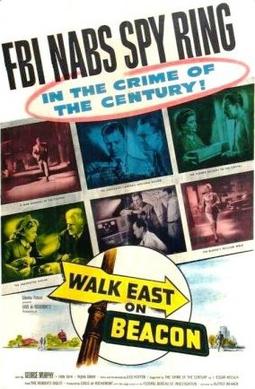
18 Days of Paranoia #17: Walk East On Beacon! (dir by Alfred L. Werker)


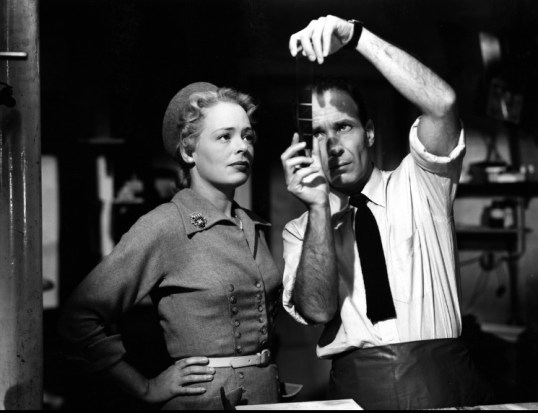
From 1952 comes Walk East On Beacon, a mix of spy thriller and film noir that highlights the efforts of the FBI to expose and take down a communist sleeper cell working right in the United States of America!  (Cue the dramatic music.)

One need only check out the opening credits to see what type of film Walk East On Beacon is going to be.  We’re told early on that the film was “suggested” by a Reader’s Digest article that was written by none other than the director of the FBI, J. Edgar Hoover. The title of that article was “The Crime of the Century: The Case of A-Bomb Spies” and it dealt with the FBI investigation that led to the arrest, conviction, and controversial execution of two Russian spies, Julius and Ethel Rosenberg.  I haven’t read the article but judging by the fact that it was written by Hoover and published in Reader’s Digest, I think it’s fairly safe to guess that it wasn’t particularly concerned with things like protecting the First Amendment, civil rights, or the freedom to hold any ideological belief regardless of how unpopular it may be with the general public.  (Of course, I would be remiss if I didn’t also point out that most historians now agree that, despite what many on the Left claimed over the decades, the Rosenbergs were indeed guilty of being spies and they played a very central role in the Russians discovering the secret to making atomic bombs.)

In the film, George Murphy plays an FBI agent named Jim Belden.  According to J. Hoberman’s book, An Army of Phantoms, the FBI specifically requested that Murphy be cast in the lead role because Murphy was an outspoken anti-communist.  (Murphy would also later be elected to the U.S. Senate.)  Project Falcon, a super-secret U.S. program, has been infiltrated by spies and Belden has been assigned to track down and capture their ringleader.  He does this by using a number of techniques that were probably considered pretty high tech back in 1952, stuff like hidden cameras and secret microphones.  He even brings in a group of lip readers to watch silent footage of two possible spies speaking so that they can tell him what the spies are talking about.  You don’t have to worry about a thing with Jim Belden on the case!

As for the members of the spy ring, they’re a mixed bunch.  Some of them are just bad people who have betrayed their country just because it’s the evil thing to do.  Others are people who idealistically joined the Communist Party years ago because they wanted to help their fellow man and, instead, they’ve now found themselves forced to spy against their country.  Prof. Albert Kafer (Finlay Currie) doesn’t want to betray America but he’s been told that his son will be executed if he doesn’t cooperate.  Kafer goes to the FBI.

As you can probably guess, this is not a particularly subtle film.  The communists are all evil and the FBI is doing its best to protect the loyal citizens of America and, if you’re going to question the legality or the ethics of their methods …. well, why don’t you just move to Russia and tell Stalin about it, okay!?  Interestingly enough, the film is shot like a film noir, with an emphasis on shadows and dark streets and desperate men trying to escape their fate.  But it has none of the moral ambiguity that one usually expects to find in a film noir.  Instead, it presents a thoroughly black-and-white view of the world.  All of the communists are either neurotic or cruelly evil while the FBI is professional, bland, and rather humorless.  There’s really only one moment — where a blackmailed spy admits to his wife that he’s been trapped into betraying his country — where the film seems to come to life.  Otherwise, this is a rather dry film, one that even comes with officious voice over narration.

While the film may not work as a thriller, it is somewhat fascinating as a historical document.  The film was shot on location in Boston and, while I realize this may just be the history nerd in me talking, it’s still somewhat interesting to see what an major American city looked like in 1952.  (It looks remarkably clean.)  As well, the film really delves into the minutia of stuff that today seems mundane but which probably took audiences by surprise in 1952, stuff like wiretapping, drop points, and how even a condolence card could be used to send a secret message.  If nothing else, the film’s portrait of a world where anyone — from a cab driver to an atomic scientist — could be a spy certainly provides a interesting snapshot of 1950s paranoia.

Other Entries In The 18 Days Of Paranoia:

  1. The Flight That Disappeared
  2. The Humanity Bureau
  3. The Private Files of J. Edgar Hoover
  4. The Falcon and the Snowman
  5. New World Order
  6. Scandal Sheet
  7. Cuban Rebel Girls
  8. The French Connection II
  9. Blunt: The Fourth Man 
  10. The Quiller Memorandum
  11. Betrayed
  12. Best Seller
  13. They Call Me Mister Tibbs
  14. The Organization
  15. Marie: A True Story
  16. Lost Girls