Film Review: Atlas Shrugged Part Three (dir by J. James Manera)


In 2014, the Atlas Shrugged trilogy came to a close with Atlas Shrugged Part III: Who Is John Galt?  As you can probably guess from the title, this is the movie that finally revealed the elusive character of John Galt.

Unfortunately, after all the time spent discussing the character over the past two movies, there’s really no way that the actual John Galt could possibly live up to all the hype.  John Galt, the man who stopped the motor of the world and who is the world’s greatest living engineer, turns out to be a sensitive lumberjack type who has founded his own scenic village in Galt’s Gulch.  He’s manly and handsome and chivalrous and he’s a bit dull.  Kristoffer Polaha, who plays the character, is a perfectly pleasant and likable actor but there’s nothing about his screen presence or his performance that suggests that he’s the man who has figured out how to save civilization from the regulatory state.  As a character, Galt works best as a literary creation, someone who the reader can imagine for themselves.  When seen on screen, he’s a bit of a letdown.

Taking over the role from Taylor Schilling and Samantha Mathis, Laura Regan plays Dagny Taggart as an overworked businesswoman who really needs a vacation.  (Of the three actresses who played the character, only Mathis was credible as the dynamic Dagny of Ayn Rand’s original novel.)  Having crashed her plane in the mountains at the end of the second film, Dagny is nursed back to health by John Galt and the inhabitants of Galt’s Gulch.  Dagny is shocked to discover that most of her old friends are now living in Galt’s Gulch.  As they explain, they’re on strike and they’re no longer going to serve a government that is looking to control and ultimately destroy them.  Unfortunately, the film presents Galt’s Gulch as being a bit of a dull place, one that is not even livened up the presence of pirate Ragnar Danneskold (Eric Allan Kramer).  It’s the type of place where Dagny can visit the local farmer’s market and recuperate in a taste-fully decorated bed and breakfast, all while falling in love with her hunky host.  If the first two Atlas Shrugged films now feel somewhat prophetic, the third one feels like a Libertarian-themed Hallmark movie.

Atlas Shrugged: Part III feels a bit rushed.  Apparently, no one from the cast and crew of either the first or the second film returned to work on Atlas Shrugged: Part III and it feels quite a bit different from the previous two films.  Whatever one may think of the way the first two films presented the effects of government regulation, they were effective because they specifically showed the consequences.  The audience actually saw two trains collide due to incompetent management.  The audience saw the government showing up and forcefully taking over Rearden Metal.  The third film relies on a narrator, one who tells us what happened instead of letting us see it with our own eyes.  We hear about a bridge collapsing but we don’t see it.  We hear about union thugs forcefully taking over a factory but we don’t see them.  We hear about out-of-control government bureaucrats but, as opposed to the first two films, we don’t really get to spend much time with them and, when we do, they’re far more cartoonish in their villainy than they were in the first two films.  John Galt does get to deliver his speech to the world but it’s in a truncated form and the film’s decision to then cut to Sean Hannity, Glenn Beck, and Ron Paul all praising the speech on television not only goes against the film’s depiction of a country where public dissent is suppressed but it also reminds the audience that the film’s outlook has more in common with Fox News than Ayn Rand.

As previously mentioned, the third film has a totally different cast from the first two films.  Greg Germann is enjoyably over-the-top as the unhinged James Taggart but, otherwise, the new cast fails to make much of an impression, with some of them only showing up for a few brief seconds before disappearing from the story.  Rob Morrow plays Hank Rearden but is only seen for less than a minute.  By sidelining one of the book’s most important characters, Atlas Shrugged: Part III also drops the whole storyline about Hank’s affair with Dagny.  While I guess that makes it easier for the film to then have Dagny and John Galt hook up, it still feels a bit unfair to the people who actually watched the entire trilogy.

Considering that both Parts I and II have improved with the passage of time, Part III is a rather disappointing ending for the trilogy.  Upon watching, John Galt would probably be disappointed but not surprised.

Horror Film Review: The Possession of Hannah Grace (dir by Diederik van Rooijen)


2018’s The Possession of Hannah Grace is a real idiot film.

As in, “Hey, idiot, there’s a dead woman behind you!”

The dead woman in question of Hannah Grace (Kirby Johnson), who was once alive and had brown eyes but then she was possessed by demons and her eyes turned blue.  An attempted exorcism didn’t go well, with the older priest ended up getting impaled on a conveniently placed hook and the younger priest being one of those young bearded types who had obviously never done an exorcism before.  Finally, Hannah’s father, Grainger (Louis Herthum), was like, “Ah, screw it,” so he just smothered her to death,

Unfortunately, the demon is still inside of Hannah’s body and, three moths later, that means trouble when it shows up at the morgue.  Megan (Shay Mitchell), who is working the night shift, is an ex-cop with drug and alcohol problems and she’s not sure if Hannah is really wandering around or if she’s just hallucinating things.  The film probably would have been more interesting if we had been as uncertain as Megan as to whether or not she was really seeing Hannah wandering around the morgue.  Unfortunately, though, the film starts with the unsuccessful exorcism and, as a result, we already know that it’s Hannah and we’re just kinda like, “We get it.  You’ve got issues.  Who cares?”

Anyway, even though the morgue is a restricted area, people keep coming down there and getting killed.  What’s interesting is that everyone who dies is on duty at the hospital yet hardly anyone seems to notice or care that they’re suddenly absent.  We do see one security guard wandering why his partner hasn’t returned but that’s pretty much it.

And it should be scary because this is one of those films that seems to exclusively take place in dark rooms and unlit hallways but it never really is, largely because we know everything that Hannah’s going to do before Hannah does it.  And everyone is so stupid that there’s not really any suspense as to whether or not Hannah’s going to be able to rip them up into little pieces of naive medical personnel.  This all, of course, leads to Megan declaring that she’s now a stronger person and will be able to face the the future with renewed confidence so I guess all of those people dying for no good reason was worth it.

Anyway, I usually like to make sure that my reviews usually run at least 500 words but I kind of feel like that would be a waste of effort where The Possession of Hannah Grace is concerned.  I’ll be happy with 440.

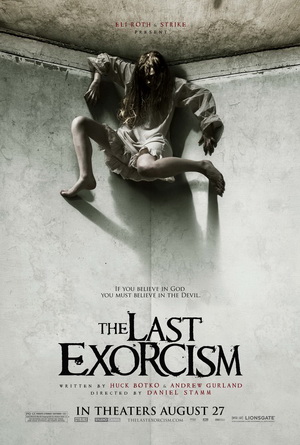
Horror Film Review: The Last Exorcism (dir by Daniel Stamm)


The_Last_Exorcism_Poster

First released in 2010, The Last Exorcism is one of the best films of the past 5 years.

I know that a lot of people are going to disagree with that statement.  When The Last Exorcism was released, a lot of people were so angered by the way the film ended that they dismissed the entire movie.  Add to that, The Last Exorcism is yet another found footage horror film and that genre has produced a lot of truly terrible movies.  Whether fairly or not, a lot of people have judged The Last Exorcism on the basis of the sins committed by films like The Devil Inside.  With all that taken into consideration, it’s perhaps not surprising that The Last Exorcism only has a rating of 5.6 on the IMDb.

However, those who casually dismiss The Last Exorcism are making a mistake.  The Last Exorcism is a hundred times better than it has any right to be.  If nothing else, it’s probably one of the best found footage horror films ever made.

Produced by Eli Roth and directed by Daniel Stamm, the film opens with footage of the Rev. Cotton Marcus (Patrick Fabian) leading a revival meeting.  We quickly see that Marcus is a showman, a born actor who knows how to manipulate and control an audience.  In interviews with a mostly unseen film crew, Rev. Marcus also explains that he’s both a highly successful exorcist and a complete fraud.  As he explains it, he has lost his faith and is participating in a documentary to reveal how he and other evangelical exorcists con and exploit their followers.  He’s agreed to perform one last exorcism, specifically so he can reveal just how much of a fraud that he really is.

One of the more interesting aspect of this setup is that it’s based on an actual documentary.  Released in 1972, Marjoe followed a former child evangelist named Marjoe Gortner as he conducted his last revival tour.  Talking directly to the camera, Marjoe would explain the tricks that he and other preachers would use to cheat the faithful out of their money.  The documentary, which won an Oscar for Best Documentary Feature in 1973, painted an intriguing picture of a con artist and The Last Exorcism does the same thing.

Marcus and the documentary film crew go out to a small rural community where farmer Louis Sweetzer (Louis Herthum) claims that his daughter, Nell (Ashley Bell) has been possessed by a demon.  Nell’s brother, Caleb (Caleb Landry Jones)  is openly hostile to both Marcus and the documentary film crew.  Marcus, meanwhile, is convinced that Nell is faking.

However, as both the film and the exorcism progress, we are given reasons to suspect that Nell might actually be possessed.  While a good deal of the film’s scares will be familiar to anyone who has ever seen a found footage horror film (there’s the usual loud noises in isolated parts of the house and the menacing shadows glimpsed in the corners), the question of whether or not Nell is possessed is given extra importance by what the answer means to Cotton Marcus.  If Nell is faking, then Marcus’s own loss of faith will be justified.  However, if it turns out that Nell actually is possessed than it will mean that Marcus hasn’t merely been a con artist for his entire life.  If Nell actually is possessed, it’ll prove the existence of a God that Marcus claims to no longer believe in.

Indeed, it’s the character of Cotton Marcus who elevates The Last Exorcism over other entries in the found footage horror genre.  Much like Father Karras (as played by Jason Miller) in the original Exorcist, Marcus is a conflicted protagonist, a former man of faith who isn’t quite as ready to give up on his belief as he originally seems.  As played by Patrick Fabian, Cotton Marcus is an intriguingly ambiguous hero.  At the beginning of the film, Fabian is spell-binding and believable as a fire-and-brimstone evangelist.  (In perhaps his best scene, he impishly sneaks a recipe for banana bread into his sermon.)  As the film progresses, Cotton Marcus goes from being an arrogant charlatan to being a very vulnerable and scared man and Fabian is both believable and compelling throughout the entire film.  Patrick Fabian elevates The Last Exorcism from being just an average (if effectively atmospheric) horror film to being a truly intriguing piece of pulp art.

As for the film’s ending, I may be in a minority but I think it works.  The most common complaint about the film’s final 15 minutes is that they tend to contradict everything that came before them.  I’m not sure that’s necessarily true.  You have to remember that we’ve only seen the film’s events through the perspective of the documentarians and we’ve only heard Marcus’s admittedly biased interpretation of what’s going on.  Perhaps the worst possible thing that you can really say about the ending is that it reveals that Marcus wasn’t as clever as we previously assumed him to be.

The Last Exorcism was followed by a far less successful sequel, which I reviewed here.