Film Review: Notorious (dir by Alfred Hitchcock)


Today is the 121st birthday of one of the great actors of Hollywood’s Golden Age, the one and only Cary Grant.  For those of us who love to watch older films, Grant is usually the epitome of old-fashioned movie star charisma.  He was an actor who could do it all, from screwball comedy to tear-jerking melodrama to exciting thrillers.  What one usually hears about Cary Grant is that he was an actor who was taken for granted because he made everything seem so effortless.

And yet, there was a darkness to Grant’s best performances.  Like Jimmy Stewart, he was an actor whose affable screen presence often hinted at inner turmoil.  And, much as in the case of Stewart, Alfred Hitchcock was a director who immediately understood that.  He cast Grant in some of his best films, usually playing a character with a secret or two to hide.  One of my favorite “darker” Grant performances and films is 1946’s Notorious.

Directed by Alfred Hitchcock, Notorious opens with T.R. Devlin (Cary Grant) meeting and, it is implied, seducing Alicia Huberman (Ingrid Bergman).  Alicia, at the time, was attempting to drink away her sorrow over her father being convicted of treason for his pro-Nazi activities during World War II.  As the daughter of an American Nazi with a reputation for drinking too much and being promiscuous, Alicia is indeed notorious.  That’s something that Devlin uses to his advantage the next morning when he informs that hangover Alicia that he is an American intelligence agent and that he is investigating the activities of a group of Nazi sympathizers who fled to South America at the end of the war.  He wants Alicia, as the daughter of a known sympathizer, to infiltrate their operations.

Reluctantly, Alicia agrees and, while they wait for to learn the exact details of her assignment, they fall in love.  Devlin is not happy when his superiors inform him that they want Alicia to approach and seduce Alex Sebastian (Claude Rains), a friend of her father’s who now lives in Brazil with his domineering mother (Leopoldine Konstantin).  Alicia is even less happy when Devlin tells her of the assignment, especially as she knows that the weak-willed Sebastian has always been in love with her.  She assumes that Devlin only pretended to love her.

After Devlin arranges for Alicia to be at the local riding club at the same time as Alex, Alex meets her and immediately brings her to the mansion that he shares with his mother.  Alex is an interesting character.  When we first meet him, he hardly seems like a Nazi sympathizer.  His happiness when he sees Alicia and the apparent sincerity of his love for her stands in contrast to the often cold, manipulative, and harsh Devlin.  Sebastian invites Alicia to move into his mansion and soon, Alicia tells Devlin that he can add Sebastian to “my list of playmates.”  When Sebastian asks Alicia to marry him, Devlin tells Alicia to do what she wants.  Alicia married Sebastian though she loves Devlin but she soon discovers just how for Sebastian and his mother will go to protect themselves and their Nazi conspirators.

Notorious is famous for its 2 and a half kissing scene between Devlin and Alicia, filmed at a time when the production code specifically stated that kisses could only last for three seconds.  Hitchcock handled this by interrupting the kiss every three seconds and then having his two stars get back to it.  Both Cary Grant and Ingrid Bergman said the scene was awkward to shoot, specifically because they had to keep finding reasons to split apart without splitting too far apart but the effect onscreen is amazingly romantic and probably about as erotic as 1940s studio production could be.  In that scene, you have no doubt that Devlin and Alicia share a passion that Alex, even though he is in love with Alicia, could never understand.  Grant and Bergman have an amazing chemistry in this scene and really the entire film.

As played by Cary Grant, Devlin is not always likable in Notorious.  He can be cold and manipulative and judgmental but, in the end, we never doubt his love for Alicia.  Alex also loves Alicia but he ultimately puts himself (and his mother) first.  As for Alicia, she is someone who has been unfairly branded by both the activities of her father and her past reputation and anyone who has ever come to work or gone to school on a Monday morning and heard the snickering that goes along with the rumors about what she did during the weekend will immediately relate to Alicia.  Alicia is told that the mission is a way to redeem herself but the film suggests that no redemption is necessary.  If anything, it’s Devlin who needs to redeem himself for the way he previously manipulated and judged her.  Devlin and his superiors are trying to stop a group of Nazi sympathizers from graining power in South America and their mission is an important one.  (That sentiment would be even more true from audience watching in 1946, just a year after the end of World War II).  But the important of their mission doesn’t change the fact that the people involved are human beings with very real and very fragile emotions.

Notorious features some of Hitchcock’s best set pieces, from the famous kissing scene to another scene involving the key to a wine cellar.  Grant, Bergman, and Rains give three of their best performances in this intelligent thriller.  (Watching, one can see why Ian Fleming suggested Cary Grant as a possible James Bond.)  I first saw Notorious in a film class in college.  At first, the class was a bit hesitant about a black-and-white movie from 1946 but, by the end, there were cheers as Devlin rushed to save Alicia.  Notorious is a timeless classic.

Notorious (1946, dir by Alfred Hitchcock, DP: Ted Tetzlaff)
Lisa Reviews An Oscar Winner: The Life of Emile Zola (dir by William Dieterle)


The Life of Emile Zola, the winner of the 1936 Oscar for Best Picture of the Year, opens with two French artists living in a drafty apartment.

Emile Zola (Paul Muni) is destined to become one of France’s most popular and important writers.  Paul Cezanne (Vladimir Sokoloff) will eventually become one of the most important artists of the post-impressionist movement.  But for now, they’re just two struggling artists who have sworn that they will never sell out their principles.  They are poor but they’re happy.  That changes for Zola after he meets a prostitute named Nana (Erin O’Brien-Moore) and he uses her life story as the inspiration for a novel.  The book is controversial and its frank content scandalizes France.  The public censor comes close to banning it.  But it also becomes a best seller.  It’s the book everyone secretly owns but claims to have never read.

Zola writes several more books, all about the conditions of the working class in France.  Eventually, he becomes what he claimed he would never be, a wealthy man living in a mansion and having little contact with the poor and oppressed.  Cezanne sees Zola one last time, calling him out for having sold his talent for money.  Cezanne explains that, on general principle, he can no longer be Zola’s friend.

Meanwhile, a quiet and rather meek family man named Captain Alfred Dreyfus (Joseph Schildkraut) has been arrested and accused of being a spy for Germany.  There’s little evidence that Dreyfus is a spy.  Indeed, most of the evidence seems to point to a Major Walsin-Esterhazy (Robert Barrat).  But, because Dreyfus is considered to be an outsider, he is convicted in a show trial and exiled to Devil’s Island.

(In real life, it’s generally agreed that Dreyfus was a victim of anti-Semitism.  As the only Jewish member of the army’s General Staff, Dreyfus was viewed with suspicion by his colleagues even before anyone knew that there was a German spy.  The Life of Emile Zola doesn’t specifically state that Dreyfus was a victim of anti-Semitism, with the exception of a brief moment when one of his accusers looks at his personnel file and says, “He’s not one of us,” while pointing at the word “Jew.”  Otherwise, the fact that Dreyfuss was Jewish is never mentioned in the film.  It’s as if the film is going out of its way to avoid offending the very people that the movie is criticizing.)

After speaking to Dreyfus’s wife (played by Gale Sondergaard, who would later become the victim of a show trial herself when she was blacklisted as a suspected communist), Zola decides to take up Dreyfus’s case.  He publishes an open letter — J’Accuse — in which he states that Dreyfus was not given a fair trial and that Dreyfus is innocent of the charges against him.  Zola finds himself in court, accused of libel.  Zola uses his trial to give Dreyfus the hearing that he never received.  While the army boos his every utterance, the people of France rally to his side.

The Life of Emile Zola is an early example of the type of prestige production that today is often referred to as being an “Oscar picture.”  It tells a true story.  As a film that condemns the treatment of Alfred Dreyfus but avoids stating the obvious reason why Dreyfus was targeted in the first place, it’s political without being radical.  And it features a performance from the most acclaimed actor of the era, Paul Muni.  Muni gives a powerful performance as Zola, holding the viewer’s attention even during the lengthy trial scenes that take up most the second half of the film.  That said, the true star of the film is Joseph Schildkraut, who plays Dreyfus as being a kind and trusting soul who finds himself caught up in a Kafkaesque nightmare.  At one point, Dreyfus is given a gun and told that there’s one way that he can avoid being put on trial for treason.  Schildkraut played the scene so well that I wanted to cheer when he refused to surrender.

The Life of Emile Zola is a big and, at times, self-consciously important production.  It was clearly designed to win a bunch of Oscars and it certainly managed to do that.  Compared to some of the other films nominated that year — The Awful Truth, Dead End, A Star is Born, Lost Horizon, Stage Door, In Old Chicago — The Life of Emile Zola can seem a bit stodgy.  However,  the performances of Muni and Schildkraut continue to make the film worth watching.

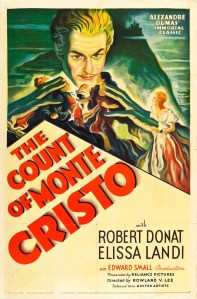
The Count of Monte Cristo (dir. by Roland V. Lee)


Note that this maybe a bit brief and off tangent. This may be one of the first reviews I’ve written for a film created well before my time. I won’t have as many movie references or personal anecdotes to add here.

I love the story of The Count of Monte Cristo. At the time of this writing, it can be found on both Amazon Prime and on Tubi.

Written in 1844 by Alexandre Dumas, it’s a tale of revenge and depending on which version you watch, there’s also a bit of redemption to it. Though it’s adapted numerous times on stage and screen, I’m familiar with 3 main movie versions. You have the modern 2002 version from Kevin Reynolds, starring Jim Caviezel, Henry Cavill and Guy Pearce. There’s the 1975 TV Movie (my personal favorite), directed by David Greene and starring Richard Chamberlain, Donald Pleasance, Tony Curtis and Kate Nelligan. And finally, we have the classic 1934 rendition, directed by Donald V. Lee and starring Robert Donat, Elissa Landi, Sidney Blackmer and Louis Calhern. Most audiences may know of the film from the references made of it in 2005’s V for Vendetta.

The Count of Monte Cristo is the story of Edmund Dantes (Robert Donat, The 39 Steps) , a sailor who has everything going for him. He’s the newly minted Captain of the Pharaon, a title bestowed to him after the original captain died during a voyage near the island of Elba. Before the original Captain passes, he gives Edmond a letter to be delivered to an individual who will make himself known. This promotion and the letter also draws the jealous eyes of the would be Captain Danglars (Raymond Walburn, Christmas in July). Edmond has the heart of the lovely Mercedes de Rosas (Elissa Landi, The Yellow Ticket), but not the affections of Mercedes’ Mother (Georgia Caine, Remember the Night), the Madame de Rosas. Together with Fernand Mondego (Sidney Blackmer, Rosemary’s Baby), they often try to convince Mercedes to find someone better.

During the party for his wedding, Edmond meets the letter’s recipient and makes the delivery. Shortly afterward, both this man and Edmond are arrested. We learn the man is the father of The King’s Magistrate, Renee de DeVillefort (Louis Calhern, Julius Caesar). Choosing to protect his father (now considered a Bonapartist), DeVillfort puts on the blame on Dantes. With Mondego and Danglars as co-conspirators, they send Dantes to the dreaded Chateau D’if, an Alcatraz-like prison on the sea. To make things worse, after Napoleon is defeated, Edmond’s captors list him as deceased and his name is struck from the prison record. Dantes spends nearly 15 years in the Chateau, falling out of everyone’s memory. During his time, he discovers and befriends the Abbe Faria (O.P. Heggie, Anne of Green Gables), another prisoner who teaches Dantes various topics of the world. The Abbe also shares the secret of the De Sparda Treasure, hidden away just off the island of Monte Cristo. Edmond eventually escapes the Chateau D’If, acquires the treasure and returns to the Paris as the mysterious Count of Monte Cristo.

The film has fine performances throughout, given the time frame. Donat’s Dantes is quite naive prior to the imprisonment, but as the Count, I felt he brought a lot of style and class to the character. It was much like watching an old serial of The Batman or The Shadow. Another major surprise (for me, anyway) was Sidney Blackmer as Mondego. I’ve only ever seen Blackmer as the old and strange Roman Castavet in Roman Polanski’s Rosemary Baby, so it was very interesting to see him in his prime. There’s a nice duel between Mondego and Dantes that showcased Blackmer’s athleticism as well as his acting. I also enjoyed Walburn’s Danglars, who felt like a weasel you’d find in a classic Disney animated film.

Visually, for a black and white film, there’s some good use of light and shadow here, particularly during the dimly lit scenes in the Chateau D’If and the face off between the Count and Mondego.

How Edmond chooses to face his enemies was interesting. A bit of scandal for one, greed for another and a full-on courtroom drama for a third. I thought the court case element was bit much, but given where the story was going, it made sense. Overall, The Count of Monte Cristo is a wonderful classic with great pacing throughout.

Film Review: The Last Days of Pompeii (dir by Ernest B. Schoedsack and Merian C. Cooper)


The summer after I graduated high school, I took a trip to Italy.

I absolutely loved it.  There’s nothing more wonderful than being 18 and irresponsible in one of the most beautiful and romantic countries in Europe.  I also loved it because everywhere I looked in Italy, I saw the remains of history.  When I was in Rome, I visited the Colosseum.  When I was in Southern Italy, I visited Comune di Melissa, the village where some of my ancestors once lived.  When I visited Florence, I became so overwhelmed by the beauty of it all that I nearly fainted.

And then there was Pompeii.  I spent a day visiting the ruins of Pompeii and it was an amazing experience.  The eruption of Mt. Vesuvius in 79 AD may have been horrific for the Romans but it’s also gave history nerds like me a chance to step right into the past.  Beyond just the thrill of seeing how the world once was, I have two main memories of Pompeii:

First, there was the visit to Pompeii’s brothel.  An Australian tourist lay down on one of the stone slabs so that his family could take pictures of him.

Secondly, there was the fact that I wore a really pretty red dress for my visit but I failed to take into account that 1) the area around Pompeii is very hilly and 2) it was a very windy day.  So, I can say that I’ve not only visited but I’ve flashed Pompeii as well.

The destruction of Pompeii has inspired several books and more than a few films, as well.  One of the earliest was the 1935 film, The Last Days of Pompeii.

The Last Days of Pompeii opens with Marcus (Preston Foster), an extremely bitter blacksmith who lives in the bustling city of Pompeii.  Marcus is bitter because he’s not rich and his family has been just been run down by some jackass in a chariot.  Marcus does find brief fame as a gladiator but he’s stricken with guilt after he kills a man and then discovers that he’s made an orphan out of the man’s son.  Marcus adopts young Flavius, just to then discover that the boy is seriously ill.  A fortune teller informs Marcus that Flavius will be healed by “the greatest man in Judea.”  Marcus naturally assumes that this is a reference to the Roman governor, Pontius Pilate (Basil Rathbone).  However, upon traveling to Judea, Marcus meets a different great man and then watches as his adopted son is healed.

Jump forward about two decades.  Marcus is now a rich man and is in charge of Pompeii’s gladiatorial games.  Flavius (now played by John Wood) has grown up to be an idealistic young man who barely remembers the day that he was healed. What Marcus doesn’t know is that Flavius has been helping slaves escape from Pompeii.  When Flavius is arrested, it appears that Marcus is doomed to watch his own son be killed in the arena.

But wait a minute — what’s that coming down the mountain?  It’s kinda smoky and red and it looks like it might be really hot and …. oh damn.

Now, there’s two problems here.  First off, from a historical point of view, the film’s timeline doesn’t work out.  Jesus was crucified in 33 AD.  Pompeii was destroyed 46 yeas later, in 79 AD.  Therefore, there’s no way that Flavius should only be in his early 20s.  Secondly, just the fact that the film takes place in Pompeii pretty much gives away the ending before the story even begins.  Since you know that the volcano is eventually going to kill everyone, it’s hard to get too caught up in any of the drama.  You just find yourself sitting there and going, “When isssssssssss the volcano going to eeeeeeeeeeeeerupt!?”

On the plus side, Preston Foster is one of the more underrated of the Golden Age stars and he does a pretty good job here.  Plus, you have to love any film that features Basil Rathbone as a semi-decadent Roman.  Rathbone plays Pilate as both a bored libertine and a guilt-stricken convert and, both times, he’s impressive.

Despite being directed by the team behind the original King Kong, The Last Days of Pompeii is a bit slow but, if you’re specifically a fan of old sword-and-sandal epics, it’s entertaining enough.  See it for Foster, Rathbone, and the ghosts of old Pompeii.

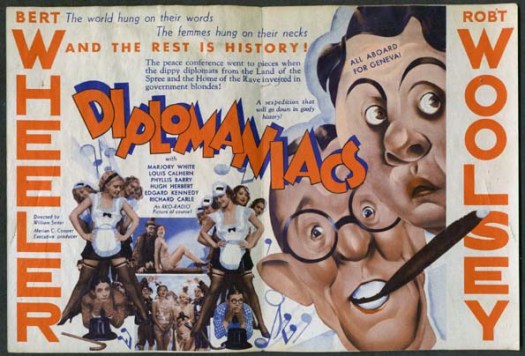
Pre-Code Confidential #21: Wheeler & Woosley in DIPLOMANIACS (RKO 1933)


gary loggins's avatarcracked rear viewer

Political satire in film ran rampant during the Pre-Code Era. Somewhere between W.C. Fields’s MILLION DOLLAR LEGS and the Marx Brothers’ DUCK SOUP  sits DIPLOMANIACS, Wheeler & Woolsey’s madcap take on war and peace, 1930’s style. It’s purely preposterous, unadulterated farce, and is guaranteed to offend someone, if not everyone.

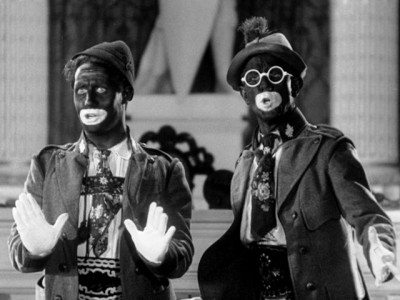
Let’s get it out of the way right now: DIPLOMANIACS is not politically correct in any way, shape, or form. It’s loaded with racist stereotypes, casting Hugh Herbert as a not-so-wise Chinaman (“It is written that it is written that it is written that it is written”), lambastes Jews, Native Americans, and homosexuals, and portrays women as sex objects (spy Marjorie White is delivered in plastic wrap). A bomb tossed into the peace talks causes everyone to turn blackface, leading to a prolonged minstrel number! If you’re already offended, stop reading… but if you can take the heat, by all…

View original post 476 more words

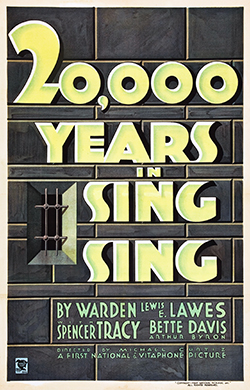
Lisa Cleans Out Her DVR: 20,000 Years in Sing Sing (dir by Michael Curtiz)


(I am currently in the process of cleaning out my DVR.  I recorded the 1932 film, 20,000 Years In Sing Sing, off of TCM on January 31st.)

I was somewhat surprised to discover that I had this 1930s prison film on my DVR.  I’m not sure what led to me deciding to record it though, if I had to guess, I’d say that it was probably the title.  I probably assumed it was about a prisoner who served a 20,000 year sentence.  I mean, that sounds interesting, right?

It turns out I was wrong though.  The film starts with a shot of a line of prisoners walking into a prison, with their sentence superimposed over their heads.  One guy is in for 7 years.  Someone else has a 50 year sentence.  Another person has a 33 year sentence.  I’m guessing that if you added all of the sentence up, you would end up with 20,000 years.

That’s a lot of angry men, all trapped in one location.  Fortunately, Sing Sing Prison has a compassionate warden.  Paul Long (Arthur Byron) is a good man, a criminal justice reformer who believe that prison should be about more than punishment.  He is tough but fair and he runs his prison on the honor system.  Break the rules and you’ll be tossed into solitary.  Respect the rules and the Warden might even let you leave the prison for a day or two.  The press and the bureaucrats may think that Warden Long is naive but prison guards love him.  “We’re behind you,” the head guard says when it appears that Long might be about to lose his job.  And the prisoners respect him, even if few of them are willing to admit it.

Tommy Connors (Spencer Tracy) is the newest prisoner.  He’s been sentenced to 5 to 30 years for robbery and assault with a deadly weapon.  Tommy’s a tough guy, the type who speaks in the rat-a-tat manner that will be familiar to anyone who has ever watched a 30s gangster film.  He’s a tough guy so he ends every sentence with “see?,” as in, “No prison is going to break me, see?” Tommy’s the type of guy who brags that, even if they send him to solitary, he can do his time standing on his head.  When he gets called into the Warden’s office, he tosses a lit cigarette on the floor.  Can the Warden reform even as rough a customer as Tommy Connors!?

It doesn’t help, of course, that Tommy has a friend named Joe Finn (Louis Calhern) and, even though Joe is on the outside, he’s constantly encouraging Tommy to break the rules.  Joe has an ulterior motive for wanting to keep Tommy in prison for as long as possible.  That motive is his desire for Fay (Bette Davis), Tommy’s loyal girlfriend.  When Fay is injured in an accident, the Warden agrees to let Tommy visit her on the condition that Tommy return in 24 hours.  However, when Tommy’s visit leads to murder, the Warden is blamed.  It gets even worse when the Warden announces that he is sure that, despite the charges against him, Tommy will honor his word and return to the prison.

Will Tommy do the right thing?  Or will he flee and destroy the Warden’s career?

20,000 Years in Sing Sing was produced by Warner Bros and it features the studio’s typical pre-code combination of a B-movie action and progressive politics.  Seen today, it’s a watchable but minor film, one that often seems dated in its view of criminal behavior.  (Even I, a huge believer in the need for criminal justice reform, thought the warden was being incredibly naive when he put the convicts on the honor system.)  That said, it’s always interesting to see Bette Davis in the days before she became the Bette Davis and was just another ingenue trying to make an impression while surviving the studio system.  As well, since Spencer Tracy eventually became best known for portraying wise, plainspoken men, it’s interesting to see him playing the cocky and disrespectful Tommy.

Still, I think there is a place for a movie about someone spending 20,000 Years in Sing Sing.

(I imagine that, after the first 10,000 years, it gets easier.)


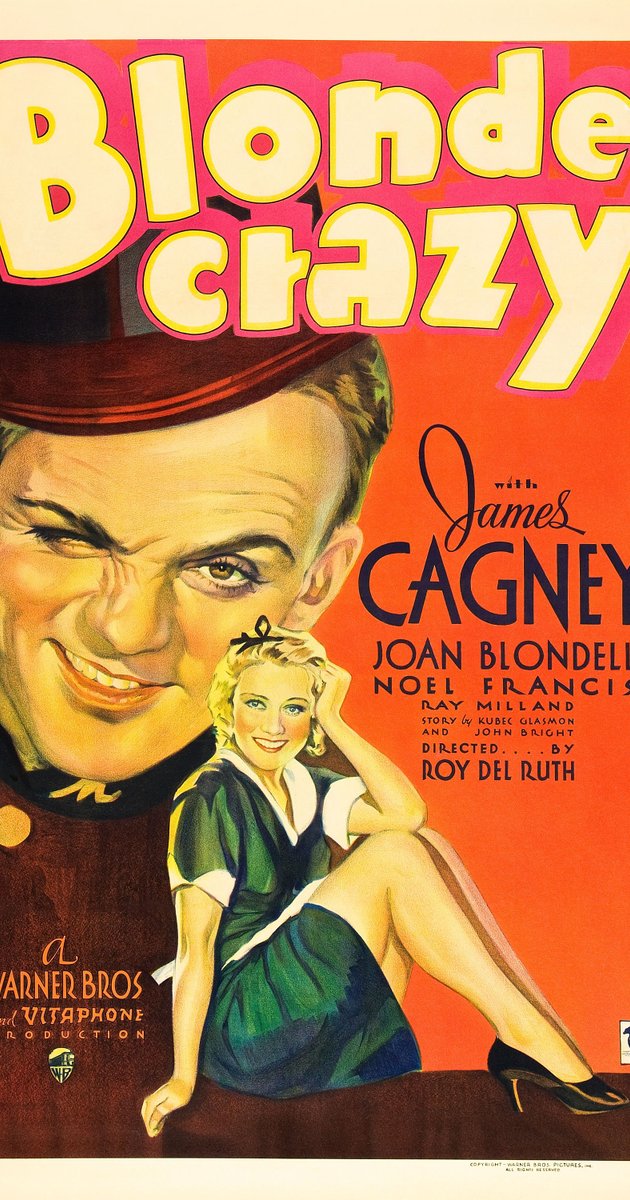
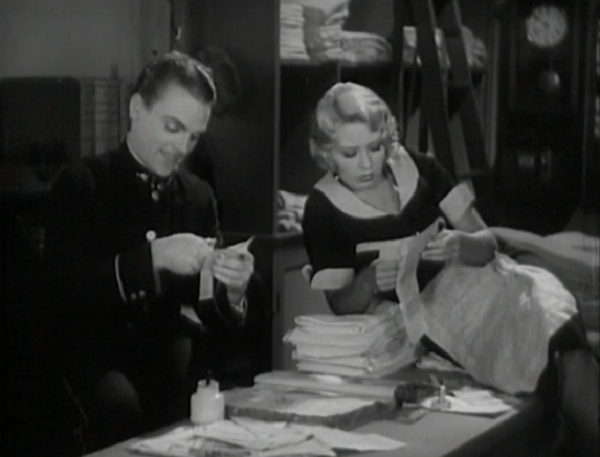
Pre Code Confidential #9: James Cagney in BLONDE CRAZY (Warner Brothers 1931)


gary loggins's avatarcracked rear viewer

blcr1

When James Cagney burst onto the screen like a machine gun barrage in 1931’s THE PUBLIC ENEMY, a star was immediately born. His rough-and-tumble personality was perfectly suited to films of the era, and he’s given a good showcase in BLONDE CRAZY, along with Pre-Code cutie Joan Blondell , who could dish it out with the best of them. Though it’s a little creaky in spots, BLONDE CRAZY is tons of fun, and Cagney gives everybody a lesson in what being a movie star is all about.

jnj2

Cagney plays Bert Harris, a bantamweight bellboy looking to make a fast buck during the Depression running crap games and selling bootleg hootch. When he first meets blonde Anne Roberts (our girl Joan) he ogles her body lecherously, and we know right from the get-go what his intentions are! But Ann’s no sucker, she a been-around-the-block kinda gal, and soon this dynamic duo are…

View original post 527 more words

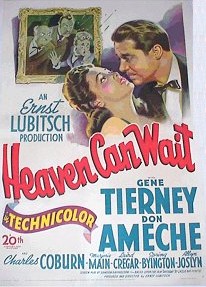
Cleaning Out The DVR #33: Heaven Can Wait (dir by Ernst Lubitsch)


(For those following at home, Lisa is attempting to clean out her DVR by watching and reviewing 38 films by the end of today!!!!!  Will she make it?  Keep following the site to find out!)

Heavencwaitposter

The 1943 film Heaven Can Wait opens with a 70 year-old man named Henry Van Cleve (Don Ameche) stepping into an opulent drawing room and having a conversation with a refined but menacing man known as His Excellency (Laird Cregar).  From their conversation, it quickly becomes obvious that Henry has recently died and His Excellency is in charge of Hell.  Most people who come to see His Excellency do so because they want to argue that they do not belong in Hell and they usually end up falling through a convenient trap door.  However, Henry is there to argue that, after living an enjoyable but dissolute life, he belongs in Hell.

Henry tells the story of his life.  He tells how he was born into great wealth and influenced by his down-to-Earth grandfather (Charles Coburn).  As a young man, he spent most of his time chasing after showgirls bur eventually, he met the beautiful and kind-hearted Martha (Gene Tierney).  He immediately fell in love with Martha but, unfortunately for him, she was engaged to his cousin (Allyn Joslyn).  Henry, however, used his considerable charm to convince her to elope with him.

(It helps, of course, that Henry’s cousin was totally and completely obnoxious, in the way that rival suitors often are in films like this.)

And, for 25 years, Henry was happy with Martha.  It took him a while to settle down and, at one point, Martha even left him as a result of his affairs.  However, they always got back together and Henry eventually did settle down, even going so far as to prevent his son from running off with a showgirl of his own.  It was only after Martha herself died that Henry, who always felt he didn’t deserve her love, returned to his old ways.

And, Henry argues, it’s because he was unworthy of his wife that he deserves to spend an eternity in Hell.  Does His Excellency agree?

Well, it would certainly be a depressing movie if he did.

One of the great things about TCM’s 31 Days of Oscar is that it gave me a chance to discover several films from director Ernst Lubitsch, films like The Smiling Lieutenant, The Love Parade, Ninotchka, and Heaven Can Wait.  Of those four Lubitsch films, Heaven Can Wait is probably the least substantial but it’s still an undeniably entertaining and nicely romantic film.  This is one of those films that you watch because the sets look wonderful, the costumes are to die for, and the performers are all pleasant to watch.  It’s pure entertainment, a crowd-pleaser in the best sense of the word.

In fact, tt was such a crowd-pleaser that it was nominated for best picture of the year.  However, it lost to the ultimate crowd-pleaser, Casablanca.

Back to School #3: Blackboard Jungle (dir by Richard Brooks)


http://www.youtube.com/watch?v=HA0_NRjx9KQ

You really can’t write about high school films without writing about 1955’s Blackboard Jungle.  While the film is often cited as being the first movie to feature a rock song on its soundtrack (Bill Haley’s Rock Around The Clock is played at the opening and the end of the film), Blackboard Jungle should also be remembered for being one of the first and most influential examples of the dedicated-teacher-in-the-inner-city film genre.

Blackboard Jungle tells the story of Richard Dadier (Glenn Ford), a newly hired teacher at an inner city high school.  As soon as he arrives for his first day at work, he meets his co-workers.  Josh Edwards (Richard Kiley) is another new teacher and is convinced that he can reach the students by talking to them about his valuable collection of jazz records. Mr. Murdock (Louis Calhern) is a burned out old cynic who believes that none of the students at the school have a future.  As Dadier quickly discovers, most of his fellow teachers have more in common with Murdock than with either him or Josh.

At first, Dadier struggles to reach his students, the majority of whom don’t see why they should waste their time in English class.  The head troublemaker, psychotic Artie West (Vic Morrow) sees the new teacher as being a rival and Dadier’s attempts to reach another student, Gregory Miller (Sidney Poitier), are made difficult by the racial animosity that dominates the entire high school.  Soon, Dadier is being targeted by his students and his pregnant wife (Anne Francis) starts to receive anonymous letters that imply that Dadier is having an affair.  It all leads to a violent classroom confrontation in which Dadier’s students are finally forced to pick a side in the battle between the forces of education and the forces of chaos.  (If that sounds melodramatic — well, it is kinda.)

It’s a little bit difficult to judge a film like Blackboard Jungle today.  We have seen so many movies about idealistic young teachers trying to make a difference in the inner city that it’s pretty easy to guess most of what is going to happen here.  In order to appreciate Blackboard Jungle, it’s necessary to understand that the only reason why it occasionally seems predictable is because it’s such an incredibly influential film.  And there are still moments in Blackboard Jungle that can take the viewer by surprise.  The scene in which Ford lists off all of the racial slurs that he doesn’t want to hear is just one example.  It’s hard to imagine that scene appearing in a movie made today.  (If it did, it would probably be played for laughs.)

That said, the performances in the film hold up surprisingly well.  Glenn Ford is a compelling hero and he and Anne Francis make for a likable couple.  Despite being 28 years old and having already played several adult roles, Sidney Poitier is a convincing high school student and, not surprisingly, he makes for a convincing leader.  However, for me, the film was dominated by Vic Morrow.

As played by Morrow, Artie Turner is a truly frightening villain.  In previous films about juvenile delinquency, the emphasis was always put on why the delinquent went bad and usually, the blame was put not on the teenager but instead on the environment around him.  He had bad parents or maybe he listened to too much jazz but, ultimately, he was not lost.  He was merely damaged.  However, Artie Turner has no convenient excuses for his behavior.  His parents go unmentioned.  When he’s exposed to jazz, he responds by breaking all of Mr. Edwards’ records.  Among all of Dadier’s students, Artie is unique in that he cannot be reached.  He’s a force of pure destruction and ultimately, Dadier’s success as a teacher depends less on reaching Artie and more on convincing his other students to reject Artie as a role model.

Blackboard Jungle may be a film that feels very familiar but it’s still one worth watching.

Artie Turner Acting Out

Artie Turner Acting Out


Lisa Marie Does Julius Caesar (dir. by Joseph L. Mankiewicz)


As some of you may know, I’ve spent the past two years on a mission.  It is my goal to eventually see and review every single film that has ever been nominated for best picture.  After taking a few months off, I am now ready to continue that quest.  For that reason, I recently sat down and watched the 1953 best picture nominee Julius Caesar.

Julius Caesar is an adaptation of William Shakespeare’s classic play about political intrigue, assassination, and demagoguery in ancient Rome.  (Technically, what follows is full of spoilers but come on, people — it’s Shakespeare!)  The citizens of Rome love their leader, Julius Caesar (played here by a very imperial Louis Calhern) but a group of senators led by Cassius (John Gielgud) fears that Caesar’s popularity will lead to the collapse of the Roman Republic.  Cassius recruits Caesar’s close friend Brutus (James Mason) into a conspiracy to assassinate Caesar on the Ides of March.  However, once the deed has been done and Brutus has explained the motives behind the assassination to the Roman public, the previously underestimated Mark Antony (Marlon Brando) delivers his famous “Lend me your ears!” speech and soon, the people of Rome turn against the conspirators.  In the end, the conspiracy’s efforts to save the Roman Republic instead leads to the birth of the Roman Empire.

Speaking as someone who loves both Shakespeare and history, it was an interesting experience to watch this particular version of Julius Caesar.  As directed by Joseph L. Mankiewicz (who later revisited the material in the infamous 1963 Best Picture nominee Cleopatra), Julius Caesar present a very traditional (and occasionally stagey) interpretation of Shakespeare’s play.  However, by this point, we’ve become so used to Shakespeare being presented with a gimmick (like modern-day costumes, for instance) that the traditional approach almost feels like something new and unexpected.  That said, Julius Caesar is definitely not the Shakespearean film to show to your friends who stubbornly insist that Shakespeare is boring or impossible to follow.  Julius Caesar was obviously made by people who appreciate Shakespeare and that remains the film’s best audience.  

When Julius Caesar was first released in 1953, it received a lot of attention because of the casting of Marlon Brando as Mark Antony.  An outspoken method actor who had been nicknamed “the mumbler” precisely because of his own internalized style of acting, Brando was considered to be too contemporary of an actor to be an effective Shakespearean.  Once the film was released, critics agreed that Brando had proven that, even while mumbling, he made for an electrifying Mark Antony and that, despite only having a few scenes, his charismatic presence dominated the entire film.  Out of an impressive cast, Brando received the film’s only nomination for acting.

It is true that, even when seen today, Brando does dominate the entire film.  He delivery of Mark Antony’s famous oration over Caesar’s bloody corpse remains one of the best Shakespearean performances to have ever been preserved on film.  It’s odd to watch this young, sexy, and energetic Brando and compare him to the legendary eccentric that we all usually think of whenever we hear the man’s name. 

That said, Brando’s performance would not be half as effective if it wasn’t surrounded by the more traditional (but no less compelling) performances of James Mason and John Gielgud.  Mason brings a brooding intensity to the role of Brutus and Gielgud is the Cassius by which all future Cassiuses must be judged.  Their performances might not be as flamboyant as Brando’s but they’re no less important.  Ultimately, the clash between the acting style of Brando and the styles of Gielgud and Mason nicely parallel the conflict over the future of the Roman Republic.

Julius Caesar won the Oscar for best art design and was nominated for picture, actor, cinematography, and original score.  Brando lost the award for best actor to Stalag 17’s William Holdenwhile the Oscar for best picture of 1953 went to a far more contemporary film, From Here To Eternity.  Brando, however, would win best actor the next year for his performance in On The Waterfront.