COLD SWEAT (1970) – starring Charles Bronson’s biceps!


Charles Bronson plays a boat captain named Joe Martin who seems be living the good life in the south of France.  He has a great job renting out boats to tourists!  He has great luck beating his friends out of big stacks of cash in poker.  He has a beautiful wife (Liv Ullman), and most importantly, he has about the biggest biceps I’ve seen in a movie not starring Arnold Schwarzenegger.  This idyllic existence falls apart when some men from his past show up and force him to use his boat to help them smuggle drugs.  It seems these guys feel like Martin owes them something since they had to go to prison for killing a cop, while ace driver Martin, escaped.  As you might expect, nobody’s plans go as expected and much action ensues!

The first thing that stands out in this film is the cast, that includes James Mason, Liv Ullman, Michael Constantin, and Jill Ireland.  Bronson’s European films uniformly had tremendous casts and this one is no different.  Even with these well known actors, Jean Topart as the villainous Katanga, is a real standout.  Second, this is the first of three films that Bronson completed with director Terence Young, who is most famous for kicking off the James Bond franchise with DR. NO, THUNDERBALL, and FROM RUSSIA WITH LOVE.  Young knows how to stage action scenes, and with the help of famous French stuntman Remy Julienne, the two men cook up some impressive car stunts and chase sequences.  Finally, Bronson himself exudes charisma and is in maximum physical condition in this film.  In a career defined largely by his supreme conditioning, this may be Bronson’s most impressive physical performance.

Charles Bronson became an international superstar when he went to Europe in 1968, where he made a series of good films with great international casts. COLD SWEAT doesn’t come together quite as well as some of his other European films like RIDER ON THE RAIN, VIOLENT CITY & RED SUN, but it’s still a fun film with good action sequences and an impressively pumped up Charles Bronson. And the film has never looked better. After decades of shabby VHS and DVD copies, Kino Lorber put out a very nice blu ray in 2019. It’s nice seeing the movie in such a high quality presentation.

Check out the trailer for COLD SWEAT below:

Film Review: Lost Horizon (dir by Charles Jarrott)


“Friends forever.  It’s a nice idea.”

With those words, the late Casey Kasem closed out the infamous “Rockumentary” episode of Saved By The Bell.  In this episode, Zack Morris fell asleep in his garage while waiting for his high school friends to arrive for band rehearsal.  While he was asleep, he dreamt about becoming a superstar as the result of Zack Attack’s hit song, Friends Forever.  Later, of course, Zack was led astray by a publicist who tried to sell him as being a “male Madonna.”  Zack didn’t care about the fame.  He was more concerned that the music and the lights at his concert were so excessive that the audience couldn’t even hear his lyrics.  Because, seriously, when you’re coming up with banger lyrics like “We’ll be friends forever/yes we will,” you want to make sure that they can clearly be heard.

It’s easy to make fun of the band and the show but that doesn’t make Casey Kasem’s words any less true.  Friends forever.  It is a nice idea.  It’s also a totally unrealistic and implausible idea.  People grow apart.  People develop new interests.  People move to different towns.  Sometimes, people just decided that they need to take a little break from the same old thing.  Instead of demanding that people remain friends forever, it would perhaps be more realistic to encourage people to enjoy and treasure the time that they have in the present.  But, to be honest, entertainment is not about that type of reality.  No one wants to hear, “Be friends until you get bored.”  Instead, they want to hear “Friends forever!”  It’s a simple idea and the simple ideas are the ones that usually bring us the most comfort.

Take the idea behind Shangri-La, for instance.  Shangri-La was a utopia that was hidden away in the Himalayas.  It was a place where there was no war, no greed, and everyone was in nearly perfect health.  It was a place where it was common for people to live to be well over a hundred years old.  It’s a place where people literally can be friends forever.  And while the place does have one very big drawback — i.e., once you decide to stay there, you can’t return to the outside world for even so much as a brief visit — it’s still easy to see why this idealized existence would appeal to many people.

The lamasery of Shangri-La was first introduced in a 1933 novel called Lost Horizon.  Written by James Hilton, Lost Horizon told the story of a group of westerners who, fleeing from a political uprising in India, find themselves in Shangri-La.  That the novel’s portrayal of a peaceful utopia hidden away from the “modern world” proved to be popular should not come as a surprise.  In 1933, the world was still recovering from the Great War.  Much of Europe was still in ruins, both economically and physically.  The combination of the First World War and the Spanish Flu pandemic had shaken everyone’s faith in the future.  Even as a group of idealistic activists, industrialists, and politicians tried to make war illegal, Mussolini seized power in Italy.  Spain was on the verge of civil war.  In Germany, a fanatical anti-Semite named Adolf Hitler had managed to move from being a fringe politician to being named chancellor.  The U.S. was suffering from the Great Depression.  Even the UK was so mired in political turmoil that it was no longer a reliable bulwark against chaos.  To the readers who were having to deal with all of that on a daily basis, the idea of Shangri-La was an inviting one.

(One of those readers was Franklin D. Roosevelt, who named his presidential retreat Shangri-La.  Years later, Dwight Eisenhower would rename Shangri-La after his son and it’s remained Camp David ever since.)

Not surprisingly, the book’s success led to it being adapted for the movies.  Frank Capra took the first crack at it, release his film version in 1937.  At the time, Capra’s adaptation was the most expensive film to have ever come out of Hollywood.  (It cost $1.6 million dollars!)  It also underperformed at the box office, nearly bankrupting Colombia Pictures.  Even though the film itself was nominated for Best Picture of the year, it still took five years for the film to earn back its cost.  Because Colombia edited the film to shorten its lengthy running time, Capra sued the studio and the end result was that everyone involved lost a good deal of money.  Considering all of the bad luck that befell the first production, one might wonder why Hollywood would even risk making a second version of the film.  And indeed, it would be several decades before any major studio attempted to bring Hilton’s novel back to the screen, despite the fact that the idea behind Shangri-La was probably looking more attractive with each crisis-filled day.

Ross Hunter

In 1973, producer Ross Hunter was sleeping on a mountain of cash.  Well, perhaps he wasn’t but a look at some of the films that he had produced would definitely suggest that he could have if he had so chosen.  Hunter started his career producing melodramas that starred Rock Hudson and were often directed by Douglas Sirk.  He was the type of producer who understood that importance of glitz and glamour, especially with the film industry facing a new competitor named television.  In the 60s, he made films that were totally out-of-touch with the turmoil of the decade but which still appealed to middle-aged viewers who wanted an escape from the hippies and the assassins.  In 1970, he scored his biggest hit of all time when he produced Airport.  As dull as that film seems to us today, it was the biggest hit of 1970 and it also gave birth to the disaster genre.  (It was also the only Ross Hunter production to be nominated for Best Picture.)

It was after the success of Airport that Ross Hunter decided to produce a remake of Lost Horizon.  Following the approach that he used in Airport he gathered an all-star cast.  In fact, George Kennedy appeared in both Airport and Lost Horizon!  Joining Kennedy were Oscar nominees Sally Kellerman, John Gielgud, Charles Boyer, Peter Finch, and Liv Ullmann.  Michael York, fresh off of Cabaret, and Olivia Hussey, who was best-known for playing Juliet in the wildly successful 1968 version of Romeo and Juliet, were cast as rebellious lovers who tried to escape the paradise of Shangri-La.  Larry Kramer, the future playwright and political activist, was hired to write the script.  Charles Jarrott, who specialized in big, glossy films and who had been nominated for Best Director for his work on Anne of a Thousand Days, was brought in to direct.  And Burt Bacharach was enlisted to write the song because, on top of being a literary adaptation with an all-star cast, Lost Horizon was also going to be a musical.

What could go wrong?

What indeed.

The 1973 version of Lost Horizon opens with an endless aerial view of the Himalayas.  In the background, singers sing about peace and love.  “There’s a lost horizon/waiting to be found/where the sound of guns/don’t pound in your ears/anymore,” the singers repeat several times, as if to hammer home the fact that the audience is not about to get Burt Bacharach at his best.

When the opening credits finally end, we find ourselves at an airport.  A very non-musical protest has broken out.  The characters in the film describe it as a revolution but instead, it just looks like a bunch of confused extras standing on a landing strip.  When it comes to an epic film like this, it’s always a good idea to see what the extras are doing.  In a good film, the extras will actually be a part of the world onscreen and you won’t even think of them as being a crowd of paid performers.  In a bad film, like this one, they’ll all stand around in a perfectly organized group and they’ll all do the exact the same thing at the same time, like shaking their fists at a plane.

Despite all of the “drama” at the airport, one airplane does manage to take off.  On the plane are the Conways, diplomat Richard (Peter Finch) and his younger brother, George (Michael York, whose blond prettiness suggests that there’s not a chance he could share any DNA with the much more rough-hewn Peter Finch).  There’s also a Newsweek photographer named Sally Hughes (Sally Kellerman), who pops pills and who suffers from a pronounced case of ennui.  She describes her job as “taking pictures of the headless so that people with heads can look at them in magazines while getting their hair done.”  (Damn, Newsweek apparently used to be  really messed up publication!)  Sam Cornelius (George Kennedy) is an engineer and an embezzler.  And finally, there’s Harry Lovett (Bobby Van), who introduces himself to everyone as being “Harry Lovett, the comedian.”  Harry was playing an USO show when the revolution broke out and apparently, he was abandoned in the country because his act was so bad.  Is the film suggesting that, in 1973, the United States would actually abandon a citizen in a dangerous, war-torn country?  I hope someone impeaches that President Nixon!

Our heroes may think that they’re escaping to freedom but it turns out that the plane is actually being hijacked!  One thing leads to another and eventually, as happens in all good musicals, the plane cashes in a remote area of the Himalayas.  At first, it seems like our heroes are done for but, fortunately, they’re discovered by Chang (the very British John Gielgud) and a group of Shangri-La monks.  Chang leads the party through the snowy mountains and eventually, they arrive at what appears to be a Disney resort but what we’re told is actually Shangri-La, a tropical paradise that sits in the middle of one of the most dangerous places on Earth!

Shangri-La has something for everyone:

Sally gets off drugs and discovers a library that, oddly enough, has every book ever written even though no one knows where Shangri-La is, none of the inhabitants can leave the area without running the risk of rapidly again, and Amazon wasn’t a thing in 1973.

Sam discovers a gold mine but, realizing that money doesn’t matter, he instead uses his engineering skills to help out the farmers of Shangri-La.  It really didn’t appear that the farmers of Shangri-La needed any help but whatever, I guess.  As long as Sam is happy.

Harry Lovett becomes a big star as the children of Shangri-La love his comedy.  Children are well-known for their lack of taste when it comes to comedy.

Richard not only falls in love with the local teacher (Ingmar Bergman’s muse, Liv Ullman) but he also meets the High Lama (the very French Charles Boyer).  It turns out that the High Lama is finally going to die and that he’s determined that Richard is the man who is destined to take over Shangri-Law, despite the fact that Richard has only recently arrived and isn’t even a Buddhist.

In fact, almost everyone is so happy that they start to sing and dance!  It takes 50 minutes for the film to reach its first big musical number.  Unfortunately, there’s a reason why most successful film musicals open with a big number instead of holding off on it.  It’s important to, early on, get the audience used to the idea that they’re watching a film set in a world where it’s perfectly common for people to break out into song.  From West Side Story to La La Land, good musicals have understood the importance of bringing the audience in early.  Lost Horizon waits until everyone has gotten used to the film being a somewhat rudimentary adventure/disaster film before suddenly springing the singing and the dancing on everyone.  It’s a bit jarring.  It wouldn’t matter, of course, if the songs were any good but again, this was not Burt Bacharach’s finest moment.

Unfortunately, one member of the group doesn’t want to stay in Shangri-La and dance and sing.  George Conway does not want to be friends forever.  Instead, he’s fallen in love with the local librarian, Maria (Olivia Hussey).  Maria dreams of seeing New York and London.  George is determined to grant her wish, despite being told that Maria is nearly as old as John Gielgud and will start to age as soon as she leaves Shangri-La.  Richard feels an obligation to accompany his brother.  Needless to say, things don’t go well.  (As Michael York would later put it himself, “There is noooo sanctuary….”)  Will Richard be able to find his way back to Shangri-La?

“Let’s not go to Camelot, ’tis a silly place,” King Arthur famously declared in Monty Python and the Holy Grail.  Lost Horizon suffers the opposite problem.  While Lost Horizon’s Shangri-La is occasionally a silly place, it’s usually just an incredibly boring place.  One can’t help but feel that Maria has a point, regardless how much time Sally spends singing about her hatred of the New York night life.  The film’s downfall is that it argues for Shangri-La being viewed an ideal without making Shangri-La into any place that you would want to visit.  Add in the anemic songs and the confused performances and Charles Jarrot’s inability to maintain any sort of compelling pace and you have a film that’s too dull to really even qualify as a fun bad film.  It’s just bad.

That said, much like friends forever, Shangri-La is a nice idea.

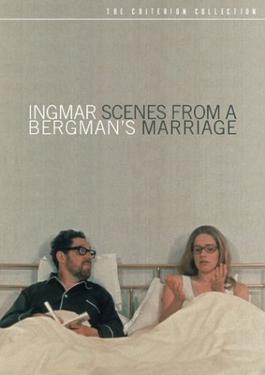
Love on the Shattered Lens: Scenes From A Marriage (dir by Ingmar Bergman)


http://www.youtube.com/watch?v=K6qrTm_-U9Y

The 1973 film, Scenes From A Marriage, is a real endurance test.

That, in itself, shouldn’t be surprising.  It’s an Ingmar Bergman film, after all.  Bergman was one of the world’s great directors but the majority of his films did not exactly focus on happy themes.  Scenes From A Marriage is a nearly three-hour film in which two people — who start out as married and eventually end up as divorced — talk and talk and talk and talk.  They talk about work.  They talk about their relationship.  They talk about their married friends who are trapped in a loveless marriage.  They talk about their unsatisfactory sex life.  They occasionally mention their never-seen daughter.  The conversations are usually friendly and semi-affectionate but there’s a hint of tension running through every single one of them.  Whenever this couple talks about anything, it’s under a cloud of disatisaction and repressed anger.  Violence always seems like it could break out at any time and, at one point, it does.  (Of course, if 167 minutes seems like a long time to watch a marriage collapse, just consider that the film was an edited version of a four-and-a-half hour miniseries that originally aired on Swedish television.)

Scenes From A Marriage is regularly cited as being one of the best films about marriage ever made and also as one Bergman’s best films.  Personally, I think it’s a bit overrated but still, no one can deny the skill with which the film was made.  Though it may ultimately just be a reflection of the film’s roots as a television series, the film is full of probing close-ups.  When Marianne (Liv Ullmann) and Johan (Erland Josephson) discuss their life, the camera gives them no escape.  There’s no sudden jump cuts or fade outs to bring the conversation to an end and, as talky as the film may be, the awkward silences often tell us even more about what’s going on between these two.  Ullmann and Josephson both give excellent performances.  There’s an honesty to their anger and their disillusionment that will often leave you cringing but unable to look away.  When Marianne and Johan discuss why they’ve never had a satisfactory sex life, it’s a crushingly honest scene and neither Ullmann nor Josephson hold anything back.  When one of their conversations suddenly erupts into a violent fight, it’s scary, heart-breaking, and expected all at the same time.  We’ve spent so much time with these two characters that we feel as if we know them.  We can see what’s coming, even if they can’t.

If I’m not as enthusiastic for Scenes From A Marriage as some, it’s because I didn’t particularly like either Marianne or Johan.  I understood them.  I felt as if I knew them.  By the end of the film’s first scene, I could confidently tell you that Johan would probably vote for Mike Bloomberg while Marianne would send money to both Elizabeth Warren and Amy Klobuchar while joking about how, if it was good enough for The New York Times, it was good enough for her.  But ultimately, both Johan and Marianne come across as being a bit too smug and safely bourgeois, even after they realize that they’re “perfect” marriage isn’t perfect at all.  This is actually something that I’ve noticed about most films about divorce.  It’s rare that you ever seen a film centered around a working class divorce.  Instead, it’s almost always the members of the middle and upper classes, people who are relatively stable financially and who have a support system of liberal and sophisticated friends and family to fall back on.  In films like this, divorce is an issue where the concerns and sufferings are almost exclusively emotional.  I think a lot of this is because most films about divorce are made by directors who have just gone through their own divorce and they basically end up telling their own side of the story under the guise of fiction.  Ingmar Bergman admitted as much when he said that Scenes From A Marriage was based on both his two failed marriages and his own relationship with Ullman.  (Just last year, we had another example of this with Noah Baumbach’s Marriage Story, a film that owes more than a little debt to Bergman’s film.)   For all of the film’s technical skill and good performances, Scenes From A Marriage is still just two and a half hours of watching two less than likable people get a divorce.  By the end of the film, you’re just happy to be away from them.

International Horror Film Review: Hour of the Wolf (dir by Ingmar Bergman)


An Ingmar Bergman horror film?

Indeed.  Despite the fact that Bergman’s bleak imagery and existential themes undoubtedly influenced any number of horror filmmakers (Wes Craven’s Last House On The Left was essentially a remake of Bergman’s The Virgin Spring), the 1968 film, Hour Of The Wolf was Ingmar Bergman’s only official horror film.

Of course, it’s also an Ingmar Bergman film, which means that it’s also a meditation on relationships, regret, the difficult of ever knowing what’s truly going on inside someone else’s head, and the artificiality of the artistic process.  It tells the story of a painter named Johan Borg (Max Von Sydow) and his pregnant wife, Alma (Liv Ullman) and their life on an isolated island.  Alma is worried about Johan’s feelings towards his former muse and ex-lover, Veronica Vogler.  Johan is haunted by nightmarish visions of menacing figures and the feelings that demons are pursuing him.

The film opens with a title card, informing us that the story that we’re about to see is true and that it’s an attempt to reconstruct the final days of Johan’s life before his mysterious disappearance.  Of course, as anyone who has seen enough found footage films can tell you, the title card is a lie and there never was a painter named Johan Borg, or at least not one who mysteriously vanished while living in an isolated house on an island.  Instead of being meant to convince us that we’re about to see a true story, the title card instead establishes that what we’re about to see can be considered to almost be a dark fairy tale.  The title card is the film’s way of saying, “Once Upon A Time…..”  It’s also a reminder that most fairy tales are considerably more grim than what those of us raised on Disney might expect.

(No coincidentally, the title Hour of the Wolf came from Swedish folk lore.  The Hour of the Wolf is the time between 3 and 5 in the morning, during which it is said that most births and deaths occur.)

While the opening credits flash by on a dark screen, we hear the sounds of men working and anyone who has any experience in theater will immediately realize that we’re listening to a set being built.  As the opening credits come to an end, we hear Bergman shouting out, “Action!”  Our next shot is Alma standing outside of the house that she shared with Johan.  Alma looks straight at the camera as she tells us that she still doesn’t know what happened to Johan.  She tells the unseen Bergman that she’s revealed to him everything that she knows.

It’s an interesting opening, one that reminds the audience that what they’re seeing is merely a recreation of what might have happened on Johan and Alma.  When Alma speaks to Bergman, there’s an interesting subtext to her words and her tone and one gets the feeling that Alma and the director are meant to have a history of their own.  It’s almost as if the film is saying that the story’s meaning can only be found in what we can’t see, in what’s going on behind the camera.  That seems especially true when you consider that, when Hour of the Wolf was filmed, Liv Ullman, who played the pregnant Alma, actually was pregnant with Bergman’s child and that Bergman himself later said that Johan Borg’s nightmares were recreations of Bergman’s own nightmares.  It’s perhaps a little too easy to imagine that the demons that inspire Johan’s art are the same demons that inspired Bergman’s films and that this film is both an apology to Ullman for his own neurotic tendencies and a tribute to her willingness to put up with him.

Hour of the Wolf is a bleakly effective film, one that works as both a dissection of an unstable relationship and a portrait of a man who may be losing his mind.  Von Sydow plays the haunted Johan as a charismatic but introverted artist, a troubled individual who can only truly express what’s happening in his mind through his art.  Indeed, Johan’s tragedy seems to be that the joy he gets from creating can only come from the pain that he suffers from imagining and dreaming.  Ullman is heart-breaking as she tries to keep her husband from succumbing to his own darkness while, at the same time, trying not to get sucked into the darkness herself.  About halfway through the film, Johan confesses to committing a shocking crime and, like Alma, you don’t know whether to believe him or to believe that he’s reached the point where he can’t tell the difference between reality and his nightmares.  Ullman plays the scene with the perfect combination of fear and sadness, sympathy and revulsion.  As for Von Sydow, he brings to life both the natural arrogance of an artist and the terror of someone who suspects that he has no control over his own existence.

Visually, this film is bleak by even the standards of Bergman.  The black-and-white cinematography plays up not just the shadows of the night but also the brutal desolation of Johan and Alma’s life on the island.  It reminds us that Johan is an artist living in a world without color.  Bergman views Johan and Alma through a detached lens, recording the collapse of their lives but, at the same time, keeping his distance as if to protect the audience from getting trapped inside of Johan’s madness.

Hour of the Wolf may have been Ingmar Bergman’s only official horror film but it’s definitely an effective thriller, one that manages to explore both Bergman’s signature themes while also keeping the audience off-balance and wondering what might be lurking in the darkness.  It may not be one of Bergman’s “best-known” films but it’s definitely one for which to keep an eye out.

Lisa Reviews An Oscar Nominee: The Emigrants (dir by Jan Troell)


(With the Oscars scheduled to be awarded on March 4th, I have decided to review at least one Oscar-nominated film a day.  These films could be nominees or they could be winners.  They could be from this year’s Oscars or they could be a previous year’s nominee!  We’ll see how things play out.  Today, I take a look at the 1972 best picture nominee, The Emigrants!)

Since I’m currently dealing with either a really bad cold or the onset of the flu (let’s hope that it’s the former), I decided that Monday would be the perfect night to stay up extremely late and watch a 190-minute Swedish movie.

The Emigrants was released in Sweden in 1971 and it received an Oscar nomination for Best Foreign Language Film.  Then, it was released in the United States in 1972 and it managed to receive four more Oscar nominations, including one for Best Picture.  The Emigrants was the third foreign language film to be nominated for Best Picture, the first film to be nominated in multiple years, and also the first Swedish film to contend for the Academy’s top prize.  (The following year, Ingmar Bergman’s Cries and Whispers would also become the second Swedish film nominated for Best Picture.)  At the same time that The Emigrants was nominated for Best Picture, its sequel, The New Land, was nominated for Best Foreign Language Film.  1972 was an interesting year.

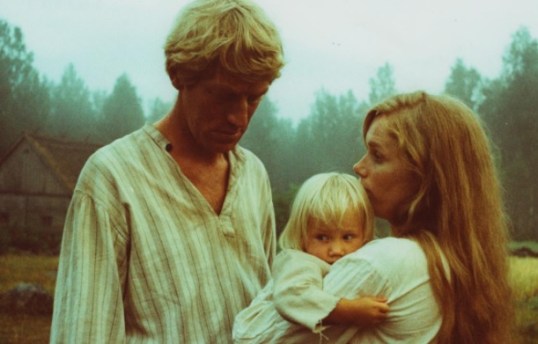
The Emigrants opens in 1844, in Sweden.  Karl Oskar (Max Von Sydow) has married Kristina (Liv Ullmann).  Like his father before him, Karl Oskar is a farmer.  It’s an exhausting life.  There is never enough food to eat.  The weather is perpetually gloomy.  The harvest is always disappointing.  As poor farmers, Karl Oskar and his family face constant prejudice.  In Sweden, the only thing more corrupt than the government is the church.  After one of his daughters starves to death, what choice does Karl Oskar and his family have other than to escape to America?

As Karl Oskar’s brother, Robert (Eddie Axberg), explains, the best rice comes from the Carolinas.  The best farmland is in America.  In America, anyone can become rich.  Anyone can walk up to the President and talk to him without running the risk of being imprisoned or executed.  (In 1844, ordinary citizens could stop by the White House and make an appointment to see the President.  This, of course, would change decades later, after a disgruntled office seeker shot President Garfield.)  In America, Robert says excitedly, no one works more than 14 hours a day!  Even slaves can own land and make their own money!

The Emigrants deals with their Karl Oskar and his family’s voyage to America.  Karl Oskar and Kristina do not travel alone.  Kristina’s uncle (Allan Edwall) is with them and hopes that, in America, he will be allowed to freely practice his religious beliefs.  A former prostitute, Ulrika (Monica Zetterlund), is also with them, hoping a new land will mean a better life for both herself and her daughter.  Even Robert’s best friend, Arvid (Pierre Lindstedt), going with them.  It’s not an easy journey.  Not everyone survives the voyage to North America but those that do soon find themselves in a young and untouched country where anything seems to be possible.

Swedish cinema has a reputation for being dark and brooding but those are two words that definitely do not apply to The Emigrants, which is about as positive a portrait of America as you could ever hope to see.  Regardless of whatever tragedy may occur during the journey, this movie leaves no doubt that the journey was more than worth it.  It unfolds at a pace that is perhaps a bit too leisurely but, at the same time, it’s also an achingly pretty movie with shots that bring to mind the best of Terrence Malick.  In fact, there are times when the film is almost too pretty.  It’s possible to get so caught up in looking at all the beauty around Karl Oskar and Kristina that you lose track of the story.  Max Von Sydow and Liv Ullmann are both achingly pretty as well and, even more importantly, they’re believable as a married couple who are often equally in love and equally annoyed with each other.

It was interesting to go from watching The Grapes of Wrath to watching The Emigrants.  If The Grapes of Wrath was an American nightmare, The Emigrants is about as pure a celebration of the American Dream as you’re going to find.  It lost the Oscar for Best Picture to a far different film about the immigrant experience in America, The Godfather.

Cleaning Out The DVR #24: Cries and Whispers (dir by Ingmar Bergman)


Cries-and-Whispers-31

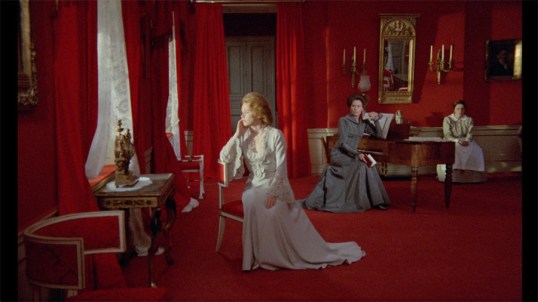
The time is the 19th century.  The country is Sweden.  The setting is a mansion that is decorated with red carpet, red walls, and almost blindly white statues.  But beyond that setting, the 1973 film Cries and Whispers is really set in the hearts and minds of four women.  One of them is selfless.  Two of them are bitter and uncaring.  And one of them is slowly dying.

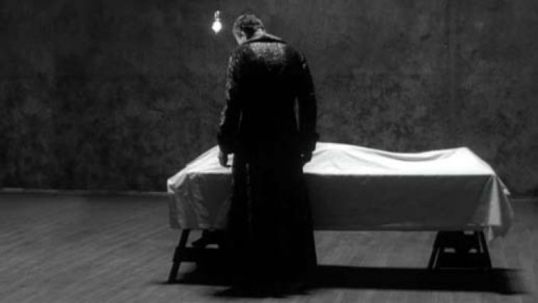
Agnes (Harriet Andersson) is the one who is dying.  She spends her time laying in bed and screaming in pain.  A doctor (Erland Josephson) provides her with no hope and can only promise that the end will come soon and a priest (Anders Ek) coldly goes about planning for her funeral and offering up empty promises of a final reward.  Occasionally, through her diary and flashbacks to her youth, we get glimpses of who Agnes was before her life become dominating by her impending death.

Agnes’s sisters have come to the house to wait out her death.  Though they’ve arrived to provide comfort, neither is capable of it.  The youngest sister, Maria (Liv Ullman), was her mother’s favorite and has grown up to be coldly self-centered.  Through flashbacks, we see the details of her affair with Agnes’s doctor.  When Maria’s husband (Henning Moritzen) reacts to her infidelity by stabbing himself, Maria can only dispassionately watch.  Meanwhile, the oldest sister, Karin (Ingrid Thulin) has grown up to be bitter and sexually repressed.  In a truly shocking scene, Karin mutilates her vagina with a shard of glass and, after smearing the blood on her face, lies in bed and smirks at her husband.

In the end, only Anna (Kari Sylwan) can provide Agnes with any comfort.  Anna is Agnes’s maid.  Deeply religious and mourning the loss of her own daughter, only Anna is willing to reach out and hold Agnes while Agnes is in pain.  And, after Agnes dies, Anna seems to be the only one who shows any real grief.

There are depressing movies and then there’s Cries and Whispers.  Cries and Whispers is such an emotionally raw and dark movie that it was difficult for me to watch.  It’s also difficult to review because just thinking about the movie brings up so many emotions.  It’s just such a well-made and extremely painful movie.

It’s also an Ingmar Bergman film and that’s fortunate because Bergman somehow had an instinct for how to keep audiences watching even when the images on screen were amazingly painful.  Visually, Cries and Whispers is as beautiful as it is thematically cold.  By emphasizing the color red (not only is the entire house decorated in red but scenes often end by fading to red as opposed to black), Bergman makes the audience feel as if they truly have been transported into the human soul.  Red, after all, is the color of blood and life.

And really, Cries and Whispers is one of those films that makes you wonder what exactly the point of life is.  While the dream-like flashbacks give us clues as to how the three sisters became who they are, they also suggest that it really doesn’t matter.  In the end, regardless of whether they’re in love or alone or happy or sad, they’re all going to die and that’s going to be it.  All stories and issues will be left unresolved.

And, in the end, the best we can hope for is that someone like Anna will mourn us.

Cries and Whispers is one of the few foreign language films to be nominated for best picture.  It’s also the only Ingmar Bergman film to be so nominated (though Bergman had more success in the Best Foreign Language Film category).  It lost to The Sting, a far happier film.

http://www.youtube.com/watch?v=6Pw7FYex5pQ