Playing Catch Up With The Films of 2017: The Boss Baby (dir by Tim McGrath)


I have to admit that The Boss Baby is an animated film that I have mixed feelings about.

Actually, that shouldn’t be surprising.  The Boss Baby is the epitome of the type of film that is disliked by critics but loved by audiences.  It got fairly dismissive reviews but it also made a ton of money and apparently, there’s a sequel in the works.

It’s a product of Dreamworks Animation, which has always basically been Pixar without the edge.  If Pixar films often seem to be about the animators working out their own personal issues through their work, the films from Dreamworks are often distinguished by just how little is actually going on beneath the surface.  If Pixar specializes in crowd pleasers that challenge you to think, Dreamworks specializes in crowd pleasers that invite you to sit back and relax.

(Of course, that’s a generalization.  Dreamworks is responsible for the Shrek films, the majority of which I absolutely love.  At the same time, as much as I love Pixar, I would warn against giving too much thought to anything in the first two Cars films.)

Anyway, The Boss Baby is the story of Ted, a little baby who wears a suit and tie and who sounds just like Alec Baldwin.  Strangely, only his older brother , Tim (Max Bakshi), appears to see anything strange about any of this.  Everyone just dismisses Tim’s concern as a product of Tim being jealous of his baby brother and, to a certain extent, they have a point.  The older children are always jealous of their younger siblings.  (Fortunately, I was the youngest of four so I never had to be jealous of anyone.)  Still, it turns out that Tim is correct about something being strange about Ted, who has actually been sent into the world on a secret mission.  Francis E. Francis (Steve Buscemi) is the CEO of Puppy Corp. and he’s conspiring to make puppies cuter than babies.  The Boss Baby has to stop him and he only has a few days to do so before he forgets how to speak and turns into an ordinary baby.

It’s a surprisingly busy plot and a lot of it feels as if it was ripped off from the Toy Story films.  Instead of talking toys, we’ve got a talking baby.  Just as Toy Story 3 featured a lengthy chase scene and a bitter villain, The Boss Baby features a lengthy chase scene and a bitter villain.  Much as how every Toy Story movie ended with a rumination on what it means to get older and grow up, The Boss Baby ends with a rumination on what it means to get older and grow up.  Many times, The Boss Baby feels like a compilation of scenes and characters lifted from other animated films.

At the same time, the idea of a baby wearing a suit and talking like a New York tough guy is undeniably cute.  I’m not the world’s biggest Alec Baldwin fan but, in this case, it’s perfect casting.  As the film itself makes clear, babies are cute.  This is especially true when they’re animated and you’re not the one who has to change their diapers or clean up after them.

There’s a thin line between keeping an audience happy and pandering and, often, The Boss Baby steps over that line.  It’s a very derivative film, one that never reaches either the comedic or the emotional highs of a good Pixar film.  However, the baby is cute and sometimes, that’s enough.


Film Review: The Girl On The Train (dir by Tate Taylor)


the-girl-on-the-train

Before I get around to talking about The Girl On The Train, I’m going to tell you a little story about myself.

A few years ago, I used to make a point of riding the DART train.  (DART stands for Dallas Area Rapid Transit.  Large sections of Upstream Color were filmed on a DART train.)  Every weekend, instead of driving out to the Dallas Angelika or the Dallas Museum of Art and contributing to climate change or whatever it was that I was supposedly doing whenever I drove my car, I would hop on the train.  It was a little inconvenient but I was saving the world.  Or something.

It was about a 30 minute ride from my local DART Station to downtown Dallas and I have to admit that I actually used to enjoy it.  I would always look out the window and watch as Dallas passed by.  I got to know all of the buildings and houses on the route pretty well.  Thanks to riding the DART train, I discovered that there’s a house on Forrest Lane that’s been boarded up for five years and counting.  Near Spring Creek, there’s a two-story house that I wouldn’t mind owning.  It’s a two-story glass house and it has a really nice deck that looks out over the creek.  I would always look at those houses and, in my mind, I would make up lurid stories about the people who lived there.  For a while, it was great fun.

(Unfortunately, it eventually stopped being fun but that’s a story that will have to wait for whenever I finally get around to reviewing Ms. 45…)

As I watched The Girl On The Train, I started to think about those times on the DART train.  And the more I thought about it, the more I realized that every story that I came up with while sitting on my DART train was a hundred times more interesting than anything that happened in The Girl On The Train.

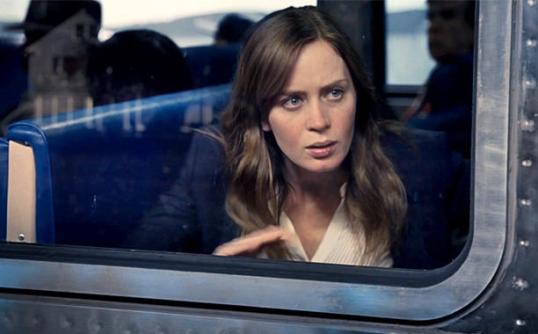
Emily Blunt stars as Rachel Watson.  Rachel is an alcoholic.  She got divorced from Tom (Justin Theroux) after she discovered that Tom was having an affair with their real estate agent, Anna Boyd (Rebecca Ferguson).  Tom and Anna are now married and have a baby.  Rachel, meanwhile, is a blackout drunk who has been unemployed for a year.  She spends her time on a train, drinking and ride back and forth between Connecticut and New York.

Every night, the train stops near Rachel’s old house.  Rachel looks out the window and she stares at her former home.  Occasionally, she sees Tom and Anna celebrating their new life.  Rachel also finds herself obsessing on the house next door.  Megan Hipwell (Haley Bennett) lives at the house and works as Tom and Anna’s nanny.  As Rachel discovers from looking out the train’s window, Megan is cheating on her husband with a mysterious, bearded man (Edgar Ramirez).

(Rachel has a really good view from her window seat.  Admittedly, I’m notoriously near-sighted so I might not be the best judge, but I could never actually see what was happening inside any of the houses that I stared at.  Rachel, however, must have super vision.  Maybe she was Supergirl before she turned into an alcoholic.  Who knows?)

One day, a drunk-off-her-ass Rachel forces her way off of the train and stumbles towards her former home.  She thinks that she sees Anna jogging and chases after her.  “Whore!” Rachel yells before passing out.  When Rachel regains consciousness, she can’t remember anything that happened.  But she has vague memories of being involved in some sort of struggle…

Eventually, Rachel learns that Megan is missing and presumed murdered.  Even worse, Rachel is the number one suspect.  The main detective (who is somewhat inevitably played by Allison Janney) suspects that Rachel mistook Megan for Anna.  It turns out that Rachel has a history of erratic behavior.  She even tried to kidnap Tom and Anna’s baby!  Seriously, lock Rachel up!

Trying to figure out what happened and clear her name, Rachel approaches Megan’s husband, Scott (Luke Evans) and pretends to be a friend of Megan’s.  It turns out that Scott was an abusive husband.  Soon, he’s both confiding in Rachel and encouraging her to start drinking again.  Rachel starts spending more and more time with Scott and it becomes obvious that she’s trying to live the life that she once imagined that Megan and Scott had.  There’s an interesting subtext to both Rachel’s obsession with Megan and her attempt to start a new relationship with Scott but it’s never really explored.  Instead, it’s brought up and then abandoned a few scenes later.

In fact, as a film, The Girl On The Train never really explores anything.  (It only grudgingly hints at the complexity of the book on which it was based.)  As opposed to similar films like Gone Girl or Denis Villeneuve’s Prisoners, there’s not much depth or insight to The Girl On The Train.  I’ve read some reviews that have complained that The Girl On The Train is “melodramatic” or “trashy,” but, if that were the case, it would at least be a fun movie to watch.  This is one of those films that thinks it’s a lot deeper than it actually is.

The Girl On The Train was probably doomed as soon as Tate Taylor was hired to direct it.  Taylor previously directed both The Help and a musical biopic called Get On Up.  Tate Taylor is one of those directors who goes out of his way not to challenge his audience (The Help is one of the most positive films about systemic racism that I’ve ever seen) but The Girl On The Train needed a director with more of a subversive edge.  The Girl On The Train needed a director who would embrace the film’s pulpy sensibility as opposed to one who would go out of his way to sand away the story’s rough edges and create an inoffensive and bland product that would be perfect for mass consumption.

And then you’ve got the film’s cast, which is full of talented performers who all seem to be uniquely uninspired by the material that they have to work with.  Emily Blunt did such good work in Looper and Sicario so why is she so boring here?  Why does Justin Theroux seem to be eagerly awaiting the end of the movie?  Why are both Haley Bennett and Rebecca Ferguson reduced to playing characters who feel as if they’ve sprung out of a misogynist’s daydream?  What is Edgar Ramirez even doing in the movie?  Or Lisa Kudrow?  Or Laura Prepon?  Why is it that every world-weary female authority figure has to be played by Allison Janney?  Why?  Why?  Why!?

So, I have to admit that I was a bit disappointed with The Girl On The Train.  I think I would have been more entertained if I had just hopped on the DART train and let my imagination do the rest of the work.

Back to School Part II #54: Neighbors 2: Sorority Rising (dir by Nicholas Stoller)


(For the past three weeks, Lisa Marie has been in the process of reviewing 56 back to school films!  She’s promised the rest of the TSL staff that this project will finally wrap up by the end of today, so that she can devote her time to helping to prepare the site for its annual October horrorthon!  Will she make it or will she fail, lose her administrator privileges, and end up writing listicles for Buzzfeed?  Keep reading the site to find out!)

neighbors2-sorority-rising

How many times can the same thing keep happening to the same people?

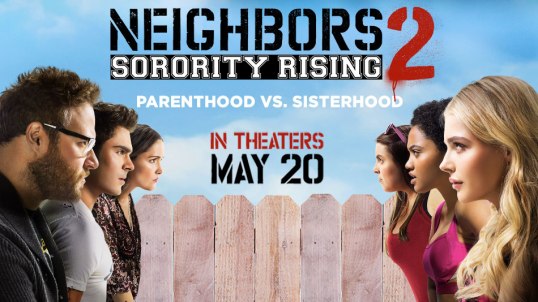
That’s a question that you may be tempted to ask yourself while watching Neighbors 2.  Neighbors 2 is, of course, a sequel to the original Neighbors.  In the first film, Seth Rogen and Rose Byrne played Mac and Kelly Radner, a married couple who are struggling to deal with the fact that, as new parents, they are now officially adults.  When a crazy and wild fraternity moves in next door to them and refuses to tone down their partying ways, Mac and Kelly are forced to take matters into their own hands.  Occasionally hilarious mayhem ensues.

In Neighbors 2, Seth Rogen and Rose Byrne again play Mac and Kelly Radner, a married couple who are struggling to deal with the fact that, as parents who are awaiting the arrival of their 2nd child, they are now officially adults and may have to finally move into a more family friendly house in the suburbs.  When a crazy and wild fraternity sorority moves in next door to them and refuses to tone down their partying ways, Mac and Kelly are forced to take matters into their own hands.  Occasionally hilarious mayhem ensues.

Yeah, it’s all pretty familiar.  Not only are many of the same jokes from the first film repeated but they’re often repeated at that exact same spot in which they originally appeared.  To the film’s credit, it does occasionally acknowledge that it’s repeating itself, though it never quite reaches the self-aware heights of something like 22 Jump Street.  Even Zac Efron returns and, again, he is initially the Radner’s enemy before eventually becoming their ally.

That said, the familiarity is not necessarily a bad thing.  Seth Rogen and Rose Byrne both know how to get laughs, even when they’re telling the same joke that they told a year ago.  Zac Efron tends to try too hard whenever he has a dramatic role (like in The Paperboy, for instance) but he’s got a real talent for comedy.

Ultimately, though, the best thing that saves Neighbors 2 from just being a forgettable comedy sequel is the sorority.  As opposed to the first film’s creepy fraternity, the sorority in Neighbors 2 is partying for a cause greater than just hedonism.  Shelby (Chloe Grace Moretz, finally getting to have fun in a movie) starts her independent sorority in response to being told that official sororities are not allowed to throw parties and, instead, can only attend misogynistic frat parties.  When Shelby and her sorority buy the house, it’s not just to make trouble.  It’s because they need a place where they can have a good time without feeling that they’re in constant danger from drunk and perverted frat boys.  A subtext of empowerment through partying runs through Neighbors 2 and it elevates the entire film.

Neighbors 2 is an entertaining film, even if it never leaves as much of an impression as you may hope.  (I have to admit that, whenever I try to list all the films that I’ve seen this year, Neighbors 2 is one of those that I often have to struggle to remember.)  That said, it’s not a terrible way to spend 97 minutes and it’ll make you laugh.  And, ultimately, that really is the most important thing when it comes to comedy.

As for the question of how often can the same thing happen to the same person…

Well, I guess we’ll have to wait for Neighbors 3 to get our answer!