Welcome to Retro Television Reviews, a feature where we review some of our favorite and least favorite shows of the past! On Sundays, I will be reviewing Homicide: Life On The Street, which aired from 1993 to 1999, on NBC! It can be viewed on Peacock.
This week, we finally meet the arraber.
Episode 1.6 “Three Men and Adena”
(Dir by Martin Campbell, originally aired on March 3rd, 1995)
This week’s episode opens with Tim Bayliss and Frank Pembleton preparing to interrogate Risley Tucker (Moses Gunn). Tucker is the arraber who Bayliss believes is responsible for murdering Adena Watson. Adena used to work for Tucker, helping him take care of his horse before her mother told Adena that she didn’t want her spending so much time with Tucker. As Tucker himself puts it, people tend to view arrabers (men who sell fruits and vegetables from a horse-drawn carriage) as being nomads. As Tucker himself is a recovering alcoholic who was previously charged with (but not convicted of) statutory rape, it’s understandable why Adena’s mother didn’t want her spending time alone with him. It’s also easy to understand why Bayliss is convinced that Tucker is guilty. Pembleton, meanwhile, is not as convinced.
Bayliss and Pembleton have already brought Tucker down to the station three times and interrogated him. Giardello also points out that Tucker has been interviewed a total of 10 times about the case and, if he’s not charged after his latest interrogation, he’ll have grounds for a harassment suit. Bayliss and Pembleton have fourteen hours to interrogate Tucker one final time and try to get a confession out of him. After fourteen hours, they have to either arrest Tucker or send him home. Giardello says that regardless of what happens, Bayliss has to go back into the regular rotation after this interrogation. Bayliss’s time of exclusively investigating the Watson case is coming to an end.
Tucker arrives at the station and Bayliss and Pembleton get to work, trying to manipulate him into slipping up and confessing.
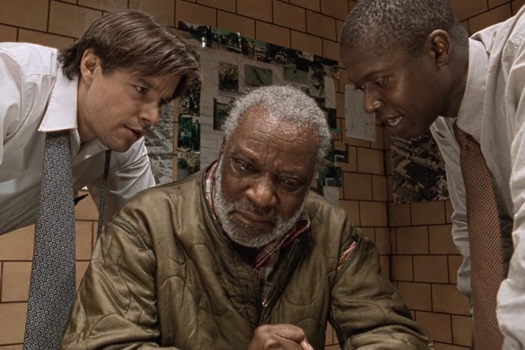
Considering how much they initially disliked each other, it’s interesting to watch how smoothly Bayliss and Pembleton work together in this episode. Bayliss takes on the role of the “bad cop,” flat out accusing Tucker of killing Adena and shoving what little evidence they have in Tucker’s face. At first, Pembleton plays the “good cop,” asking Tucker about what it’s like to be an arraber before moving on to discussing Tucker’s alcoholism. Tucker says that he hasn’t had a drink in sixteen months. Even when Pembleton asks if it’s possible that he slipped up and had a drink and blacked out on the night that Adena died, Tucker insists that he hasn’t touched a drop in sixteen months.
Bayliss and Pembleton work well together but Tucker remains adamant that he did not kill Adena. Even when Bayliss threatens to press Tucker’s face against a hot pipe, Tucker swears he didn’t kill Adena. Even when Pembleton gets Tucker to admit that he had feelings for Adena, Tucker says he didn’t kill Adena. Tucker defiantly demands to take a polygraph and he passes it. Bayliss, knowing that polygraphs are inadmissible in court and are hardly reliable arbiters of the truth, tells him that he failed. At one point, the emotionally exhausted Tucker says that he’s not even sure if he’s innocent or not anymore. That’s as close as Tucker comes to confessing.
As the interrogation wears on, Tucker starts to fight back and it’s somewhat jolting to realize that he’s been aware of how Bayliss and Pembleton have been manipulating him from the start. He accuses Pembleton of thinking that he’s better than other black people. He accuses Bayliss of having a dark side, pointing out that Bayliss was prepared to torture him to get a confession to a crime that Tucker insists he didn’t do. It’s obvious that, in both cases, Tucker has correctly read both men. Pembleton and Bayliss react by ganging up on Tucker, bombarding him with questions. Tucker breaks down and starts to cry but, as time runs out, he continues to insist that he didn’t kill Adena Watson.
In the end, Tucker ends up sitting in the break room, watching television and waiting for someone to take him home. Bayliss packs up all of the evidence in the Watson case, knowing that he failed to get the confession that he needed. Despite not getting the confession, Bayliss has finally won Pembleton’s respect. Pembleton tells Bayliss that he now believes Tucker is guilty. Bayliss admits that he’s no longer as sure as he once was.
It says something about the strength of this episode that I’m not fully convinced of Tucker’s guilt as well. When the episode started, I was sure that the arraber was guilty. By the time it ended, my feelings were a bit more mixed. For all of the emotional turmoil that Tucker went through over the course of the interrogation, he remained adamant that he didn’t kill Adena Watson. Tucker confessed to being an alcoholic. He confessed to having gotten into fights in the past. He confessed to having pedophiliac feelings towards Adena. But the only time he even slightley wavered in his claim that he didn’t kill Adena was when he was so exhausted that he barely knew what he was saying. As well, the evidence against him was almost entirely circumstantial. Evidence was found that Adena had been in Tucker’s barn but there was no way to prove that she was there the night she died. Tucker’s barn did mysteriously burn down after Adena’s murder but there was no way to prove that Tucker burned it down to hide evidence. I suspect Risley Tucker probably was guilty. But if I was on a jury, I’d probably have to say that, without a confession, there was too much reasonable doubt.
By the end of the interrogation, all three men are exhausted. The viewer is exhausted too! This is an intense episode, one that plays out like a particularly kinetic, three-person play. Kyle Secor and Andre Braugher continue to prove themselves to be a brilliant team but, in this episode, they’re equally matched by Moses Gunn, who keeps you guessing as far as Risley Tucker’s guilt or innocence is concerned. Gunn, who died a few months after this episode aired, gives a performance that leaves you feeling as conflicted about Tucker as the two detectives. If Tucker is guilty, then he’s a soulless monster who has gotten away with murder. If Tucker is innocent, then we’ve just spent 50 minutes watching an elderly, recovering alcoholic go through a truly Hellish experience. As the episode ends, the viewer is aware that all three of the men will be changed forever as a result of the 14 hours they spent in the box.
This was an outstanding episode, one that ended on a note of sadness. Adena Watson’s killer will never be caught. If Tucker did it, he got away with it. If Tucker didn’t do it, Bayliss and Pembleton’s obsessive pursuit of him means that the real killer is probably already far away from Baltimore. Not every case gets solved and not everyone gets justice. To quote Casino’s Ace Rothstein, “And that’s that.”
 Through the Shattered Lens