The TSL’s Horror Grindhouse: Madhouse (dir by Jim Clark)


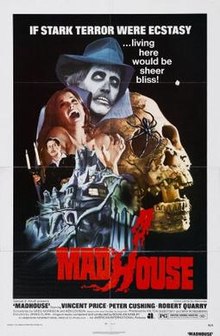
In this 1974 film, Vincent Price plays Paul Toombes, a talented actor who, despite his formal training and his distinguished background, is best-known for giving hammy performances in low-budget horror films.

Hmmm …. do you think Vincent Price possibly could have related to this character?  I mean, one thing that people often forget is that Vincent Price did not start his career in horror movies.  Price started his career as a romantic lead and then he eventually moved into character parts.  He was tested and apparently quite seriously considered for the role of Ashely Wilkes in Gone With The Wind.  Price was also considered for the role of Mr. Potter in It’s A Wonderful Life and rumor has it that he would have gotten the role of Addison DeWitt if George Sanders had turned down All About Eve.  Before he became an icon of horror, Price had roles in big-budget Oscar nominees like The Song of Bernadette and Wilson.  He even appeared in the classic film noir, Laura.

It wasn’t until the 50s that Price started to regularly appear in horror films and soon, that was what he was best known for.  Price’s naturally theatrical style made him a perfect fit for the genre and it won him a legion of adoring fans.  The same can be said of Paul Toombes.

Paul Toombes is best-known for playing the role of Dr. Death.  He appeared in five Dr. Death films, the majority of which were written by his friend, Herbert Flay (Peter Cushing).  Unfortunately, the murder of his fiancée put a temporary end to Toombes’s acting career.  Even though Toombes was acquitted of the crime, everyone seems to assume that he did it.  Apparently, having a nickname like Dr. Death doesn’t do much to convince people of your benevolence.

However, Toombes finally has a chance to rebuild his career!  The BBC wants to produce a Dr. Death TV series and they want Toombes to once again play his most famous role.  The only problem?  People involved with the production are getting murdered, one-by-one.  Is Dr. Death responsible or is he being set up?

Madhouse is kind of an early slasher film, though, with its gloved killer and its whodunit plot, it has more in common with an Italian giallo than an installment of Friday the 13th.  The deaths are bloody but not too bloody.  In fact, for a film that’s full of murder and betrayal, Madhouse is surprisingly good natured.  The main appeal of the film, of course, is to see Vincent Price and Peter Cushing acting opposite of each other.  Though they were both known for appearing in horror films, Price and Cushing were two very different actors and each brought his own individual approach to Madhouse.  Price is his usual flamboyant self while Cushing is considerably more reserved and the contrast of their styles actually creates an interesting dynamic between Toombes and Flay.

Madhouse is also full of footage from previous films that Vincent Price had made for AIP.  (Of course, these movies are presented as being Dr. Death films.)  Basil Rathbone and Boris Karloff both appear in archival footage, acting opposite Price.  It’s nice to see them, even if neither one of them was actually alive when Madhouse was filmed.  Paul Toombes actually gets a scene where he praises Bail Rathbone’s performance and one gets the feeling that the sentiments were being expresses as much by Price as by the character he was playing.

Madhouse is okay.  The plot’s not particularly challenging and the tone tends to go all over the place, as if the film can’t decide whether it wants to be a horror movie or a Hollywood satire.  However, the film works whenever Vincent Price is on-screen, which is often.  Price is just fun to watch, especially when he’s teamed up with an old pro like Peter Cushing.  For fans of Price and Cushing, Madhouse is an entertaining chance to watch two icons of horror go at it.
 

Cleaning Out The DVR: Night Watch (dir by Brian G. Hutton)


I recorded 1973’s Night Watch off of TCM on March 17th!

There’s a tendency, among critics, to dismiss almost every film that Elizabeth Taylor made after Who’s Afraid of Virginia Woolf?  Sure, Reflections In A Golden Eye has its defenders but, otherwise, Taylor’s later films are often viewed as being overproduced and self-indulgent with Taylor giving uncertain, occasionally histrionic performances.

Those criticisms aren’t entirely unjustified.  Some of it may have been due to her own notoriously poor health and her troubled marriage to Richard Burton.  Even more of it was probably due to Taylor’s struggle to remain relevant as a middle-aged actress working in the 1970s.  I have to admit that I’m strangely fascinated by the latter half of Taylor’s film career, just because it does feature so many bizarre films and strange performances.  Taylor was always a good actress but, in her later films, it was hard not to get feeling that her stardom was her own worst enemy.  Taylor was often cast specifically because of her notoriety and she often seemed to work with directors who weren’t willing to reign her in whenever she started to go overboard.

That, however, doesn’t mean that every film that she made in the 70s was a bad one.

Take Night Watch, for instance.  Yesterday, as I watched Night Watch, I asked myself, “How is it that I’ve never seen or even heard of this film before!?”

Because seriously, Night Watch was really good.

Liz plays Ellen Wheeler, an apparently unstable woman living in the UK.  She’s haunted by the night that her first husband was killed in a car crash, along with his mistress.  Ellen has remarried but she worries that her new husband, John (Laurence Harvey), might be cheating on her with her best friend, Sarah (Billie Whitelaw).  It turns out that she has good reason to be worried because that’s exactly what John is doing!  It’s not that John doesn’t love Ellen.  It’s just that he doesn’t know how to deal with her constant nightmares and delusions.

For instance, Ellen is convinced that she’s witnessed a murder!  She says that, in the abandoned house next door, she saw a man with a slit throat.  Later, she claims that she saw a woman murdered over there as well.  When the police investigate, they find no one in the house.  But Ellen swears she saw something.  She even suspects that her neighbor, Mr. Appleby (Robert Lang), may have buried the bodies in his garden.

(Mr. Appleby is not amused by the suggestion.)

Is Ellen going crazy or did she really see something?  I bet you think you already know the answer.  I know that I did.  But then Night Watch ends with a twist that is shockingly effective and unexpected.  For once, I didn’t know how the movie was going to end and now, a day later, I’m still thinking about those final scenes.

Night Watch has its flaws.  With the exception of when he played Col. Travis in The Alamo, Laurence Harvey was never a particularly sympathetic actor and he comes across as his usual cold self in Night Watch.  And, as good as Taylor is, there are still a few moments where she does go a bit overboard.  During the first half of the film, you have to make your way through a lot of yelling to get to the good part.

But that good part is so good that it’s worth it!  Night Watch is a genuinely atmospheric and surprising film, one that catches you off guard and one in which the tension does not relent until the final credit has rolled across the screen.  Ellen’s nightmares are especially well-realized and the film’s final moments are both frightening and surprisingly graphic.  This is a film that sticks with you.

If you haven’t seen it yet, keep a watch for it!

http://www.youtube.com/watch?v=Aao2hzmuNes

Horror Film Review: Taste the Blood of Dracula (dir by Peter Sasdy)


Taste_the_blood_of_dracula

Two years after being temporarily destroyed at the end of Dracula Has Risen From The Grave, Dracula returned in 1970’s Taste The Blood of Dracula!  Returning in the role and uttering only a handful of lines, Christopher Lee gave one of his most intimidating performances in the role of everyone’s favorite vampire.

Picking up where Dracula Has Risen From The Grave ended, Taste the Blood of Dracula opens with a sleazy merchant named Weller (Roy Kinnear) upsetting his fellow passengers during a carriage ride through Eastern Europe.  After they forcefully toss him out of the carriage, Weller comes across a crucifix-impaled Dracula.  Weller watches as Dracula dissolves into red dust.  Weller gathers up the dust and Dracula’s ring and brooch.

A few months later, the plot picks up with three wealthy men in England.  Hargood (Geoffrey Keen), Paxton (Peter Sallis), and Secker (John Carson) pretend to be charitable church goers but, in reality, they spend most of their spare time down at a wonderfully ornate brothel.  One night, at the brothel, they meet a disgraced nobleman named Courtley (Ralph Bates), who was disinherited for attempting to hold a black mass.  Intrigued by Courtley’s promise to give them an experience that they’ll never forget, the three men agree to purchase Dracula’s blood from Weller.

When they go to meet Courtley in a desecrated church, things suddenly go wrong.  Courtley attempts to force the three men to drink from a goblet containing a mix of his and Dracula’s blood.  After all three of the men refuse, Courtley himself drinks the blood.  The men respond by beating Courtley to death and then fleeing from the church.  After the men are gone, Courtley’s dead body transforms into a now living Dracula.  Dracula announces that those who have destroyed his servant will now be destroyed themselves.

And he proceeds to do just that, turning the men’s children into vampires and then commanding them to kill their parents.  Among those possessed are Alice (Linda Hayden), Hargood’s daughter for whom the film suggests Hargood may have incestuous feelings.  Alice is in love with Paul (Anthony Corlan), the son of Paxton.  When both Alice and his sister Lucy (Isla Blair) disappear, Paul sets out to find them and instead, comes across Dracula…

Taste the Blood of Dracula features Dracula at his cruelest (which, of course, makes it all the more ironic that his main motivation here is to avenge the death of his servant).  Whereas Dracula could probably very easily kill all three of the men himself, his decision to use their children to get his revenge adds a whole new level of horrific ickiness to the film.  Fortunately, none of the three men are particularly likable but still, it’s hard not to be disturbed when you’re confronted by the image of a vampirized daughter driving a stake into her own father’s heart.

But then again, that’s a part of the appeal of the old Hammer films, isn’t it?  Hammer films actually “go there” in a way that the period’s American horror films would probably never quite dare.

As for Taste the Blood of Dracula, there’s a lot to recommend it.  Director Peter Sadsy keeps the action moving, both the sets and the supporting cast are properly baroque, and how can you go wrong with Christopher Lee playing Dracula?  Christopher Lee is one of those actors who could do so much with just a glare and the fact that his Dracula says very little only serves to make him all the more intimidating and frightening.

Christopher Lee, of course, has never made a secret of the fact that he didn’t particularly care much for the Hammer Draculas, often complaining that the films failed to stay true to the spirit of Bram Stoker’s conception of the character.  Undoubtedly, Lee does have a point and the Hammer Draculas did decline in quality over the years.  (Just wait until we get to Dracula A.D. 1972.)  But Taste the Blood of Dracula is still a pretty effective vampire film.  Hammer’s Dracula may not have been Stoker’s Dracula but, as played by Lee, he still dominates our dreams and nightmares.