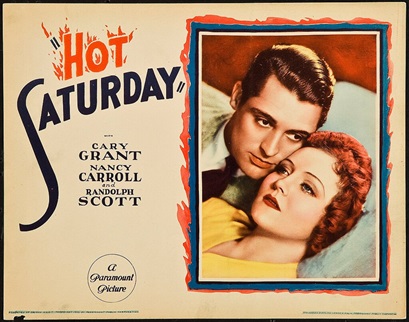
Love On The Shattered Lens: Hot Saturday (dir by William A. Seiter)


First released in 1932 and featuring Cary Grant in his first leading role, Hot Saturday is a film about gossip and love.

Ruth Brock (Nancy Carroll) is a young bank teller living in a small town.  It’s the type of town where everyone knows everyone else.  For instance, everyone knows that every man in town wants to date Ruth but that Ruth, for her part, is not in any hurry to settle down and get married.  She’s having too much fun going to dances, drinking with her friends, and enjoying life.  Everyone knows that playboy Romer Sheffield (Cary Grant) is interested in Ruth but then again, Romer appears to be interested in everyone.  Romer has scandalized the town by allowing a woman named Camille (Rita LaRoy) to live at his mansion.

Ruth has a date with one of her coworkers, Conny Billop (Edward Woods), but, when Conny refuses to take no for an answer, she gets away from him and ends up at Romer’s estate.  Ruth and Romer spend the night together, just talking.  Still, thanks to Conny and Eva (Lillian Bond), the daughter of Ruth’s boss, the whole town is soon convinced that Ruth is Romer’s lover.  The town is so scandalized that Ruth even loses her job.

Fortunately, Bill Fadden (Randolph Scott) has returned to town.  Bill is a geologist.  He grew up in town, with Ruth.  He’s spent the last seven years on a surveying expedition but now he’s back and he wants to marry Ruth.  How lucky is Ruth?  She not only has two good men in love with her but one of them looks like Cary Grant and the other one looks like Randolph Scott!  However, when Bill hears the rumors, will he continue to love her or will he be yet another person who gives in to the curse of small town gossip?

Hot Saturday is a film that truly took me by surprise.  It’s a pre-code film and it’s one that has all of the usual tropes that one usually associates with the pre-code era.  Everyone’s obsessed with sex.  There’s a lot of kissing.  There’s a lot of drinking.  There’s an emphasis on legs and lingerie.  There’s even a scene where Ruth gets into a wrestling match with her younger sister when she discovers that her sister has taken her new panties.  I’m one of four sisters so I could certainly relate but it’s still not the sort of thing that one necessarily expects to find in a film from the 1930s.  But that’s one reason why I love the Pre-Code era.  Allowed to police itself, pre-code Hollywood made films that were more realistic and open about their subject matter than the films made under the production code but which also still had their own unique innocence to them.  Hot Saturday has an ending that would have never been allowed during the Code era, one that is, dare I say it, rather empowering.

But, beyond all that, Hot Saturday is an intelligently written film that strikes a good balance between drama and character-driven comedy.  Nancy Carroll is beautiful and likable in the lead role.  Cary Grant and Randolph Scott are both as handsome and charming as can be.  Hot Saturday is both a look at the reality and dangers of small town gossip and a touching love story.  I enjoyed it.

30 Days of Noir #7: The Sniper (dir by Edward Dmytryk)


Halfway through the chilling 1952 film, The Sniper, there’s a scene in which a woman is seen standing on the rooftop of a San Francisco apartment building.  She’s nonchalantly hanging laundry.  When she steps to the side, we suddenly see that there’s a man standing on the next rooftop over.  And he’s holding a rifle.

Fortunately, in this case, the man is a policeman.  He’s one of several cops who have been ordered to stand on rooftops with their weapons drawn and to keep an eye on the city below.  There’s a killer on the loose and the city is demanding that the police capture him.  And yet, even with a city that’s caught in the grip of fear and even with heavily armed men watching everything going on in the streets, life goes on.  People go to bars.  People go to work. Couples stroll in the park.  And one woman hangs her laundry to dry on the rooftop of an apartment building.

Suddenly, the policeman spots someone on another rooftop, a man who isn’t supposed to be there.  He’s a young guy, carrying what looks like a rifle.  The police quickly rush to the rooftop where they arrest the young man.  Have they caught the sniper who has been terrorizing San Francisco?

The police think that they have their man but we know that they don’t.  We know that the sniper is a guy named Eddie Miller (Arthur Franz).  Eddie is a delivery man.  He’s handsome but, from the minute we first see him, we can tell that there’s something off about him.  He stumbles through life, keeping his head down and rarely speaking to anyone.  The few times he does attempt to smile, it’s painfully awkward.  He’s someone who is struggling to convince the people of San Francisco that he’s one of them but the more he tries, the more of an outsider he seems to be.  In fact, the only time that we see Eddie truly happy is when he goes to a carnival and comes across a dunk tank.  Over and over again, he throws a baseball and cause the woman inside to be submerged in cold water.

At first, Eddie tries to deal with his bad thoughts by deliberately burning his hand on an electric stove.  When he goes to the emergency room, he asks the attending doctor why he would do something like that but the doctor is soon distracted by another patient.  With his hand bandaged, Eddie goes on a shooting spree, targeting brunette women.

This dark film is fairly evenly divided, between Eddie, the cops that are trying to catch him, and the psychiatrist who tries to explain him.  Not surprisingly, the cops, led by the appropriately named Lt. Kafka (Adolphe Menjou), aren’t particularly interested in what makes the sniper tick.  They just want to get him off the street.  However, Dr. James Kent (Richard Kiley) is convinced that the only way to stop not only this killer but others is to understand what’s going on inside of his mind.  The differences between Kafka and Kent’s approaches are most obvious in a scene in which every registered sex offender in San Francisco is paraded into a squad room full of jeering cops.  While the detectives taunt the offenders that they know, the offender that they don’t know prepares to kill yet again.

The Sniper was directed by Edward Dmytryk, who previously directed the Oscar-nominated (and superficially similar) Crossfire.  This was Dmytryk’s first film after his career was temporarily derailed by his refusal to testify before the House Unamerican Activities Committee.  (He later changed his mind and named names while testifying about his time as a member of the Community Party.)  Interestingly enough, top-billed Adolphe Menjou was one of the leaders of the anti-communist Motion Picture Alliance for the Preservation of American Ideals, a prominent supporter of the blacklist that Dmytryk had narrowly escaped.

Filmed in a black-and-white, documentary style, The Sniper is a chilling and disturbing film.  When Eddie stalks through the city at night, the dark shadows that he casts against the walls of empty alleyways and closed storefronts serve to remind us that men like Eddie could be lurking anywhere, unseen and unknown.  During the day scenes, the harshly bright lighting reminds us of just how vulnerable we are.  If the night provides too many places to hide, the day provides too few.  Arthur Franz gives a disturbingly credible performance as Eddie.  While he plays Eddie as being obviously troubled, he also suggests how someone like Eddie has managed to survive without getting exposed.  Menjou is properly cynical as the world weary Kafka while Richard Kiley brings some needed passion and anger to the film’s most talky scenes.  The film ends on a note of melancholy ambiguity, leaving it to us to make up our own mind about how to deal with the Eddie Millers of the world.