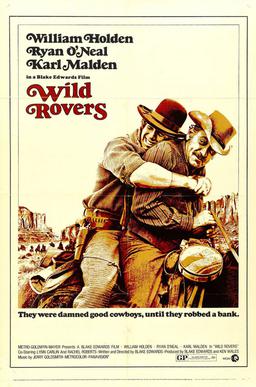
Wild Rovers (1971, directed by Blake Edwards)


In Montana, Walter Buckman (Karl Malden) runs his ranch with an iron hand, warning his neighbor, Hansen (Sam Gilman) not to even think of allowing his sheep to graze on his land.  Walter has two sons, hot-headed John (Tom Skerritt) and the laid back and good-natured Paul (Joe Don Baker).  When Walter learns that two of his ranch hands — aging Ross Bodine (William Holden) and young Frank Post (Ryan O’Neal) — have robbed a bank and are heading down to Mexico, he sends John and Paul to bring them back.  Walter is a big believer in the law and he’s not going to allow any of his people to get away with breaking it.

Ross is a veteran cowboy, who only robbed the bank after Walter withheld his pay to cover the damage of a saloon fight between Ross and Hansen’s men.  Frank is the wilder of the two.  He looks up to Ross and Ross is protective of Frank, even if he has a hard time admitting it.  Ross and Frank are heading down to Mexico so Ross can retire in peace.  Instead of going straight to Mexico, though, they make the mistake of stopping by a small town so Frank can play a little poker and visit the town’s brothel.

Wild Rovers was Blake Edwards’s attempt to make an epic, revisionist western and he includes plenty of shots of the sun setting over the mountains as well as several violent shoot-outs that are shot in Peckinpah-style slow motion.  Unfortunately, the story itself isn’t really strong enough to support Edwards’s ambitions and all of the shots of the countryside, while nice to look at, don’t really add up too much.  Wild Rovers was also a troubled production, with MGM slashing Edwards’s original three-hour film down to 106 minutes and advertising it with a poster featuring O’Neal hugging Edwards from behind, making the film look like a buddy comedy in the style of Butch Cassidy and the Sundance Kid (or an early version of Brokeback Mountain) as opposed to a violent and elegiac western.  (In 1986, a director’s cut was released, which ran for 136 minutes.)  If you only know Blake Edwards from his Pink Panther movies, the grim and tragedy-filled Wild Rovers will come as a surprise.

One thing that Wild Rovers does have going for it is a good cast.  William Holden and an energetic Ryan O’Neal are a solid team and Karl Malden, Tom Skerritt, Rachel Roberts, James Olson, and Moses Gunn all give good performances too.  This movie also provides Joe Don Baker with a sympathetic role and he’s very likable as the laid back Paul Buckman.  It’s not the type of role that Baker often got to play and it’s obvious that a lot of scenes between John and Paul were cut from the film but, in the truncated version, Joe Don Baker’s Paul Buckman becomes the moral center of the film’s story.

Wild Rovers was a disappointment at the box office, one of many that Edwards suffered in the 70s before he and Peter Sellers brought back Inspector Clouseau.

Lisa Cleans Out Her DVR: Change of Habit (dir by William A. Graham)


(Lisa is currently in the process of cleaning out her DVR!  How long is it going to take?  Some would say forever but, here at the Shattered Lens, we’re hoping that she might have it all done by August.  Anyway, she recorded the 1969 film Change of Habit off of Starz on March 20th!)

It’s Elvis vs. God for the heart of Mary Tyler Moore!

(Okay, so that may be a little bit glib on my part but, seriously, that pretty much sums up Change of Habit.)

Change of Habit opens with three nuns walking through New York City.  There’s the forgettable nun, Sister Barbara (Jane Elliott).  There’s the black, streetwise nun, Sister Irene (Barbara McNair).  And then there’s the idealistic and wholesome nun, Sister Michelle (Mary Tyler Moore).  Because they’re nuns, even notoriously rude New Yorkers are nice to them.  They walk across a busy intersection and all of the cars stop for them.  A cop sees them jaywalking and just smiles and nods at them.  In case you were ever wondering why someone would become a nun, it’s because nuns always have the right-of-way and they don’t have to obey arbitrary laws.  It’s a good life.

The sisters are shopping and, as the opening credits roll, the three of them duck into a dressing room and change into contemporary civilian clothing.  Obsessively, the camera keeps zooming in on everyone’s bare legs.  You can literally hear the film’s producers telling all the boys in the audience, “This may be a G-rated Elvis film but that’s not going to stop us from implying nun nudity!”

It’s Sister Michelle’s idea that the nuns should wear contemporary clothing, the better to relate to the Godless youth of the 1960s.  Unfortunately, now that they’re dressed like everyone else, they have to actually obey traffic laws.  When they attempt to cross the street for a second time, cars honk at them and the cop yells at them for jaywalking.

Michelle, Irene, and Barbara get jobs working at a free clinic.  The clinic is run by John Carpenter (Elvis Presley).  Carpenter is looking for aspiring actresses to appear in a movie about a babysitter being stalked by a masked murderer on Halloween and … oh sorry.  Wrong John Carpenter.  This John Carpenter is a no-nonsense doctor who will stop at nothing to bring peace and good health to the most poverty-stricken neighborhoods in New York!

That’s right.  It’s an Elvis film with a social conscience!

And that probably sounds like a joke but Change of Habit‘s heart is in the right place.  It’s intentions are good.  At least a few of the people involved in the film were probably trying to make the world a better place.  There’s a subplot involving an autistic child that, when you consider this film was made in 1969, is handled with unusual sensitivity.  Of course, that doesn’t mean that the rest of Change of Habit doesn’t feel totally and completely out-of-touch.  The entire film feels so dated that I imagine it probably even felt dated when it was initially released.  This is one of those films where the local black militants give Sister Irene a hard time about being a sell-out, just to eventually admit, during a block party, that maybe white folks aren’t so bad after all.  By the end of the movie, they’re even joking with the cops.  All that was needed was for Elvis to sing a song or two.  To be honest, there are times when Change of Habit feels like the 1969 version of Kendall Jenner’s Pepsi commercial.

Of course, the majority of the film deals with Elvis falling in love with Mary Tyler Moore.  He doesn’t know that she’s a nun and, as she falls in love with him, she’s forced to make a difficult choice.  Does she follow God or does she follow Elvis?  Actually, the film ends before she officially makes that choice but there’s little doubt as to what she’s going to eventually do.  In his final non-concert film appearance, Elvis is totally miscast as a serious-minded doctor and, it must be said, he looked miserable throughout the entire film.  You get the feeling he’d rather be doing anything than starring in Change of Habit.  (Maybe he was already thinking about how much he wanted a special FBI badge.)  Mary Tyler Moore is a bit more believable as a nun.  Fortunately, both Moore and Elvis were likable performers and their likability makes Change of Habit, as ludicrous as it often is, far more watchable than it has any right to be.

In the end, Elvis may not have saved society but he did get to sing a gospel song or two.