Retro Television Review: Decoy 1.10 “The Scapegoat”


Welcome to Retro Television Reviews, a feature where we review some of our favorite and least favorite shows of the past!  On Thursdays, I will be reviewing Decoy, which aired in Syndication in 1957 and 1958.  The show can be viewed on Tubi!
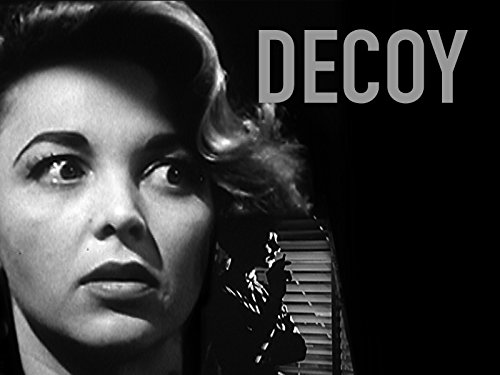
This week, Casey makes the mistake of being nice.

Episode 1.10 “The Scapegoat”

(Dir by Teddy Sills, originally aired on December 16th, 1957)

Call this one “Casey Screws Up …. Again.”

Casey and Detective Hank Hopkins (John Connell) are escorting embezzler Dorothy Boyer (Lenka Peterson) to jail.  As they wait at an airport, Casey cannot help but feel sorry for Dorothy.  Everyone who sees Dorothy recoils from the sight of her handcuffs.  (“She’s a crook!” one little girl yells.)  Casey agrees to take off the handcuffs as long as Dorothy doesn’t try to run away.  Of course, as soon as Casey is distracted, Dorothy runs.

Casey and Hank try to track down Dorothy.  They discover that Dorothy was embezzling the money so that she could afford a special school for her son, who is repeatedly described as being “retarded” but whose noncommunicative behavior suggests that he would probably, today, be diagnosed as having some form of autism.  Casey and Hank fear that Dorothy is going to murder her child, to spare him from being sent to a “public institution” while she’s serving time in prison.

They’re right.  Dorothy is on the verge of throwing her son off a bridge when Casey, Hank, and the cops track her down.  Casey says that she understand why Dorothy is scared.  “You think your son will be sent to a public institution and people will be cruel to him!” Casey says.  “What about me?  I work for a public institution!  Was I cruel to you?”

“Who’s going to give love to a backward child!?” Dorothy cries.

Casey then taunts, “Go ahead, throw him over!”

This causes Dorothy to realize that she loves her son too much to toss him over the bridge.  The episode ends with Casey speaking directly to the camera.  Dorothy will only have to serve six months in prison.  As for Casey and Hank, they’re put on official probation for three months for letting Dorothy escape.  “You live and you learn,” Casey says.

This episode was a real time capsule.  Yes, it was weird to hear the term “retarded” tossed around so casually, though I found the term “backward child” to be far more offensive.  But, let’s be realistic here.  This show aired 1957 and it’s a bit silly to expect a 68 year-old television program to sound like it was written in 2025.  To me, what was really upsetting was how everyone that Casey talked to seemed to feel it was perfectly understandable that the father of Dorothy’s child abandoned Dorothy because of their son.  Everyone, except for Casey and Hank, acted as if Dorothy should be ashamed of her child.  To make clear, the show did not endorse that attitude but still, the callousness of almost everyone in Dorothy’s life was hard to take.  I was glad that Casey cared.

That said, I did cringe a bit at that “I work for a public institution” line.  One nice person does not signify a change in culture.

Shattered Politics #11: The Phenix City Story (dir by Phil Karlson)


PhenixCityPoster

If A Man Called Peter was the epitome of a stereotypical 1950s film, The Phenix City Story is the exact opposite.  Like A Man Called Peter, The Phenix City Story was released in 1955.  And like A Man Called Peter, The Phenix City Story is based on a true story.  However, beyond that, A Man Called Peter and The Phenix City Story might as well have been taking place on different planets.

And, in many ways, they were.  The Phenix City Story not only takes place in Phenix City, Alabama but it was filmed there as well and featured a few actual citizens in the cast.  Not only was The Phenix City Story telling a true story but the story was being told by some of the same people who actually lived through it.  That makes The Phenix City Story brutally realistic, with brutal being the key word.

And, just in case we have any doubt about the film’s authenticity, it actually opens with a 15 minute documentary in which Clete Roberts (who was an actual news reporter) interviews several citizens of the town.  All of them, speaking in thick Alabama accents and nervously eyeing the camera, assure us that what we are about to see is true.  Quite a few of them also tells us that they still live in fear of losing their lives as a result of everything that happened.

What’s amazing is that, once the actual film does get started, it manages to live up to all of that build up.  The Phenix City Story is a shocking film that remains powerful even 60 years after it was initially released.

As the film opens, we’re informed that Phenix City, Alabama is home to some of the most dangerous and violent criminals in the state.  From his club, crime boss Rhett Tanner (Edward Andrews) runs a shadowy organization that not only controls Phenix City but the entire state of Alabama as well.  The police ignore his crimes.  The majority of the town’s citizens are too scared to stand up to him.  When a returning veteran of the Korean War, John Patterson (Richard Kiley), tries to stand up to Tanner, the result is even more violence.  A young black girl is kidnapped and murdered, her body tossed on John’s front lawn as a warning.  John’s best friend is killed but Tanner uses his influence to have the death ruled accidental.

Finally, John and a group of other reformers convince John’s father — Albert Patterson (John McIntire) — to run for Attorney General.  Albert runs on a reform platform and exposes both the corruption of Phenix City and how Tanner’s power extends through the rest of the state as well.  When Albert wins the Democratic primary, he’s gunned down in the street and it’s up to John to avenge his death…

To say that The Phenix City Story is intense would be an understatement.  As directed by Phil Karlson, there’s not a single frame of The Phenix City Story that’s not full of menace and danger.  The stark black-and-white cinematography is full of shadows and the camera moves almost frantically from scene to scene, occasionally catching glimpses of dark figures committing acts of violence and cars speeding away from who knows what outage.  It’s a dark film but, ultimately, it’s also a hopeful one.  It suggests that evil will triumph when good men do nothing but that sometimes you can depend on good men — like Albert and John Patterson — to actually step up.

The Phenix City Story shows up on TCM occasionally and you should keep an eye out for it.  It’s one of the best B-movies ever made.