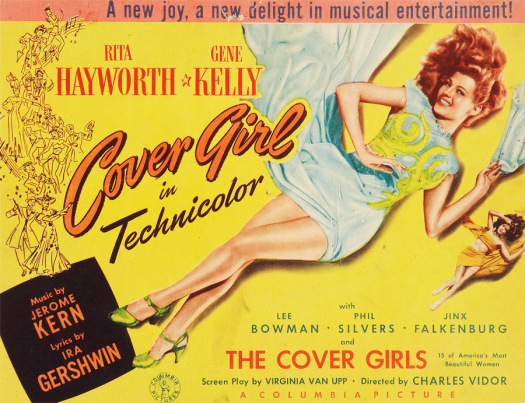
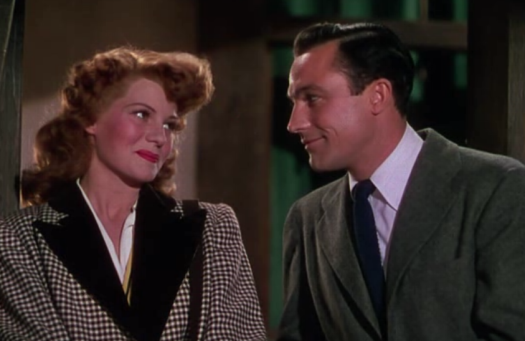
Bright, bold, and bouncy, COVER GIRL was a breakthrough film for both Rita Hayworth and Gene Kelly. Sultry, redheaded Rita had been kicking around Hollywood for ten years before Columbia Pictures gave her this star-making vehicle, while Kelly, on loan from MGM, was given free rein to create the memorable dance sequences. Throw in the comedic talents of Phil Silvers and Eve Arden , plus a bevy of beauties and songs by Jerome Kern and Ira Gershwin, and you have what very well may be the quintessential 40’s musical.
Rusty Parker (Rita) is a hoofer at Danny McGuire’s (Kelly) joint in Brooklyn (where else?). She enters a contest sponsored by Vanity Magazine to find a new cover girl for their 50th anniversary issue. Editor John Coudair ( Otto Kruger ) spots her and is reminded of the girl he once loved and lost (who turns out to have been…
The 39th film in the Fabulous Forties box set was 1947’s Smash-Up, the Story of a Woman. I have to say it was a little bit strange going from watching the hilarious and life-affirming My Man Godfrey to watching the very serious and rather depressing Smash-Up.
Smash-Up is pure, tear-jerking Hollywood melodrama. When the film starts, Angie Evans (Susan Hayward) is in a hospital, with her face totally covered in bandages. Just by looking at her, we already know that her story is not going to be a happy one.
Flash back time! Angie was a nightclub singer and a pretty good one at that. The audiences loved her and she loved performing but she loved one thing more. (See how overwrought my prose was there? That’s a reflection of Smash-Up’s style.) She loved Ken Conway (Lee Bowman, who may be related to me but probably isn’t). Ken was a singer himself, though he was nowhere near as successful as Angie. However, after Ken and Angie married, Angie put her career on hold while Ken went on to become a huge success.
Angie was already a drinker before she met Ken. Having a few drinks before going out on stage helped to calm her nerves. It helped her to relax and become the performer that the audiences loved. However, once Ken became a star and Angie found herself continually alone in their home, she started to drink because it was the only thing that made her happy. Whenever she started to regret giving up her career, she drank. When she was worried that Ken was having an affair with his secretary (Marsha Hunt), Angie drank. Ken’s best friend and songwriter, Steve (Eddie Albert), could see that Angie was losing control. However, Ken refused to accept that his wife had a drinking problem. Accepting that Angie was drinking to be happy would mean accepting that she wasn’t happy in the first place.
Trapped in the middle of all this was their daughter, Angel (Sharyn Payne). When Ken, finally admitting that his wife could not control her drinking, demanded custody of Angel, Angie was determined to get back her daughter.
But, even though she wanted to, Angie could not stop drinking. Or smoking. And the smoking, the drinking, and the kidnapping did not make for a particularly good combination.
According to Wikipedia, Smash-Up was a failure at the box office and I can actually see why. 1940s American cinema can basically be divided between the earnest, patriotic, and optimistic films that were released during World War II and the dark and pessimistic films that came out after the war ended and the world realized just how evil and dangerous human beings could be. Smash-Up is one of those dark films. It’s not a happy film, nor is it at all subtle. In fact, as much as I love a good melodrama, Smash-Up occasionally seems like a bit much. Absolutely every bad thing that could happen does happen and it’s typical of the approach of Hollywood in the 40s that, for all the trouble Angie suffers as a result of her drinking, the film still has to find an excuse to send her to hospital with her face in bandages. The film is often very empathetic in its treatment of Angie but, in the 1940s, mistakes still had to be punished.
Fortunately, Susan Hayward gives a great performance in the role of Angie, capturing the aching sadness that leads her to drink in the first place. She saves the entire film and, quite justifiably, she received a nomination for best actress for her performance here. She didn’t win but she still made Smash-Up worth seeing.
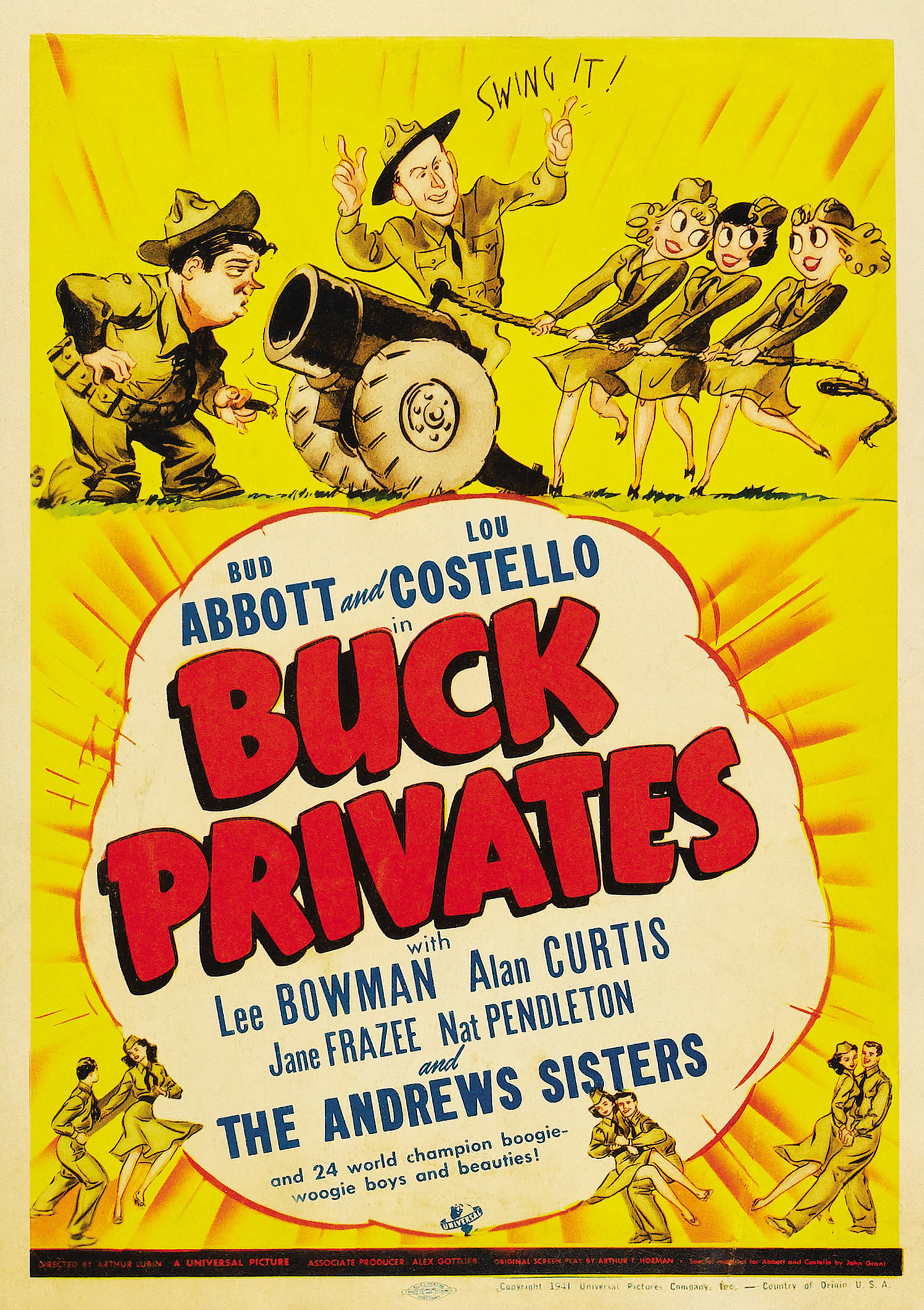
The comedy team of Bud Abbott and Lou Costello don’t get much love these days. They belong to another era, but there was a time that Abbott & Costello were the most popular comedy duo in the nation, consistently landing in the top ten box office rankings. They honed their snappy patter and slapstick routines in burlesque, got national attention on Kate Smith’s radio show, and made their film debut in ONE NIGHT IN THE TROPICS. Universal Studios sat up and took notice, signing the boys to a contract and starring them in BUCK PRIVATES, creating a simple formula that would serve the team well for the better part of the decade: put Bud and Lou into a situation that allows them to perform their tried-and-true routines, add a romantic subplot, surround them with solid support, toss in some popular music acts, and let ’em run wild.
Now, don’t get me wrong. This isn’t going to be one of my series like Shattered Politics or Embracing the Melodrama. I’m not going to post six best picture reviews a day for the next three weeks until I’ve reviewed every single one of them. Instead, I’m just going to keep my eyes open. When I see that a best picture nominee is going to be on TCM, I’ll be sure to record, watch, and review it. On days that I have some extra time, I’ll watch and review something from my DVD and Blu-ray collection. And, of course, I’ll keep make sure to keep up with what’s available on Netflix, Hulu, and all the other streaming services.
And, on a night like tonight when its sleeting outside and I’m aware that I probably won’t be going outside for the next two or three days, I’ll be sure to look through my DVR and see what I still need to watch.
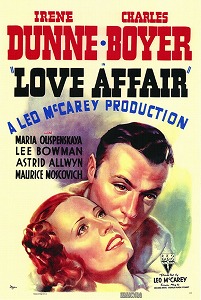
Tonight, for example, I did just that and I ended up watching the 1939 best picture nominee, Love Affair.
Love Affair tells the story of two rich people in love. Michel (Charles Boyer) is a painter and a notorious playboy. Terry (Irene Dunne) is an aspiring singer. They’re both engaged to other people but, when they meet on a cruise, it’s love at first sight. They try to avoid each other. They try to remain faithful to their significant others. But, when the boat docks off of the island of Madeira, Terry agrees to visit Michel’s grandmother with him.
Michel’s grandmother is played by Maria Ouspenkaya and, while Ouspenkaya does a good job playing the eccentric grandma and even received an Oscar nomination for her 10 minutes or so of screen time, it’s hard to look at her without imagining that she’s about to say something about what happens when the moon is full. Or, at least, that’s the case if you’re a fan of the old Universal horror films and you’ve seen Ouspenkaya play the gypsy in original Wolf Man. Instead of talking about the curse of lycanthropy, Michel’s grandma instead tells the two that they are meant to be together.
Anyway, once they return to New York, Michel and Terry agree to separate and, if after six months they still can’t stop thinking about each other, they’ll meet at the top of the Empire State Building. Michel spends his six months becoming a more responsible human being. Terry spends her six months singing.
Six months pass. Michel stands at the top of the Empire State Building. Little does he know that, on her way to meet him, Terry got struck by a car. Michel is convinced that Terry stood him up. Meanwhile, Terry is confined to a wheelchair.
Wow, depressing movie, huh? Well, don’t worry. That’s only the first half of the movie. There’s still a lot more misunderstandings to get through before Terry can deliver her classic final line.
Occasionally, I’ve seen an old film referred to as being creaky but I don’t think I ever understood what that meant until I saw Love Affair. Love Affair is such an old-fashioned melodrama and such a product of a bygone era that it can’t help but be a little bit fascinating. Love Affair is definitely a film that was made at a different time and for a very different, far less cynical audiences and, watching the film today, definitely requires a bit of an attitude adjustment. However, what Love Affair may now lack in entertainment value, it makes up for in historical value. By today’s standards, Love Affair may seem slow and a bit too melodramatic but it remains a time capsule. If you want to go back to 1939, you can either build a time machine or you can watch Love Affair.
(And, fortunately, Love Affair is in the public domain, which means it’ll be a lot easier to find than a working time machine.)



 Through the Shattered Lens