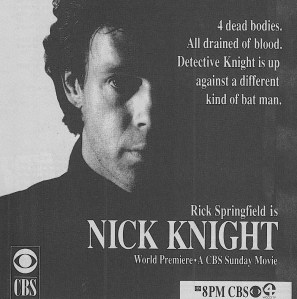
Directed in 1989 by Farhad Mann, Nick Knight (a.k.a. Midnight Cop) was a made for tv movie meant as a pilot for a series filmed in Los Angeles. It would take another 3 years to for the show to be picked up as Forever Knight, and even then, it was difficult show to catch given you could really find it sometime after Midnight on Saturdays and/or Sundays. As Vampires in media go, Nick Knight is tucked away in a very small place between the success of Kathryn Bigelow’s Near Dark in 1987 and Francis Ford Coppola’s Bram Stoker’s Dracula in 1992. It’s nowhere near as good as either of those films, but plays on most of the vampire tropes. Allergic to Garlic? Check. Aversion to sunlight? Sure. As I’m writing this the way I would cover a TV episode, this review will have spoilers and will be a bit long in the tooth. My apologies in advance. For the TSL Horrorthon this year, I’m hoping my contribution will be (at least) the first season of Forever Knight. For the film, If you search for it, you can find on YouTube.
Detective Nick Knight (Rick Springfield, Hard to Hold) loves to work the night shift, but not before getting in a quick visit at a local suntan spa. It’s a bit uncomfortable, enough for him to hit the panic button and bring in a few staff to check in on him. He blames it on claustrophobia, “It’s like a coffin in there.”, he says and moves on. When an ancient jade goblet is stolen from a museum, leaving a guard murdered, Knight is brought on to the scene where Don Schanke (John Kapelos, The Shadow, The Breakfast Club) is already helping the cops take photos of the crime scene, and putting himself in the way of things. Nick interviews Dr. Alyce Hunter (Laura Johnson, TV’s Falcon Crest) about the homicide. Alyce reports the goblet was used in ritual blood drinking sacrifices (something that Knight sounds like he’s aware of since he can understand some of the ancient writing in the museum).
Cleaning up the scene, the media approaches Knight and asks if it’s “another Vampire murder”. Word has gotten out that there’s no blood in the course. Knight’s rescued by Captain Brunetti (Richard Fancy, The Girl Next Door) who asks to have him stop by his office after he gets the autopsy work. At the morgue, Nick is given a mug of tea that he just can’t stomach. Thankfully, Dr. Jack (Robert Harper, Twins)knows about Nick’s true nature, and is working helping him find a cure (which includes the tea). “How is your tanning coming along?”, Jack asks. “I’m up to ten minutes.” is Nick’s response, with a smile. When Nick returns to the Precinct, the Captain assigns Knight a new partner to help him with the vampire crimes. Nick’s been able to work alone for the most part, but now he finds himself paired with Schanke. This poses a few problems with hiding his nature.
Schanke and Knight get to know each other on their first night shift, with some talk about Schanke’s married life vs. Nick being forever single. The conversation is interrupted by a dispatch call about an Uzi toting gunman terrorising a local gym. They arrive on the scene, and much like Riggs & Murtaugh, Nick is gung ho about the situation, which causes a third cop on the scene to get killed. With a hostage in stow, the gunman threatens Nick. The girl gets herself out of trouble with a swift knee to the gunman’s gut, causing him to unload a full magazine into Knight. This brings out the vampire in Nick, who throws the gunman into an electrical fence, killing him.
With the case wrapped up, Nick visits Alyce, who spent her evening going through a book on the dig that discovered the cup. Before his arrival, she found a picture of the archeological team that includes someone who looks just like Nick. She makes a copy of the picture, but never mentions it to Nick during his visit. They have a moment, leading to a kiss. Of course, this also causes Nick’s fangs to sprout. He makes a hasty exit.
Having not seen Nick during the evening, Dr. Jack visit’s Nick’s haven, a closed down movie theatre with It’s a Wonderful Life still on the marquee. He finds Nick chugging on a wine bottle full of blood. They have a small argument over Nick’s humanity, leading Nick to admit his desire for love and companionship despite the vampiric side effect of watching people die around them. They make up and move on, there’s crime on the streets and the city needs it’s Midnight Cop. Nick explains that the stolen goblet is part of a pair (one of which he owns) that may be able to cure one of vampirism. The other goblet was coveted by Nick’s maker, LaCroix (Michael Nader, TV’s All My Children), who wants Nick to embrace his vampirism instead of trying to fix it. Could he be the thief?
When a homeless couple goes missing, Nick visits a local vampire nightclub. There he finds Janette (Cec Verrell (Silk). She informs him that while, yes, LaCroix is in town and yes, he may have something to do with the goblet, the missing couple has nothing to do with him. On his way out of the nightclub, Nick bumps into Alyce, who followed him. When some other vampire locals approach the couple, she notices a scar on Nick’s chest (matching one in the photo she had), and confronts him. He doesn’t outright admit to being a vampire, but she gets the feeling she’s on the right track. She even dares him a little, baring her neck. Nick doesn’t take the bait.
On the radio, we hear “The Nightcrawler” who is really LaCroix. The Nightcrawler hosts “Metal for the Ages”, lamenting that he hasn’t seen his old friend Jean Pierre (Nick) in some time. LaCroix dedicates his next song to him, which just happens to be Bobby Brown’s “My Prerogative”. I don’t remember Bobby Brown’s music ever being Metal, but we’ll roll with it.
Eventually, Nick has to deal with both LaCroix and the real villain in this tale. The story ends on a bit of a dark note, resolving the whole mystery, but still leaves open the promise of Nick’s search for Mortality. The city is safe for now, and that’s what counts.
Though the film isn’t terribly strong on the plot, it does shine with the music choices. With classic 80s hits like Steve Winwood’s “Don’t You Know What the Night Can Do” and “Human” by The Human League, Nick Knight definitely has a bit of style, though it’s a bit over the top and campy on the action sequences. It was one of those films that I had a better memory of than what it truly was.

 Through the Shattered Lens