Film Review: Atlas Shrugged, Part II (dir by John Putch)


2012’s Atlas Shrugged: Part II picks up where Part I left off.

The time is still the near future.  (Part I specifically set the story as taking place five years into the future.  Part II declines to use a specific date but it does feature some news personalities playing themselves so it’s still clearly only meant to be a few years from 2012.)  The economy has gotten even worse.  The poor are only getting poorer while the rich are getting richer.  Under the direction of Head of State Thompson (Ray Wise) and his main economic advisor, Wesley Mouch (Paul McCrane), the government has nationalized nearly every business.  Halfway through the film, Thompson declares a national emergency and uses the Fair Share Law to invoke Directive 10-289.  All inventors, businessmen, and other creative people are required to sign their patents over to the government and to stop trying to develop now techniques.  Wages are frozen.  No one can be fired and no one can be hired.  Creative thinking is discouraged.  Asking questions or expressing doubt is forbidden.  People are encouraged to snitch on anyone not following the Directive.  Thompson and Mouch insist that it’s for the “good of the people,” and anyone who disagrees runs the risk of being dragged into court and sent to prison for ten years.  Meanwhile, gas now costs $42.00 a gallon.  One of the funnier moments of the film features someone paying $865.72 to fill up a truck.

Dagny Taggart (Samantha Mathis), the Vice President of Taggart Transcontinental Railways, is still trying to discover who invented an experimental motor that she found hidden away in a mine.  The motor could potentially change the way that goods are transported but it appears to be missing one component.  Unfortunately, all of the great scientists and inventors have been vanishing, with many of them leaving behind notes that ask, “Who is John Galt?”  Meanwhile, Dagny’s lover, Hank Rearden (Jason Beghe), fights to protect Rearden Metal from being taken over by the government and Dagny’s brother, James (Patrick Fabian), sells out to Wesley Mouch with the end result being that there’s no one left at Taggart Transcontinental with the intelligence or the experience necessary to keep two trains from colliding in a tunnel.

Given that Ayn Rand herself was an atheist who wrote very critically of religion, it’s interesting how much of Atlas Shrugged: Part II feels like one of those evangelical films where the Rapture comes and the entire world falls apart because all of the believers have suddenly vanished.  In the case of Atlas Shrugged, the world falls apart because all of the creatives and all of the leaders of industry and all of the innovative thinkers have abandoned it so that they can create a new community with John Galt.  (They’ve “stopped the motor of the world.”)  In many ways, this is the ultimate in wish fulfillment, a way of declaring, “They’ll miss me when I’m gone!”  Indeed, the majority of people who keep a copy of Rand’s novel displayed on their bookcase do so because they believe that they would be one of the lucky ones who was approached by Galt.  No one expects that they’ll be the person left behind to try to run the railroad.  It’s a bit like how like the most strident Marxist activists always assume they’ll be the ones organizing the workers as opposed to being a worker themselves.

Not surprisingly, the same critics who attacked Part I didn’t care much for Atlas Shrugged Part II.  When I first saw it, I thought the film was a bit too long and I was annoyed that, with the exception of a few minutes at the end, the film didn’t really seem to move the story forward.  At the same time, just as with the first film, I appreciated the fact that the second film was proudly contrarian in its portrayal of the government as being inherently incompetent.  After all, this was 2012, back in the “good government” era, when a lot of people still reflexively assumed that the government was staffed only by hyper-competent policy wonks who knew what they were doing and who were only concerned with making sure that “the trains ran on time,” to borrow an old expression.

Rewatching the film this weekend, I have to say that I actually appreciated Atlas Shrugged Part II a bit more than the first time I watched it.  Yes, Part II was still a bit too long and the domestic drama between Hank and his wife fell flat but Part II is still a marked improvement on the first film.  Some of that is because Part II had a higher budget than Part I and, as a result, it didn’t look as cheap as the first film.  The corporate offices looked like actual corporate offices and the factories looked like real factories.  Secondly, the second film had an entirely different cast from the first film.  Samantha Mathis, Jason Beghe, and especially Patrick Fabian were clear improvements on the actors who previously played their roles.  That’s especially important when it comes to Mathis and Beghe because, as opposed to the first film, Part II convinces the viewer that  Dagny and Hank actually are as important as they think they are.  When the trains collide in the tunnel, the viewer never doubts that Mathis’s Dagny could have prevented the disaster if not for the government’s attempts to force her out of her own company.  As well, the viewer never doubts that Beghe’s Hank would fight to the end to protect his business, even if it means prison.  One wouldn’t have necessarily believed that while watching the first film.

Finally, having lived through the COVID era, the film’s portrait of government overreach and incompetence feels a lot more plausible when watched today.  One doesn’t have to be a fan of Rand’s philosophy or agree with her solutions to see the parallels between Directive 10-289 and the policies that led to children being kept out of schools and numerous small business having to shut their doors.  In an era when most people’s faith in governmental institutions has been broken to such an extent that it might never be fixed in our lifetime, Atlas Shrugged Part II resonates.  Whereas the film once felt subversive, now it feels downright prophetic.

Cleaning Out The DVR: Wish Upon A Christmas (dir by Terry Ingram)


WishUponAChristmas

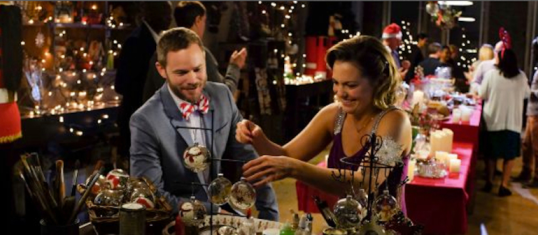
After finishing up with A Gift-Wrapped Christmas, it was time to move onto the final Lifetime Christmas film on my DVR, Wish Upon A Christmas.  Wish Upon A Christmas premiered on December 13th and, much like Becoming Santa, The Flight Before Christmas, and Last Chance For Christmas, it features Santa as a matchmaker.

Well, maybe it does.  Though he has the beard and the jolly attitude, the film is somewhat ambiguous as to whether or not Mr. Tomte (Kevin McNulty) is actually Santa Claus or not.  The facts certainly suggests that he may be.  Before Mr. Tomte shows up in town, Danny (Dylan Kingwell) does make a wish that Santa could bring his single father, Jesse (Aaron Ashmore), a girlfriend.  And then, one night, a bright light flashes in the sky and there’s an explosion in the distance as something crashes to the ground.  Was it a meteorite or was it Santa’s sleigh?  Who can say?  But Danny does come across a silver bauble that Mr. Tomte is somewhat desperately searching for.  Is it just a family heirloom and or is it, as Danny suspects, filled with the magic that allows Mr. Tomte to fly his sleigh?

Meanwhile, Jesse is the much beloved owner of a company that makes hand-crafted ornaments.  He inherited the business from his parents and Jesse is a big believer in tradition.  Despite the fact that it’s cutting into profits, he insists that every ornament be hand-made and that his workers take their time to make each one perfect.  His workers are so happy that they even hum Christmas carols while they’re working.

Unfortunately, the big mean corporate world does not understand what makes Jesse’s business so special.  They send efficiency expert Amelia (Larisa Oleynik) to inspect the company and make some recommendations.  Much like George Clooney in Up In the Air, Amelia makes her living by firing people and convincing them that it’s for their own good.  However, as soon as Amelia arrives in town, she finds it difficult to do her job.  For one thing, she grew up in the town and she’s always had a crush on Jesse.  Secondly, it turns out that she’s not as cold-hearted as she believes.

So, will Amelia fire everyone at the factory?  Or will Danny’s wish come true?

Well, you already know the answer.  This is a Lifetime Christmas movie and there’s nothing really surprising about it.  However — and yes, I do realize that this has become a reoccurring theme when it comes to my Lifetime Christmas movie reviews — Wish Upon A Christmas is such a sweet and good-intentioned film that it would really be silly to be overly critical of it.  You know what you’re getting when you watch a Christmas movie on Lifetime and Wish Upon A Christmas delivers.

Add to that, Kevin McNulty makes for a very likable Santa.  Next year, he should co-star in a movie with The Flight Before Christmas‘s Brian Doyle-Murray in which they play the competing Santa brothers.  It’ll be fun!

Back to School #56: 10 Things I Hate About You (dir by Gil Junger)


10_things_i_hate_about_you_final_poster

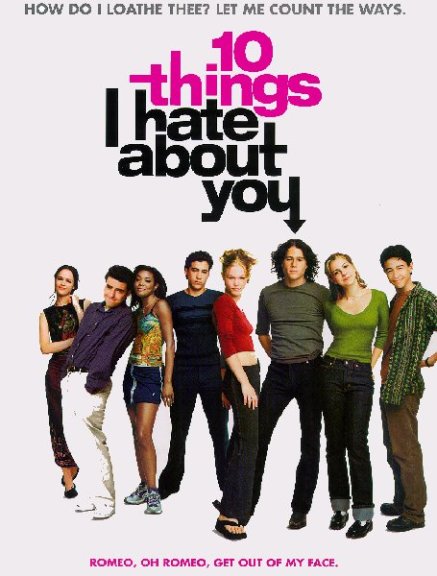
A few nights ago, my sister Erin and I watched the 1999 high school-set romantic comedy 10 Things I Hate About You for like the hundredth time.  Seriously, we love this movie so much and, in fact, just about everyone that we know seems to love it as well.  10 Things I Hate About You is one of those films that brings people together.  If you like this movie, I’ll probably like you.

(Want to see true displays of spontaneous sisterhood?  Go to Girlie Night at the Alamo Drafthouse when they’re showing 10 Things I Hate About You.  You will walk out of the movie with a hundred new best friends.)

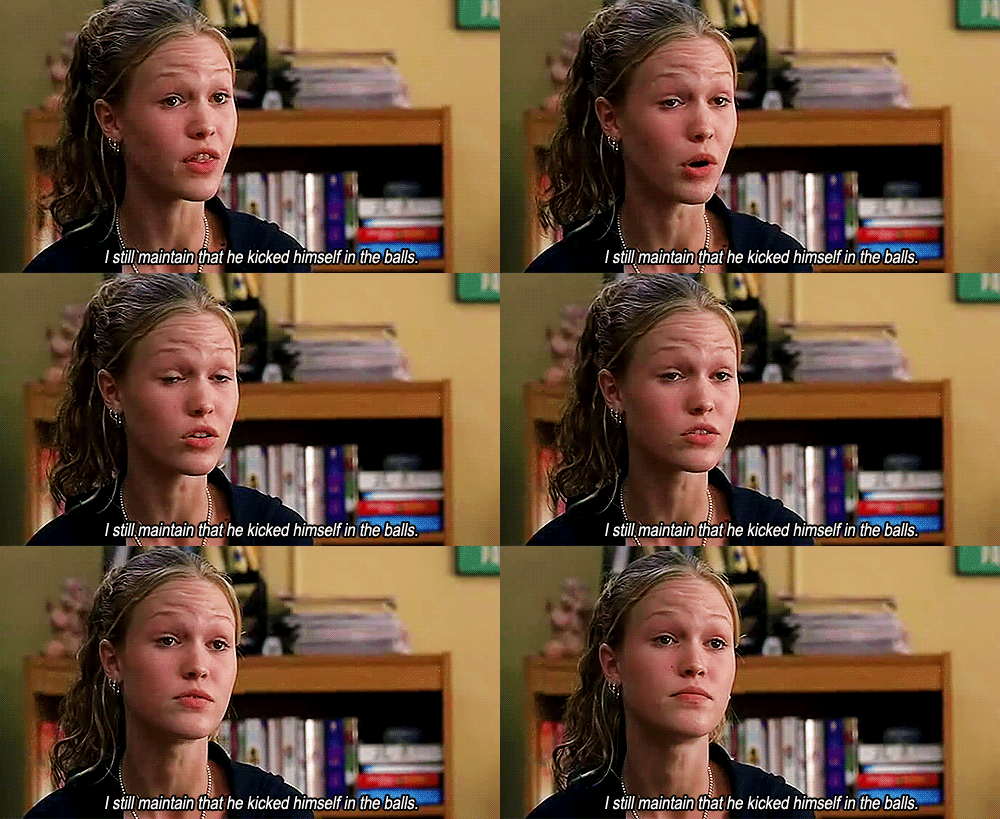
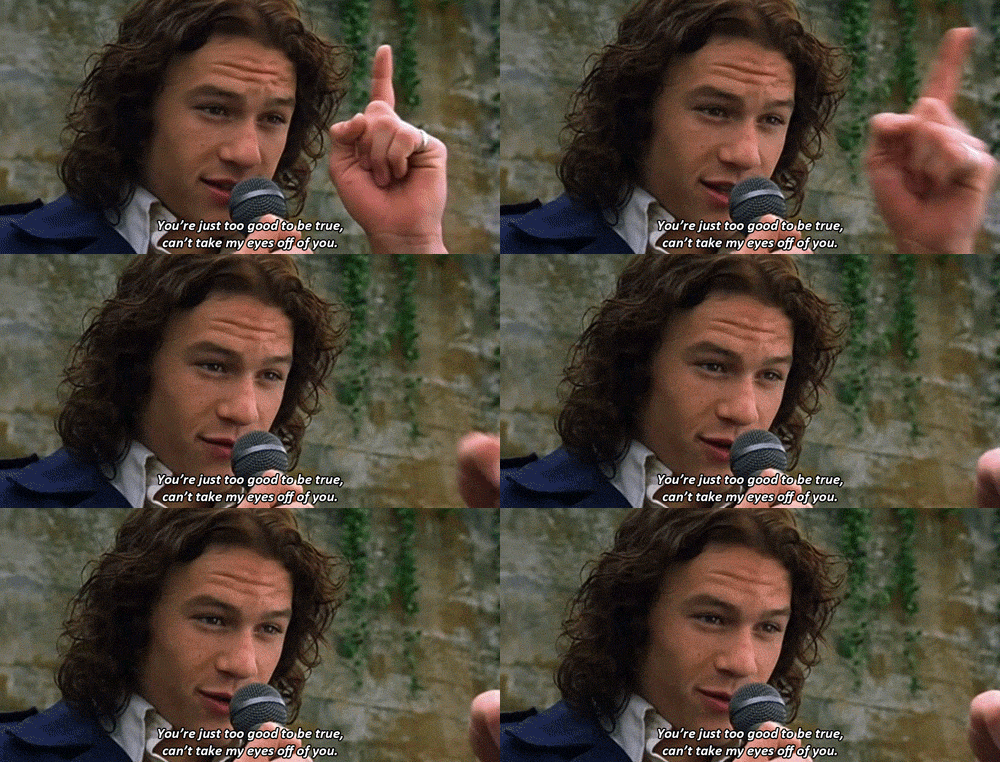
Why do people love 10 Things I Hate About You?  There’s a lot of reasons.  I love Heath Ledger singing Can’t Take My Eyes Out Of You.  I love watching Joseph Gordon Levitt at his most adorable.  I love that it’s a film about two sisters, largely because I have three older sisters and there is so much about the scenes between Kat (Julia Stiles) and Bianca (Larisa Oleynik) to which I could relate.  I love the film’s quirky sense of humor and its unapologetically big heart.  I love the way the film’s script expertly balances cynicism with sentimentality and humor with warmth.  I love the fact that movie takes in place in beautiful houses and features beautiful people wearing beautiful clothes.  What Erin and I especially love about this film is that, as played by Julia Stiles, Kat is just a kickass chick.

flawless-queen-kat-stratford-16681703

Of course, there’s a reason for that.  Much as how the superficially similar Clueless was adapted from Jane Austen’s Emma, 10 Things I Hate About You is adapted from Shakespeare’s play The Taming of the Shrew.  Oddly enough, Shakespeare’s plays seem to translate well into stories about high school.  Maybe it’s because his characters are so often motivated by jealousy, romance, and — it must be said about some — by pure stupidity.  10 Things I Hate About You is definitely one of the best of the teen Shakespeare films.

Taking place at an upper class high school, 10 Things I Hate About You opens with Cameron James (Joseph Gordon-Levitt) arriving for his first day at Padau High School and quickly befriending the only slightly less adorable Michael Eckman (David Krumholtz).  Cameron wants to ask out the beautiful and innocent Bianca (Larisa Oleynik) but Bianca’s overprotective father (played by Larry Miller) has decreed that Bianca can only date if her older sister Kat (Julie Stiles) is also dating.  The problem is that all of the boys at school are scared of the outspoken Kat.

So, Cameron convinces the hilariously vapid male model Joey Donner (Andrew Keegan) to pay the school rebel, Patrick Verona (Heath Ledger, so handsome and charismatic and sexy), to ask Kat out on a date.  Joey, you see, wants to date Bianca as well but Cameron is sure that he can win Bianca away from Joey…

Yes, it’s all a little bit complicated but then again, Shakespeare often is.  For that matter, so is high school.

10 Things

What matters is that all of this leads to a collection of classic scenes and classic dialogue.  What’s my favorite scene from 10 Things I Hate About You?  There’s so many that it’s difficult to narrow it down to just one.  There’s the huge party where Joey continually strikes a pose and a drunk Kat ends up dancing on a table.  There’s the wonderful scene where Patrick serenades Kat.  Or how about when Kat reads the poem that gives the film its title.  But for me, my favorite scene is that one where, after spending nearly the entire film as rivals, Kat and Bianca finally talk to each other as sisters.  Bianca demands to know why Kat won’t go to the prom.  Kat tells Bianaca about her own previous history with Joey.  It’s a low-key and heartfelt scene, wonderfully played by both Larisa Oleynik and Julia Stiles, and I love it just because I’ve had similar conversations with all of my sisters.

planet-loser

I suppose this is where I should make some clever comment about having “10 things I love about 10 Things I Hate About You” but actually, there’s more like a 100 things I love about 10 Things I Hate About You.

This movie makes me happy every time I see it.

And, really, what else can you ask a film to do?

tumblr_ms08c08EbP1sezoa7o1_250