Rainbow Valley (1935, directed by Robert N. Bradbury)


In the early 1900s, the town of Rainbow Valley is trying to complete a road that will connect it to another town.  Outlaw Rogers (LeRoy Mason) doesn’t want that road finished because he wants to buy up all the land around Rainbow Valley.  He brings in a hired gun named Galt (Jay Wilsey) to intimidate the townspeople.  When a traveler named John Martin (John Wayne) saves mail carrier George Hale (George “Gabby” Hayes) from the outlaws, the townspeople ask Martin to serve as their marshal and to help finish the road.  Martin agrees but it turns out that he and Galt have a history.

This was one of the B-westerns that John Wayne made before Stagecoach made him a major star.  Wayne gives a confident performance as John Martin.  It’s about as close to a traditional John Wayne performance as you are likely to find in his early films.  It’s a good and short western, with enough gunfire and tough talk to appeal to fans of the genre.

The most interesting thing about this film is that it takes place at the turn of the century, when the old west was being replaced by the modern world.  Everyone in town is amazed that George Hale drives a car.  John says that it’s the first car that he’s ever actually seen.  Of course, this is a western and all the important work is done on horseback.  The best part of the movie is when George realizes that he and Miss Eleanor (Lucille Brown) can’t drive to warn John about an ambush because the car is out of gas and there’s not a filling station to be found.  Eleanor can’t ride a horse so he does the next best thing.  He has the horses pull his Model T like a wagon!

Four years after this movie came out, John Wayne starred as The Ringo Kid in Stagecoach.  In Rainbow Valley, he showed that he was already a star.
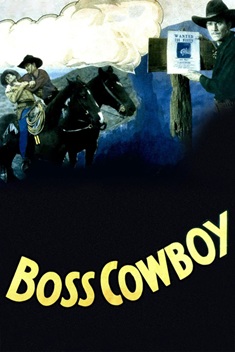
Boss Cowboy (1934, directed by Victor Adamson)


Boss Cowboy takes place in the 30s but it’s very much a western.  One car shows up and telephone poles dot the countryside but almost everyone in the movie rides a horse.  The Nolans and the Rosses are two ranching families.  Both families are losing cattle.  Nolan foreman Dick Taylor (Buddy Roosevelt) suspects that the culprit is the Ross foreman, Jack Kearns (George Cheseboro) and he’s right.  Kearns is ripping off both families.  Complicating Taylor’s effort to stop Kearns are his romantic feelings towards Mary Ross (Frances Morris), who is visiting from “back east.”  Sally Nolan (Fay McKenzie) is also visiting and running joke is her handing off her small dog to a ranch hand named Slim (Alan Holbrook).

No apparent relation to either Teddy or FDR, Buddy Roosevelt was a respected stunt man who tried his hand at starring in a few westerns,  Unfortunately, Buddy Roosevelt wasn’t much of an actor, which is painfully apparent while watching him in Boss Cowboy.  He’s fine when he’s riding a horse and pulling a gun but when he has to speak, it’s difficult to watch.  As bad as Buddy Roosevelt’s acting was, he was not the worst actor in Boss Cowboy.  That honor was split between Frances Morris and Fay McKenzie.  Boss Cowboy is pretty dull.  Every scene drags and there are plenty of awkward silences while the cast tries to remember their lines.

Though he wasn’t much of an actor, Buddy Roosevelt remained in a demand as a stunt man throughout the 40s.  In the 50s and 60s, he was kept busy playing townsmen in shows like The Life and Legend of Wyatt Earp.  In 1962, he made his final film appearance in The Man Who Shot Liberty Valance.  He then retired to Colorado, where he did at age of 75 in 1973.  In all, his Hollywood career spanned 46 years, from 1916 to 1962.


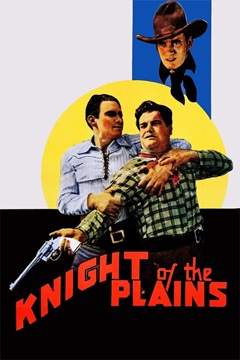
Knight of the Plains (1938, directed by Sam Newfield)


Clem Peterson (Richard Cramer) has a plot to force all of the ranchers in the valley to give up their land.  He gives a phony land claim to Carson (John Merton), who presents himself as being a Mexican nobleman.  In a situation like this, you need a singing cowboy and luckily, there’s one nearby.  Fred (Fred Scott) and Fuzzy (Al St. John) get involved after their cattle are stolen by Clem and his men.  Fred not only fights to save the ranchers but he also sings a song or two.

Singing cowboy films are always strange.  Cowboys who ride horses and pull guns and get into fistfights should not also be tenors.  Fred Scott looks convincing on a horse and he has one heck of a fistfight towards the end of the movie but he’ll also start singing at the drop of a hat and it just doesn’t feel right.  John Wayne did a few singing cowboy films early in his career and he could usually pull it off.  Fred Scott wasn’t much of an actor and had a forgettable screen presence.  He had a good voice, though.

This film was produced by Stan Laurel, of Laurel and Hardy fame.  Always read those credits.  You never know who you might find.

Idaho Kid (1936, directed by Robert F. Hill)


When the wife of rancher Clint Hollister (Earl Dwire) died in childbirth, Clint was so distraught that he rejected his son, Todd.  Todd was raised by a rival rancher, John Endicott (Lafe McKee).  Hollister resented Endicott for taking his son and a feud developed between the two families.  Hoping the end the feud, 15 year-old Todd ran away from home and made a new life for himself as a frontier scout named Idaho.

15 years later, Idaho (Rex Bell) returns home with his sidekick, a reformed outlaw known as The Kid (David Sharpe).  Neither Hollister nor Endicott recognize Idaho and, without revealing his identity, Idaho tries to stop their feud.  Hollister’s men want to keep the feud going and they manipulate Hollister into challenging his own son to a duel.

Idaho Kid is one of the better B-westerns that Rex Bell made between 1928 and 1936.  Though the film has its share of action scenes, Idaho Kid‘s intelligent script puts more emphasis on character development than most B-westerns, with Hollister especially being portrayed as a complex character as opposed to just a stock western villain.  Rex Bell always seemed authentic whenever he was riding a horse or shooting a gun.  Idaho Kid shows that he could also play more than just a standard western hero.

Though he was being pushed for stardom by Fox Film, Rex Bell voluntarily retired from the film industry in 1936 and instead pursued a career in politics.  He was the Lieutenant Governor of Nevada when he died of a heart attack in 1962.