Film Review: The Panic In The Needle Park (dir by Jerry Schatzberg)


The 1971 The Panic in Needle Park tells the story of two young lover in New York City.

Helen (Kitty Winn) is an innocent runaway from Indiana who, when we first meet her, has just had a back alley abortion.  Her boyfriend, Marco (Raul Julia), doesn’t seem to be too concerned about her or anyone else for that matter.  Instead, it’s Marco’s dealer, Bobby (Al Pacino), who checks in on Helen and who visits her when she eventually ends up in the hospital.  It’s also Bobby who gives her a place to stay after she gets out of the hospital.

Bobby is a small-time dealer.  He’s not book smart but he knows how to survive on the streets and it’s hard not to be charmed by him.  He literally never stop talking.  As he explains it to Helen, he’s been in jail 8 times but he’s not a bad guy.  His brother, Hank (Richard Bright, who also co-starred with Pacino in The Godfather films), is a burglar and he legitimately is a bad guy but he and Bobby seem to have a close relationship.  Bobby also swears that he’s not a drug addict.  He just occasionally indulges.  It doesn’t take long to discover that Bobby isn’t being completely honest with either Helen or himself.

Together, Bobby and Helen ….

Well, they don’t solve crimes.  In fact, they really don’t do much of anything.  That’s kind of the problem with movies about drug addicts.  For the most part, drug addicts are boring people and there’s only so many times that you can watch someone shoot up before you lose interest.  Heroin may make the addicts feel alive but, with a few notable exception (Trainspotting comes to mind), it’s always been a bit of a cinematic dead end.  The film takes a documentary approach to Bobby and Helen’s descent into addiction and it’s not exactly the most thrilling thing to watch.

Bobby and Helen live in an area of New York that’s known as needle park, largely due to the fact that it’s full of addicts.  It’s a place where people sit on street corners and nod off and where everyone’s life is apparently fueled by petty crime.  An unlikable narcotics detective (Alan Vint) occasionally walks through the area and tries to talk everyone into betraying everyone else.  It turns out that being a drug addict is not like being in the mafia.  Everyone expects you to betray everyone else.

As I said, it’s a bit of a drag to watch but you do end up caring about Bobby and Helen.  They come across as being two essentially decent people who have gotten caught up in a terrible situation.  Even when they piss you off, you still feel badly for them because you know that they’ve surrendered control of their lives to their addictions.  It helps that they’re played by two very appealing actors.  This was only Al Pacino’s second film and his first starring role but he commands the screen like a junkie James Cagney.  Meanwhile, making her film debut, Kitty Winn gives a sympathetic and likable performance as Helen.  You watch Winn’s vulnerably sincere performance and you understand why Helen would have looked for safety with undeserving losers like Marco and Bobby and, as a result, you don’t hold it against her that she seems to be addicted not just to heroin but also to falling for the wrong men.  Helen does a lot of stupid things but you keep hoping that she’ll somehow manage to survive living in needle park.

Pacino, of course, followed-up The Panic In Needle Park with The Godfather.  As for Kitty Win, she won best actress at Cannes but the role didn’t lead to the stardom that it probably should have.  Her best-known role remains playing the nanny in The Exorcist.

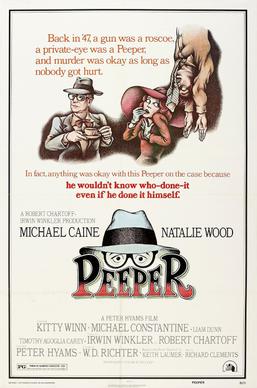
Peeper (1975, directed by Peter Hyams)


Peeper gets off to a good start, with a Humphrey Bogart look alike standing on a dark street corner and reading the opening credits in a reasonable approximation of Bogart’s unmistakable voice.  It all goes down hill from there.

Peeper stars Michael Caine as Leslie C. Tucker, a cockney private detective who is working in Los Angeles in the late 40s.  Tucker is hired by a shady businessman named Anglich (Michael Constantine).  Anglich explains that he knows that he has a daughter but he doesn’t know who or where she is.  He wants Tucker to track her down.  It doesn’t take much time for Tucker to conclude that Anglich’s daughter might be a member of the wealthy and quirky Pendergrast family.  In fact, Tucker thinks that Anglich’s daughter might be Ellen Pendergrast (Natalie Wood, who seems to be bored with the role).  It should be a simple enough case to solve but there are numerous complications along with two thugs (played by Timothy Carey and Don Calfa) who, for some reason, are out to get Anglich and Tucker.

It’s hard to know what to make of Peeper.  It’s meant to be an homage to the detective films of the 40s but it also tries to parody the genre.  Unfortunately, Peter Hyams has never been a director known for his light touch and, in this film, his idea of comedy is to have everyone shout their lines.  (Michael Constantine is the worst offender.)  Michael Caine is also miscast in the lead.  The film tries to get some comedic mileage out of Caine delivering Bogart-style dialogue in his cockney accent but it’s a joke that’s never as funny as the film seems to think.

Peeper was a critical and box office failure but fortunately, there were better things in store for both Michael Caine and Peter Hyams.  Hyams went on to direct Capricorn One while Michael Caine established himself as one of the most durable character actors around.

Horror on the Lens: The House That Would Not Die (dir by John Llewellyn Moxey)


Today’s horror on the lens is a 1970 made-for-TV movie called The House That Would Not Die!

In this film, Barbara Stanwyck and Kitty Winn move into a colonial house that is rumored to be haunted!  Seances, possession, and scandal follows!  There’s time travel, slow mo, an exaggerated wind effects!  It’s all kinda silly but kinda fun too.

Enjoy!

Horror Film Review: Exorcist II: The Heretic (dir by John Boorman)


Exorcist2poster

The Exorcist is one of the greatest horror films of all time and a personal favorite of mine.  But what about Exorcist II: The Heretic?  Well, it would be a bit of an understatement to say that The Heretic has not quite received the amount of critical acclaim as the first film.  Since it was first released in 1977, The Heretic has been widely considered to be one of the worst sequels of all time.  It’s a film that is often cited as evidence as to why not all successful films need a follow-up.

Myself, I have sat through The Heretic twice.  And yes, it is a pretty bad film but I have to admit that I enjoyed it each time that I saw it.  It’s not a scary film at all.  It’s not a successful horror film.  But, as an unintentional comedy, it’s hilarious.

The Heretic opens four years after the end of The Exorcist.  Father Merrin (Max von Sydow) is dead, having had a heart attack during the first film while performing an exorcism on Regan MacNeil (Linda Blair).  In the years since, some in the Vatican have cast doubt on whether or not Merrin actually performed exorcisms.  It turns out that, contrary to everything that we saw in the first film, Father Merrin was actually something of a rebel.  His teachings are controversial.  For instance, he was convinced that everyone has latent psychic powers and that the demon Pazuzu possesses those who have the potential to be the strongest psychics.  Why?  Because those people have the ability to lead humanity into a shared global consciousness and…

Well, it gets a little bit complicated.  That’s one of the big differences between The Exorcist and Heretic.  The Exorcist kept things relatively simple.  The Heretic drags in a lot of metaphysical argle bargle.

The deceased Father Merrin has been brought up on charges of heresy.  The Cardinal (Paul Henreid, many, many years after Casablanca), assigns Father Lamont (Richard Burton) to investigate the circumstances surrounding Father Merrin’s final exorcism.

The presence of Richard Burton is what elevates Heretic from merely being bad to being so bad that it’s good.  As written, Father Lamont is supposed to be something of a naive idealist, someone who never met Father Merrin but who has been intrigued by his writings.  Reportedly, several youthful actors turned down the role and eventually, production decided to make Lamont an older man and they ended up casting Richard Burton.  Speaking in a shaky rasp and staring at the camera with bloodshot eyes, Burton appears to be at the height of his famous self-loathing in this film.  Burton is so miscast as an idealistic priest that the film becomes fascinating to watch.  Occasionally, the film tries to make us suspect that Lamont himself may be possessed but with Burton snarling his way through the role, how could anyone tell the difference?

Lamont tracks Regan down in New York.  Regan doesn’t remember a thing about the exorcism and appears to be an overly happy teenage actress.  (A good deal of the movie is devoted to her rehearsing a big dance number.)  She is under the care of psychiatrist Gene Tuskin (Louise Fletcher).  Tuskin has a device called the Synchronizer.  When two people are hooked up to it, they can literally see into each other’s minds.  They can share the same memories.  They can … wait a minute.  What the Hell?  The Synchronizer essentially appears to be little more than a blinking light but it can actually allow you to enter into someone else’s mind?  Doesn’t that seem like that should be a big deal?

Well, it’s not.  Everyone pretty much just shrugs and accepts it…

Through the use of the Synchronizer, Reagan, Lamont, and Tuskin get to watch a lot of scenes from the first Exoricst.  It also allows Father Lamont to have visions of Africa and another exorcism, this one involving a young boy named Kokumo.

This leads to one of my favorite parts of the film; Richard Burton wandering around a dusty African market and randomly telling people, “I am looking for Kokumo.”  It turns out that Kukomo has grown up to be a doctor and he’s now played by James Earl Jones, who appears to be amused by his dialogue.  Also showing up in the film’s Africa scenes is Ned Beatty.  Beatty plays a pilot who flies Lamont to Kokumo’s village.  “Have you come here before?” Beatty asks.  “Once … on the wings of a demon,” Lamont replies.

Well, okay then…

The first Exorcist worked largely because William Friedkin directed it as if he was making a documentary.  John Boorman takes the exact opposite approach here, trying to turn a cheap sequel into a metaphysical meditation on good, evil, and nature.  It’s amazingly pretentious and it would actually be rather annoying if not for the fact that Burton doesn’t make the slightest bit of effort to come across as being in any way emotionally or intellectually invested in his over-the-top dialogue.  When you combine Burton’s overwhelming cynicism with Linda Blair’s nearly insane perkiness, Louise Fletcher’s genial confusion, and James Earl Jones’s cheerful humor, the end result is something that simply has to be seen to be believed.

So, yes, The Heretic is as bad as you’ve heard.  But that doesn’t mean you shouldn’t watch it.