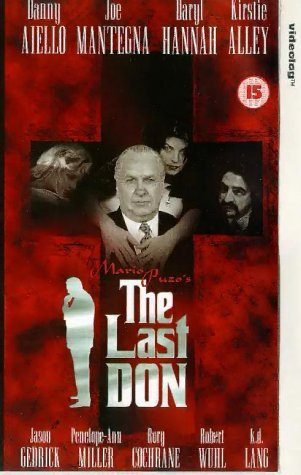
Miniseries Review: Mario Puzo’s The Last Don (dir by Graeme Clifford)


First broadcast over three nights in 1997, The Last Don tells the story of a powerful and respected Mafia family. They control politicians across the country and they own casinos in Vegas and their power even extends all the way to Hollywood. Despite having many enemies, the family has thrived due to the leadership of a wise but ruthless Don.  This Don remembers the old ways and imparts lessons about honor to the members of his own family.  Never let anyone know what you’re thinking.  Never side against the family.  If someone like you were to make enemies, they would become the Don’s enemies and then they would fear you …. you know, stuff like that.

However, times are changing and America is changing with it.  The underworld is no longer run by men of honor.  On top that, the Don is aging and in ill-health. Who will succeed him? One possible successor is respected by all but he’s stayed out of the dirtier aspects of the family’s business and, in fact, he seems to have no desire to be a feared man.  Another possible successor is ruthless and has a terrible temper.  He sometimes speaks out of turn, because the Don has a sentimental weakness for his children.  This possible successor’s anger is feared but perhaps fear is the future of the organized crime in America.  The old ways are changing but one thing remains the same.  The Don believes in America and he believes in family and….

Wait.

Okay, is it just me or does this all sound just a little bit familiar?

If it does, that’s probably because The Last Don is based on a novel by The Godfather‘s Mario Puzo.  Though the family may be called The Clerichuzios and the action may have been moved fro the 40s and the 50s to the 60s, 70s, and 80, the story is still the same basic one that was told in The Godfather.  Don Clerichuzio (Danny Aiello) is an honorable man whose time is coming to an end.  His grandnephew, Cross (Jason Gedrick), is the possible successor who isn’t crazy.  His grandson, Dante (Rory Cochrane), is the possible successor who is violent and doesn’t know how to negotiate.  Don Clerichuzio’s dream is for the family to become completely legitimate but good luck with that when the film business and the political world are just as corrupt as the Mafia.  I supposed one could argue that The Last Don is narrated by Don Clerichuzio while The Godfather has no narration at all but, seriously, once you have to add a voice-over to explain what’s going on, you have pretty much already last the war.

And yes, I did mention the film business.  When Francis Ford Coppola first read The Godfather, he famously hated the Hollywood sections of the book and, with the exception of Tom Hagen’s visit to Jack Woltz (and Woltz’s subsequent discovery of a horse’s head in his bed the next morning), Coppola refused to include them in the movie.  The second half of The Last Don, however, goes full Hollywood and, more or less, proves Coppola’s point.  Cross’s sister, Claudia (Michelle Burke, who also co-starred with Cochrane in Dazed and Confused), gets a job as an agent and one of her clients is the world’s most famous actress, the ludicrously named Athena Aquataine (Daryl Hannah).  When Athena has trouble with her crazy ex-husband (Chris Meloni, bringing a spark of genuine danger to the production), Cross helps her out, falls in love, and gets involved in the production of her next film.  This brings him into conflict with a studio exec named Bobby Bantz (Robert Wuhl).  Unfortunately, all of the Hollywood stuff is pretty dull.  One gets the feeling that Puzo was perhaps settling some old scores with the character of Bobby but Robert Wuhl is one of those goofy actors who belongs nowhere near a Mafia drama.  And don’t even get me started on country singer k.d. lang, who is bizarrely cast as a film director.

(Add to that, how can anyone take a character named Athena Aquataine seriously?  I never miss an Athena Aquataine movie!))

The Hollywood stuff distracts from the Mafia stuff, which is unfortunate because the Mafia stuff is at least occasionally interesting and it’s certainly better-acted than the Hollywood scenes.  Joe Mantegna plays Pippi, who is Cross’s father and who, years earlier, killed Dante’s father.  (Mantegna’s always good but it’s a struggle to take any character named Pippi seriously.)  Kirstie Alley plays Rose Marie, who is Dante’s mentally unstable mother and the Don’s only daughter.  Aiello, Mantegna, and Alley all give good performances, as do Burt Young and Seymour Cassel in the roles of family associates.  As for the “younger generation” of Clerichuzios, Gedrick is a bit dull but then again, Cross isn’t a very interesting character.  The slightly-built Cochrane is miscast as Dante but ultimately, that miscasting kind of works in that it reminds us that, due to his father being the scion of a rival family, Dante is destined to always be viewed as being an outsider.

As I said earlier, The Last Don was originally broadcast over three nights.  I watched the whole thing — all five hours of it — in one sitting and, yes, it was a bit of an endurance test.  It’s not just that it’s long but also that it keeps getting bogged down in all of the Hollywood stuff.  You don’t watch a film like this because you want to spend five hours watching Robert Wuhl mug for the camera.  You watch a film like this for the Mafia action and, for a film called The Last Don, there really wasn’t enough Mafia action.  It has its moments but it never feels as authentic as The Godfather, Casino, Goodfellas, The Irishman, The Sopranos or any of the other classic films and shows about the Mafia..  The Last Don needed to be extremely Italian but instead, it was only slightly Italian.  Robert Evans famously said that Coppola was selected to direct The Godfather because Coppola would make audiences “smell the pasta.”  There’s very little pasta in The Last Don.
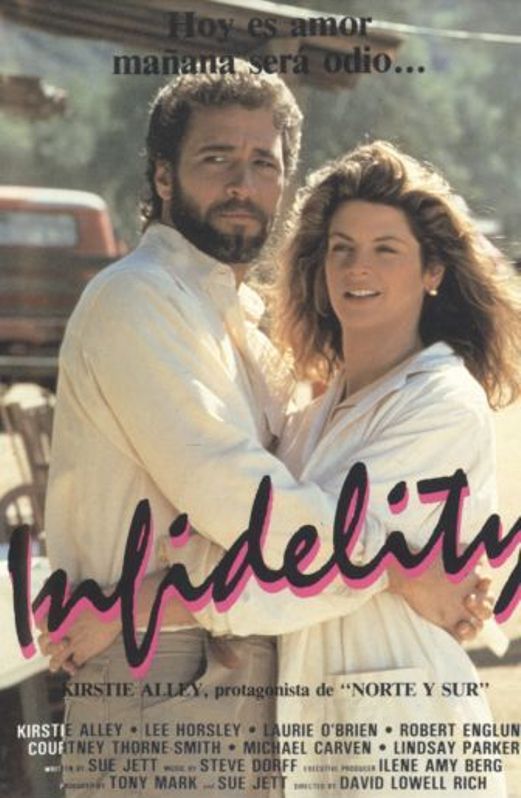
Infidelity (1987, directed by David Lowell Rich)


Nick Denato (Lee Horsley) is a world-famous photographer.  His wife, Ellie (Kirstie Alley!), is a renowned doctor.  They have homes in San Francisco and Africa and they regularly fly from one continent to another.  The Denatos used to be called “jet-setters,” back when flying back and forth was seen as a positive instead of as a crime against the environment.

Despite the fact that Ellie is pregnant, Nick leaves his wife behind in San Francisco so that he can explore Nepal with his buddy Scott (Robert Englund!!) and Scott’s young and leggy assistant, Robin (Courtney Thorne-Smith!!!!).  While Nick is away, Ellie has a miscarriage.  Nick flies home but it’s too late.  His wife already resents him for not being there when she needed him.  It doesn’t help that, a week later, Scott and Robin come to visit and Scott tells a story about how he nearly fell off a cliff.  “And where were you, buddy!?”  Scott says to Nick with a laugh, forgetting that Nick was back home with his hospitalized wife.  An awkward silence follows.

Ellie can tell that there is an obvious attraction between Nick and Robin.  Nick denies it and then, to prove Ellie wrong, he cheats on her but not with Robin.  Instead, Nick cheats with Ellie’s best friend, Eileen (Laura O’Brien).  Ellie divorces Nick, stops talking to Eileen, and gets involved with Etienne (Michael Carven).  Nick returns to Africa, where he spends his nights listening to opera in a tent and thinking about how much he loves his his ex-wife.

Infidelity was made for television and it used to come on late night television frequently in the 90s, mostly because of its cast.  Not only did the cast features Rebecca Howe but also Freddy Krueger and whoever it was that Courtney Thorne-Smith played on Melrose Place.  The main problem with the film is that Kirstie Alley and Lee Horsley have zero chemistry so you don’t really care if they get divorced or if they get back together.  The other problem is that Lee Horsley is a convincing cowboy but he’s not as convincing as a sophisticated Italian-American photographer who spends his spare time listening to opera.  The movie also cops out by having Nick cheat with a fairly minor character rather than with Robin.  On the plus side, the movie’s got Robert Englund playing the type of role that he almost always played in his pre-Nightmare on Elm Street days, the loyal friend.  What’s interesting about Englund’s performance here is that he had already played Freddy Krueger three times before playing Scott in Infidelity.  In fact, Infidelity aired at the same time that Nightmare on Elm Street 3: Dream Warriors was still playing in theaters.  Englund is likable as Scott and the film shows what type of career Englund probably would have had if David Warner hadn’t turned the role of Freddy down in the first Nightmare on Elm Street.


Horror Film Review: Village of the Damned (dir by John Carpenter)


At the risk of getting in trouble with at least a few people around the TSL offices, I am going to say something right now.  It may be controversial.  It may be shocking.  It may even make you question your belief in whatever it is that you believe in.

Ready?

Here we go:

I do not think that the 1995 version of Village of the Damned is that bad.

Now, please notice that I didn’t say that I thought it was that great, either.  However, when you listen to some people talk about this movie (which, admittedly, doesn’t seem to happen a lot), they make it sound as if Village of the Damned is one of the worst films ever made.  It is usually cited as being a waste of director John Carpenter’s abilities and Carpenter himself has said that he’s indifferent to the film.  Carpenter has gone as far as to call the film a “contractual assignment.”

Of course, one reason why people dislike the 1995 Village of the Damned is because it’s a remake of an acknowledged classic.  Even worse, it’s an unnecessary remake.  I would not disagree with that opinion.  The 1960 Village of the Damned holds up remarkably well, featuring George Sanders at his best and a lot of creepy little children.  (If anything, the fact that the original is in black-and-white makes the children look even creepier in the original.)  Having recently watched both versions of Village of the Damned, I can say that the remake doesn’t really improve on the original.

And yet, I would still argue that John Carpenter’s Village of the Damned is an underrated and crudely effective little movie.

The film tells the story of the town of Midwich, California.  (The original film took place in the UK and Midwich doesn’t really sound like the name of a town you’d find in California.  Incidentally, my favorite town in California is a place named Drytown, specifically because the town bar advertises itself as being “the only wet place in Drytown.”)  Midwich is a nice, little town.  Everyone is friendly.  Everyone knows everyone else.  Carpenter spends a while establishing Midwich as being the idealized coastal town.  But then, one day, the skies turn dark and everyone in Midwich loses consciousness.  Unfortunately, that doesn’t work out well for some people.  Frank McGowan (Michael Pare), for instance, is driving when the blackout occurs and he ends up dying when his truck goes off the road.  Another unfortunate fellow was manning the grill at the church picnic and, when he passed out, he ended up burning to death.

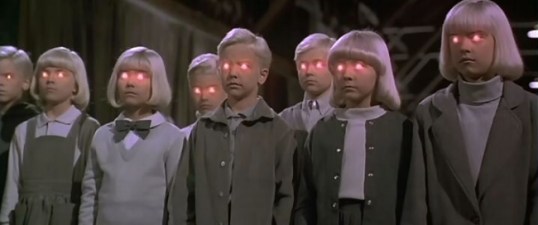
When everyone does wake up, it’s discovered that ten women are now pregnant.  One of them, Kate (Linda Kozlowski), is the widow of Frank.  Another, a teenage girl named Melanie (Meredith Salenger), is a virgin.  Nine months later, all of the babies are born on the same night, though Melanie’s is stillborn.  The 9 babies eventually become 9 very creepy children.  They have pale skin, white hair, glowing eyes, and no emotions.  Soon the government, led by Dr. Verner (Kristie Alley), invades the town so that they can investigate and experiment on the children.  You know that once the government shows up and takes over, everyone’s screwed.

And, while all of this is going on, the once friendly and vibrant town of Midwich becomes a far different place.  We watch as the citizens of the town die, one after another.  Melanie finds herself ostracized and abandoned.  The local reverend (Mark Hamill) goes insane and ends up perched on a hill with a rifle.  The town doctor (Christopher Reeve) loses his wife when she walks into the ocean.

And the children continue to coldly and unemotionally kill anyone who displeases them.  One man is forced to shoot himself.  In perhaps the film’s most disturbing scene, a scientist is forced to dissect herself.

Admittedly, some of the actors do a better than others.  Meredith Salenger gives the best performance while Mark Hamill definitely gives the worst.  At first, Kirstie Alley seems miscast but she actually gives one of the better performances in the film.  As the nominal hero, Christopher Reeve is boring but then again, many small town doctors are.  Of course, nearly everyone in the movie is dead by the time the end credits roll.

It’s a seriously dark movie and, when taken on its own terms, it’s definitely effective.  Carpenter does such a good job of establishing Midwich as a place where anyone would want to live that it does carry an impact to see the town suddenly isolate from the world and the once happy citizens resorting to suicide just to escape the town’s children.  In the end, John Carpenter’s Village of the Damned does capture the anguish of feeling as if there’s no escape from the present nor hope for the future.

Village of the Damned is crudely effective but effective nonetheless.