Lisa Marie Reviews The Oscar Winners: The Bad and the Beautiful (dir by Vincente Minnelli)


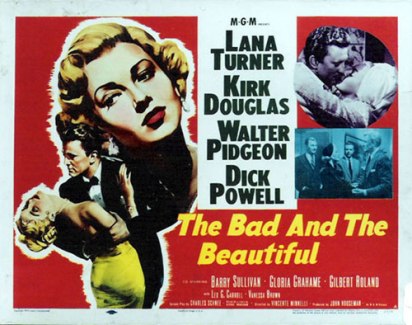
BadAndTheBeautiful1952hs800

What can I say about The Bad and the Beautiful?

Released in 1952 and directed by Vincente Minnelli, The Bad and the Beautiful is arguably one of the greatest films ever made.  It’s certainly one of my favorite films.

Perhaps appropriately, The Bad and the Beautiful is a film about the movies.

Jonathan Shields (played in a truly amazing performance by Kirk Douglas) is a legendary film producer.  He’s won Oscars, he’s got a reputation for being a genius, and, as the film begins, he is one of the most hated men in Hollywood.  It’s been years since Shields made a succesful film but he thinks that he’s finally come up with a movie that can put him back on top.  His assistant, Harry Pebbel (played with a weary dignity by Walter Pidgeon), invites Hollywood’s best director, actress, and screenwriter to a meeting and he proceeds to spend the rest of the film trying to convince them to help Jonathan make his comeback.

The only problem is that all three of them hate Jonathan Shields and have sworn that they’ll never work with him again.  Through the use of flashbacks, we see how each of them first met Jonathan and how each eventually came to despise him.

Director Fred Amiel (Barry Sullivan) first met Jonathan when Jonathan hired him to pretend to be a mourner at his father’s funeral.  With Jonathan’s help, Fred moves up from directing B-movies to finally getting a chance to make his dream movie, an adaptation of a believably pretentious novel called The Far Off Mountain.  With Jonathan’s help, Fred even gets womanizing film star Gaucho Ribera (a hilariously vain Gilbert Roland) to agree to star in Fred’s movie.  Jonathan also introduces Fred to Georgia (Lana Turner), the alcoholic daughter of Jonathan’s mentor.

Jonathan eventually makes Georgia into a film star and Georgia falls in love with him.  Of all the major actresses of the 1950s, Lana Turner seems to get the least amount of respect from film historians.  She’s more remembered today as the epitome of glamour and scandal but, in The Bad and the Beautiful, Turner gives one of the best performances of her career.  In her best scene, Georgia has a nervous breakdown while driving in the rain and, for those few minutes, you forget that you’re watching an iconic film star.  Instead, you’re just amazed by the performance.

Finally, the screenwriter is James Lee Bartlow (Dick Powell), an intellectual novelist who is brought to Hollywood by Jonathan.  While the reluctant Bartlow finds himself being seduced by J0nathan, his flighty wife (Gloria Grahame) is seduced by Gaucho.

The Bad and the Beautiful is perhaps one of the few perfect movies ever made, a film that qualifies as both art and entertainment.  There are so many reasons why I love this film that its hard for me to describe them all.  The film snob in me loves the fact that Minnelli directed The Bad and the Beautiful as if it were a classic black-and-white film noir.  The entire film is lit and shot to emphasize shadows and moral ambiguity.  As played by Kirk Douglas, Jonathan Shields is as seductive and dangerous a figure as Barbara Stanwyck in Double Indemnity.  My inner film historian loves the fact that the film is full of barely disguised portraits of real life Hollywood figures like David O. Selznick, Val Lewton, Alfred Hitchcock, and Diane Barrymore.  Finally, and perhaps most importantly, my girly girl side loves that this film is basically a big melodramatic soap opera.  Lana Turner’s outfits are to die for and Jonathan Shields is the ultimate bad boy that we can’t help but love.

The Bad and the Beautiful received 6 Oscar nominations but it wasn’t nominated for best picture.  (This snub is all the more surprising when you consider what the Academy did name as the best picture of 1952 — Cecil B. DeMille’s The Greatest Show on Earth.)  Out of those six nominations, the Bad and the Beautiful won five Oscars.  (Of all the film’s nominees, only Kirk Douglas failed to win.)  As of this writing, The Bad and the Beautiful still holds the record for most Oscars won by a film that failed to be nominated for best picture.

What Lisa Marie Watched Last Night: Eddie Macon’s Run (dir. by Jeff Kanew)


Last night, as morning slowly approached, I curled up on the couch in my comfy Hello Kitty bathrobe and turned the TV over to the Retro Channel, where I watched a film from 1983.  The name of that film?  Eddie Macon’s Run.

Why Was I Watching It?

The short answer is insomnia.  The long answer is that, when I checked the guide to see what was on TV at 3 in the morning, Eddie Macon’s Run was the only film listed that I had never heard of before.  Since my life’s goal is to see every single film ever made, I knew I would have to watch this mysterious Eddie Macon’s Run at some point so I figured, “Why not tonight?”

What Was It About?

Eddie Macon’s running!  Okay, well, there’s actually a little more to it than that…

Eddie (played by John Schneider, who has appeared in countless SyFy films) is a nice, blue-collar guy who finds himself wrongly imprisoned in Hunstville, Texas.  During the prison rodeo, Eddie manages to escape and soon, he’s running down to Mexico where his wife and son are waiting.  Kirk Douglas plays the cop who chases Eddie across Texas.  Whenever Douglas shows up on screen, we hear a saxophone playing on the soundtrack.  Scenes of Eddie thinking about his family are accompanied by country songs that, the credits reveal, were sung by John Schneider.  Yes, it’s that type of film.

What Worked?

To be honest, the main thing that worked for me about this film is that it was shot on location in rural South Texas.  That’s the same part of Texas that my mom grew up in and whenever I would bug her to tell me a story about when she was “my age,” the stories always took place in South Texas and I always enjoy seeing it in films (even if that film, as in the case of this one, goes out of its way to make South Texas seem like the 9th circle of Hell).

John Schneider, all hot and sexy here, gave a surprisingly good performance.

Kirk Douglas, meanwhile, didn’t really give that good of a performance but my God, that man could grimace with the best of them.

A kind of youngish John Goodman shows up for about 2 minutes and the whole process of going, “Oh my God, is that John Goodman!?  I think that is John Goodman!” provided a nice break from the film’s general monotony.

What Did Not Work?

This is one of those films that, though it was filmed in Texas, was obviously made by Yankees.  As such, the movie is full of actors who were obviously imported from up north and who are painful to listen to as they attempt to recreate the accents of South Texas.   

The film, itself, moved about as slowly as the sun going down over the flat plains in North Texas.  Seriously — for a film that featured nonstop running and Kirk Douglas finding about a hundred different ways to clench his jaw, Eddie Macon’s Run sure was boring.  There’s a scene where Eddie is menaced by two ranchers and I swear to God, it seemed to last for a few hours. 

It also quickly became apparent that the only way for the film’s plot to be believable was for every single character in the film to be a complete idiot. 

“Oh My God!  Just Like Me!” Moment

Eddie eventually meets the niece of the governor of Texas (played by Lee Purcell) and she agrees to help Eddie run because it’s “just a slow Wednesday.”  That’s totally why I would get involved with an escaped fugitive as well.

Lessons Learned

Give me a couch and put me in a Hello Kitty bathrobe and I’ll watch anything.


A Quickie With Lisa Marie: Holocaust 2000 (dir. by Alberto De Martino)


Earlier this morning, while suffering from an annoyingly persistent case of insomnia, I decided to spend 2 hours watching a classic Italian exploitation film, Alberto De Martino’s oddly effective Omen rip-off, Holocaust 2000.

In Holocaust 2000, Kirk Douglas plays a businessman who wants to build a gigantic nuclear power plant in the Middle East.  There are a few problems with this plan.  First off, the site that Douglas selects just happens to be right next to a cave that is full of religious artifacts.  Secondly, there’s a handful of angry environmentalists picketing his London office.  And, perhaps the biggest problem, Douglas’ son happens to be the Antichrist.  This fact is obvious to the viewer because not only is his son named Angel (yes, we’re in the land of irony) but he also looks and acts nothing like Douglas.  Not only does Angel have a noticeably weak chin (no cleft to be seen at all) and speak with a rather posh accent but he’s also so extremely English that he’s even played by an actor named Simon Ward.

In other words, the viewer is pretty much in on the game from the beginning.  What makes the movie work is that director De Martino understands that everyone’s going to know that Angel’s the antichrist from the minute he first appears so, as opposed to the Omen films, he doesn’t waste a lot of time playing any “is-he-or-isn’t-he” games.  Instead, in the great tradition of Italian exploitation, De Martino jumps straight into the apocalypse without worrying about things like narrative cohesion and the end result is an enjoyably chaotic film that rarely makes sense but is never boring.  Whereas the Omen films are almost tedious in their attempts to provide theological justification for all the blood that’s spilled on-screen, Holocaust 2000 has a cheerful, let’s-make-it-up-as-we-go-along feel to it that, at times, almost makes the whole thing feel like some long lost Lucio Fulci film.

Holocaust 2000 is probably best known for two sequences.  The first features a helicopter blade very graphically chopping off the top of a man’s head.  If seeing the original Dawn of the Dead made me nervous around helicopters, seeing Holocaust 2000 has ensured that I will never ever step anywhere near one of those things.  Seriously, I’ve seen a lot of gore over the past few years but the decapitation scene in this movie …. well, perhaps it’s best to just shudder and move on.  (For the record, Holocaust 2000 came out before Dawn of the Dead so the helicopter decapitation scene here was not stolen from that film.  If anything, it was simply a more graphic version of David Warner losing his head in the Omen.)

The second sequence is a scene in which a very nude Kirk Douglas (who, it must be admitted, looked a lot better at 61 than most 20 year-olds do today) has a nightmare in which he watches the world literally come to an end.  Set to Ennio Morricone’s intense and memorable score, this sequence manages to be surreal, disturbing, and entertaining all at the same time.  It epitomizes everything that makes Holocaust 2000 such a surprisingly effective work of pure cinematic exploitation.

Like many of the great Italian exploitation films, Holocaust 2000 was released under several titles.  It is currently available on DVD under the title Rain of Fire and a big bleh to Lionsgate for choosing to go with such a boring name.  Admittedly, I can see their logic.  Though the movie was first released in theaters in 1977, it took 31 years for it to show up on DVD.  During that time, 2000 came and went and the world didn’t end (or maybe it did and the last 10 years have just been an extended hallucination, the choice is yours).  But still, Rain of Fire sounds like a substandard country song about a nasty divorce that ends in murder.  On the other hand, a title like Holocaust 2000 — nakedly exploitive and borderline offensive — represents everything that we’ve come to so love about Italian exploitation films.