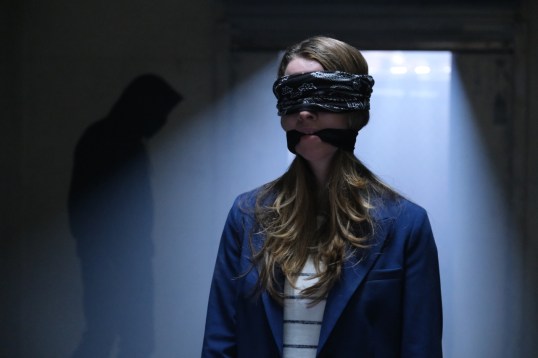
Lifetime Film Review: Abducted On Air (dir by Philippe Gagnon)


Whenever I find myself in need of motivation, I remember the words of Britney Spears:

You want a hot body? You want a Bugatti?
You want a Maserati? You better work bitch
You want a Lamborghini? Sippin’ martinis?
Look hot in a bikini? You better work bitch
You wanna live fancy? Live in a big mansion?
Party in France?
You better work bitch, you better work bitch
Now get to work bitch!

As my fellow TSL writers can tell you, there’s not a day that goes by that I don’t, at some point, shout out, “Get to work, bitch!”  And while that habit has occasionally gotten me a few strange looks around the office, it definitely works.  For instance, I didn’t know if I’d have the strength to write 24 film reviews in one day.  I didn’t even know if it was worth the trouble.  But I just thought to myself, “You better work, bitch!”

Unfortunately, that technique doesn’t work for everyone.  Abducted on Air is about Sasha Bruder (Kim Shaw), a television news reporter who wants to make it to the top without actually having to actually earn it through hard work.  Unfortunately, even though she has an on-air job at a local news station, it doesn’t seem like she’s heading anywhere.  Her boss, Gavin (Bruce Dinsmore), doesn’t respect her and lead anchor Diane Baldwin (Perry Reeves) is the one who gets all the attention.

But then, one day, Sasha does not come into work.  An investigation reveals that she was apparently abducted from the station and that her kidnapping was caught on video!  For days, Sasha and her disappearance dominates the news.  Where is Sasha Bruder and can she be rescued in time?

Of course, what the public doesn’t know is that Sasha set up her own kidnapping and is currently hanging out in a warehouse.  Even though she insists that her co-worker, lover, and collaborator, Aidan Ferguson (Gord Rand), actually blindfold her and tie her up, that’s just so she’ll be able to bring some authenticity to her story when she eventually resurfaces.

Eventually, Sasha does decide to leave the warehouse.  She emerges with a harrowing tale about how she was abducted and everything that she’s been through over the past couple of days.  Sasha becomes a celebrity and is promoted to co-anchor of the morning newscast.  Diane is not particularly happy about that but Gavin doesn’t care.  All Gavin cares about are ratings and Sasha’s bringing them in.

However, faking a kidnapping is not as easy as it may look.  When it looks like the truth about Sasha’s abduction might finally be revealed, Sasha has no choice but to take matters into her own hands….

I enjoyed Abducted On Air.  Admittedly, a lot of that had to do with the fact that I tend to distrust television journalism,  (In many ways, this was a film that seemed like it was specifically designed to appeal to my every bias.)  This is a film about people obsessively trying to climb to the top of one of the the most superficial professions in existence and the fact that everyone in the movie is so obsessed with finding success in a dying industry actually gave Abducted On Air a bit of a satirical edge.  Perrey Reeves and Kim Shaw both gave good performances as the two rival journalists, making this film a fun one to watch whenever you want to imagine what’s going on behind the scenes of your local news broadcast.
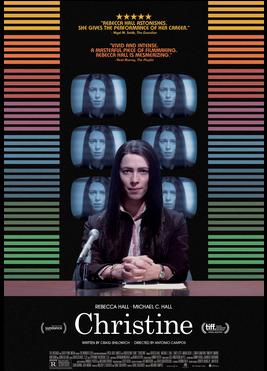
The Things You Find on Netflix: Christine (dir by Antonio Campos)


I really regret that I didn’t get a chance to see Christine when it played here last year.  I wanted to but the movie was only in theaters for a week and then it vanished.

I guess I shouldn’t be too surprised that Christine didn’t become a blockbuster.  I imagine that most potential viewers were turned off by the fact that 1) it wasn’t a remake of the movie about the killer car and 2) it was based on the true story of a reporter who, in 1974, committed suicide on live television.  I imagine that, to many people, the film sounded like it would be indescribably sad.  It certainly sounded that way to me.  That’s why, when the movie opened at the Dallas Angelika, I said, “I’ll see it next week.”  Of course, by the time “next week” rolled around, the movie was gone.

And that’s a shame.  I just watched Christine on Netflix and I discovered that it was one of the best films of 2016.  Yes, it is a sad film but it’s also a frequently fascinating one.  The movie may tell the story of a tragedy but it’s anchored and enlivened by a brilliant performance from Rebecca Hall.  People who love movies, of course, already know that Rebecca Hall is a brilliant actress but, unfortunately, she rarely gets the roles in the films that she deserves.  As of this writing, her most financially successful film was probably The Town and, in that film, she was pretty much wasted in a nothing role.  She is perfectly cast in Christine, perhaps as perfectly cast as any performer could ever hope to be.

Rebecca Hall plays Christine Chubbuck, a reporter who was based in Sarasota, Florida.  In 1974, she started a newscast by announcing, “”In keeping with Channel 40’s policy of bringing you the latest in ‘blood and guts’, and in living color, you are going to see another first—attempted suicide.”  She then drew a gun from a shopping bag that was sitting behind the anchor desk.  As thousands watched, she shot herself in the back of the head.

Along with the gun, the shopping bag had contained the homemade puppets that Christine used whenever she volunteered at the local children’s hospital.  On the anchor desk, among her papers, was a news report that she had written the previous night, announcing that “Local news personality Christine Chubbuck” had shot herself on live television and had been taken to the hospital in critical condition.  Christine, who was reportedly frustrated both personally and professionally, was briefly the number one story in the nation.

One of the more interesting things about the suicide of Christine Chubbuck is that it happened in 1974, long before YouTube, Facebook Live, or Twitter.  Chubbuck’s suicide was only aired once and the footage has subsequently vanished.  If Christine Chubbuck, or anyone else, committed suicide on television today, it would immediately be all over the internet.  We would end up seeing, at the very least, clips of it on an almost daily basis.  Sadly, we would see it so much that we would probably become desensitized to it.  Since Christine Chubbuck’s death was recorded but remains unseen, both she and her suicide have achieved an almost mythical quality.  One can look at the details of Christine Chubbuck’s death and see almost anything that they want.

Christine follows the last few months of Chubbuck’s life.  As played by Rebecca Hall, Christine is confident enough that she can imagine interviewing Richard Nixon but insecure enough to obsess over whether she was nodding too much while the imaginary President gave his imaginary answer.  She lives with her mother (J. Smith-Cameron), a self-described hippie who keeps making references to a breakdown that Christine had in Boston.  When she complains about the pressure that she’s under to sensationalize the news, her boss dismisses her with “You’re a feminist!”  (He says it like an accusation.)  When she gives in and purchases a police scanner so that she can find the stories that the boss is demanding, she ends up spending most of her night listening to two cops brag about “how far” they got with their girlfriends the night before. When she goes to the doctor to complain about chronic stomach pain, she’s told that she has to have an ovary removed and she’ll probably never be able to conceive.  When she thinks that she finally has a date with the man who she’s been crushing on, she is instead dragged to an empty-headed encounter group.  Her group partner has a slick answer for every problem that Christine has until Christine says that she’s thirty and she’s still a virgin.

“Oh,” her partner replies, flummoxed.

In the film, Christine struggles with both depression and, in my opinion, bipolar disorder as well.  Unfortunately, for her mental well-being, she’s a woman in 1974.  The only thing that the world has to offer her are vapid self-affirmation (“I’m okay, you’re okay!  I’m okay, you’re okay!” one co-worker chants at a particularly dramatic moment) and sexist bosses who dismiss what is clearly a manic episode as either “being moody” or “being difficult.”  Speaking as someone who is very sensitive as to how mental health issues are portrayed onscreen, all I can say is that Christine gets it right.

I’m probably making this film sound like the most depressing movie ever made and it’s definitely not a happy film.  I had tears in my eyes by the end of it.  At the same time, it’s also a compulsively watchable character study.  Rebecca Hall gives such a good and brave performance as Christine that you can’t look away, even when you feel like you should.  Rebecca Hall is also ably supported by Michael C. Hall, Tracy Letts, Morgan Spector, Timothy Simons, and Maria Dizzia, who all play her sometimes sympathetic, sometimes annoyed co-workers.

Now, I do think that I should warn anyone from thinking that Christine is a 100% accurate look at Christine Chubbuck’s life and death.  The film left me so moved that I actually did some research and I came across this article from the Washington Post — Christine Chubbuck: 29, Good-Looking, Educated, A Television Personality. Dead. Live and in Color.  After reading the profile, it was easy to see that the film did take some dramatic license.  However, it was also easy to see that Christine gets the essence of the story right.

If, like me, you missed Christine in the theaters, you can now see it on Netflix.  And you should!

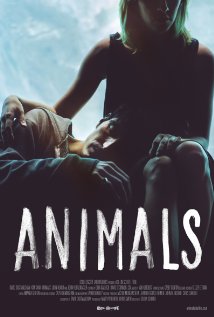
Film Review: Animals (dir by Collin Schiffli)


Animals

Animals is a pretty depressing movie and I guess that’s appropriate since it’s a movie about two heroin addicts.  The script was written by David Dastmalchian, who also plays the role of Jude.  Reportedly, he based the script on his own experiences with drug addiction.  As a result, Animals is one of those movies that is full of believable details.  I’ve never used heroin and I don’t think I ever would.  However, even if there was a chance that I would touch heroin, Animals would probably change my mind.  It’s a seriously dark movie.

And don’t get me wrong — that’s a good thing.  If you’re going to make a movie about two people slowly killing themselves as a result of their drug addiction, the movie probably should be a bit on the dark side.  But, at the same time, that doesn’t necessarily make Animals a lot of fun to watch.

The film tells the story of Jude and his girlfriend, Bobbie (Kim Shaw).  They both come from upper middle class backgrounds, they’re both obviously well-educated (it’s suggested that Jude may have gone to medical school), and — even in the throes of drug addiction — they’re both still attractive enough that they can still blend in with “mainstream” society.  As we see, in a handful of flashbacks, they once owned a comfy apartment together.  Now, they live in a car that they park outside of the Chicago Zoo.  Jude and Bobbie spend most of their time trying to figure out how they’re going to make enough money to get their next fix.

And the best parts of the film are the parts that deal with Jude and Bobbie tricking unsuspecting people out of their money.  As tedious as Jude and Bobbie’s addiction-centered existence may sometimes be, it’s hard not to admire their determination.  Their schemes range from the simple to the complex.  They go to weddings and steal the gifts.  Pretending to be a high-priced online prostitute, Bobbie goes to men’s houses and, after grabbing their money, runs outside where Jude waits for her in a running car.  (Needless to say, none of the men are willing to risk the public shame of calling the police and admitting to how they met Bobbie in the first place.)  Probably their most impressive scheme involves tricking a mall security guard into splitting the reward money for finding a stolen laptop.  Jude and Bobbie are so good at cheating people that you do end up regretting that they couldn’t put their obviously intelligence to less self-destructive uses.

Eventually, of course, one of the two has an overdose and gets taken to the hospital.  For the first time, the two of them are separated and forced to realize just how destructive and co-dependent their relationship really is.  Will they stay apart and get clean or will true love (and heroin addiction) conquer all?

There’s a really harrowing scene in which Jude and Bobbie are harassed by some undercover cops who turns out to be just as brutal as the drug dealers that they claim to be fighting.  And both Shaw and Dastmalchian give good performances.  Even John Heard gets to play a character who isn’t a scheming and corrupt government official.  There’s a lot to admire about the film but, ultimately, it’s so dark and depressing that it’s difficult to recommend.  Unlike a film like Trainspotting, there’s not much going on underneath the grimy surface.  On the basis of their work here, I’ll watch anything else that Schiffli, Shaw, and Dastmalchian do but Animals is one of those films where one viewing is more than enough.