Late Night Retro Television Review: ChiPs 4.2 “Sick Leave”


Welcome to Late Night Retro Television Reviews, a feature where we review some of our favorite and least favorite shows of the past!  On Mondays, I will be reviewing CHiPs, which ran on NBC from 1977 to 1983.  The entire show is currently streaming on Prime!
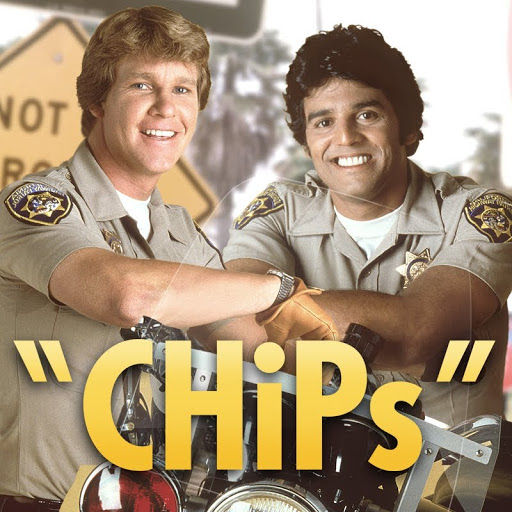
This week, death comes to California.

Episode 4.2 “Sick Leave”

(Dir by John Florea, originally aired on September 28th, 1980)

Andy (Robert Viharo) is a veteran member of the highway patrol who, when he’s not chasing down bad guys, is a student at the the local college.  He wants to become an archeologist and go to Peru.  Unfortunately, Andy has a brain lesion and may not get the chance.  His behavior is erratic.  His vision is failing.  He refuses to admit that there’s anything wrong.  Can Ponch and Jon get him off the street before he gets someone killed?  Andy says that if he wants to die, he wants to go out saving someone’s life and not sitting behind a desk.  An escalating fraternity prank war makes Andy’s dream come true.  The theft of a fraternity’s prized bird sculpture leads to a high-speed chase and several overturned cars.  Andy manages to save a young woman from a crashed car but, when the car explodes, he ends up with a hunk of shrapnel sticking out of his back.  Ouch!  He dies in Baker’s arms.  If Ponch had been the one holding him, one can only assume that Andy would have been magically healed by the power of Estrada.

This is the rare episode of CHiPs in which someone dies.  In fact, I think this is only the third episode in which a traffic accident has led to a fatality.  It happened once during the pilotDuring the second season, several people were killed in a multi-car pileup.  For the most part, though, CHiPs features people who somehow manage to survive the most horrendous of crashes.  Andy is killed by a sharp hunk of metal but, the show suggests, he would have died anyway from the brain lesions.

Along with a rare death, this episode featured a lot of slo mo of doom.  At the start of the episode, Andy’s reckless driving causes Ponch to crash his motorcycle and we get to watch Erik Estrada’s stunt double fly through the air in slow motion.  Later, when Andy runs away from the exploding car, the entire scene is in slow motion.  It works.  There’s a reason why slow motion is so overused.  It’s incredibly effective.

Overall, this episode had good intentions but a somewhat shaky execution.  Robert Viharo went so overboard with his performance that you couldn’t help but wonder why Ponch and Baker were the only ones who noticed that Andy obviously wasn’t doing well.  Not even Sgt. Getraer seems to notice!  The main problem is that silly scenes of the fraternity prank war (one fraternity even rents a helicopter!) were mixed with scenes of Andy’s mind literally shutting down as we watched.  Tonally, this episode was a mishmash.  CHiPs, with its bass-heavy theme and Erik Estrada’s blinding smile, might not have been the right place to try to pull off a heart-rending drama.
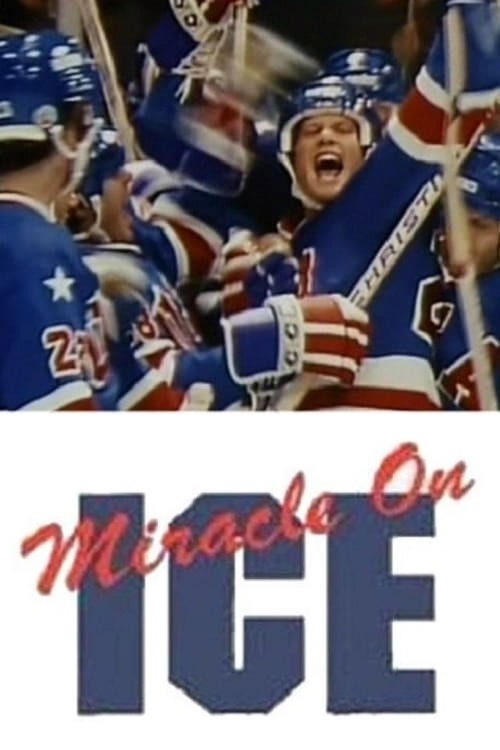
Miracle On Ice (1981, directed by Steven Hilliard Stern)


On February 22nd, 1980, the U.S. Olympic Hockey team pulled off one of the greatest upsets in sports history when they defeated the Soviet team during the Winter Olympics.  At a time when America was struggling under Jimmy Carter and the Soviet Union appeared to be winning the propaganda war, a group of unheralded college students brought the U.S. together in celebration as they defeated the Soviets and then went on to defeat Finland for the gold medal.

Everyone knows that the Miracle On Ice, as it was called, served as the basis of the Disney film Miracle, with Kurt Russell playing coach Herb Brooks.  What is now forgotten is that the story was first recreated in 1981, with a made-for-tv movie called Miracle On Ice.  Who played Herb Brooks in that movie?

Karl Malden.

Keep in mind, Herb Brooks was 42 years-old when the U.S. team defeated the Soviets and he was a former player himself.  Malden was 69 when he starred in Miracle On Ice and didn’t look like he had ever worn skates in his life.  Malden is convincingly grumpy and hard-nosed as Brooks but he’s still very miscast and the movie misses the point that one of the reasons why Brooks could coach the young American team was because he was still relatively young himself.  The actors playing the members of the team are better cast, with Andrew Stevens playing team leader Mike Eruzione and Steve Guttenberg cast as goalie Jim Craig.  A lot of time is devoted to Craig’s financial difficulties and his fear that remaining an amateur for the Olympics, instead of going pro, will continue to make life difficult for his family.  On the one hand, it is messed up that the U.S., at the time, did not allow its Olympians to turn professional.  On the other hand, the fact all of the players were considered to be “amateurs’ made their victory over the Soviets all the more special.

It takes a while for Miracle on Ice to get to the main event.  There’s a lot of scenes of Brooks dealing with everyone’s skepticism and Eurozione trying to keep the players from giving up in the face of the Soviet Union’s previous domination of the game.  Once the movie does finally reach the Winter Olympics, it relies on actual footage from the game, which is actually pretty cool.  Watching the real footage, you can still feel the growing excitement in both the stadium and the broadcast booth as people started to realize that the American team was going to pull it off and defeat the Soviets.  It’s impossible not to be inspired by the Soviet Union getting humiliated by a bunch of American college players.  The Soviets may have had the performance enhancing drugs but the Americans had the spirit!

Of the two films about America’s victory, Miracle is definitely the one to see but Miracle On Ice still pays tribute to a great moment.

April Noir: Blue Velvet (dir by David Lynch)


First released in 1986 and still regularly watched and imitated, Blue Velvet is one of the most straight forward films that David Lynch ever made.

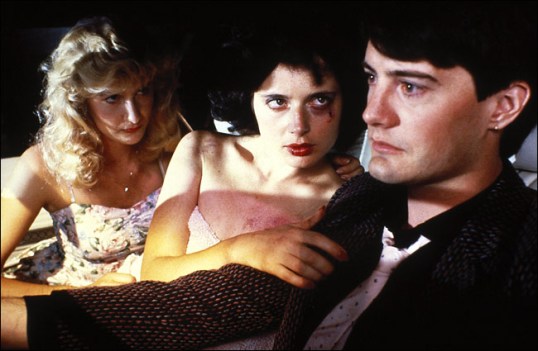
For all the talk about it being a strange and surreal vision of small town America, the plot of Blue Velvet is not difficult to follow.  After his father has a stroke that leaves him confined to a hospital bed, Jeffrey Beaumont (Kyle MacLachlan) returns home from college.  Lumberton appears to be a quiet and friendly little town, with pretty houses and manicured lawns and friendly people.  Jeffrey, with his dark jacket and his expression of concern, appears a little out-of-step with the rest of the town.  He’s been away, after all.  One day, while walking through a field, Jeffrey discovers a rotting, severed ear.  Jeffrey picks up the ear and takes it Detective Williams (George Dickerson).  Detective Williams, who looks like he could have stepped straight out of an episode of Dragnet, is such a man of the innocent 1950s that his wife is even played by Hope Lange.

“Yes, that’s a human ear, alright,” Williams says, deadpan.

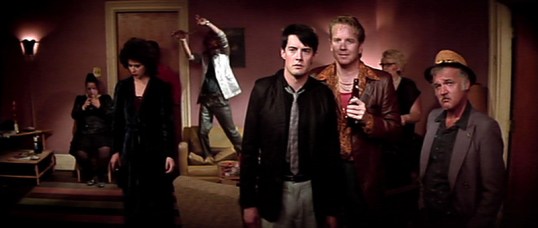
Blue Velvet (1986, dir by David Lynch, DP: Frederick Elmes)

With the help of Detective Williams’s blonde and seemingly innocent daughter, Sandy (Laura Dern), Jeffrey launches his own investigation into why the ear was in the field.  He discovers that Lumberton has a teeming criminal underworld, one that is full of men who are as savage as the ants that we saw, in close-up, fighting over that ear in the field.  Jeffrey discovers that a singer named Dorothy (Isabella Rossellini) is being sexually blackmailed by a madman named Frank Booth (Dennis Hopper).  When Dorothy discovers Jeffrey hiding in her closet (where he had been voyeuristically watching her and Frank), it leads to Jeffrey and Dorothy having a sadomasochistic relationship.  “Hit me!” Dorothy demands and both the viewer and Jeffrey discover that he’s got his own darkness inside of him.  “You’re like me,” Frank hisses at Jeffrey at one point and, if we’re to be honest, it almost feels like too obvious a line for an artist like David Lynch.  Lynch once described the film as being “The Hardy Boys in Hell,” and the plot really is as straightforward as one of those teenage mystery books.

That said, Blue Velvet also features some of Lynch’s most memorable visuals, from the brilliant slow motion opening to the moment that the camera itself seems to descend into the ear, forcing us to consider just how fragile the human body actually is. The film goes from showcasing the green lawns and blue skies to Lumberton to tossing Jeffrey into the shadowy world of Dorothy’s apartment building and suddenly, the entire atmosphere changes and the town becomes very threatening.  We find ourselves wondering if even Detective Williams can be trusted.  That said, my favorite visual in the film is a simple one.  Sandy and Jeffrey walk along a suburban street at night and the camera shows us the dark trees that rise above them, contrasting their eerie stillness to Sandy and Jeffrey’s youthful flirtation.

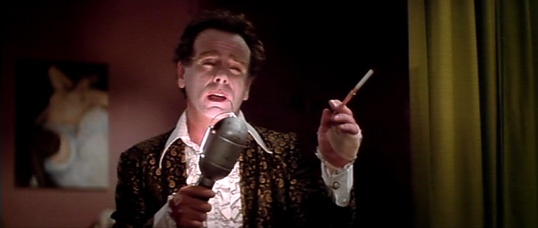
Dean Stockwell in Blue Velvet

Dean Stockwell shows up as Ben, an associate of Frank’s who lip-synchs to Roy Orbison’s In Dreams while Frank himself seems to have a fit of some sort beside him.  In retrospect, Blue Velvet played a huge role in Dennis Hopper getting stereotyped as an out-of-control villain but that doesn’t make him any less terrifying as Frank Booth.  Hopper, recently sober after decades of drug abuse and self-destructive behavior, summoned up his own demons to play Booth and he turns Frank into a true nightmare creature.  Isabella Rossellini is heart-breaking as the fragile Dorothy.  That said, the heart of the film belongs to Kyle MacLachlan and Laura Dern and both of them do a wonderful job of suggesting not only the darkness lurking in their characters but also their kindness as well.  For all the talk about Lynch as a subversive artist, he was also someone who had a remarkable faith in humanity and that faith is found in both Jeffrey and Sandy.  MacLachlan and Dern manage to sell moments that should have been awkward, like Sandy’s monologue about the returning birds or Jeffrey’s emotional lament questioning why people like Frank have to exist.  Both Jeffrey and Sandy lose their innocence but not their hope for a better world.

Blue Velvet is a straight-forward mystery and a surreal dream but mostly it’s an ultimately hopeful portrait of humanity.  The world is dark and full of secrets, the film says.  But that doesn’t mean that it can’t be a beautiful place.


Blue Velvet (1986, dir by David Lynch, DP: Frederick Elmes)