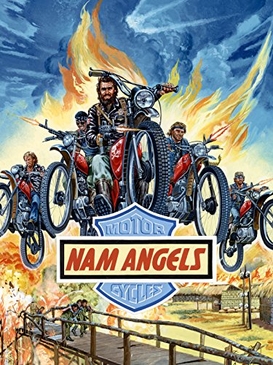
 During the Vietnam War, an American patrol is captured by a German (Vernon Welles) who plans to sell them to the VC. Only their commanding officer, Lt. Vance Calhoun (Brad Johnson), manages to get away. When he’s told the the Army can’t spare any men for a POW rescue mission, he instead recruits a group of Hell’s Angels who just happen to be hanging out in Vietnam. When the Hell’s Angels learn that there’s gold hidden in the caves near the POW camp, they hop on their motorcycles and heard on out.
You might wonder why the Hell’s Angels were in South Vietnam to begin with. The easy answer is that they were there to raise Hell and spread the legend of their motorcycle club. The truth is that they were there to win the war for America. Like many Vietnam films released in the 80s, the main message of Nam Angels is that America could have won if not for the cowardly officers who weren’t willing to rescue our POWs. America should have listened to Vance Calhoun and the Hell’s Angels. Meanwhile, the real-life Hell’s Angels sued the filmmakers for trademark infringement. It doesn’t get more American that!
As for Nam Angels, it has all of the explosions and motorcycles that are promised by the title and, as always, Vernon Wells is a good villain. Considering the premise, it’s disappointing that Nam Angels proves itself to be a typical straight-to-video war movie but it still features all of the action, torture, and tough talk the fans usually want from these movies. It ends with a quote from John Milton that doesn’t really have anything to do with the film that we just watched.
This was one of the 104 films that Cirio Santiago directed over his career. Reportedly, Steven Spielberg was a fan of this one, casting Brad Johnson in Always on the basis of his performance in Nam Angels. Make good movies because you never know who might be watching.

 Through the Shattered Lens