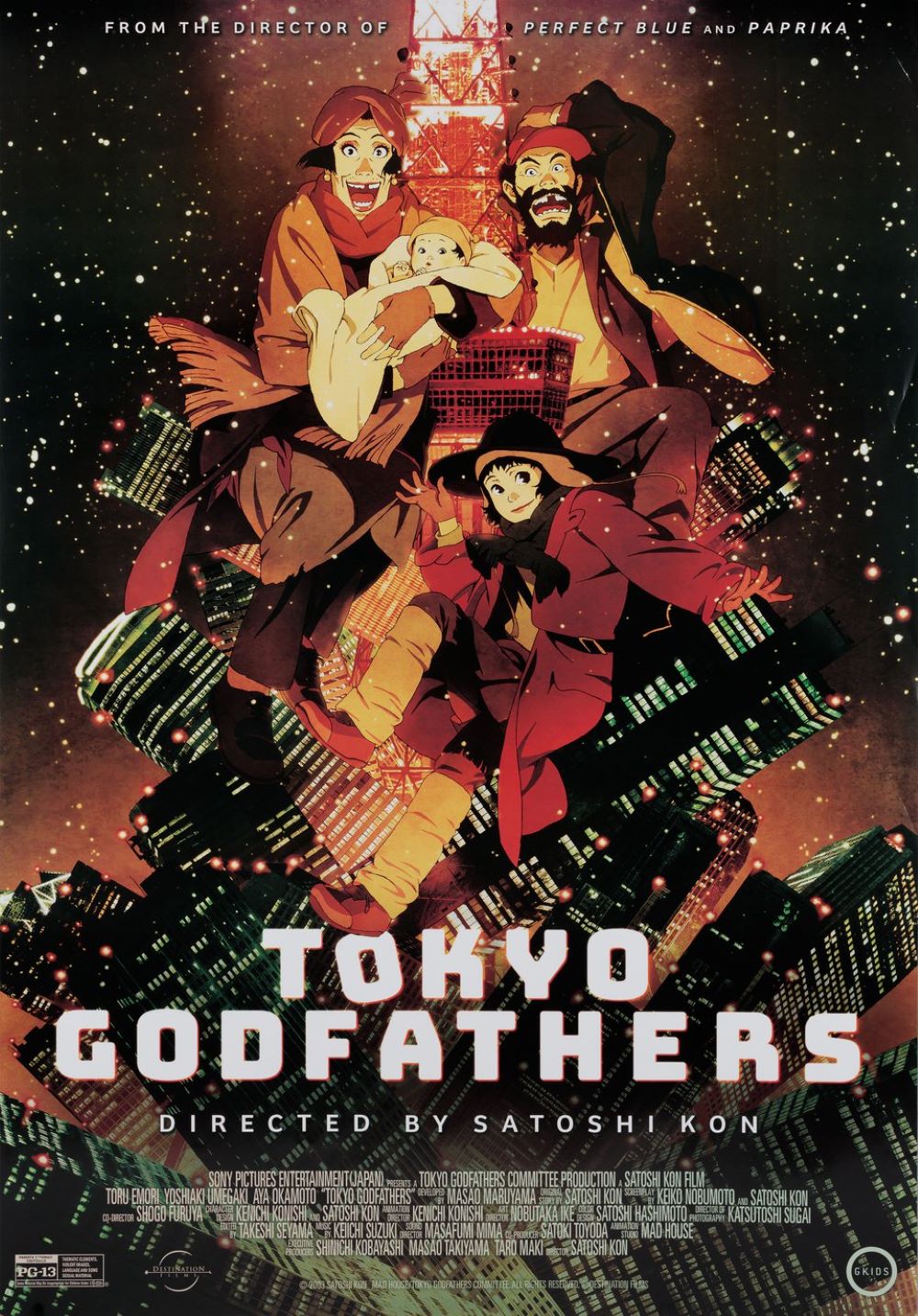
Anime You Should Be Watching: Tokyo Godfathers (Tōkyō Goddofāzāzu)


“I’m scared of my family, but I want to go home.” — Miyuki

Tokyo Godfathers is a film that shows how hope and kindness can be found in the most unexpected places, all wrapped up in a hilarious, chaotic, and heartwarming story set on Christmas Eve in Tokyo. Directed by Satoshi Kon, this 2003 anime follows three unlikely characters: Gin, a middle-aged alcoholic with a troubled past; Hana, a lively transgender woman who dreams of being a mother; and Miyuki, a guarded teenage runaway dealing with her own pain.

The adventure begins when the trio, scavenging through garbage for Christmas presents, discovers an abandoned newborn baby. Hana names the baby Kiyoko, meaning “pure child,” and the three set off on a mission to find the baby’s parents using a few clues left behind. Their journey takes them into the depths of Tokyo’s bustling city life—through snowy streets, a yakuza wedding, and encounters with all kinds of characters, from hitmen to estranged families.

What makes Tokyo Godfathers stand out is its perfect blend of humor and emotional depth. It’s easy to laugh at the trio’s bickering and mishaps, but the film also offers sincere moments of vulnerability and growth. Hana’s fierce protectiveness, Gin’s struggle for redemption, and Miyuki’s search for acceptance form a trio of deeply relatable characters. Their rough lives and personal regrets are shown honestly, but the warmth they create together feels genuine and touching.

The film doesn’t shy away from depicting the harsh realities of their world, including violence, abuse, and loss. Yet even in moments of hardship and conflict, acts of giving and empathy persist. Sometimes these harsh and tender moments intersect in the same sequence—such as tense confrontations that unexpectedly end in compassion, or scenes where despair is met with generosity. This layering creates a powerful sense of life’s complexity, showing that kindness can shine brightest amidst chaos and pain.

Visually, the film captures the chilly, neon-lit cityscape with beautiful detail. The animation highlights not only the busy and bright streets of Tokyo but also the subtle emotions of the characters, from shy glances to moments of frustration or tenderness. The film’s mix of grounded realism with moments of coincidence or miracle lends it a magical yet believable atmosphere.

At its core, the film explores what family really means. The three main characters, though not related by blood, support and care for each other in ways many traditional families don’t. The baby Kiyoko serves as a catalyst for each character to confront their past and rethink their relationships. The story gently shows that family can be chosen, formed through shared hardship and love rather than just genetics.

The film’s holiday setting works beautifully because it taps into the holiday themes of forgiveness, second chances, and hope. But it doesn’t shy away from showing the harsh realities of homelessness, loss, and loneliness—making the moments of joy feel even more earned. The characters are flawed but deeply human, and their journey toward reconciliation and connection is both honest and uplifting.

Though the story relies on some lucky coincidences and wild turns, these moments of serendipity feel like part of the film’s charm, highlighting how unpredictable and strange life can be. These surprises keep the story moving and weave a sense of wonder through the gritty city streets.

The supporting characters the trio meet add layers of complexity and humor, and small scenes—like Miyuki bonding with a single mother despite a language barrier or Hana’s reflections on her past love—enrich the narrative. These interactions remind us that no one’s story is simple and everyone carries hidden struggles.

By the end, each main character faces their own moment of truth—whether it’s Gin reconnecting with his daughter or Miyuki standing up to her past. The film leaves viewers with a hopeful message: even when life feels broken, it’s possible to find grace, redemption, and unexpected family.

Tokyo Godfathers is perfect if you want a holiday movie with heart, humor, and a refreshing dose of realness. You don’t need to be an anime fan to appreciate its warmth and message. It’s a touching reminder that kindness and connection can be found in the most unlikely places—even on the coldest winter nights.

VGM Entry 67: EarthBound


VGM Entry 67: EarthBound
(Thanks to Tish at FFShrine for the banner)

Hirokazu Tanaka and Keiichi Suzuki composed Mother in 1989, and it would remain perhaps the most eclectic soundtrack in all of video gamedom until 1994, when they teamed up again for Mother 2.

http://www.youtube.com/watch?v=TRRn10r5vpc

Better known to western gamers as EarthBound, Mother 2 (Nintendo, 1994) was… well… on the new game ‘name your characters’ screen you are asked the crucial question “What is your favorite homemade food?”, and that’s about as normal as it ever got. Since Mother was never released here, EarthBound was our first experience with Shigesato Itoi’s madness, and the already ridiculous events and dialogue were made all the more bizarre by a sometimes incredibly awkward (though fairly grammatically sound) translation. (Consider that the most powerful spell in the game is called “PSI Rockin Omega”.) Perhaps this was not originally by intent, but I like to pretend NOA fell in love with it and let a few oddities through intentionally.

The EarthBound soundtrack was huge, or so it seemed to me. With no comprehensive ost on the market it can be a bit hard to tell, but at least one fan rip I came across contained 78 tracks. Every town had a theme. Every combat zone had a theme. There were easily a dozen or more different battle themes. The new music just never stopped coming from start screen to the ending credits. According to Wikipedia, Keiichi Suzuki claimed in a Famitsu interview only available in Japanese that he wrote over 100 songs for the game. Many of these obviously were not used, but Suzuki also only accounts for half of the music.

http://www.youtube.com/watch?v=eYgWyWaLf5A

EarthBound‘s finest musical moments took place in combat. This video presents a compilation of eight battle tunes (by no means all-inclusive) which should give you a good idea of what the game had to offer. The music was a mix of smooth grooves like the first track played here and corny absurdities like the second, with the former typically representing aliens and tougher bosses and the latter such detestable foes as “New Age Retro Hippie”, “Scalding Coffee Cup”, and “Big Pile of Puke”.

The corny tracks are more representative of the larger gaming environment, but the groove numbers are where Tanaka and Suzuki really excelled, culminating with “Kraken of the Sea” (6:27).

I’m not actually sure who was responsible for the combat music throughout this game, or whether the individual tracks were collaborative efforts. (Many songs in the game in fact were.) It would certainly make sense, considering how they all fall into two neat categories, to reason that one composer made the groove tracks and another did the comedy ones, but I certainly can’t confirm this. The track “Another 2” on the highly mutilated official Mother 2 ost contains quite a few samples from the former and none from the latter, and it’s credited to Tanaka specifically, but that might simply mean he was responsible for the remix. “Another 2” contains the bicycle theme as a hidden track after a half minute of silence, and that was definitely written by Suzuki, so there’s really no clear evidence here pointing to one musician or the other.

http://www.youtube.com/watch?v=t4z82byt5mA

The two best songs in the game are the last two you’ll hear before the ending. Both are combat tunes, and they couldn’t be more different. “Pokey Means Business” was my favorite song in any video game as a kid, and I don’t think I need to tell you why.

Or are you not there yet? Wait for it…

Ok so, maybe it’s not decisively the best song on the SNES, but it’s definitely the heaviest. Funny that for all the dozens of games out there marketing their edginess as their selling point, none came anywhere near goofy little EarthBound. Once again I am not sure if this is a product of Suzuki, Tanaka, or both. I just know that Pokey meant business alright…

http://www.youtube.com/watch?v=YYb9kSCkjE8

And then there was Giygas. Credits suggest this was all a product of Tanaka’s twisted mind, and it may well go down in history as he most disturbing boss music ever written. Everything about Giygas was completely abstract, from his form to his combat moves. (The game would just say “You cannot grasp the true form of Giygas’ attack!” and deal out damage.)

There are a lot of hairbrain theories out there as to what Giygas represents, especially in connection with how his final form outlines the shape of a fetus. Frankly I think if you’re playing EarthBound for the plot you’re probably reading too much into it.

This song does have a little bit of relevance to what’s going on though. The transition starting around 1:40 and the music box charm it leads into at 2:32 reflect a break in the gameplay action where Paula uses her psychic powers to ask various friends for help. So while its inclusion certainly adds to the creepiness of the overall piece, it’s also intended to be a bit heartwarming. And anyway the song as it appears here, 4:03 in length, is a little arbitrary. The song isn’t a single continuous piece, and the transitions take place as a result of progression in the boss fight.

The song and its visual counterpart have earned quite a bit of internet popularity for its unorthodox behavior. You’ll have to forgive me for sharing this last one with you:

http://www.youtube.com/watch?v=9rXv-uviqu8

VGM Entry 36: Mother, Batman, Goemon


VGM Entry 36: Mother, Batman, Goemon
(Thanks to Tish at FFShrine for the banner)

A lot of solid Nintendo soundtracks were released in 1989, and I can’t touch on all of them, but here are a few other noteworthies I can’t justify passing over.

http://www.youtube.com/watch?v=ijv4RKjqous

Ganbare Goemon 2 (Konami, 1989) added a lot to the sound of the original 1986 Goemon titles (Legend of the Mystical Ninja series in the west), maintaining the same style but adding a percussion track and much more complimentary and varied tone selections. I’ve not managed to find a satisfactory answer as to who composed it though. Tomoya Tomita, Koji Murata, and Michiru Yamane have all been credited here an there without any explanation as to their different rolls, and I’m pretty sure at least the latter two were definitely involved in some capacity, but I can’t be sure.

Konami has a long history of botching the names of their video games, and the Goemon series is no exception. For instance, I have seen sites unattentively list authorship credits as: “Goemon: Satoko Miyawaki. Goemon 2: Michiru Yamane”. But not only was there no game in the Goemon series actually titled Goemon or Ganbare Goemon, there were two games titled Ganbare Goemon 2. Different sub-titles sort this out, but I don’t trust the creators of massive composer compilation lists to have attentively adhered to this.

In so far as the original Mr. Goemon was released on arcade and the third Ganbare Goemon title was an MSX port of the first NES game (I’m not sure why it’s listed separately), calling the 1989 instalment Ganbare Goemon 2 was a fair move. The confusion in this instance did not arise until Konami decided to release Ganbare Goemon 2: Kiteretsu Shogun Magginesu in 1993. (If you add them all up, the second “Goemon 2” was the tenth Goemon video game.)

At any rate, you’re hearing Ganbare Goemon 2, no subtitle, and it was released in 1989. Enjoy.

http://www.youtube.com/watch?v=s1u0fh2doG4

Nobuyuki Hara and Naoki Kodaka composed Batman (Sunsoft, 1989) in the wake of Mega Man 2, when the bar for NES action game soundtracks was through the roof. I certainly don’t think it’s as good as Takashi Tateishi’s historic work, but it demands an honorable mention. Its most famous track, first in this compilation, feels straight out of a Castlevania game, whereas the second song here kicks off with more of a Mega Man vibe. All the while it is consistently driven by a forceful bass which really best defines the soundtrack. It is in large part the consequence of Hara and Kodaka landing on highly complimentary bass and drum tones which seem to mutually emphasize each other. The bass track is also much more complex in a lot of these songs than was typical for Nintendo music, and the dark, punchy vibe is perfectly suited for a Batman-themed action game.

Similarly, the frequent employment of Castlevania-style melodies is less a ripoff than a completely appropriate sound for the game. I mean, it could be a total coincidence that they sound alike at all. What is our hero here supposed to be again? Oh yeah, a bat.

Or it could be the case that Hara and Kodaka were avid fans of contemporary video game musicians and incorporated the best of every world with conscious intent. A lot of amazing works have derived from calculated stylistic fusions, and I would not rule out either possibility.

http://www.youtube.com/watch?v=VODQhOl_orc

And then there is Mother (Nintendo, 1989). If you ever played Earthbound on the SNES, its music is etched into your memory whether you like it or not. Earthbound was the sequel, and Mother has still yet to be released outside of Japan today. I was a cool little middle school computer nerd who managed to get his hands on a fan-translated ROM, but having succeeded in acquiring it, I promptly lost all interest in actually playing it. It’s a shame, because now I am completely perplexed as to how these two games overlapped. The gameplay is literally identical to the SNES sequel, and I’m not wholly convinced that the plot is not as well. Likewise, quite a number of the songs of Earthbound first appear in Mother, including a lot of the battle themes. Keiichi Suzuki and Hirokazu Tanaka remained partners for both titles, and there is hardly any break where one lets off and the other begins. The original was certainly one of the most unique compositions on the Nintendo, but the same can be said for its sequel on the SNES despite the music really not changing much.

This compilation is really one of garudoh’s weaker efforts, and I can’t easily provide you with many alternatives, so I may leave most of the Mother discussion for Earthbound when I get to it.

http://www.youtube.com/watch?v=SAf4Lt2oBp8

But on a final note, here is one of the revisited battle themes in its original form, just to give you an idea of how effective Keiichi Suzuki and Hirokazu Tanaka’s drum and bass emphasis was even on a system as limited as the NES.