Film Review: Stay Hungry (dir by Bob Rafelson)


In the 1976 film Stay Hungry, Jeff Bridges plays Craig Blake.

When we first meet Craig, he doesn’t have much of a personality, though we still like him because he’s played by Jeff Bridges.  Living in Alabama, he’s a young rich kid who, after the death of his parents, divides his time between his nearly empty mansion and his country club.  Craig suffers from a good deal of ennui and seems to spend a lot of time writing letters to his uncle in which he promises that he’s going to eventually get his life together.  Craig eventually gets a job at a real estate firm that is managed by Jabo (Joe Spinell).  We know that the real estate firm is shady because Joe Spinell works there.

Craig is assigned to handle the purchase of a small gym so that he can eventually close the place and allow it to be torn down to make room for an office building.  However, Craig soon falls for the gang of colorful eccentrics whose lives revolve around the gym and bodybuilder Joe Santo (Arnold Schwarzenegger, who gets an “introducing” credit, even though this was his fourth film).  The friendly Franklin (Robert Englund) is Santo’s “grease” man.  Anita (Helena Kallianiotes) is tough and can kick anyone’s ass.  The receptionist, Mary Tate (Sally Field), is a free spirit with whom Craig soon falls in love.  In fact, the only less than likable person at the gym is the former owner, Thor Erickson (R.G. Armstrong), a heavy-drinking perv who has a hole in the floor of his office that he uses to peek down at the women’s locker room.

There’s not much of a plot here.  Instead, the film plays out in a rather laid back manner, with Santo befriending Craig and showing him the joy of embracing life.  Arnold Schwarzenegger actually won an award (well, a Golden Globe) for his performance here and it must be said that he’s very good as the gentle and easy-going Santo.  Because he’s huge and he’s Schwarzenegger, we expect him to be intimidating.  Instead, he’s a soft-spoken guy who is quick to smile and who doesn’t even get upset when he finds out that Mary Tate and Craig are now involved.  There’s even a surprising scene where Joe Santo picks up a fiddle and starts playing with a bluegrass band.  Schwarzenegger is so likable here that it’s easy to wonder where his career might have gone if he hadn’t become an action star.  Even early in his career (and when he was still speaking with a very thick accent), Schwarzenegger shows off a natural comic timing.  He’s fun to watch.

In fact, he’s so much fun that the rest of the film suffers whenever he’s not onscreen.  The cast is full of talented people but the film’s loose, plotless structure keeps us from truly getting too invested in any of them.  (Santo is training for Mr. Universe so at least he gets an actual storyline.)  Sally Field and Jeff Bridges are cute together but their romance is never quite as enchanting as it seems like it should be.  The main problem with the film is that, when it ends, one still feels like Craig will eventually get bored with the gym and return back to his mansion and his country club.  One doesn’t get the feeling that Craig has been changed so much as Craig just seems to be slumming for the heck of it.

There are charming moments in Stay Hungry.  I’m a Southern girl so I can attest that the film captured the feel of the South better than most films.  If you’re a Schwarzenegger fan, you have to see this film because it really does feature Arnie at his most charming and natural.  Unfortunately, despite all that, the film itself never really comes together.
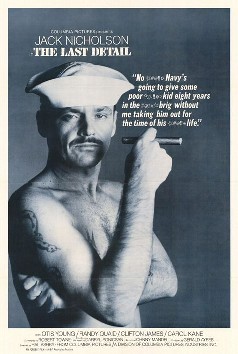
The Last Detail (1973, directed by Hal Ashby)


Billy “Badass” Buddusky (Jack Nicholson) and Richard Mulhall (Otis Young) are two Navy lifers stationed in Virginia.  On shore patrol, they’ve been assigned to transport a 18 year-old seaman to a Naval prison in Maine.  The kid has been dishonorably discharged and sentenced to eight years in the brig for trying to steal $40 from a charity box.  (The charity was a favorite of the wife of his commanding officer.)  Buddusky and Mulhall are expecting to find a hardened punk but instead, they end up escorting Larry Meadows (Randy Quaid), a timid teenager who suffers from kleptomania and who doesn’t seem to understand just how bad things are going to be for him for the rest of his life.  Not only is he going to do eight years in the brig, surrounded by hardened criminals, but his dishonorable discharge is going to follow him for the rest of his life.

Resenting having to take Meadows to prison and also feeling that he’s getting a raw deal, Buddusky and Mulhall decide to make a few stops on their way to Maine, so that Larry can enjoy what little time he has left and hopefully lose his virginity before being locked up.  In between brawling with Marines, visiting a brothel (where a young Carol Kane plays one of the prostitutes), and hanging out with a group of hippies (one of whom is played by Gilda Radner), Meadows comes to think of Buddusky and Mulhall as being his best friends.  Unfortunately, for Meadows, both Buddusky and Mulhall have their job to do.

Hal Ashby’s road picture is a character study of three men who are all lifers, even if they don’t realize that.  Both Buddusky and Mulhall hate the Navy but they also can’t relate to anyone who isn’t a member of the service.  Meadows’s entire future has been pre-determined because he tried to steal $40 but he doesn’t realize it until its too late.  When the film came out, it was controversial due to its “colorful” language.  In an interview, screenwriter Robert Towne defended the frequent profanity because, as he put it, when you’re in a situation you hate, “that’s what you do.  You bitch.”  Hal Ashby’s loose direction captures the road trip feel as the three leads reluctantly head to their ultimate destination.

The Last Detail features one of Jack Nicholson’s best performances.  Buddusky is cynical and doesn’t trust anyone other than Mulhall but even he knows that Larry Meadows deserves better than to spend eight years in the brig.  Along with lending his star power to the film and standing by director Hal Ashby when Ashby was arrested for marijuana possession, Nicholson also played a big role in the casting of Randy Quaid as Larry Meadows.  (The other final contender for the role was John Travolta but Nicholson insisted on Quaid).  The 6’5 Quaid towers of Nicholson and Young, making him look as if he could escape any time that he wants.  But Larry is so naive that he doesn’t want to make any trouble for his “friends.”  Though this wasn’t his first film, The Last Detail is the film that made Quaid one of the busiest character actors of the 70s and 80s and it also, at least temporarily, made him a part of the Jack Nicholson stock company.

Both sad and funny, The Last Detail is one of the best films of the 70s and features Jack Nicholson at his most unforgettable.

Lisa Reviews An Oscar Nominee: Coming Home (dir by Hal Ashby)


Well, here we are!  It’s January 1st.  In just a few days, the Oscar nominations will be announced and then, on February 9th, the winners will be revealed!  From now until the day of the ceremony, I will be taking a look at some of the films that were nominated for and won Oscars in the past.  As of this writing, 556 films have been nominated for best picture.  I hope that, some day, I will be able to say that I have seen and reviewed every single one of them.

Let’s start things off with the 1978 Best Picture nominee, Coming Home!

Coming Home takes place in California in 1968.  While hippies stand on street corners and flash peace signs, teenagers are being drafted and career military men are leaving for Vietnam and people continue to tell themselves that America is doing the right thing in Indochina, even though no one’s really sure just what exactly it is that’s going on over there.  At the local VA hospital, the wounded and the bitter try to recover from their wartime experiences while struggling with an often heartless bureaucracy and feelings of having been abandoned by their country.

When Marine Corps. Capt. Bob Hyde (Bruce Dern) is deployed to Vietnam, he leaves behind his wife, Sally (Jane Fonda).  Told that she can no longer live on the base while her husband is overseas, Sally gets an apartment, a new car, and eventually a new hairdo.  She also gets a new friend, Vi Munson (Penelope Milford).  Vi smokes weed and is critical of the war in Vietnam.  It doesn’t take long for Sally to start to enjoy the idea of being free and not having to cater to Bob’s every whim.  Sally even ends up volunteering at the local VA hospital.

That’s where she meets Luke (Jon Voight, looking youngish and incredibly sexy), a bitter but sensitive vet who, having gone to Vietnam and returned to the U.S. as a paraplegic, is now outspoken in his opposition to the war.  Luke is also friends with Billy (Robert Carradine), who is Vi’s shell-shocked brother.  When Luke and Sally first meet, they collide in a hallway and Sally gets a bag full of urine spilled on her.  It’s only later that Luke and Sally realize that they knew each other in high school and soon, they’re having an affair.  Luke, who is as gentle a lover as Bob is brutish, brings Sally to her first orgasm in a sensitively-directed scene that should be studied by any and all aspiring filmmakers.

Unfortunately, the problem with having an affair while your husband is away is that, eventually, your husband’s going to come back.  Bob returns from Vietnam and he’s no longer the confident and gung ho officer that he was at the start of the film.  He now walks with a pronounced limp and, like Luke, he’s angry.  However, whereas Luke has channeled his anger in to activism, Bob tries to keep his emotions bottled up.  (He does take the time to give the finger to a few protesters and, considering how obnoxious most of the protesters in this film are, you can’t help but feel that Bob may have had a point.)  When Bob discovers that Luke and Sally have been having an affair, he snaps….

Meanwhile, Billy is having a hard time readjusting to life, Vi is getting picked up by sleazy men in bars, and there’s a ventriloquist who shows up a few times.  There’s a lot going on in Coming Home and, at times, it feels like the film’s trying to cram in too much.  The film often seems a bit disjointed, with semi-documentary footage of Voight hanging out with real paraplegic vets awkwardly mixed in with didactic scenes of Sally turning against the war.

That the love story between Sally and Luke is so effective has far more to do with the performances of Jane Fonda and especially Jon Voight, than it does with anything in the film’s script.  Indeed, the script itself doesn’t seem to be too concerned with who Luke and Sally were before they collided in that hallway and it also doesn’t seem to be all that interested in who they’ll be after the end credits role.  As written, they’re just plot devices, specifically created and manipulated to express the film’s antiwar message.  But then you see Jon Voight’s haunted eyes while he’s listening to a group of vets discuss their experience or you hear the pain in his voice while he talks to a bunch of high school students and it’s those little moments and details that tell you who Luke is.  By that same token, Jane Fonda does a good job of showing each stage in Sally’s liberation, even if you can’t help but feel that the main reason Sally becomes an anti-war feminist is because she’s played by Jane Fonda.

Of course, in the end, the entire film is stolen by Bruce Dern.  You actually end up feeling very sorry for Bob Hyde (and, to the film’s credit, you’re meant to).  It would have been very easy to just portray Bob as being a close-minded pig but the film respects his pain just as much as it respects Luke’s anti-war activism and Sally’s need to be free.  In the end, you actually feel worse for Bob than you do for either Luke or Sally.  Bob is as much a victim of the war as anyone else in the film.

Coming Home was one of the first films about Vietnam to ever be nominated for best picture.  Jane Fonda and Jon Voight both won Oscars but the film itself lost to a far different look at the war in Vietnam, The Deer Hunter.