Film Review: Fools’ Parade (dir by Andrew V. McLaglen)


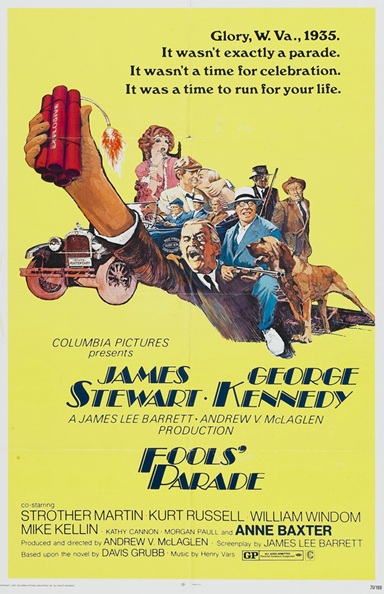
1971’s Fools’ Parade opens in 1935.

Three men are released from the West Virginia state penitentiary and given a train ticket out of town by the prison captain, Council (George Kennedy).  The men are a bank robber named Lee Cottrill (Strother Martin), a young man named Johnny Jesus (a young Kurt Russell), and a courtly older man named Mattie Appleyard (James Stewart).  Despite his polite tone of voice and his folksy manner, Appleyard is actually the most notorious of the three men being released.  Convicted of murdering two men, Appleyard has spent the past 40 years in prison.  Both Appleyard and Cottrill are looking to go straight.  Every day of his sentence, Appleyard worked and earned money.  Along with a glass eye, Appleyard leaves prison with a check for $25,000 dollars.  Appleyard plans to cash the money at the bank and then open a store with Cottrill.

Unfortunately, Appleyard has been released at the height of the Great Depression.  The streets are full men desperately looking for work.  People will do anything to feed their families or to make a little extra money.  Salesman Roy K. Sizemore (William Window) transports guns and dynamite.  Willis Hubbard (Robert Donner) works as a conductor on the train.  Aging prostitute Cleo (Ann Baxter) offers to sell the virginity of her adopted daughter, Chanty (Katherine Cannon).  Junior Killfong (Morgan Paull) sings on the radio and occasionally takes on deadlier work with his friend, Steve Mystic (Mike Kellin).  As for Captain Council, he’s decided that he’s going to make his money by ambushing the train carrying the three men that he has just released from prison.  After killing the men, Council will cash Appleyard’s check himself.

Of course, it doesn’t quite work out as simply as Council was hoping.  Willis Hubbard has a crisis of conscience and lets Appleyard, Cottrill, and Johnny know what Council is planning.  The three men narrowly make their escape but Council frames Appleyard for a murder that he didn’t commit.  Now wanted once again, the three men must not only get the money but also clear their names.  It won’t be easy because, as Hubbard explains, they may be free from the penitentiary but now, they’re trapped in “the prison of 1935.”

Fools’ Parade really took me by surprise.  I watched it because it featured two of my favorite actors, James Stewart and Kurt Russell.  And both Stewart and Russell give very good performances in the film.  Stewart was always at his best when he got a chance to hint at the melancholy behind his folksiness and the young Kurt Russell plays Johnny with a sincerity that makes you automatically root for him.  For that matter, the normally sinister Strother Martin is very likable as Lee Cottrill, a bank robber who is still struggling with the idea of going straight.  But, beyond the actors, Fools’ Parade is a genuinely sad portrait of desperate people trying to survive.  At one point, Sizemore and Cottrill watch as their train passes a camp of people who have been displaced by the Great Depression and it’s even implied that the villainous Council has some regret over what he’s become.  (There’s a small but poignant scene in which Council and Cleo acknowledge the passage of time and, for a minute, the viewer realizes these two people were, at one time, maybe as idealistic and optimistic as Johnny.)  It’s a well-acted film, one in which moments of humor are mixed with moments of true sadness.  I may have picked the film for Jimmy and Kurt but, in the end, the film’s story and performances drew me in.  The 63 year-old Stewart proved that he could still give a memorable performance and the 20 year-old Kurt Russell proved that he was a future star in the making.  If you haven’t seen it, this is definitely a film to check out.

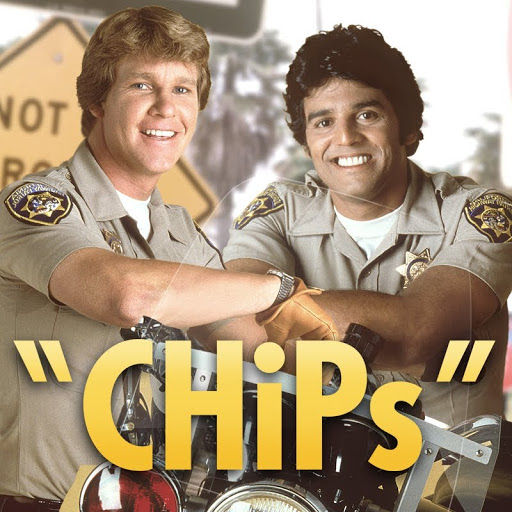
Late Night Retro Television Reviews: CHiPs 2.23 “The Greatest Adventures of CHiPs”


Welcome to Late Night Retro Television Reviews, a feature where we review some of our favorite and least favorite shows of the past!  On Mondays, I will be reviewing CHiPs, which ran on NBC from 1977 to 1983.  The entire show is currently streaming on Freevee!

This week, the second season of CHiPs comes to a close.  Now, if you don’t remember much about what happened during the first two seasons of the show, don’t worry.  This finale has got you covered.  But first, let’s watch the opening credits and chair dance to the CHiPs theme song.

Episode 2.23 “The Greatest Adventures of CHiPs”

(Dir by Don Weis, originally aired on May 12th, 1979)

With Ponch and Baker absent from the morning briefing because they’ve gone to Bakersfield to teach a class, Sgt. Getraer announces to the assembled members of the High Patrol that they have been nominated for an award for going beyond the normal call of duty.  Everyone’s totally excited for Ponch and Baker.  Armed with a bulky 70s tape recorder, Grossie asks everyone for their favorite Ponch and Baker stories so that he can write a speech honoring them….

Yep, it’s a clip show.

It’s not just any clip show, either.  It’s a 90-minute clip show.  Of course, there’s only about fifteen minutes of new footage.  The rest of it is made up of scenes of Baker yelling at motorists and Ponch smiling.  Even when CHiPs attempts to show why both of them deserves a reward, it’s obvious that Baker does all the work and Ponch gets all the credit.

I understand the logic behind clip shows.  They’re cheap and it allows almost everyone to have the weekend off.  They’re not very entertaining to watch, though perhaps they carried more weight in the days before streaming and DVRs ensured that you could rewatch your favorite scenes whenever you wanted to.  They are, however, very easy to review.

This clip show marks the end of the show’s second season.  A clip show always seems like a weak way for a season (much less a show) to go out but again, I get it.  Everyone’s tired.  Everyone wants to head to Cabo for the summer.  Get us out of here!  CLIP SHOW!

(That said, this clip show does get some credit for including some pretty groovy disco footage!  SOLID!  Estrada gets to do his Travolta impersonation while everyone watches and claps.)

The second season of CHiPs was actually pretty entertaining, even if it is kind of silly just how much the show highlights Ponch over Baker.  Technically, of the two of leads, Larry Wilcox was the better actor but Erik Estrada always seemed like he was having more fun.  The second season had a few dud episodes but it also had its share of spectacular stunts and a lot of lovely California scenery.  Sindy Cahill being perfect at everything got old pretty quickly but at least Arthur “Grossie” Grossman was around to provide some comic relief.

Well, that’s it.  There’s not too much you can say about a clip show.  Next week, we’ll start season three!

Late Night Retro Television Review: CHiPs 2.19 “Bio-Rhythms”


Welcome to Late Night Retro Television Reviews, a feature where we review some of our favorite and least favorite shows of the past!  On Mondays, I will be reviewing CHiPs, which ran on NBC from 1977 to 1983.  The entire show is currently streaming on Freevee!

This week, it’s all about bio-rhythms!

Episode 2.19 “Bio-Rhythms”

(Dir by Don Weis, originally aired on February 17th, 1979)

The Davis family is back!

Now, if you don’t remember the Davises. they were the family of independent truckers who appeared in an episode called The Volunteers.  Patriarch Charley Davis (Tige Andrews) is taciturn and protective.  Their friend, Sam (Steve Franken), is taciturn and protective …. actually, to be honest, he and Charley are kind of interchangeable.  Daughter Robbie (Katherine Cannon) is in charge of the business and is being pressured by another trucker (Michael Conrad), who is willing to resort to sabotage to keep Robbie from making her deliveries.  It’s a good thing that Robbie has got Ponch on her side!

Technically, Robbie also has Baker on her side but this is definitely a Ponch episode.  Baker is present but he does very little.  Instead, it’s Ponch who flirts with Robbie.  It’s Ponch who stops by Robbie’s apartment and uses her shower.  It’s Ponch who spends an extended period of time wearing just a towel.  Somewhat inevitably, Charley shows up around the same time that Ponch steps out of the shower.  Ponch is kicked out of the apartment and his clothes are tossed out the window.  Ponch loses his towel while retrieving his clothing.  Cue the close-ups of an old woman staring at him with a impressed look in her eyes and Erik Estrada flashing his Estrada smile.  It’s not that Erik Estrada wasn’t nice to look at.  It’s just that he was so obviously aware that he was nice to look at that the whole scene ends up feeling rather smarmy.  One gets the feeling that there was a clause in Estrada’s contract specifying that he, and only he, would be allowed to show off on the show.

While Ponch helps Robbie deal with her rivals, he also learns about biorhythms, the pseudo-science that says that, by calculating how long someone’s been alive, it can be determined which days are going to be good for them and which days are going to be bad.  Sindy Cahill is doing a study on biorhythms for her master’s degree.  Getraer tells his squad that the department is also very interested in whether or not biorhythms effect an officer’s productivity.  Baker is skeptical about biorhythms but Ponch believes in them and even buys a biorhythm calculator.

Believing the Baker’s biorhythms have him at peak physical perfection, Ponch arranges for Baker to play handball against Getraer.  Ponch even takes bets.  Unfortunately, Ponch spent so much time figuring out Baker’s biorhythms that he never stopped to consider Getraer’s.  The episode ends with Getraer on his way to victory and Baker looking embarrassed.

Handball?  Biorhythms?  Corrupt labor unions?  Could this episode be more Californian?

This episode was fairly dull.  A huge problem was that the Davis family and their drama are never as interesting as the show seems to think that they are.  Much as with The Volunteers, I felt like I was watching a backdoor pilot for a show about the Davises when I really just wanted to watch a show about the Highway Patrol.  This episode didn’t do much for me.  Maybe everyone’s biorhythms were off when they filmed it.

Late Night Retro Television Review: CHiPs 2.2 “The Volunteers”


Welcome to Late Night Retro Television Reviews, a feature where we review some of our favorite and least favorite shows of the past!  On Mondays, I will be reviewing CHiPs, which ran on NBC from 1977 to 1983.  The entire show is currently streaming on Freevee!

This week, we’ve got ourselves a convoy!

Episode 2.2 “The Volunteers”

(Dir by John Florea, originally aired on September 23rd, 1978)

After a high-speed chase causes a robbery suspect to crash his car into a chemical storage facility (which subsequently explodes), three truckers have to get their trucks full of chlorine gas to the next available facility.  Unfortunately, it’s a 170-mile drive over rough terrain and it’s a very hot day.  If the gas gets to hot, it’ll explode.  If It doesn’t get to the storage facility in time, it’ll explode.  In fact, it appears that just about anything can make chlorine gas explode.  Californians might love chlorine for their pool but they don’t want it in the air.

Getraer assigns Ponch, Baker, Baricza, and Jane Turner to escort the trucks to the facility.  Jane Turner (Rana Ford) is a new member of the highway patrol.  She drives a squad car and she’s the first woman and only the second black person who we’ve seen working for the highway patrol on this show.  She doesn’t really do much in this episode and, about halfway through, she breaks off from the main group to help deal with a highway pile-up.  For that matter, Getraer and Baricza end up vanishing as well.  As usual, it’s all on Ponch and Baker.

Despite the danger of a chemical spill killing the population of Los Angeles county, Ponch spends most of this episode trying to get laid.  The episode opens with him leering at a jogging stewardess (Anna Upstrom) and then bragging about how he has a date with her later that night.

“She doesn’t smoke, drink, or dance,” Ponch says.

“What are you two going to do?” Baker earnestly asks.

Ponch arches his eyebrow and grins.

But Ponch is soon distracted by one of the truck drivers, a woman named Robbie Davis (Katherine Cannon), who is quick to yell that not only can she drive a truck but she can vote as well.  Ponch arches his eyebrow and grins.  Baker gets in on the action by saying, “Prettiest little truck driver I’ve ever seen.”

Robbie’s father (Tige Andrews) and the other trucker (Sam Brodie) all totally think Robbie should hook up with Ponch but they’re still amused when, late in the episode, Ponch accepts a ride from a blonde in a convertible.  Ponch arches and eyebrow and grins as he gets in the car.  WE GET IT, PONCH!

It’s not easy transporting chlorine gas.  Along with rough desert terrain, there’s also a group of beer-drinking rednecks who drive by in a pickup truck and threaten to shoot one of the tanks.  All of that drunk driving leads to another multi-car pile-up.  For some reason, one of the vehicles in the pile-up was transporting a tiger, which promptly gets loose and enters a grocery store.  Ponch and Baker grab raw meat from the butcher’s station and use it to trick the tiger into entering an office.  After they shut the door, the owner of the store yells at them for wasting meat.  There’s also a town puts up a roadblock to keep the trucks from coming through because they don’t want chlorine gas getting into the air.  And then there’s an avalanche, which causes chlorine gas to leak out of Robbie’s truck, sending her to the hospital.

Considering everything that happens in this episode, it’s odd that it all feels rather boring.  The best episodes of CHiPs focus on fast motorcycles and beautiful scenery.  This episode featured slow-moving trucks and the desert.  Bleh.  I hate the desert.  This episode also featured a lot of interaction between Robbie, her father, and their friend.  In fact, they were so prominently featured that it wouldn’t surprise me if this episode was meant to be a backdoor pilot for a trucking show.  (This episode aired in 1978, which was a big year for trucker movies.)  But the Davis family just wasn’t that interesting.

This episode didn’t really capture my attention.  Hopefully, next week will see a return of fast bikes and nice scenery.

Late Night Retro Television Review: CHiPs 1.17 “Hitch-Hiking Hitch”


Welcome to Late Night Retro Television Reviews, a feature where we review some of our favorite and least favorite shows of the past!  On Mondays, I will be reviewing CHiPs, which ran on NBC from 1977 to 1983.  The entire show is currently streaming on Freevee!

This week, Baker solves everything!

Episode 1.17 “Hitch-Hiking Hitch”

(Dir by Phil Bondelli, originally aired on February 9th, 1978)

It’s another crazy week on the highways of California.

Baker saves a wind sailor who loses control of his boat while testing it on the freeway.  Baker saves a trucker when the brakes go out on his rig.  Baker helps out an old man (George Chandler) who refuses to leave his home until he’s promised that he and his dog won’t be put in an assisted living facility.  Baker tells two teenagers, Jenny (Lark Gein) and Marge (Stacy Nelkin), about the dangers of hitchhiking on the highways.

In other words, this is yet another first season episode of CHiPs where the main theme seems to be that Ponch is thoroughly useless.  Oh, don’t get me wrong.  Ponch definitely helps out.  When Baker tells Ponch to direct traffic, Ponch hops off his motorcycle and starts waving at cars to either stop or go.  But it’s still hard not to notice that, when something needs to be done, Baker is the one who does it.  Indeed, Baker is usually the only one who knows how to do it.  You have to kind of wonder why he’s not in charge since he always knows what to do.

Still, Sgt. Getraer is the man in charge and he’s been named “Sergeant of the Month” by CHiPs Magazine.  Ponch and Baker are worried that Getraer is too humble to really enjoy the honor.  For some reason, Ponch thinks that playing a joke on Getraer by switching out his helmet will make Getraer enjoy life more.  It really doesn’t make much sense to me but this is Ponch that we’re talking about.

There’s an odd scene where Ponch and Baker are having lunch at a diner.  A man in a van pulls up and sees that their bikes are in the parking spot that he wants.  The man, who is rather large, picks up the bikes and puts them on the sidewalk.  He then picks up a car and moves it to the side.  Luckily, Getraer rolls up and gives the guy a ticket.

While Baker and Getraer are doing their jobs, Ponch is trying to get laid.  When Mary Kate (Katherine Cannon) comes to the station to bail out her sister (who is one of the hitchhikers), Ponch takes one look at her and says, “I bet you were named after your grandmother, who was also very beautiful.”  Mary Kate responds that she was named after two spinster aunts.  She goes on a few dates with Ponch and claims that her sister has been led astray by her friend.  It turns out Mary Kate is wrong and her sister is the one who keeps insisting on hitchhiking.

The hitchhiking nearly ends in disaster but fear not!  Baker is there to save Marge from some creeps driving a van.  Seriously, what would California do without Jon Baker?

Anyway, the scene with the out-of-control truck was kind of exciting but otherwise, this was a typical episode of CHiPs.  It wasn’t particularly memorable but the California scenery was lovely to look at.  Anyone want to go wind sailing?

Retro Television Reviews: Can Ellen Be Saved (dir by Harvey Hart)


Welcome to Retro Television Reviews, a feature where we review some of our favorite and least favorite shows of the past!  On Sundays, I will be reviewing the made-for-television movies that used to be a primetime mainstay.  Today’s film is 1974’s Can Ellen Be Saved!  It  can be viewed on YouTube!

Ellen Lindsey (Katharine Cannon) is an intelligent but depressed teenager who feels that she just doesn’t belong anywhere in the world.  She’s not interested in the money and class-obsessed lifestyle of her parents, Arnold (Leslie Nielsen, back in his serious actor days) and Bea (Louise Fletcher).  At the same time, she’s also not interested in the silly lives of her friends, who spend all of their time chasing boys and talking about celebrities.  Ellen is looking for something deeper and she thinks that she may have found it when she attends a religious retreat led by a charismatic man named Joseph (Michaele Parks).

Everyone at the retreat is very friendly and very dedicated and very concerned with finding more to life than just surface pleasures.  They spend hours listening to sermons.  They spend even longer singing hymns.  The leaders of the retreat emphasize that anyone can leave whenever they want but, if they do, they’ll still be making the biggest mistake of their life.  Ellen is happy because she’s finally found a group of friends who seem to feel the same way that she does about society and materialism.  Joseph is happy because he’s brainwashed another member of his cult who he can now send out to panhandle for him and the compound.

Arnold and Bea are not happy when Ellen runs away to join Joseph’s commune.  When Arnold visits the commune, he discovers a secretive world where outsiders are not welcome.  He also discover that Ellen no longer seems to be capable of thinking for herself.  With the police unwilling to help, Arnold and Bea turn to an enigmatic deprogrammer named James Hallbeck (John Saxon).  Hallbeck specializes in grabbing kids that have joined cults and bringing them back to their parents.  Of course, it’s hard not to notice that neither Joseph nor Arnold seems to be giving much thought to what Ellen actually wants from her life.

Can Ellen Be Saved? is a well-made TV movie that has a lot in common with later films like Split Image and Ticket To Heaven.  As in both those movies, the first half of the film details how cults initially brainwash their members while the second half deals with the sometimes harsh process of reversing that brainwashing.  And, just as in those two later films, Can Ellen Be Saved? features parents who mistakenly assume that their child can be returned to them exactly as she was before.  Though all three of the films feature cults that are definitely sinister, they also feature main characters who were lost before they joined the cult and all three of them end on an ambiguous note, leaving us to wonder if the characters have regained their free will or if they’ve just traded one brainwashing for another.

Along with being a well-written and well-acted film, Can Ellen Be Saved features one of those once-in-a-lifetime casts.  Popping up in small roles are familiar faces like William Katt, Rutanya Alda, and Kathleen Quinlan.  Michael Parks and John Saxon are both convincing as two morally ambiguous characters whose own motives are left enigmatic.  Katherine Cannon is sympathetic as Ellen, whose need to be a part of something leaves her vulnerable to manipulation.  Finally, it must be said that Leslie Nielsen — despite his reputation for having been a dull dramatic actor — is actually very effective as Ellen’s confused but well-meaning father.  Usually, when I watch Neilsen in a dramatic film, I find myself expecting him to wink at the camera or deliver a silly line in a deliberately flat and unemotional tone.  But, in this film, I actually forgot I was watching Leslie Nielsen.  Instead, he just become a suburban dad, trying to understand why his daughter was so dissatisfied with the life that he had worked so hard to give her.

I wasn’t expecting much from Can Ellen Be Saved? but it turned out to be surprisingly effective.