METEOR is a Crashing Bore (AIP 1979)


gary loggins's avatarcracked rear viewer

meteor1

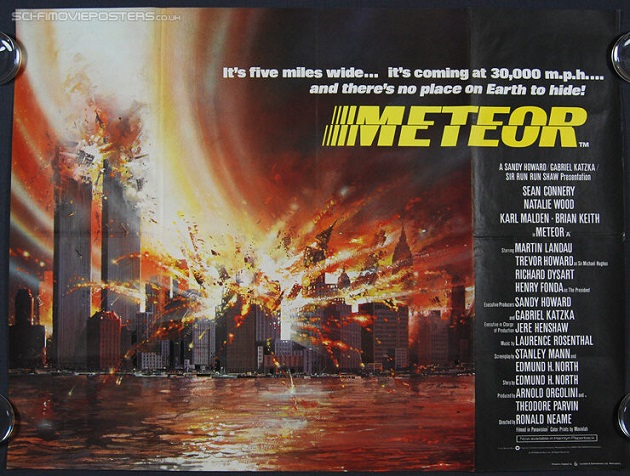
American-International Pictures had gotten pretty fancy-schmancy by the late 70’s. The studio was leaving their exploitation roots behind and branching out to bigger budgeted films like FORCE TEN FROM NAVARONE, LOVE AT FIRST BITE, and THE AMITYVILLE HORROR, with bigger name stars for marquee allure. Toward the end of 1979 they released METEOR, a $16 million dollar, star-studded, special-effects laden, sci-fi/ disaster film spectacle that bombed at the box-office and contributed to the company’s demise.

meteor2

Coming at the tail end of the disaster cycle, METEOR is formulaic as hell. Take a group of well-known stars (Sean Connery, Natalie Wood , Karl Malden , Brian Keith , Martin Landau, Henry Fonda ), give them a disastrous menace to combat (in this case a five-mile wide meteor hurtling toward Earth), add some conflict (US/USSR Cold War relations), and some scenes of destruction, and voila! instant disaster movie! Unfortunately, by 1979 audiences had already grown tired…

View original post 403 more words

The Films of Dario Argento: The Cat o’Nine Tails


(I’m using this year’s horrorthon as an excuse to watch and review all of the films of Dario Argento.  Yesterday, I reviewed The Bird With The Crystal Plumage.  Today, I take a look at The Cat o’Nine Tails.)

gatto_a_nove_code

In 1971, Dario Argento followed up the massive success of The Bird With The Crystal Plumage with his second film as a director, The Cat o’Nine Tails.  While The Cat o’Nine Tails was another huge financial success, it’s never been as a critically acclaimed as Argento’s first film.  Argento, himself, regularly cites The Cat o’Nine Tails as being his least favorite of all of the films that he’s directed.

Much like The Bird With The Crystal Plumage, The Cat o’Nine Tails is a giallo that uses it’s rather complicated mystery as an excuse (a MacGuffin, to quote Hitchcock) for several suspenseful set pieces, the majority of which end with someone suffering some sort of terrible fate.  In this case, a series of murders are taking place around a mysterious medical complex, the Terzi Institute.  The murders are connected to some research being done at the institute.  I’m not going to spoil things by revealing what exactly is being researched but I will say that the key to the mystery is vaguely ludicrous, even by the typically flamboyant standards of the giallo genre.

But, then again, so what?  The fact that the genre’s mysteries are often overly complex and feature solutions that don’t always make sense is actually one of the appeals of the giallo film.  You don’t really watch a giallo for the mystery.  You watch it to see how the story will be told.  Perhaps more than any other genre, giallo requires a director with a strong vision.

And, if nothing else, Argento has always had a strong directorial vision.  Even when you may disagree with the choices that he makes (and I’m sure we all wonder why, in his later films, Argento grew so obsessed with telepathic insects), you can’t deny that they’re always uniquely Argento.  Though the film never reaches the delirious heights of The Bird With The Crystal Plumage, The Cat o’Nine Tails still has several strong set pieces.  There’s a sequence involving a poisoned glass of milk that I particularly appreciate.  And then there’s the long scene at the crypt, in which our two protagonists realize that they don’t really trust each other all that much.  And, of course, there’s the ending.  For a film that’s often dismissed as being lesser Argento, The Cat o’Nine Tails features one of Argento’s darkest endings.

The Cat o’Nine Tails is unique as being one of the only Argento films to regularly show up on TCM.  A lot of that is because The Cat o’Nine Tails is perhaps the least gory of all the films that Argento has made.  That doesn’t mean that there isn’t plenty of death and mayhem.  There is.  Blood is spilled but it never exactly flows.  The Cat o’Nine Tails is an Argento film that you could probably safely watch with an elderly relative.  That’s not necessarily meant as a complaint.  It’s just an observation that, when compared to the panty murder in The Bird With The Crystal Plumage or the skewering in The Mother of Tears, Cat o’Nine Tails is definitely a toned down Argento film.

The other reason why The Cat o’Nine Tails is popular on TCM is because it stars none other than that classic film mainstay, Karl Malden.  Continuing the Argento tradition of featuring protagonists who aren’t sure what they’ve witnessed, Malden plays a former newspaper reporter who is now blind.  He teams up with another reporter (played by James Franciscus, who may not have been a great actor but who did have perfect hair) to solve the murders.  Franciscus has the eyes.  Malden has the brains.  And Malden’s niece, Lori (Cinzia De Carolis), is largely present to provide the film with its final ironic twist.

Malden does a pretty good job in the role, too.  I’ve read some reviews that have complained that Malden overacts but actually, he gives the perfect performance for the material.  In fact, Malden’s unapologetically hammy performance contrasts nicely with the work of James Franciscus, which could  charitably be called subdued.  (Perhaps a better description would be dull…)

Cat o’Nine Tails may not be Argento’s best but I still like it.  If for no other reason, watch it for Malden and that wonderfully dark ending.


Darkness on the Edge of Town: WHERE THE SIDEWALK ENDS (20th Century Fox 1950)


gary loggins's avatarcracked rear viewer

where1

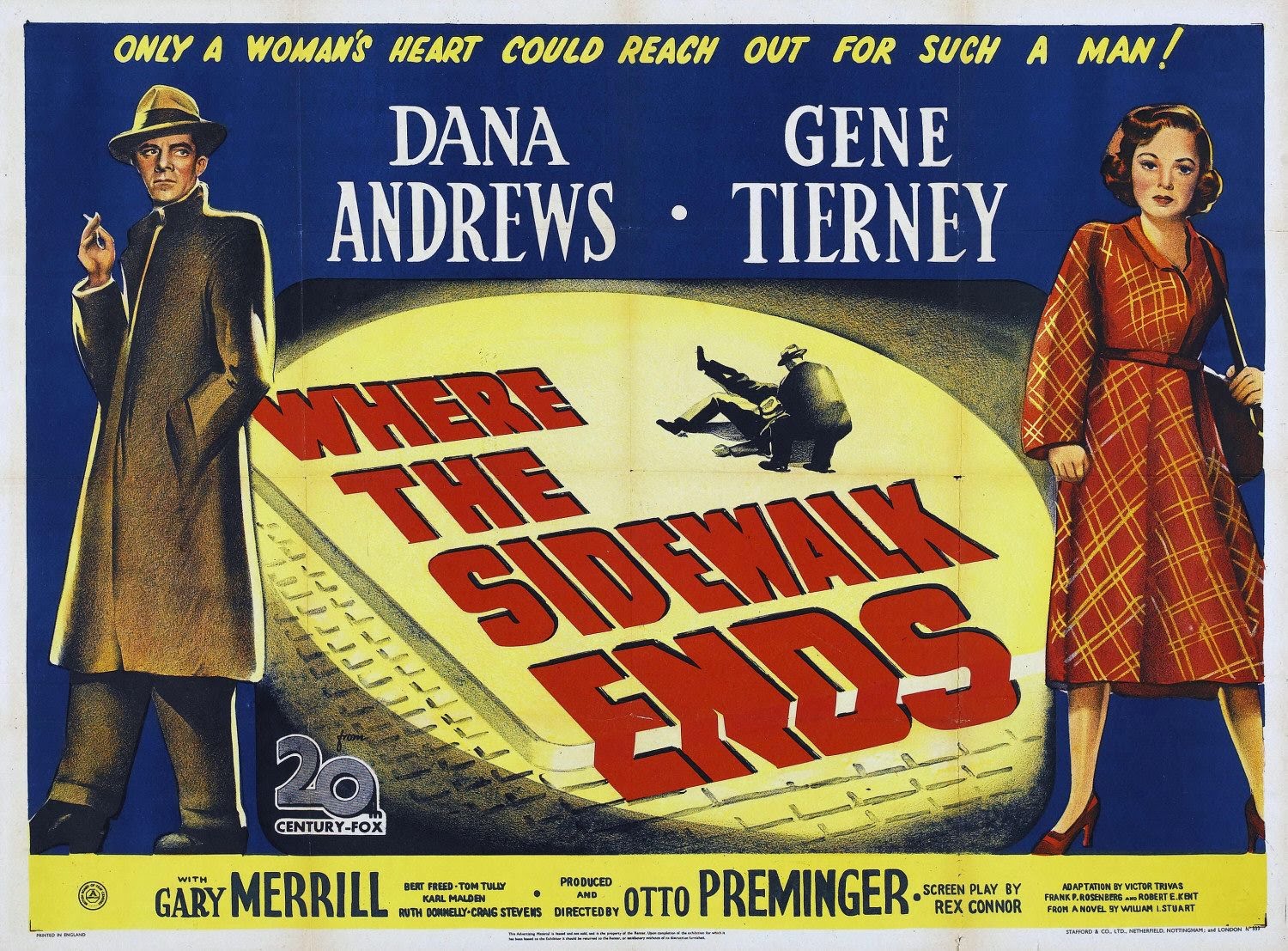
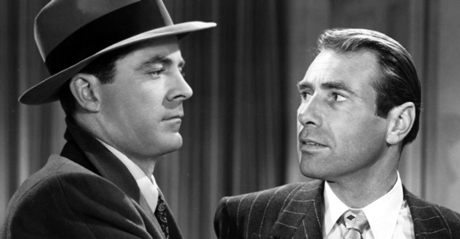
I recorded WHERE THE SIDEWALK ENDS way back in June, and haven’t watched it until just recently. It was well worth the wait, for this is one of the finest noirs I’ve seen yet. Director Otto Preminger reunited with the stars of his film LAURA, Dana Andrews and Gene Tierney, to give us a bleak crime drama that more than holds its own with the best films noir of the era.

Police Detective Mark Dixon (Andrews) is a proto-Dirty Harry cop, a tough SOB not above laying the smackdown on New York City’s criminal element. Another assault charge leads to Mark being demoted by his superiors. Mark’s got a reason for his brutality tactics, though: his father was a criminal, and he’s psychologically compelled to clean up the corruption in his city.

where4

He’s particularly got a hair across his ass about gambling czar Tommy Scalise (Gary Merrill), who was set up in…

View original post 275 more words

Lisa Marie Reviews An Oscar Winner For Labor Day: On The Waterfront (dir by Elia Kazan)


On-the-Waterfront

I like On The Waterfront.

Nowadays, that can be a dangerous thing to admit.  On The Waterfront won the Oscar for Best Picture of 1954 and Marlon Brando’s lead performance as boxer-turned-dockworker Terry Malloy is still regularly cited as one of the best of all time.  The scene where he tells his brother (played by Rod Steiger) that he “could have been a contender” is so iconic that other films still continue to either parody or pay homage to it.  On The Waterfront is one of those films that regularly shows up on TCM and on lists of the greatest films ever made.

And yet, despite all that, it’s become fashionable to criticize On The Waterfront or to cite it as an unworthy Oscar winner.  Certain film bloggers wear their disdain for On The Waterfront like a badge of honor.  Ask them and they’ll spend hours telling you exactly why they dislike On The Waterfront and, not surprisingly, it all gets tedious pretty quickly.

Like all tedious things, the answer ultimately comes down to politics.  In the early 50s, as the House UnAmerican Affairs Committee conducted its search for communists in Hollywood, hundreds of actors, writers, and directors were called before the committee.  They were asked if they were currently or ever had been a member of the Communist Party.  It was demanded that they name names.  Refusing to take part was career suicide and yet, many witnesses did just that.  They refused to testify, apologize, or name names.

And then there was the case of Elia Kazan.  When he was called in front of HUAC, he not only testified about his communist past but he named names as well.  Many of his past associates felt that Kazan had betrayed them in order to protect his own career.  On The Waterfront was Kazan’s answer to his critics.

In On The Waterfront, Terry Malloy’s dilemma is whether or not to voluntarily testify before a commission that is investigating union corruption on the waterfront.  Encouraging him to testify is the crusading priest, Father Barry (Karl Malden), and Edie (Eva Marie Saint), the saintly girl who Terry loves.  Discouraging Terry from testifying is literally every one else on the waterfront, including Terry’s brother, Charlie (Rod Steiger).  Charlie is the right-hand man of gangster Johnny Friendly (a crudely intimidating Lee J. Cobb), who is the same man who earlier ordered Terry to throw a big fight.

At first, Terry is content to follow the waterfront of code of playing “D and D” (deaf and dumb) when it comes to union corruption.  However, when Johnny uses Terry to lure Edie’s brother into an ambush, Terry is forced to reconsider his previous apathy.  As Terry gets closer and closer to deciding to testify, Johnny order Charlie to kill his brother…

The issue that many contemporary critics have with On The Waterfront is that they view it as being essentially a “pro-snitch” film.  It’s easy to see that Elia Kazan viewed himself as being the damaged but noble Terry Malloy while Johnny Friendly was meant to be a stand-in for Hollywood communism.  They see the film as being both anti-union and Kazan’s attempt to defend naming names.

And maybe they’re right.

But, ultimately, that doesn’t make the film any less effective.  Judging On The Waterfront solely by its backstory ignores just how well-made, well-acted, well-photographed, well-directed, and well-written this film truly is.  Elia Kazan may (or may not) have been a lousy human being but, watching this film, you can’t deny his skill as a director.  There’s a thrilling grittiness to the film’s style that allows it to feel authentic even when it’s being totally heavy-handed.

And the performances hold up amazingly well.  Marlon Brando’s performance as Terry Malloy gets so much attention that it’s easy to forget that the entire cast is just as great.  Rod Steiger makes Charlie’s regret and guilt poignantly real.  Karl Malden, who gets stuck with the film’s more pedantic dialogue, is the perfect crusader.  Eva Marie Saint is beautiful and saintly.  And then you’ve got Lee J. Cobb, playing one of the great screen villains.

The motives behind On The Waterfront may not be the best.  But, occasionally, a great film does emerge from less than pure motives.  (Just as often, truly good intentions lead to truly bad cinema.)  Regardless of what one thinks of Elia Kazan, On The Waterfront is a great work of cinema and it’s on that basis that it should be judged.

On_the_Waterfront_poster