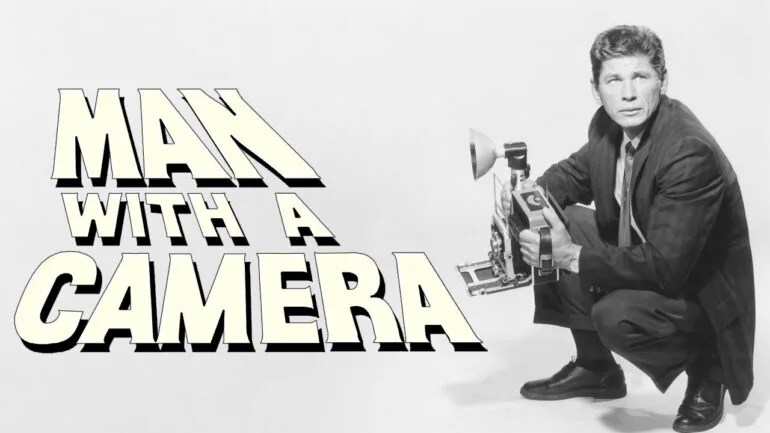
MAN WITH A CAMERA (TV Series) – starring Charles Bronson – S1, E6: Double Negative


In this episode, freelance photographer Mike Kovac (Charles Bronson) receives a tip from reporter Mike Costigan (Frank Faylen) about a mysterious woman. Acting on the lead, Mike snaps a photograph of the woman, only to discover that she bears a striking resemblance to Helen Sprague (Tracey Roberts), a lady who was reportedly murdered by night club owner Howard Dorn (Don Durant). When she shows back up alive, the D.A. will have to drop the charges on Dorn, right? Well it’s not that easy as a punch-drunk ex-fighter Pete Montee (Karl Lukas) shows up at Mike’s house and insists that the woman in the photo is his girlfriend Connie Sawyer. It turns out that Costigan and Dorn are trying to cash in on Kovac’s honest reputation to get away with murder. When Mike gets wise to their plan, he becomes their next target for death!!

This episode of MAN WITH A CAMERA was directed by Gerald Mayer, who would direct 11 episodes of the series. It’s a solid “film noir” episode, with Bronson’s Mike Kovac getting caught up in a murder plot involving double-crossing bad guys, a duplicitous dame, and a dumb lug, where he’ll be lucky if he comes out alive. Of course, a young Bronson is the biggest draw in every episode of MAN WITH A CAMERA. Along with his magnetic screen presence, Bronson always knew how to throw a punch and he gets to engage in a couple of nice fisticuff sequences in “Double Negative.” It makes for good balance as his camera gets him into hot water at the beginning and his fists get him out of hot water at the end. I also want to throw some love Karl Lukas’ way as the ex-fighter, Pete Mantee. He’s clearly not the sharpest tool in the toolshed, but his performance is the most enjoyable of the series, outside of Bronson, up to this point. His combination of innocent, dumb, and unbelievably strong is a lot of fun. 

Overall, “Double Negative” is one of the best episodes of MAN WITH A CAMERA so far. Bronson is at his best and I really like the film-noir feel. If you haven’t watched on episode on Amazon Prime yet, this would not be a bad place to start! 

SHANE (The TV Series) – Episode 1: The Distant Bell (aired September 10th, 1966)


I’ve been called “Charles Bronson’s biggest fan” on multiple occasions and by people I greatly respect. It’s possible that’s close to being true, but I chose to buy the entire TV series of SHANE on DVD because I wanted to watch Bronson’s wife, Jill Ireland, in a role that doesn’t include her more famous husband. I also wanted to see a young David Carradine as Shane. It doesn’t hurt that the 1953 film starring Alan Ladd is one of my absolute favorite movies. 

The very first episode of SHANE starts off with Mr. Starett (Tom Tully) and the new schoolmarm (Diane Ladd) riding into town. They immediately run into Mr. Ryker (Bert Freed) and his henchman Harve (Lawrence Mann), who tells them in no uncertain terms that there will never be a school in this town. Enter Shane (David Carradine), who works for Mr. Starett. He tells Harve to get out of the way, and Mr. Starett, the school teacher and Shane head out to their ranch.

The new school is going to be in Ed Howell’s (Karl Lukas) barn. Mr. Howell is concerned about the school and his own personal safety since he’s heard of Ryker’s threats. Mr. Starett reassures him that everything will be okay so they head to Grafton’s general store to purchase supplies. Mr. Ryker shows up there and tries some more intimidation. When they leave the store, they notice a fire off in the distance. It’s Ed Howell’s barn. Appalled by all of this violence, the schoolteacher catches the next stage out of town. 

Marian Starett (Jill Ireland), old man Starett’s daughter, decides she will teach the school. She knows her son Joey (Christopher Shea) needs to be educated along with the other children in the area. Since the barn was burned down, Marian asks Mr. Grafton if they can use the saloon to hold their classes since men don’t come to drink until 4:00 or later. Of course, now Mr. Ryker decides to come early and start drinking. They break bottles and glasses on the floor while the kids try to do their multiplication tables. Scared for the children, Marian takes the kids out and the future of the school appears to be in doubt again. 

Shane decides he’s had enough of this crap. He begins building a school out in the country and tells Marian that school will start there tomorrow. He’s prepared to defend the school against Ryker, Harve and anyone else who gets in the way. The next morning, Shane tells Marian & Mr. Starett to listen for the school bell. If they hear it, come on. If they don’t, there will be no school. Harve confronts Shane at the new school building. If Shane is defeated, the idea for the school and the education of the kids in the valley will be dead with him…

I enjoyed this first episode. The main cast does a fine job. David Carradine is a solid Shane. He has the confidence of a man who knows his true value is his ability with a gun. He doesn’t lead with the gun, but he’ll go there when it’s required. Jill Ireland is also good as Marian Starett. There’s a nice bit of sexual tension between her and Shane, and she’s also good as the doting mother to Joey. It is nice to see her in a role that doesn’t involve Charles Bronson, and she’s good in this first episode. Tom Tully is good as old man Starett, Marian’s father-in-law. His character is necessary as a guy who provides some needed relief between Shane and Marian. Finally, Joey is played by Christopher Shea. I’ll have to see how he grows on me as the series progresses. He’s fine in the first episode. Interestingly, he voiced Linus in the classics, “A Charlie Brown Christmas” and “It’s the Great Pumpkin, Charlie Brown” so I’m willing to give him some space to grow! 

I’m looking forward to seeing where the series goes. It’s a total of 17 episodes so it won’t take too long to get there! 

A Movie A Day #185: Emperor of the North Pole (1973, directed by Robert Aldrich)


Emperor of the North Pole is the story of depression-era hobos and one man who is determined to kill them.
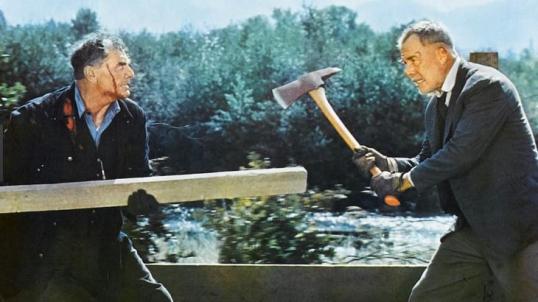
The year is 1933 and Shack (Ernest Borgnine) is one of the toughest conductors around.  At a time when destitute and desperate men are riding the rails in search of work and food, Shack has declared that no one will ride his train for free.  When Shack is first introduced, the sadistic conductor is seen shoving a hobo off of his train and onto the tracks.  Shack smiles with satisfaction when the man is chopped in half under the train’s wheels.

A-No.1 (Lee Marvin) is a legend, the unofficial king of the hobos.  A grizzled veteran, A-No. 1 has been riding the rails for most of his life.  (The title comes from the hobo saying that great hobos, like A-No. 1, are like the Emperor of the North Pole, the ruler of a vast wasteland).  A-No. 1 is determined to do what no hobo has ever done, successfully hitch a ride on Shack’s train.  He even tags a water tower, announcing to everyone that he intends to take Shack’s train all the way to Portland.

If A-No. 1 did not have enough to worry about with Shack determined to get him, he is also being tailed by Cigaret (Keith Carradine), a young and cocky hobo who is determined to become as big a legend as A-No. 1.  Cigaret and A. No. 1 may work together but they never trust each other.

Like many of Robert Aldrich’s later films, Emperor of the North Pole is too long and the rambling narrative often promises more than it can deliver.  Like almost all movies that were released at the time, Emperor of North Pole attempts to turn its story into a contemporary allegory, with Shack standing in for the establishment, A-No. 1 representing the liberal anti-establishment, and, most problematically, Cigaret serving as a symbol for the callow counter culture, eager to take credit for A-No. 1’s accomplishments but not willing to put in any hard work himself.

As an allegory, Emperor of the North Pole is too heavy-handed but, as a gritty adventure film, it works wonderfully.  Lee Marvin is perfectly cast as the wise, no-nonsense A-No. 1.  This was the sixth film in which Marvin and Borgnine co-starred and the two old pros both go at each other with gusto.  Carradine does the best he can with an underwritten part but this is Borgnine and Marvin’s film all the way.  Marvin’s trademark underacting meshes perfectly with Borgnine’s trademark overacting, with the movie making perfect use of both men’s distinctive screen personas.  As staged by Aldrich, the final fight between Shack and A-No. 1 is a classic.

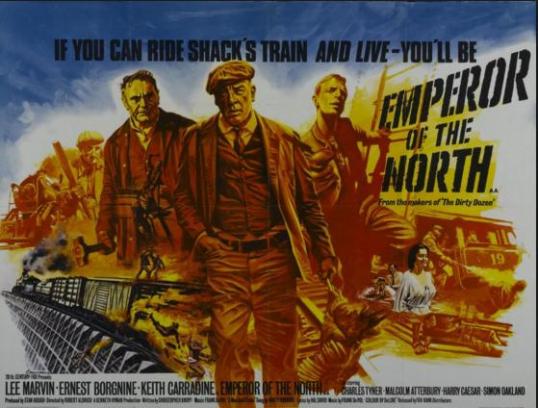
Even at a time when almost every anti-establishment film of the early 70s is being rediscovered, Emperor of the North Pole remains unjustly obscure.  When it was first released, it struggled at the box office.  Unsure of how to sell a movie about hobos and worrying that audiences were staying away because they thought it might be a Christmas film, 20th Century Fox pulled the movie from circulation and then rereleased it under a slightly altered name: Emperor of the North.  As far as titles go, Emperor of the North makes even less sense than Emperor of the North Pole.  Even with the title change, Emperor of the North Pole flopped at the box office but, fortunately for him, Aldrich was already working on what would become his biggest hit: The Longest Yard.

Keep an eye out for Lance Henriksen, in one of his earliest roles.  Supposedly, he plays a railroad worker.  If you spot him, let me know because I have watched Emperor of the North Pole three times and I still can’t find him.