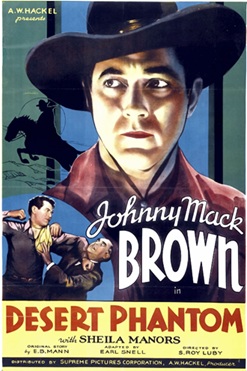
Desert Phantom (1936, directed by S. Roy Luby)


In a frontier town, rancher Jean Halloran (Sheila Bromley) has a big problem.  Someone is shooting and killing all of her ranch hands and sending her notes in which he tells her to give up her ranch and leave town.  When an ammunition salesman and trick shooter named Billy Donavon (Johnny Mack Brown), Jean hires him to serve as a bodyguard and to track down the mysterious Phantom.  Billy, however, has a secret of his own.

Desert Phantom is a remake of an old Harry Carey film.  I don’t know why Poverty Row did remakes since all of their films pretty much had the same plot regardless.  A stranger comes into town and gets involved with a female rancher and a bad guy who is trying to hide his actual identity.  In this one, Nelson McDowell gets to supply the comic relief as a befuddled veterinarian while familiar faces like Ted Adams and Karl Hackett are there to keep us guessing about how the Phantom could actually be.  If you’ve watched enough of these movies, though, you’ll always be able to guess who the bad guy is.

This isn’t the best of Johnny Mack Brown’s movies.  The Phantom’s story seems like it could have been interesting but that would have meant taking more risks than most of the Poverty Row studios were willing to do.  Johnny Mack Brown is as convincing a cowboy as always and is the film’s saving grace.  Brown was a western star precisely because he could make even something like Desert Phantom watchable.

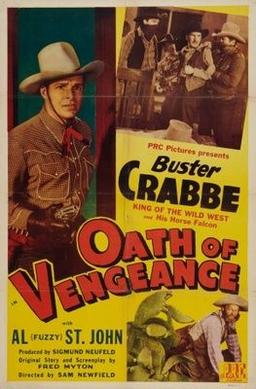
Oath of Vengeance (1944, directed by Sam Newfield)


In a small frontier town, the ranchers and the farmers are nearly at war with each other.  Cattle are being rustled.  The head of the farmers (Karl Hackett) is accused of killing a ranch hand.  Store owner Fuzzy Q. Jones (Al St. John) suspects that it’s all a set-up and he’s not going to stand for it.  If the farmers kill all the ranchers and the ranchers kill all the farmers, there won’t be anyone left to shop at his store.  Fuzzy calls in his friend, Billy Carson (Buster Crabbe).

Buster Crabbe may have gotten his start in the westerns by playing Billy the Kid but the producers of his films eventually realized that there was only so long that Buster could play a character known as “the Kid” and Billy the Kid’s reputation as an outlaw was actually not helpful at the box office because parents didn’t want to send their kids to a matinee that might teach them the wrong lessons.  After a handful of “Billy the Kid” films, Buster’s western hero suddenly had a new name.  Billy Carson was a standard western do-gooder, called in whenever a town needed to be cleaned up or his old sidekick Fuzzy needed some help around the store.  Crabbe was a convincing hero no matter what but the Billy Carson films lacked the thing that made the Billy the Kid films interesting.  Usually, no one was trying to arrest Billy Carson.

Oath of Vengeance isn’t bad, at least not by the standards of Poverty Row westerns.  There’s plenty of fights and Crabbe, being a former Olympian, looks convincing with he throws a punch.  The plot is a pretty standard B-western plot but Crabbe’s natural likability carries the day.  Fans of the genre will be happy to see Charles King and Kermit Maynard, playing bad guys.  Frank Ellis plays the ranch hand whose murder sets off the story.  It’s always good to see the old gang back together again.

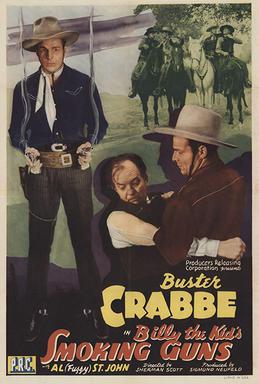
Billy The Kid’s Smoking Guns (1942, directed by Sam Newfield)


It’s a tale as old as time.  During the days when the west was wild, the U.S. Army is planning on setting up a new outpost near a town so the bad guys want to run all the ranchers off of their land so that they can be the ones to sell it.  Sheriff Carson (Ted Adams) is corrupt and working for the bad guys so the ranchers have to turn to Billy the Kid (Buster Crabbe) and his sidekicks, Jeff (Dave O’Brien) and Fuzzy (Al St. John) for help.  When Jeff is wounded in a fight, Fuzzy takes him to Doc Hagen (Milton Kibbee), little suspecting the doctor is actually the leader of the bad guys and using his medical practice to kill anyone who won’t give up their land!

Coming to us straight from Poverty Row, this B-western is interesting in that it seems to take a very cynical view of law enforcement.  Sheriff Carson is corrupt and Billy and his friends are running from the law themselves.  Buster Crabbe’s Billy the Kid films always kept it unclear why Billy was in trouble with the authorities.  Crabbe’s Billy the Kid always seemed to be the nicest guy in the west.  (Of course, Crabbe was also 33 and no longer seemed like he should have been known as “the Kid.”)  Eventually, the series was retconned and Buster Crabbe was no longer playing Billy the Kid but instead he was playing an upstanding citizen named Billy Carson.

Crabbe may not be a convincing outlaw but he is a convincing hero, which is all these films really required.  Billy the Kid’s Smoking Guns is a little bit interesting because of the character of Doc Hagen, whose occupation makes him a little more memorable than typical B-western bad guy.  The film is also interesting in that, for once, there’s no love interest.  Instead, it’s just men in hats shooting at each other.  That probably made the film’s youthful target audience happy.

The real-life Billy The Kid was killed when he was only 21 and after he had been an outlaw for only three years.  Buster Crabbe would g0 on to play Billy (or o some variation of Billy) until he was closing in on 40.


Shadows of Death (1945, directed by Sam Newfield)


After a railroad agent is murdered and his map of the future locations of the railroad is stolen, Billy Carson (Buster Crabbe) rides into a frontier town and searches for the guilty party.  Fortunately, for Billy, his best Fuzzy Q. Jones is the mayor, the sheriff, and the town barber!  Unfortunately, local gunslinger Clay Kincaid (Eddie Hall) wants to make a name for himself by taking on the famous Billy Carson.  Corrupt businessman Landreau (Charles King) encourages Clay by lying to him and telling him that Bully is planning on stealing Clay’s girl, Babs (Dona Dax).

A standard Poverty Row western, Shadows of Death was made by the same crew and cast who were involved with most of Buster Crabbe’s Billy The Kid films.  I’m not sure if Billy Carson is meant to be the same character as Billy the Kid, though.  Billy the Kid always had bounty hunters after him but Billy Carson works for the railroad.  However, it would be strange if Fuzzy Q. Jones just happened to be the favored sidekick of two gunslingers who just happen to both be named Billy.  Along with Fuzzy’s vaudeville style comedy, one thing that audiences could always take for granted was that Charles King would play the villain in these movies and Frank Ellis would always be his henchman.  I always wonder if audiences in the 40s noticed that Charles King’s businessman and Frank Ellis’s gunslinger always returned from the dead with every B-western that came out.

My favorite scene in this one is Billy bursting into Landreau’s office, just for Landreau to say that he expects visitors to knock.  Billy pauses long enough to knock on the door before getting down to the business of frontier justice.

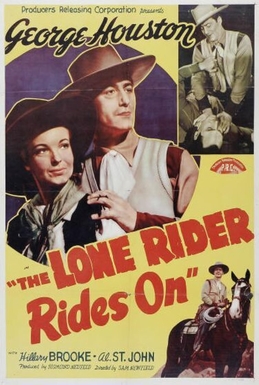
The Lone Rider Rides On (1941, directed by Sam Newfield)


In the days of the wild west, Tom Cameron (George Houston) rides the range alone, seeking vengeance for the murder of his family.  They were killed when their wagon train was ambushed by the same outlaws who has previously sold them a plot of land.  Tom was a child at the time and he only remembers that the leader of the outlaws had a distinctive facial scar.  Tom Cameron is The Lone Rider.

No, not the Long Ranger.  The Lone Rider!  George Houston was an opera star who made for a surprisingly convincing gunslinger and the movie opens with him singing I Am The Lone Rider, just to make sure that it was understood that his vengeance-driven vigilante was a completely different character from that other vengeance-driven vigilante.  The Lone Rider is looking to avenge his family and, with the help of store keeper “Fuzzy” Jones (professional sidekick Al St. John), the Lone Rider does just that.  Though this is a standard B-western, the plot is a little more serious than most other B-movies.  This was the first of several Lone Rider movies and, despite the obviously low budget, there’s some emotional heft to its story.  Tom discovers that his brother (Lee Powell), who he thought had died in the attack, actually survived and joined up with the gang.  The story is about both Tom’s vengeance and his brother’s redemption.  Fans of the genre will enjoy the film’s classic western story and George Houston’s convincing performance as a gunslinger on a mission.

The Lone Rider would ride on for 16 more movies, the last one being released in 1944.  In 1942, George Houston was replaced in the lead role by Robert Livingston.  Houston went from starring in westerns to becoming one of Hollywood’s most respected vocal coaches.  (Howard Keel was one of his students.)  Shortly after the Lone Rider road for the last time, George Houston died while planning his musical comeback.  He had a heart attack and the police, thinking he was just intoxicated, tossed him in the drunk tank where he subsequently died.  He was only 48 years old.

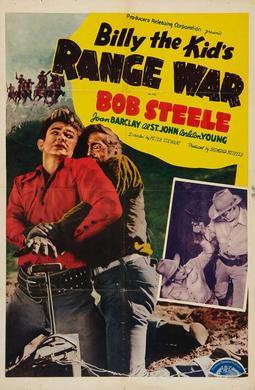
Billy The Kid’s Range War (1941, directed by Sam Newfield)


Billy the Kid was a big damn hero.

At least that’s the claim of Billy The Kid’s Range War, in which Billy (played by middle-aged Bob Steele) is a do-gooder with a comedic sidekick named Fuzzy (Al St. John) and a hankering to help Ellen Gorman (Joan Barclay) bring a new stagecoach line to town.  Williams (Karl Hackett) does want to the Gorman family to success so he hires Buck (Rex Lease) to dress up like Billy the Kid and ride a horse that looks like Billy the Kid’s and commit crimes, like killing Ellen’s father.  Framed for all those crimes that he didn’t commit and with his best friend (Carleton Young) ordered to arrest him, Billy decides to go under cover so that he can clear his good name.  Someone pretending to be Billy the Kid got him into this mess.  Now, Billy’s going to get out of it by pretending to be someone else.

The action is pretty standard for a B-western.  Mostly, it’s interesting to see a movie where Billy the Kid is actually a nice guy who gets framed.  No wonder a whole generation grew up with no idea about true history of the American frontier.  Sam Newfield directed a handful of Billy the Kid films and the capable Bob Steele starred in most of them but this is the only one that I’ve sat down and watched and it actually left me missing the production values of the Johnny Mack Brown films.  For fans of these type of westerns, there’s the promise of seeing familiar actors like George Cheseboro and Ted Adams doing there thing.  Even the outstanding character actor Milton Kibbee makes an appearance.  For those who do not like westerns, this film is not going to change their minds.

Despite the promise of the title, there is no range war in this movie.  There’s just Billy the Kid, trying to clear his good name.

Chip of the Flying U (1939, directed by Ralph Staub)


In this B-western, Johnny Mack Brown plays Chip Bennett, the foreman of the Flying U Ranch.  The ranch is owned by J.G. Whitmore (Forrest Taylor) and his daughter (Doris Weston), who has just returned from college and who has eyes for Dusty (Bob Baker), a singing ranchhand.

Ed Duncan (Anthony Warde) and his gang are in the arms smuggling business.  To make their business a success, they need access to the ranch, which sits on the shore of a lake.  Knowing that Chip would never let them take over, Duncan tries to frame Chip for a bank robbery and murder.  Chip responds by kidnapping two of Duncan’s men, leading to a final and explosive shootout.

Chip of the Flying U is a western that doesn’t seem to know what era it’s supposed to be taking place in.  Chip, Duncan, and all of the other ranch hands dress like they’re in the late 1800s.  Doris Weston dresses like she’s just stepped out of a 1930s photoshoot.  Duncan is trying to smuggle hand grenades, which were invented in 1908 but not commonly used until World War I.  The movie’s time period is all over the place but that was frequently the case with the B-westerns of the 30s.  Shot on studio backlots and for a very low budget, these films were not concerned with historical accuracy.  Instead, they were about shootouts and a few songs.  Chip of the Flying U offers up both, along with Fuzzy Knight as the comedic sidekick who turns out to be very good with a rifle.

With lots of horse chases and bloodless shoot-outs and not too much romance, this movie may seem creaky by today’s standards but probably thrilled the kids who caught while spending an afternoon at the movies in 1939.  Today, the appeal of movies like this is that the good guys are unquestionably good and the bad guys are unquestionably bad.  They remind us of a simpler time that may have never existed but we all hope it did.

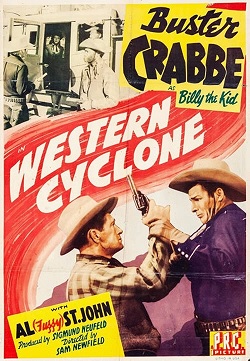
Western Cyclone (1943, directed by Sam Newfield)


Feeling that the old west has become a dangerous place, law-abiding gunslinger Billy the Kid (Buster Crabbe) fakes a stagecoach robbery and pretends to kidnap the governor’s daughter, all to show him that the west needs more law enforcers.  The governor is so impressed by Billy’s ruse that he agrees to stand tough on crime.  This upsets Dirk Randall (Glenn Strange, who also played Frankenstein’s monster is some of the later Universal horror films), a businessman who has been funding the criminals in order to make the governor look weak so that Randall could defeat him in the next election.

Randall orders one of his men to pull a gun on Billy while Billy is leaving the local saloon.  Billy pulls and fires his own gun in self-defense but it’s Randall who actually kills the man by shooting him in the back and then running off in the confusion.  Because the man was shot in the back, Billy is accused of murder, arrested, and sentenced to death in record time.  With Billy in jail, it falls to his comic relief sidekick, Fuzzy Jones (Al St. John), to prove that Billy didn’t actually fire the shot that killed the man.

By most accounts, Billy the Kid was a nasty piece of work who would kill anyone who look at him in the wrong way but, in the 30s, the character was the hero of a series of 42 Westerns that all featured him as a hero and a valued member of the community.  (Originally, Bob Steele played Billy.  Buster Crabbe took over the role with the seventh film.)  Western Cyclone was the 17th Billy the Kid film and, as long as you’re not a stickler for historical accuracy, it’s an entertaining B-western.  The plot is formulaic but Crabbe was a good hero, Strange was a diabolical villain, and, for once, Al St. John got to play an important role in resolving the film’s story.  Fuzzy Jones did some impressive detective work.  The real Billy the Kid probably could have used someone like Fuzzy in his corner.