Film Review: Air (dir by Ben Affleck)


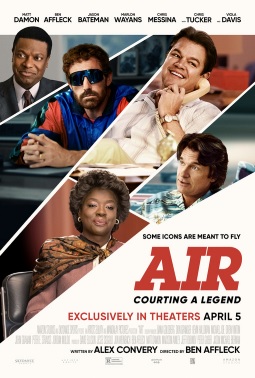
Air opens with a montage of the 80s.  Ronald Reagan is President.  MTV is actually playing music.  Wall Street is full of millionaires.  Sylvester Stallone is singing with Dolly Parton for some reason.  Because the specific year is 1984, people are nervously giving George Orwell’s book the side-eye.  Everyone wants an expensive car.  Everyone wants a big house.  Everyone wants the world to know how rich and successful and special they are.

What no one wants is a pair of Nike basketball shoes.  All of the major players are wearing Adidas and Converse while Nike is viewed as being primarily a company that makes running shoes.  CEO Phil Knight (played by Ben Affleck) is considering closing down the basketball shoe division.  Sonny Vaccaro (Matt Damon), however, has a plan that he thinks will save the division.  Instead of recruiting three or four low-tier players to wear and endorse Nike shoes, Sonny wants to spend the entire division’s budget on just one player.  Sonny is convinced that a young Michael Jordan is destined to become one of the best players in the history of basketball and he wants to make a shoe that will be specifically designed for Jordan.

The problem is that Michael Jordan doesn’t want to have anything to do with Nike because Nike is not viewed as being a cool brand.  Jordan wants to sign with Adidas, though he’s considering other offers as well.  He also wants a new Mercedes.  Even though everyone tells Sonny that he’s wasting his time and that he’ll be responsible for a lot of people losing their jobs if he fails, Sonny travels to North Carolina to make his pitch personally to Jordan’s mother (Viola Davis).

For it’s first 50 minutes or so, Air feels like a typical guy film, albeit a well-directed and well-acted one.  Almost all of the characters are former jocks and the dialogue is full of the type of good-natured insults that one would expect to hear while listening to a bunch of longtime friends hanging out together.  For all the pressure that Sonny is under, the underlying message seems to be one of wish fulfilment.  “Isn’t it great,” the film seems to be saying, “that these guys get to hang out and talk about sports all day?”  When Sonny runs afoul Michael Jordan’s agent, David Falk (Chris Messina), one is reminded of the stories of temperamental film executives who spent all day yelling at each other on the telephone.  The efforts to sign Jordan feel a lot like the effort to get a major star to agree to do a movie and it’s easy to see what attracted Damon and Affleck to the material.  Even though the majority of the film takes place in the Nike corporate offices, it deals with a culture that Damon and Affleck undoubtedly know well.

But then Jason Bateman delivers a great monologue and the entire film starts to change.  Despite his reluctance to sign with Nike, Michael Jordan and his family have agreed to visit the corporate headquarters.  Sonny has a weekend to oversee the creation of the shoe that will hopefully convince Jordan to sign.  When Sonny shows up for work, he’s excited.  But then he has a conversation with Rob Strasser (Jason Bateman), the head of marketing.  Strasser talks about his divorce and how he only sees his daughter on the weekends.  Every weekend, Rob brings his daughter the latest free Nike stuff.  His daughter now his 60 pairs of Nike shoes.  Rob admits that, even if he loses his job, he’ll probably still continue to buy Nike shoes because that’s now what his daughter expects whenever she sees him.  Rob compares Sonny’s plan to the Bruce Springsteen song Born in the USA, in that the tune sounds hopeful but the lyrics are much darker.  If the plan succeeds, Nike will make a lot of money.  If it fails, Rob and everyone in the basketball division will be out of a job and that’s going to effect every aspect of their lives.  Rob points out that Sonny made his decision to pursue only Michael Jordan without thinking about what could happen to everyone else.  Sonny says that success requires risk.  Rob replies that Sonny’s words are spoken, “like a man who doesn’t have a daughter.”

It’s an honest moment and it made all the more powerful by Bateman’s calm but weary delivery of the lines.  It’s the moment when the film’s stakes finally start to feel real, even though everyone knows how the story eventually turned out.  As well, it’s in this moment that the film acknowledges that the Air Jordan legacy is a complicated one.  Rob talks about how the shoes are manufactured in overseas sweatshops.  Later, when discussing whether or not Michael Jordan should get a percentage of the sales, Jordan’s mother acknowledges that the shoes aren’t going to be cheap to purchase.  They’re going to be a status symbol, just as surely as the Mercedes that Jordan expects for signing with the company.  Air becomes much like that Springsteen song.  On the surface, it’s a likable film about a major cultural moment, full of dialogue that is quippy and sharply delivered without ever falling into the pompous self-importance of one of Aaron Sorkin’s corporate daydreams.  But, under the surface, it’s a film about how one cultural moment changed things forever, in some ways for the better and in some ways for the worse.

It’s an intelligent film, one the creates a specific moment in time without ever falling victim to cheap nostalgia.  Matt Damon gets a brilliant monologue of his own, in which he discusses how America’s celebrity culture will always attempt to tear down anyone that it has previously built up.  Ben Affleck plays Nike’s CEO as being an enigmatic grump, alternatively supportive and annoyed with whole thing.  As for Michael Jordan, he is mostly present in only archival footage.  An actor named Damian Delano Young plays him when he and his parents visit Nike’s corporate headquarters but, significantly, his face is rarely show and we only hear him speak once.  In one of the film’s best moments, he shrugs his shoulders in boredom while watching a recruitment film that Nike has produced to entice him and, because it’s the first reaction he’s shown during the entire visit, the audience immediately understands the panic of every executive in the room.

Air is a surprisingly good film.  It’s currently streaming on Prime.
Film Review: Custody (dir by James Lapine)


custody-2-620x345

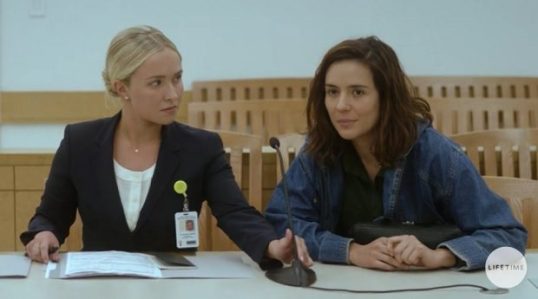
Last night’s Lifetime movie premiere, Custody, didn’t really feel like a Lifetime film.

This was largely because it really wasn’t.  Custody was written and directed by the acclaimed theatrical director, James Lapine.  The cast features not only Emmy winner Tony Shalhoub and Oscar nominee Catalina Sandino Moreno but also two Oscar winners, Viola Davis and Ellen Burstyn.  Unlike most Lifetime films, Custody was not filmed in Canada.  There were no Toronto landmarks in the background.  (You never realize how much you miss Canada until it’s gone.)  Custody played at Tribeca last year.  Much like Stockholm, Pennsylvania, Custody was made for a theatrical release but it ended up premiering on television instead.  As a result, Custody did not follow the usual Lifetime 8 act pattern.  The commercial breaks felt awkward.  With a 150 minutes running time, this film tested my four-minute attention span.

The other thing that set Custody apart from most other Lifetime films was that it wasn’t much fun to watch.  The great thing about Lifetime movies is that they are almost always fun.  It doesn’t matter what serious subject is being examined.  It doesn’t matter how dramatic things may get.  Lifetime movies are always fun.  To use one of my favorite terms, Lifetime movies embrace the melodrama.  Lifetime films push the limits.  Lifetime films say, “You think we won’t introduce a crazy twin halfway through the movie?  JUST WATCH US!  You think we won’t toss in a sudden case of amnesia or a cheating husband or a psychotic au pair in lingerie?  YOU DON’T KNOW LIFETIME!”

Custody, on the other hand, was a very serious movie about a very serious topic and therefore, it wasn’t much fun to watch.  In fact, Custody was a bit of a well-intentioned mess.  It followed one case as it worked its way through the family court system.  Sara Diaz (Moreno) has been wrongly accused of being an unfit mother.  Her attorney is Ally Fisher (Hayden Panettiere), who has just graduated from law school and who comes from a rich family.  Ally’s grandmother is played by Ellen Burstyn, largely because everyone’s rich grandmother is played by Ellen Burstyn.  Representing the state is Keith (Dan Fogler), who has absolutely horrid taste in ties.  The judge is played by Viola Davis and she’s going through a messy divorce from Tony Shalhoub.

I could see what Lapine was going for.  Custody juggles several plotlines, showing how everyone involved in the case has their own individual biases and problems to deal with.  Will the judge’s dissolving marriage make her more or less sympathetic to Sara?  Will the white and privileged Ally ever be able to truly understand Sara’s situation?  Will Keith ever learn how to properly select a tie?  These issues may seem petty when taken on their own but, when crammed together, they form one big human drama.

Or, at least, that seems to have been the plan.  Lapine gets some good performances from his cast but Custody never quite comes together.  This is one of those heavy-handed films where characterization is more likely to be advanced by a lengthy monologue than by action.  Add to that, Custody is ultimately far too enamored of the family court system.  Everyone means only the best and the bureaucracy is your friend.

I will say this.  Based on my own experience working as an administrative assistant in a law office, Custody does get one thing very right.  Male lawyers are always the worst dressed people at any courthouse.  On this count, Dan Fogler played one of the most realistic attorneys ever seen on TV.


Back to School #64: Friday Night Lights (dir by Peter Berg)


For the past three weeks, I’ve been looking at some of the best, worst, most memorable, and most forgettable high school and teen films ever made.  I’ve been posting the reviews in chronological order and, as I look back over the previous 63 Back to School reviews, one thing that I can’t escape is football.

It’s funny.  Despite being a Texas girl, I know very little about football and, whenever I have found myself watching a game, I’ve usually end up getting bored out of my mind.  I’m not a huge fan of sports films, either.  It’s just not my thing.  And yet, as a result of doing this series of reviews, I’ve watched more football films over the past month than I had probably seen in my entire life previously.  Some of the films that I’ve reviewed specifically were football films — The Pom Pom Girls, All The Right Moves, and Varsity Blues, for example.  However, even the film that weren’t specifically about the sport often featured scenes set on the football field.  Just think of Forest Whitaker in Fast Times At Ridgemont High or the socially conflicted jocks from Dazed and Confused.

For a lot of films, football and high school seem to go together.  And one of the most acclaimed high school football films is 2004’s Friday Night Lights.  Now, I have to admit that Friday Night Lights is not one of my favorite films.  It’s a football film, I’m not into football, and therefore, Friday Night Lights is a film that I respect more as a well-made film than like as a source of entertainment.  Perhaps the best thing that I can say about Friday Night Lights is that I understand why so many people who do love football also happen to love this film.

And I do have to say that I appreciate that Friday Night Lights is also a film about Texas that actually manages to realistically portray my home state without resorting to the predictable clichés that dominated Varsity Blues.

Taking place in Odessa, Texas, Friday Night Lights follows the 1988 season of the Permian Panthers.  As opposed to most sports films, Friday Night Lights does not focus on a team of lovable underdogs.  Instead, the Panthers are already known for being a championship team.  As the season begins, Coach Gary Gaines (Billy Bob Thornton) is under tremendous pressure to continue that winning tradition.  However, when the team’s star player is injured during the first game of the season, the Panthers suddenly find their pre-ordained winning season in doubt.  Gaines finds himself being alternatively celebrated and demonized depending on how the previous night’s game has gone and his players find themselves under tremendous pressure from everyone in town.  The film features a great performance from Billy Bob Thornton and a really good one from Derek Luke, playing a player who abruptly goes from being a future superstar to a present could-have-been.  In fact, the entire film is well-acted with even country singer Tim McGraw giving a surprisingly multi-faceted performance as a former player-turned-drunk.

In short, Friday Night Lights is a lot like Varsity Blues, except that it doesn’t suck.

(Incidentally, Friday Night Lights did inspire a TV series.  I never watched it.)

Friday_night_lights_ver2