Long before the end credits of 22 Jump Street imagined Jonah Hill and Channing Tatum going to culinary school, the flight academy, and into outer space, the Police Academy films bravely tested just how far one already thin premise could already be stretched.
In Police Academy 4, Commandant Eric Lassard (George Gaynes) comes up with another plan to make the city safer. (Since Lassard has been coming up with plans for three years without any success, it may be time to let the old man retire peacefully.) This time, he wants to institute Citizens on Patrol, which would mean training citizens to act like cops. It sounds like the type of terrible idea that could get a city sued into bankruptcy but considering that this is a city where a human sound effects machine and the former head of the 16 precinct’s biggest gang can become decorated police officers, I guess it’s as good an idea as any.
As usual, Carey Mahoney (Steve Guttenberg) and the gang are ready to help Lassard. Bruce Mahler’s Fackler is no longer a part of the ensemble but Bubba Smith, Bobcat Goldthwait, Michael Winslow, David Graf, Tim Kazurinsky, Marion Ramsey, and Brian Toschi are all back. Also returning, after skipping out on the first two sequels, is Capt. Harris (G.W. Bailey). Harris wants to see Lassard fail so that he can take over the police academy. It’s the same thing as the first three films. As in previous Police Academy films, there’s a visit to the Blue Oyster leather bar and a last minute crime wave to give the Citizens on Patrol a chance to prove they belong in the program. The Citizens on Patrol include Billie Bird, Brian Backer, David Spade, wrestler Tab Thacker, and Corrine Bohrer as a love interest for Bobcat Goldthwait. Sharon Stone also makes an appearance, playing a journalist and improbably falling for Steve Guttenberg. Watching the film, it is obvious that the idea was that, in future Police Academy films, the Citizens on Patrol could replace any of the regular cast members who wanted too much money to return. As a result, almost every veteran of the cast has a doppelganger in the Citizens on Patrol. Brian Backer could replace Steve Guttenberg. Tab Thacker is there to put Bubba Smith on notice that no one is irreplaceable. Is Bobcat Goldthwait being difficult? Just remind him that David Spade can play a crazy eccentric too.
Police Academy 4 is the most crowded of the Police Academy films and, even by the franchise’s undemanding standards, most of the jokes fall flat. Jim Drake took over as director after the director of the previous two films, Jerry Paris, died of a brain tumor and Drake struggles to balance low comedy with police action. Guttenberg and company don’t have the same energy in this installment as they had in the previous three and the new cast members all feel as if they’re out place sharing scenes with the veterans, like a group of underclassmen who have been invited on the senior trip.
This would be the final Police Academy film for Steve Guttenberg. Would the franchise be able to survive without him? Check here tomorrow to find out with my review of Police Academy 5!
Released in 1986 and directed by Anthony Perkins himself, Psycho III picks up a few months after Psycho II ended. Norman (Anthony Perkins, of course) is still free. He’s still got his motel. He’s still talking to his dead mother. Of course, at the end of Psycho II, Norman was told that the woman who Norman thought was his mother actually wasn’t his mother. Instead, Emma Spool told Norman that she was his mother, which led to Norman promptly hitting her with a shovel and then keeping her preserved body hidden away in the motel. Got all that? Great, let’s move on….
In Psycho III, business suddenly starts booming at the Bates Motel! All sorts of people come by to visit.
For instance, there’s the obnoxious tourists who show up at the motel so they can watch a football game and get drunk. Future director Katt Shea plays one of the unfortunate tourists, who ends up suffering perhaps the most undignified death in the history of the Psycho franchise. Shea later ends up being stored in the motel’s ice chest. At one point, the local sheriff grabs a piece of ice and tosses it in his mouth without noticing that it’s covered in blood.
And then there’s Duane Duke (a young Jeff Fahey!), who is superhot but also super sleazy. For reasons that are never quite clear, Norman hires Duke to be the assistant manager at the motel. Duke turns out to be thoroughly untrustworthy but he’s Jeff Fahey so he remains strangely appealing even when he shouldn’t be.
Red (Juliette Cummins) shows up at the motel so that she can have sex with Duke and then get stabbed to death while taking off her top in a phone booth. That, I guess, is Psycho III‘s equivalent of the first film’s shower scene. Later, Duke comes across Norman mopping up all the blood in the phone booth but he doesn’t say anything about it. Duke knows better than to ask why there’s blood in the phone booth.
Tracy Venable (Roberta Maxwell) is a journalist whose sole purpose in life is to prove that Norman murdered Emma Spool. Tracy’s main function in this film is to explain just why exactly so many different women have claimed to be Norman’s mother. It’s a rather complicated story and you’ll get a migraine if you think about it for too long.
And finally, there’s Maureen (Diana Scarwid), the former nun who has lost her faith and her sanity. She shows up at the motel and stays in Marion Crane’s old room. She takes a bath instead of a shower and slits her wrists. When Norman storms into the room to kill her, the barely lucid Maureen mistakes him for the Virgin Mary and sees his knife as being a crucifix. Maureen survives and Norman is hailed as a hero for rescuing her. Later, Norman and Maureen fall in love. You can guess how that goes.
When compared to the first sequel, Psycho III is much more of a standard slasher film and there’s certainly never any doubt over who is doing the killing. However, Perkins again does a great job in the role of Norman, making him both sympathetic and creepy. Fahey, Scarwid, Maxwell, and Hugh Gillin (as the hilariously clueless sheriff) all provide good support. There’s really not a single character in this film who doesn’t have at least one odd or memorable quirk. Duane Duke, for instance, is one of the most amazingly sleazy characters in the history of American cinema. Just when you think that the character can’t get any worse, he proves you wrong.
As mentioned above, Perkins directed this film. It was one of two movies that Perkins would direct before his death. As a director, Perkins had a good visual sense, even if he did allow the narrative to meander a bit. There’s nothing particularly subtle about Perkins’s direction and several of the scenes — like the sex scene between Duke and Red — are so over the top that they become rather fascinating to watch. That said, there was really no longer any need to be subtle when it came to Norman Bates and his story.
With the exception of the weird Gus Van Sant remake with Vince Vaughn, Psycho III would be the last Psycho film to be released into theaters. It would also be Perkins’s second-to-last time to play Norman. (The last time would be in a 1990 made-for-TV sequel, Psycho IV: The Beginning. Despite it’s title, Psycho IV pretty much ignored everything that happened in the previous two sequels.) Perkins passed away in 1992, at the age of 60 but the character of Norman Bates would live on, both in his own performances and in the later work of Freddie Highmore in Bates Motel.
So, imagine that you’ve got a huge film franchise that was built around one iconic character. And guess what? In the previous installment of your huge film franchise, that iconic character was killed so graphically that there’s no possible way that he could just pop up and go, “It was just a flesh wound.” What do you do?
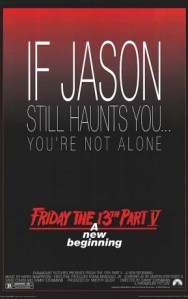
This is the problem that was facing Paramount Pictures when it came to making a fifth Friday the 13th film. The previous installment made a lot of money but it also ended with Jason pretty decisively dead. Paramount’s solution? Friday the 13th without Jason. Released (much like me) in 1985 and directed by Danny Steinmann, Friday the 13th: A New Beginning remains a controversial film among fans of the franchise. A lot of people claim that it’s the worst installment. Myself, I consider it to be one of the best.
Friday the 13th: A New Beginning opens (like many great B-movies) with a cemetery in the rain. Wearing a yellow raincoat, Tommy Jarvis (played in a cameo by Corey Feldman) approaches a grave that is marked “Jason Voorhees.” Suddenly, two rather moronic gravediggers come running up. While Tommy hides in the nearby bushes, the gravediggers dig Jason up. “Yee-haw!” one of them shouts.
(I know this because I turned on the close captioning as I watched the film. It’s one thing to hear the dialogue in a Friday the 13th film being spoken. It’s another thing to see it actually written out at the bottom of your screen.)
Suddenly, Jason — complete with hockey mask and machete — pops out of the grave and kills the two grave robbers. He walks over to where Tommy is hiding, lifts up his machete, and — suddenly, Tommy(now played by a brooding and sexy John Shepherd) wakes up! It turns out that several years have passed and Tommy, after spending five years in a mental asylum, is now on his way to Pinehurst, a halfway house that just happens to be located in the Crystal Lake area.
A New Beginning has such a bad reputation that it’s often forgotten that this opening sequence is one of the few genuinely scary sequences to be found in the entire franchise. Everything from the ominous dark skies to the lushly green bushes that Tommy hides in to the artful way the lightning storm is used to punctuate the sense of danger contributes to making this sequence feel very ominous and genuinely nightmarish. It’s a bit shocking (yet undeniably effective) to go from the impressionistic lushness of Tommy’s dream to the rather harsh and grainy look of the rest of the film.
(For those of you who are familiar with Italian horror, it almost feels like the dream was directed by Dario Argento while the rest of the film was done by Joe D’Amato.)
Anyway, Tommy gets dropped off at Pinehurst where he meets the two liberal do-gooders who are in charge of the facility, Matt (Richard Young) and Pam (Melanie Kinnaman). He also meets “Reggie the Reckless” (Shavar Ross), the bratty little grandson of Pinehurst’s cook, as well as the other residents of Pinehurst. Pam and Matt inform Tommy that Pinehurst has no rules. Or as they inform him, “It’s an honor system.”
It quickly becomes apparent that they might want to reconsider that honor system because not only do Eddie (John Robert Dixon) and Tina (DebbiSue Voorhees) get caught having sex on the neighbor’s property but Vic (played by Mark Venturini, who was all sexy and dangerous in his 2 minutes of screen time) ends up hacking the annoying Joey (Dominick Brascia) up into little pieces with an axe.
(In Vic’s defense, he looked really good with an axe and Joey was really annoying.)
While Vic is whisked off to jail (Sadly, never to be seen again) two paramedics scoop up remains of Joey. One of the paramedics — Roy (Dick Wieand) — stares at the body for a long time and doesn’t seem to find his coworkers jokes humorous. Hmmm…wonder what’s up with that?
As tragic as the death of Joey is, it does lead to one of my favorite lines of all time when, the morning after the murders, the remaining residents of Pinehurst gather for breakfast and they notice that two extra places have been set for the dead Joey and the incarcerated Vic. Stuttering Jake (Jerry Pavlon) exclaims, “You don’t set a place for a dead person!” And you know what? He’s right.
Soon, people all over town are getting murdered. The guys who talks to himself while snorting cocaine (played, in a rather funny performance, by Bob DeSimone) gets an axe to the forehead. The waitress (Rebecca Wood-Sharkey) who flashes her boobs at a mirror and goes, “It’s showtime!” gets murdered as she leaves work. Two Jersey Shore wannabes are killed when their car stalls. The Sheriff (Marco St. John) looks over one crime scene and says, “What the Hell’s going on here?” Roy, standing behind him, says, “You talking to me, Sheriff?” Hmmm…it’s odd how Roy keeps popping up in the movie for no reason…
The Mayor (played by Ric Mancini) confronts the Sheriff and demands to know who is killing everyone in town. “Jason Voorhees,” the Sheriff slowly responds. “Jason Voorhees is dead! He was cremated” the Mayor screams as he empties on ashtray on the sheriff, “THIS IS JASON VOORHEES!” This is probably my favorite scene in the entire movie because St. John underplays his entire role while Mancini overplays and delivers every line as if he’s in a community theater production of Lost in Yonkers.
That gets to the heart of what I really enjoy about A New Beginning — not only does this film have the largest body count of any film in the series, it also has the most genuinely eccentric cast of characters. Absolutely nobody in this film behaves like a conventional human being. It goes beyond just the normal odd slasher movie behavior. Instead, watching this film is like peering into some sort of parallel universe where some minor shift in the Earth’s tilt has caused everyone to go a little crazy. Probably the closest the film comes to a normal person is poor traumatized Tommy and he only says about ten lines in the entire film. (That said, John Shepherd did a really good job and had a lot of presence of Tommy. There’s an oddly eerie scene about halfway through the film where Tommy stares up at a neon sign and, as I looked at his face illuminated by the glowing blue of the sign, I realized that what I had always heard about good acting — that it all starts with expressive eyes — was true.)
(In a perfect world, Tommy would have eventually ended up with Vi — played by Tiffany Helm — the new wave girl who spends almost the entire movie dancing in her room. Seriously, they would have made a cute couple.)
Anyway, once our killer has gotten through killing random townspeople, he starts to kill off the residents at Pinehurst. After taking part in one of the most explicit sex scene in the history of the franchise, Eddie and Tina are rather brutally killed off. (That’s a shame because Voorhees and Dixon both had a really good and fun chemistry together and were both likable actors. Unfortunately, their characters were sex-crazed and you know what that means…) While Matt goes off to try to find the missing Eddie and Tina, Tommy, Pam, and Reggie go off to hang out with Reggie’s rather odd brother Demon (played by Miguel Nunez, Jr.) who wears more jewelry than I do and sings a duet with his girlfriend while he’s sitting on the most disgusting toilet in the history of film. (Seriously, I had to look away…)
Anyway, the remaining residents of Pinehurst are all killed by a seemingly resurrected Jason (however, Jake and Robin — played by Juliette Cummins — do get to watch A Place In The Sun before they die so at least something good happened to them that night) and Pam ends up spending almost the entire rest of the movie running around in the rain and tripping in the mud whenever Jason shows up. Jason eventually corners Pam, Tommy, and Reggie in a barn but then ends up falling out of a window and landing on some conveniently placed spikes. Jason’s hockey mask falls off and — surprise! — it wasn’t Jason after all. Instead, it was Roy, the weird Paramedic who kept showing up randomly and looking around kinda guilty-like whenever anyone mentioned anything about the murders. Wow!
One of my favorite films book is Peter M. Bracke’s Crystal Lake Memories: The Complete History of Friday the 13th. Taking on the series on a film-by-film basis, Crystal Lake Memories is a fascinating oral history that is full of all sorts of interesting behind-the-scenes facts. Reading the chapter on Friday the 13th: A New Beginning, one is left with the impression that 1) everyone on the film was constantly snorting cocaine and 2) director Danny Steinmann is perhaps the most enigmatic figure in the history of the films.
In Crystal Lake Memories, depending on who is being interviewed, Danny Steinman comes across as either a maniac, a bully, or an underappreciated genius. Quite a few people claim that Steinmann was out-of-control. However, actress DebiSue Voorhees (who you would expect to have all sorts of unpleasant stories about the film since she’s the one who had to spend an entire shooting day laying on the ground naked in front of a bunch of strangers) is a lot more complimentary, saying that Steinmann was a “gentleman” throughout the entire shoot. What everyone seems to agree on is that he was the son of wealthy art dealer and that he got his start as a director by making a hardcore porn film before moving on to make two wonderfully trashy exploitation films — The Unseen and Savage Streets. Steinmann was apparently hired to bring a certain rough edginess to A New Beginning and he obviously did just that as A New Beginning had more violent deaths and more nudity than any previous installment of the series. Because of the need to get an R rating, a lot of bloody footage hit the cutting room floor but what was left is surprisingly effective. (Pictures of what was cut can be found on several sites online and yes, it’s all pretty gruesome.)
Unlike most people, I actually think that A New Beginning is one of the best films in the franchise, precisely because it is so ludicrous and over-the-top. What Danny Steinmann did with this film was that he took everything that one expected from a Friday the 13th film and he pushed it all to its most logical extreme. Everyone knew that, regardless of whether the film was being made by a major studio or not, the Friday the 13th films were meant to trashy, ludicrous, sleazy, and fun. Steinmann was just the only one who had the guts to admit it by making a film that not only admitted what it was but celebrated it as well. Friday the 13th: A New Beginning is the most openly grindhouse of all of the Friday the 13th films and for that, it deserves more credit than it’s gotten.
Despite upsetting a lot of fans (not to mention the critics), Friday the 13th: A New Beginning was a box office success which could only mean that there would be another installment in the franchise. Coming tomorrow: my review of Friday the 13th: Jason Lives.
 Long before the end credits of 22 Jump Street imagined Jonah Hill and Channing Tatum going to culinary school, the flight academy, and into outer space, the Police Academy films bravely tested just how far one already thin premise could already be stretched.
 Through the Shattered Lens