Welcome to Retro Television Reviews, a feature where we review some of our favorite and least favorite shows of the past! On Sundays, I will be reviewing the made-for-television movies that used to be a primetime mainstay. Today’s film is 1993’s The Only Way Out! It can be viewed on YouTube.
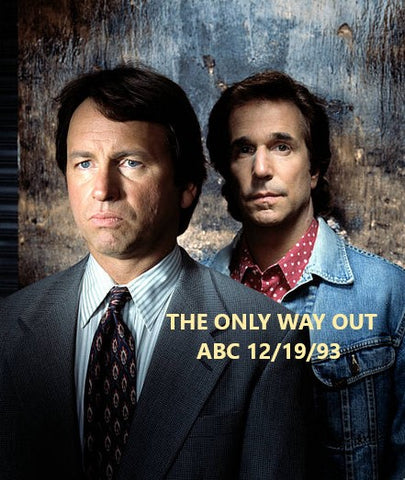
“I’ll kill you before I let you go,” Tony (Henry Winkler) says to his terrified girlfriend, Lynn (Stephanie Faracy).
Agck! Those are frightening words and they are certainly not something that you would expect to hear from a character played by notorious Hollywood nice guy Henry Winkler. And, indeed, it would probably shock most of the characters in the film if they knew how Tony talked to Lynn. Tony is a grad student who has worked at any number of jobs. While some people might say all of those jobs prove that Tony has a hard time sticking to anything, Tony has obviously learned how to convince people that he’s actually a just a determined man working his way through grad school and taking whatever job will help to pay the bills. Tony is friendly and romantic and given to grand gestures. He’s the type who shows up unexpectedly at Lynn’s place of employment with flowers. He’s the type of guy that strangers applaud while those close to him look for any way to escape.
Lynn knows all about the other side of Tony. Tony is controlling, obsessive, and abusive. He hits her. He barks orders at her kids. When she tells him that she wants him out of her life, he refuses to go and blames her for all of their problems. He’s someone who can quickly go from being everyone’s friend to being a monster. He preys on insecurity and, whenever anyone stands up to him, he plays the victim. Tony is a classic abuser and the fact that he’s played by the likable Henry Winkler makes him all the more disturbing. Like most abusers, Tony knows how to turn on the charm. He knows the power of a smile and a few complimentary words.
Lynn is in the process of getting divorced from an architect named Jeremy (John Ritter). It’s been a remarkably amicable divorce, with Jeremy and Lynn agreeing on joint custody and apparently not bearing any ill feelings towards one another. The only problem is that Lynn cannot bring herself to actually sign the divorce papers. Jeremy wants to marry Susannah (Julianne Phillips) and Susannah is not happy about the long wait. She’s even less happy when Jeremy takes it upon himself to try to protect Lynn from Tony. Soon, Tony is stalking Jeremy and Jeremy finds himself considering a particularly extreme solution to his problem.
It’s John Ritter vs Henry Winkler and the casting of two of Hollywood’s best-known nice guys as violent rivals works surprisingly well. Winkler is memorably unhinged while Ritter plays a guy who is struggling to hold onto a life that, until Tony shows up, seemed to be perfect. In the end, it’s not just Tony who catches us by surprise by just how far he’s willing to take things. The film’s ending took me by genuine surprise. Featuring excellent dramatic turns from two actors best known for their comedic skills, The Only Way Out is a superior melodrama.
 When I saw that Erin has picked
  Through the Shattered Lens