So, I Watched Paint Your Wagon (1969, Dir. by Joshua Logan)


Lisa Marie asked me to review Paint Your Wagon for Clint Eastwood’s birthday and, being a good sister, I agreed.  I have to learn to stop doing that.

Paint Your Wagon is a musical western starring a bunch of people who have done a lot of westerns but who still have no business singing, at least not in a movie.  If they want to sing in private, that’s fine.  Ben Rumson (Lee Marvin) and “Pardner” (Clint Eastwood) discover gold in a muddy creek and soon, the incredibly ugly town of No Name City springs up.  Because everyone in the town is a dude, everyone’s really lonely.  Then a Mormon shows up with two wives and the miners convince him to sell his youngest wife, Elizabeth (Jean Seberg) to the highest bidder.  Ben is always drunk but he still manages to buy Elizabeth.  Elizabeth says that she’s not going to marry Ben unless he builds her a cabin and also lets her marry Pardner as well.   Hello, polyamory. Eventually, a bull gets loose in the mines underneath No Name City and the entire town collapses but that’s okay because it was an ugly town and no one’s going to miss it.  Ben sings about how he was born under a wandering star so that means he can’t stay very long in once place, even if he does have a polyamorous marriage to look forward to.  Pardner sings that he likes to talk to the trees so he doesn’t need a town to live in.

My first thought on Paint Your Wagon is that it was really, really long.  It had a two and a half hour running time but it felt more like five or six.  My second thought is that movie looked really bad, like it was filmed through a mud filter.  It wasn’t just the buildings in the town that looked bad.  The entire movie looked dirty, oppressive, and depressing.  I like my musicals to have more color to them.  This movie looked like it needed an antibiotic.  My third thought was that, for a musical, none of the songs made much of an impression.  After the movie was over, I didn’t find myself humming any of them.  I can’t even remember what most of them were about.  Even if they had been better, Lee Marvin and Clint Eastwood shouldn’t have been singing them.  Lee Marvin’s singing voice sounded like whiskey being poured out over cement.  Clint Eastwood’s voice was thin and he got stuck with all the sappy songs.  I’ll take old and grumpy Clint Eastwood over singing and sappy Clint Eastwood any day.  This was like watching a community theater production where you’re not supposed to care about how bad the performance is because you know everyone in the cast.  Finally, I thought that there wasn’t enough wagon painting.  The entire town was unpainted.  It wasn’t just the wagon that was being neglected.

The funniest thing about this movie is that was advertised as being “the comedy goldmine of 69.”  Nice.

I didn’t like Paint Your Wagon but don’t worry.  I’ll be watching Trouble With The Curve later today.  Now that one, I do like!


Music Video of the Day: I Talk To The Trees by Clint Eastwood (1969, dir by Joshua Logan)


Okay, it’s not so much a music video as it’s a scene from a movie but whatever.  It’s Clint Eastwood’s birthday, we’re about to post a ton of Clint Eastwood-related reviews today, and I wanted to start things out with Clint!

This scene is from 1969’s Paint Your Wagon.  You know what?  Clint’s voice wasn’t that bad in this movie.  That said, I’m glad I talked to my sister into reviewing it instead of me.  When I was in college, I took a class about musicals and there was this frat boy sitting behind me who just obsessed with Paint Your Wagon,

Happy birthday, Clint!

Enjoy!

4 Shots From 4 Marilyn Monroe Films: All About Eve, Don’t Bother To Knock, Bus Stop, The Misfits


4 Shots from 4 Films is just what it says it is, 4 shots from 4 of our favorite films. As opposed to the reviews and recaps that we usually post, 4 Shots from 4 Films lets the visuals do the talking!

If only she hadn’t been destroyed by the Kennedys, Marilyn Monroe would be 92 years old today.  Though Marilyn died in 1962, her performances will live forever.  This is…

4 Shots From 4 Marilyn Monroe Films

All About Eve (1950, dir by Joseph L. Mankiewicz)

Don’t Bother To Knock (1952, dir by Roy Ward Baker)

Bus Stop (1956, dir by Joshua Logan)

The Misfits (1961, dir by John Huston)

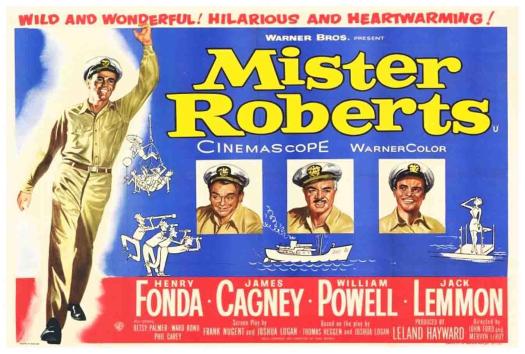
Navy Blue & Gold: MISTER ROBERTS (Warner Brothers 1955)


gary loggins's avatarcracked rear viewer

I grew up a “Navy brat”, often accompanying my dad to bases in Newport, RI. and Bethesda, MD. I’d hang out at the Enlisted Men’s Club he ran, watching Bugs Bunny and Road Runner cartoons with the sailors while dad did the books. I remember going aboard ship plenty of times, and saw one of my first movies with the crew on Family Night (the Cary Grant/Doris Day flick THAT TOUCH OF MINK). So naturally, I have a soft spot for nautical tales, and one of my favorites has always been MISTER ROBERTS.

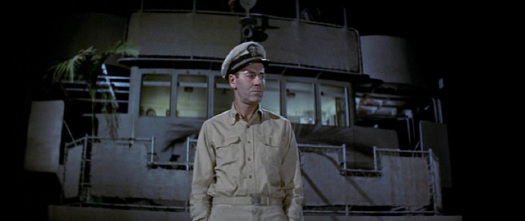
The film marked Henry Fonda’s return to the screen after an eight year absence. Fonda had starred in the original Broadway production to great acclaim, and his performance is imbued with his own experiences during WWII. Douglas Roberts is a lieutenant (j.g.) assigned to the cargo ship Reluctant in the South Pacific, run by the vain…

View original post 733 more words

Cleaning Out The DVR: Picnic (dir by Joshua Logan)


Original_movie_poster_for_the_film_Picnic

Tonight, I continued to clean out the DVR by watching the 1955 film Picnic.

Now, Picnic is kind of a strange film.  It’s one of those films from 50s that takes place in a small town where everyone is obsessed with sex but, since it’s the 1950s, nobody can just come out and say that they’re talking about sex.  So, instead, all of the dialogue is very discreet.  For instance, when Madge Owen (Kim Novak) talks to her mother, Flo (Betty Owens), about her date with her boyfriend, Alan (Cliff Robertson), Madge confesses that they spent the night kissing.  Flo asks if Madge if they have done anything more than kiss but, of course, she never comes straight out and says what “more” would be.  The audience knows what she’s talking about but it’s as if the world would actually end if anyone actually uttered the word.  “Oh mom!”  an embarrassed Madge says before confirming that she and Alan haven’t done anything more than kiss.

Flo desperately wants Madge to marry Alan because Alan is rich and his father owns the town’s grain elevator.  Marrying Alan would allow Flo to move up in the town’s strict social hierarchy.  However, Madge isn’t sure that she loves Alan.  Certainly, Alan seems to be a good man with a good future but he’s not a romantic.  Instead, he is someone who has his entire life already mapped out for him.

On Labor Day, a stranger comes to town.  His name is Hal Carter and he shows up riding on a freight train.  He’s come into town to see his old friend, Alan.  It turns out that Hal and Alan went to college together and were members of the same fraternity.  Hal was a star football player but he eventually flunked out of school and has spent the last few years drifting around the country.  However, Hal is now ready to settle down and he wonders if his old roommate Alan can get him a job at the grain elevator.

Now, here’s the strange part.  Hal is played by William Holden.  When he made Picnic, William Holden was 38 years old and looked closer to being 45.  (By contrast, Cliff Robertson, in the role of his former college roommate, was 32 and looked like he was 25.)  Hal spends a lot of time talking about his traumatic childhood and how he is finally ready to settle down and start acting like an adult.  In short, Hal talks like a 30 year-old but he looks like he’s nearly 50.  It’s odd to watch.  But even beyond the age issue, William Holden was an actor who always came across as being both confident and cynical.  Hal is a secret romantic with a deep streak of insecurity.  As great an actor as he may have been, William Holden is so thoroughly miscast here that it actually becomes fascinating to watch.  It brings a whole new subtext to the film as you find yourself wondering why no one is town finds it strange that a middle-aged man is still struggling to deal with his childhood.  When all the town’s young women ogle that shirtless Hal, it’s as if he’s wandered into a town populated only by teenagers with daddy issues.

(Paul Newman played the role of Hal in a Broadway production of Picnic.  And really, that’s who the ideal Hal would have been, a young Paul Newman.)

The majority of the film takes place at the town’s Labor Day picnic, where almost every woman in town is driven to distraction by the sight of Hal dancing.  Even the spinster teacher, Rosemary (Rosalind Russell), is so turned on by Hal’s masculinity that she makes a pass at him and accidentally rips his shirt.  Of course, some of Rosemary’s behavior is due to the fact that she’s drunk.  Her date, the befuddled Howard Bevans (Arthur O’Connell), made the mistake of being whiskey to the picnic.

Hal also dances with Madge’s 13 year-old sister, Millie (Susan Strasberg).  I have to admit that, even though I related strongly to Madge, Millie was my favorite character in the film.  Millie wears glasses and can recite Shakespeare from memory.  She knows that everyone around her is full of it and she’s willing to call them on it.  Of course, Millie herself ends up with a crush on Hal and it’s a dream for her when she finally gets to dance with him.

(Strasberg was 17 years old but is believable as a 13 year-old.  At the same time, since Hal appears to be nearly 50, his sudden closeness to Millie carries an icky, if unintentional, subtext.)

But then Madge suddenly appears, wearing a pink dress and literally emerging from the black night.  She starts to sway to the music.  As she slowly approaches Hal, he forgets about Millie and soon is dancing with Madge.  It’s actually a rather striking scene, one that so full of dream-like sensuality that it almost seems more like it was directed by surrealist David Lynch as opposed to the usually workmanlike Joshua Logan.

(In the video below, the scene freezes about 12 seconds in, before starting up again at the 16 second mark.  This is a glitch with the upload and is not present in the actual film.)

Needless to say, a drifter can’t just come into town and steal his ex-roommate’s girlfriend without drama following.  Picnic starts out as a slightly overheated examination of small town morality and then, after about an hour, it goes the full melodrama route, complete with police chases, stolen cars, a fist fight in an ornate mansion, and a lot of big speeches about the importance of love.  Needless to say, it’s all a lot of fun.

Picnic was nominated for best picture of the year.  However, it lost to the far more low-key Marty.

Film Review: Camelot (dir by Joshua Logan)


Back when I was 18 years old, I auditioned for a community theater production of Camelot.  For as long as I can remember, I’ve always been intrigued with the spectacle and romance of the Arthurian legends and I just knew that I would make the perfect Guinevere.  And so, for two nights, I auditioned.  I performed “Baby One More Time” as my audition song, I showed off my dance moves, and I did countless cold readings with countless potential Arthurs and Lancelots.  At the end of the two days, the director told me that he would be in touch and I left with stars in my mismatched eyes, convinced that I had won the role of Guinevere.

Two days later, I got a call not from the director but from the assistant director.  She informed me that while my dancing was impressive, I wasn’t right for the role of Guinevere because:

1) I was too young.

2) I couldn’t sing.

3) My voice carried too much of a rural twang for me to be a believable Queen of England.

However, she did tell me that I had been selected to be a part of the “chorus.”  Well, I may have only been 18 but I still had my pride so I told her that, if I couldn’t I play Guinevere, I had no interest in being in their little production of Camelot.  I was later told that this caused a lot of people to assume that I was a diva but no matter, I stand by my decision.

When I later saw the theater’s production of Camelot, I felt thoroughly vindicated.  It wasn’t just the fact that the actress they cast as Guinevere had no stage presence, no boobs, and a horsey face.  It’s the fact that Camelot itself isn’t a very good show.  As good as the songs are, Camelot is something of a talky mess and Pellinore is one of the most annoying characters ever.

It was only after I saw that mediocre production that I discovered that there was a film version of Camelot. Released in 1967, the Warner Bros. production was one of the many big budget musicals released in the late 60s.  It has a terrible reputation (and was a box office bomb) but I recently decided to watch it for two reasons.

First off, Camelot was nominated for five Academy Awards (though not best picture) and won three (Best Art-Set Decoration, Best Costume Design, and Best Music — Scoring of Music, Adaptation or Treatment).  That means that Camelot won two more Oscars than The Graduate and one more than Bonnie and Clyde.

Secondly, this film version of Camelot features Franco Nero (who, in 1967, was literally the most handsome man in the world) in the role of Lancelot.

And so, I recently set aside 3 hours and I watched the film version of Camelot.

Camelot tells a familiar story.  Arthur (played here by Richard Harris) becomes king of England and he marries Guinevere (Vanessa Redgrave).  At the magnificent castle of Camelot, the most noble knights of England gather at a round table and Arthur preaches equality and chivalry.  Eventually, the righteous French knight Lancelot (Franco Nero) travels to Camelot and becomes Arthur’s  greatest knight.  However, Lancelot and Guinevere fall in love and, as a result of the schemes of Arthur’s illegitimate son Mordred (David Hemmings), Lancelot and Arthur are soon at war with each other.

Despite my dislike of the stage production, I actually started watching the film version with high hopes.  I have a soft place in my heart for the overproduced musical spectacles of the late 60s and I figured that what was slow on stage might be more tolerable when seen on film.  Unfortunately, I was incorrect.  Camelot is a painfully old-fashioned film and, clocking in at 179 minutes, it’s also one of the most boring movies ever made.  Richard Harris was reportedly miserable while making the film and it shows in his performance.  You get the feeling that King Arthur would rather be anywhere other than Camelot.

The only time that the film comes alive is when Franco Nero is allowed to command the screen.  While the very Italian Nero is somewhat miscast as the very French Lancelot, that doesn’t change the fact that Nero plays the role with a passion that’s missing from the rest of the film.  Franco Nero’s blue eyes did more to make me believe in Camelot than any of the songs sung by Richard Harris.  One need only watch the scenes that Franco shares with Vanessa Redgrave to understand why they’ve been a couple for over 40 years.

Ultimately, Camelot is interesting mostly as an example of how the old Hollywood studio establishment attempted to deal with competition from television and European films.  Instead of attempting to adapt to the new culture of the 60s, the old studio bosses just continued to make the same movies they had always made, with the exception being that they now spent even more money than before to do so.  While it’s easy to mock them, you have to wonder if the Camelot of 1967 is all that different from the John Carter of today.