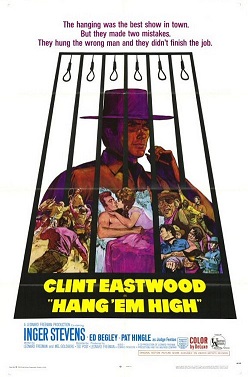
Hang ‘Em High (1968, directed by Ted Post)


1889.  The Oklahoma Territory.  A former lawman-turned-cattleman named Jed Cooper (Clint Eastwood) is falsely accused of working with a cattle thief.  A group of men, led by Captain Wilson (Ed Begley) lynch him and leave Cooper hanging at the end of a rope.  Marshal Dave Bliss (Ben Johnson) saves Cooper, cutting him down and then taking him to the courthouse of Judge Adam Fenton (Pat Hingle).  Fenton, a notorious hanging judge, is the law in the Oklahoma territory.  Fenton makes Cooper a marshal, on the condition that he not seek violent revenge on those who lynched him but that he instead bring them to trial.  Cooper agrees.

An American attempt to capture the style of the Italian spaghetti westerns that made Eastwood an international star, HangEm High gives Eastwood a chance to play a character who is not quite as cynical and certainly not as indestructible as The Man With No Name.  Cooper starts the film nearly getting lynched and later, he’s shot and is slowly nursed back to health by a widow (Inger Stevens).  Cooper is not a mythical figure like The Man With No Name.  He’s an ordinary man who gets a lesson in frontier justice as he discovers that, until Oklahoma becomes a state, Judge Fenton feels that he has no choice but to hang nearly every man convicted of a crime.  (Judge Fenton was based on the real-life hanging judge, Isaac Parker.)  Over the course of this episodic film, Cooper becomes disgusted with frontier justice.

HangEm High is a little on the long side but it’s still a good revisionist western, featuring a fine leading performance from Clint Eastwood and an excellent supporting turn from Pat Hingle.  The film’s episodic structure allows for Eastwood to interact with a motley crew of memorable character actors, including Bruce Dern, Dennis Hopper, L.Q. Jones, Alan Hale (yes, the Skipper), and Bob Steele.  HangEm High has a rough-hewn authenticity to it, with every scene in Fenton’s courtroom featuring the sound of the gallows in the background, a reminder that justice in the west was often not tempered with mercy.

Historically, Hang ‘Em High is important as both the first film to be produced by Eastwood’s production company, Malpaso, and also the first to feature Eastwood acting opposite his soon-to-be frequent co-star, Pat Hingle.  Ted Post would go on to direct Magnum Force.
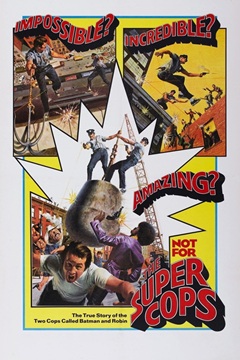
The Super Cops (1974, directed by Gordon Parks)


David Greenberg (Ron Liebman) and Robert Hantz (David Selby) are two tough and smart New York City cops who become detectives and play by their own rules.  They make arrests off-duty.  They drive their lieutenants crazy.  They bust drug dealers and prostitutes and single-handedly clean up their police precinct.  They’re the Super Cops and they’re even nicknamed Batman and Robin.  When they throw punches, a graphic “POW” appears on screen with a sound effect.

There’s an old saying about how, when the truth is different from the legend, always print the legend.  That’s certainly the case here.  The real-life David Greenberg went into politics and ended up doing time for mail fraud, insurance fraud, and obstruction of justice.  Robert Hantz was busted for possessing marijuana while he was on vacation in the Bahamas.  The arrest led to a demotion and Hantz quit the force as a result.  The film hints at Greenberg and Hantz’s involvement with the Knapp Commission, which investigated police corruption in the 70s.  (Lisa wrote about it when she reviewed Serpico.)  But the film does not mention that the Knapp Commission suspected that Greenberg and Hantz murdered two drug dealers.

You don’t get any of that with The Super Cops, which tries to mix the grittiness of films like The French Connection, The Seven-Ups, and Serpico with moments of cartoonish comedy and it really doesn’t work.  (Years after The Super Cops was released, Hill Street Blues proved that gritty drama and dark comedy could be mixed but it has to be done just right.)  Ron Liebman overacts while David Selby doesn’t seem to be acting at all.  (Liebman and Selby are both good actors but you wouldn’t know that from this movie.  For Liebman, I suggest checking out his performance in Night Falls On Manhattan.  For Selby, I recommend an overlooked dark comedy called Headless Body in Topless Bar.)  It’s hard to believe that Gordon Parks went from doing Shaft to doing this.  Shaft would have tossed the Super Cops through a window.  Popeye Doyle would have given him an assist.

There is one good thing to note about The Super Cops.  Edgar Wright is a fan of this film and it partially inspired the far superior Hot Fuzz.


Horror on TV: Kolchak: The Night Stalker 1.2 “The Zombie” (dir by Alexander Grasshoff)


Tonight, on Kolchak: The Night Stalker:

Chicago gangsters are turning up dead!  Is it a mob war or is it something else?  Kolchak suspects the latter and, as you can guess from this episode’s title, he’s right.  This episode features gangsters, numbers runners, and voodoo!

It originally aired on September 20th, 1974!

Enjoy!

http://www.youtube.com/watch?v=aN_GstECzL0

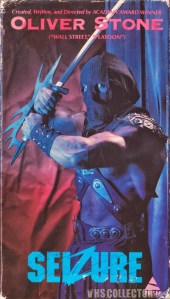
A Halloween Film Review: Seizure (1974, directed by Oliver Stone)


seizure1Everyone had to start somewhere and, long before he became one of the leading political provocateurs of American cinema, Oliver Stone was just another struggling film school grad who was looking for a chance to make a name for himself.  Like many aspiring filmmakers, Stone made his directorial debut with a low-budget horror film.
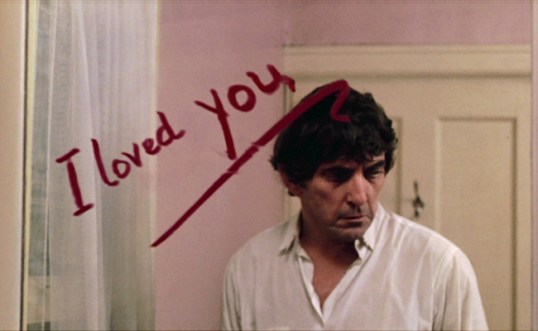
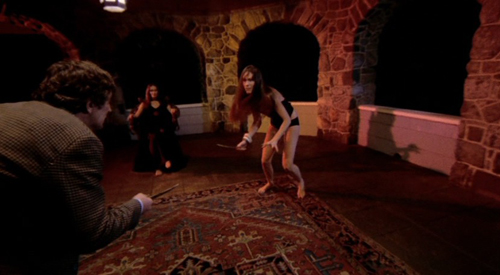
Filmed in Quebec and featuring an eclectic cast that included a soap opera star, a former Warhol superstar, a faded teen idol, a past Bond girl, and a future Bond villain, Seizure stars Jonathan Frid (of Dark Shadows fame) as Edmund Blackstone.  Edmund is a horror novelist who is described as being “a modern-day Edgar Allan Poe.”  When Edmund’s rich friends get together for the weekend, they are terrorized by three maniacs: the Queen of Evil (Martine Beswick), a mute giant called the Jackal (Henry Judd Baker), and a psychotic dwarf named The Spider (Hervé Villechaize).  

All of Edmund’s guests face the inevitability of death in a different way.  Playboy Mark Frost (Troy Donahue) is too concerned with pursuing pleasure to realize that he’s in danger.  Businessman Charlie Hughes (Joseph Sirola) gets out his wallet and tries to buy his way out of trouble.  Mikki (Mary Woronov), Charlie’s much younger wife, strips down to her underwear and runs away.  Eunice Kahn (Anne Meachem) jumps out of a window after the Spider ticks her into using an aging cream.  Eunice’s husband, philosopher Serge (Roger de Koven), faces death with stoicism.  Edmund’s brother-in-law, Gerald (Richard Cox), is a long-haired hippie who accidentally gets shot in the head by Edmund and dies saying, “You bastard!”  Edmund’s wife (Christina Pickles) tries to protect her son (Timothy Ousey) and Edmund reveals himself to be the first of the many flawed father figures who would appear in Stone’s films.

seizure_dvdreview_splash650

If not for the identity of its director, Seizure would be a forgotten film.  In fact, it seems to be a film that Stone wishes was forgotten.  He rarely mentions it in interviews and usually describes Seizure as being a “learning experience” and there’s really nothing about Seizure that would make you think the director would go on to win three Oscars.  It’s a slow and talky movie that is just occasionally weird enough to be interesting.  Seizure‘s philosophical digressions are pure Stone but otherwise, it’s hard to see any sign of the director that Stone would become in Seizure.

Still, what other movie features Jonathan Frid and Mary Woronov having a knife fight while Martine Beswick and Hervé Villechaize watch?

seizure_10