I first saw There Was A Crooked Man as a part of TCM’s tribute to the great actor Warren Oates. Warren Oates was rarely cast in the lead but, as a character actor, he appeared in supporting roles in several great films. Unfortunately, There Was A Crooked Man is not one of them.
Directed by Joseph L. Mankiewicz and written by the screenwriting team of Robert Benton and David Newman (best known for writing Bonnie and Clyde), There Was A Crooked Man is meant to be a comedic western. Outlaw Paris Pittman (Kirk Douglas) is arrested while visiting a bordello. Paris is sent to an Arizona prison, where everyone tries to get him to reveal where he has hidden the stash from a $500,000 robbery. Pittman uses everyone’s greed to manipulate them into helping him attempt to escape. Standing in Pittman’s way is the new warden, a liberal reformer played by Henry Fonda.
There Was A Crooked Man is a long movie that features a lot of familiar faces. Burgess Meredith plays The Missouri Kid, who has been in prison for so long that he is now an old man. Hume Cronyn and John Randolph play a bickering gay couple who eventually become a part of Pittman’s scheme to escape. Even Alan Hale, the skipper from Gilligan’s Island, shows up as a guard named Tobaccy! There Was A Crooked Man is a big movie but it’s also not a very good one. It’s not serious enough to be a good drama but it’s not funny enough to be a good comedy either.
At least the movie has Warren Oates going for it. Oates plays Harry Moon, a prisoner who is drafted into Pittman’s escape plot. It is a typical Warren Oates supporting role but he steals every scene that he appears in. Even in the smallest of roles, Warren Oates was worth watching and he’s the best thing about There Was A Crooked Man.
Hume Cronyn, Warren Oates, Kirk Douglas, Michael Blodgett, and John Randolph in There Was A Crooked Man
While watching the 1963 best picture nominee, Cleopatra, I had many thoughts. The film lasts over 4 hours so I had a lot of time to think.
For instance, I often found myself impressed by the sheer size of the production. I marveled at the recreation of ancient Greece and Rome. I loved looking at the ornate costumes. I loved feeling as if I was taking a look back at what Rome may have actually looked like at the height of the Roman Empire. Making it all the more impressive was that this film was made in the days before CGI. When the film’s Romans walked through the streets of Rome, they weren’t just actors standing in front of a green screen. They were walking down real streets and surrounded by real buildings. It reminded me of the awe and wonder that I felt when I was in Italy and I was visiting the ruins of ancient Rome.
(I don’t know if any of the cast accidentally flashed everyone like I did when I visited during Pompeii on a windy day but considering how short some of the skirts on the men were, it wouldn’t surprise me if they did!)
And, as I marveled at the recreation of Rome, I also thought to myself, “How long is this freaking movie?” Because, seriously, Cleopatra is an amazingly long movie. It’s not just the film is over four hours long. It’s that the film feels even longer. Gone With The Wind, The Godfathers Part One and Part Two, Once Upon A Time In America; these are all long films but, because they’re so great, you never find yourself checking the time while watching. Cleopatra is the opposite of that. Cleopatra is a film that, at its slowest, will make you very much aware of how many seconds are in a minute.
I found myself marveling at the lack of chemistry between Elizabeth Taylor and Richard Burton. If anything, this is the most shocking thing about Cleopatra. If Cleopatra is famous for anything, it’s famous for being the film where Elizabeth Taylor (cast in the role of Cleopatra) first met Richard Burton (who was playing Mark Antony). Their affair dominated the gossip headlines. (If TMZ and YouTube had been around back then, there would be daily videos of Richard Burton punching out paparazzi.) Cleopatra was the first of many big-budgeted, overproduced films that Taylor and Burton co-starred in.
(Then again, they also starred in Who’s Afraid of Virginia Woolf, a film that is almost the exact opposite of Cleopatra.)
In the role of Mark Antony, Burton spends most of the film looking absolutely miserable. Elizabeth Taylor, meanwhile, seems to be having a lot more fun. It’s almost as if she understood what Cleopatra was going to become so she went out of her way to give the type of over-the-top performance that the film deserved. The same can also be said about Rex Harrison, who plays Julius Caesar and who, perhaps because he appears to have shared her attitude, actually does have some chemistry with Taylor.
Actually, if anyone gives a truly great performance in Cleopatra, it’s Roddy McDowall. McDowall plays the future Emperor Augustus with a mesmerizing intensity. Again, McDowall’s performance is not exactly subtle but Cleopatra is not a film that demands subtlety.
As the film finally neared its end, I found myself wondering how Joseph L. Mankiewicz went from directing two close to perfect films, A Letter To Three Wives and All About Eve, to directing this. Even more amazing, Mankiewicz had previously directed one of the best Roman Empire films ever, 1953’s Julius Caesar. (When compared to Cleopatra, the low-key and thoughtful Julius Caesar appears to have been filmed on an entirely different planet.) Well, in Mankiewicz’s defense, he was not the original director. He was brought in to replace Rouben Mamoulian, who had previously attempted to make the film with Joan Collins, Ben-Hur‘s Stephen Boyd, and Peter Finch. When Mankiewicz was brought in, the cast was replaced with Taylor, Burton, and Harrison. Between the expensive stars, the troubled production, and all of the offscreen romantic melodrama, Mankiewicz probably did the best that he could.
Today, Cleopatra is mostly interesting as an example of a film from the “Only Gigantic Productions Will Save Us From Television!” era of Hollywood filmmaking. Cleopatra started out as a $2,000,000 production and ended up costing $31,000,000. It was the number one film at the 1963 box office and it still nearly bankrupted 20th Century Fox. While the film does have some kitsch appeal, the critics hated it and it’s easy to see why.
And yes, it was nominated for best picture of the year, a tribute to the size of the production and the determination of 20th Century Fox to get something — anything — in return for their money.
Cleopatra is a bit of a chore to sit through but it can be fun if you’re in a snarky mood. It’ll do until the inevitable Angelina Jolie remake comes along.
Last week, I started a little series that I call Embracing The Melodrama, Part II. Over the next three weeks, I will be reviewing, in chronological order, 128 cinematic melodramas. I started this series with the 1927 silent film Sunriseand now, we have reached our 18th film, the 1949 best picture nominee, A Letter To Three Wives!
Now, I’m going to start this review by pointing out something that will probably scare off some of our readers. So, before you read the next paragraph, understand that A Letter To Three Wives is a great film that’s full of great performances and witty dialogue and you really should watch it the next time that it’s on TCM. Got all that? Okay. Good. Moving on…
A Letter To Three Wives feels a lot like a 1949 version of Desperate Housewives. Now, before you freak out, I’m talking about early Desperate Housewives as opposed to later Desperate Housewives. The similarities are actually pretty striking. Both A Letter To Three Wives and Desperate Housewives take place in an upper class suburb. Both of them deal with women who appear to have happy marriages but who are all actually dissatisfied with how their lives have turned out. Both of them are satires disguised as mystery stories. (The mystery in Desperate Housewives involved murder. The one in A Letter To Three Wives involves adultery.) Perhaps most significantly, both Desperate Housewives and A Letter To Three Wives are narrated by a snarky woman who exists largely off screen.
The narrator in A Letter To Three Wives is named Addie Ross and voiced by Celeste Holm. We never actually see Addie but we hear a lot from her and a lot about her. Apparently, every man in town has, at some point, been in love with Addie. Every woman is jealous of her. And Addie, amazingly enough, seems to have the power to know exactly what’s happening in everyone else’s marriage. At the start of A Letter To Three Wives, Addie has sent … well, a letter to three wives. In the letter, Addie explains that she’s run off with one of their husbands but she declines to reveal which husband. Each one of the wives thinks back on her marriage and wonders if her husband is the one.
Deborah (Jeanne Crain), for instance, is a country girl who met and married Bradford “Brad” Bishop (Jeffrey Lynn) during World War II. Deborah is insecure about the fact that Brad comes from an upper class background and that he was apparently engaged to marry Addie before he met Deborah.
(Here’s an interesting piece of trivia for those of you who, like me, are into true crime stories. Along with the movie character, there’s also a real-life murderer named Bradford “Brad” Bishop. Like the character in the movie, he came from an upper class background. Unlike the film character, the real Brad Bishop ended up murdering his wife, his children, and his mother and then fled to Europe. He’s been a fugitive for close to 40 years and is believed to still be alive. He’s currently on the FBI’s most wanted list.)
And then there’s Rita (Ann Sothern), who is an old friend of Brad’s. Rita is married to George. George is a quiet and intellectual English professor who is insecure over the fact that Rita, working as a soap opera writer, makes more money than he does. George is played by Kirk Douglas and, admittedly, it does take a while to get used to the idea of Kirk Douglas playing an introverted intellectual. But, once you get over the initial shock, Kirk Douglas gives a pretty good performance. Kirk may be miscast but that actually works to the film’s advantage. In a world where surface appearances hide the unexpected truth, it only makes sense that a mild college professor would look like Kirk Douglas.
My favorite wife was Lorna Mae (Linda Darnell), who grew up next to the train tracks and who pursues and eventually married a wealthy, older man (Paul Douglas). It was impossible for me not to relate to and even admire Lorna Mae. Much like me, Lorna Mae was determined to get what she wanted. Perhaps my favorite scene with Lorna Mae was when she blatantly did everything possible to get stuffy old Paul Douglas to look at her legs, largely because I’ve done the exact same thing on occasion.
A Letter To Three Wives is an entertaining and witty film that still holds up today. Director Joseph L. Mankiewicz deservedly won the Best Director Oscar for his work here. The film itself was nominated for best picture but lost to All The King’s Men. I actually happen to like All The King’s Men but, if I had been an Academy voter in 1949, my vote would have totally gone to A Letter To Three Wives.
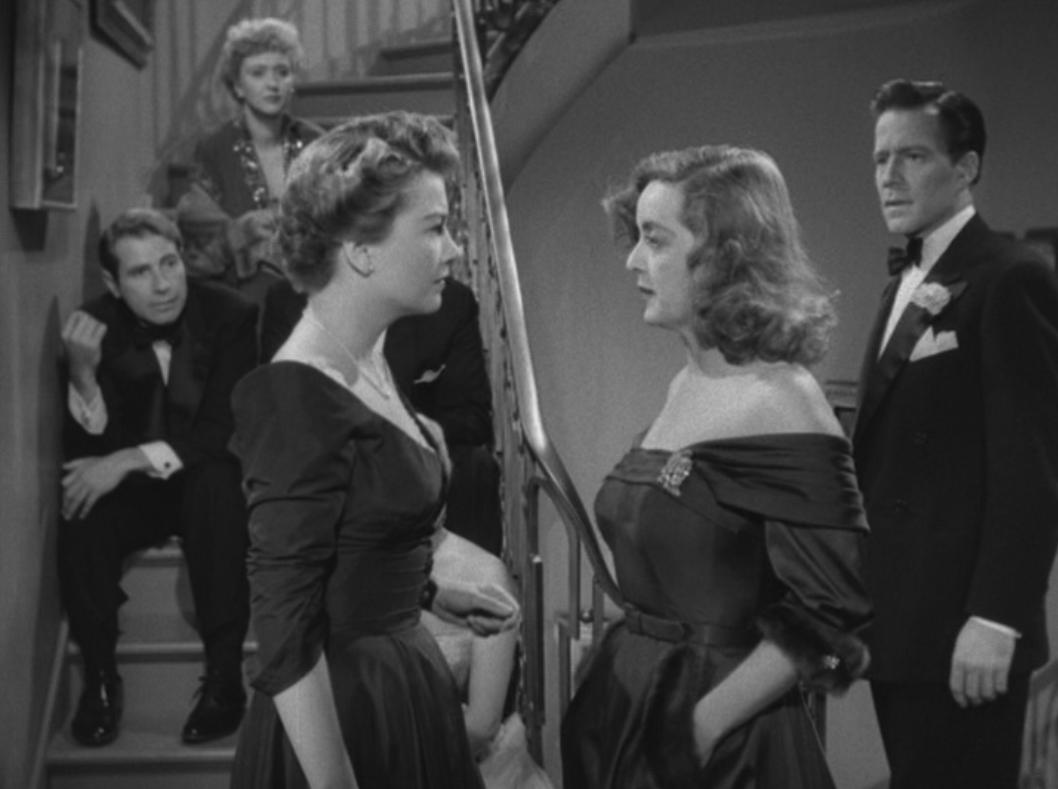
“Fasten your seat belts, it’s gonna be a bumpy night!” — Margo Channing (Bette Davis) in All About Eve (1950)
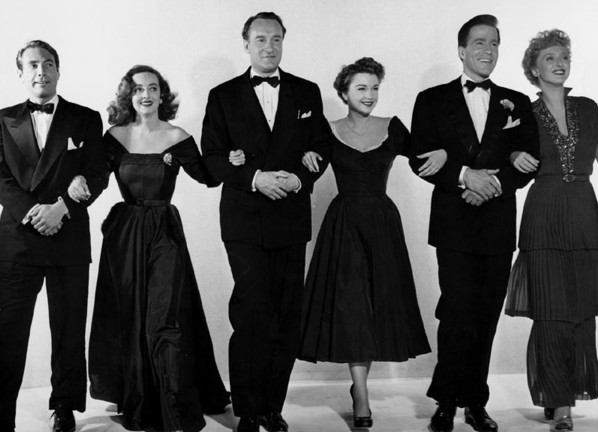
If you’re a lover of classic films or even if you’re just someone who occasionally watches TCM, chances are that you already know All About Eve. It’s one of those films that is endlessly quoted and it features at least two performances — Bette Davis’s turn as aging Broadway diva Margo Channing and George Sanders’ acidic theater critic Addison DeWitt — that serve as frequent inspiration for professional impersonators. It’s the film that was named best picture of 1950 and it continues to hold the record for both the most Oscar nominations overall and it’s the only film in Oscar history to receive four female acting nominations.
Even more importantly, it’s a film that everyone already knows it great.
So, that brings up the question that every film blogger dreads: how do you review a classic film that everyone already knows about? I’ve often said that it’s easier to review a bad film than a great one. It’s easy to pinpoint why a film fails but when it comes time to explain why a film is great, it’s often difficult to put to words the intangible qualities that elevate it.
For instance, I could tell you that the film has a fascinating plot but that barely only begins to scratch the surface of everything that’s going on underneath the glossy and melodramatic surface of All About Eve. The movie tells the story of how scheming young actress Eve Harrington (Anne Baxter) becomes a star with the help of Addison DeWitt and at the expense of the talented but aging Margo Channing. In telling Eve and Margo’s stories, All About Eve explores issues of female friendship and competition, sexuality, and why older men are celebrated while older women are constantly at risk of being pushed to the side for a newer model. The complexity and power of All About Eve’s storyline can be summed up by the fact that right now, when I watch the film, I relate to Eve but I imagine that twenty years from now, I’ll rewatch and I’ll relate to Margo.
I could tell you that this is a film that is full of bigger-than-life characters and iconic performances but that doesn’t even begin to scratch at the surface of how well-acted and perfectly cast this film is. Even boring old Hugh Marlowe is a perfect choice for playing boring old playwright Lloyd Richards. (His wife is played by Celeste Holm. Reportedly Bette Davis hated working with Celeste Holm but onscreen, their friendship feels very real and poignant and leads to some of the best scenes in the entire film.) Gary Merrill, who later married Bette Davis, is likable as Margo’s boyfriend and Thelma Ritter is great as Margo’s outspoken assistant, largely because she’s Thelma Ritter and she was always great. Marilyn Monroe famously makes the most of her minor role in All About Eve, playing an aspiring actress who has a very good reason for calling the butler a waiter. And then there’s Bette Davis and George Sanders, both of whom are simply brilliant.
My favorite scene from All About Eve
But to me, the best performance in All About Eve comes from Anne Baxter. Baxter plays Eve as a perpetually smiling schemer and one of the great pleasures of the film is watching as Eve wrecks passive-aggressive havoc through Margo’s circle of friends. Just watch the scenes where she deftly manipulates Celeste Holm. All About Eve is usually referred to as being a vehicle for Bette Davis but if you actually watch the film, you see that the title is absolutely appropriate. The film really is all about Eve.
And I could always tell you about how wonderfully sardonic the dialogue is but you already know that. There’s a reason why even people who have never seen the film still quote Margo’s suggestion that everyone fasten their seat belts!
So, in the end, what can I tell you about All About Eve? Well, all I can really tell you is that it’s a great film and, if you haven’t seen it, you need to make time to learn all about Eve.
As some of you may know, I’ve spent the past two years on a mission. It is my goal to eventually see and review every single film that has ever been nominated for best picture. After taking a few months off, I am now ready to continue that quest. For that reason, I recently sat down and watched the 1953 best picture nominee Julius Caesar.
Julius Caesar is an adaptation of William Shakespeare’s classic play about political intrigue, assassination, and demagoguery in ancient Rome. (Technically, what follows is full of spoilers but come on, people — it’s Shakespeare!) The citizens of Rome love their leader, Julius Caesar (played here by a very imperial Louis Calhern) but a group of senators led by Cassius (John Gielgud) fears that Caesar’s popularity will lead to the collapse of the Roman Republic. Cassius recruits Caesar’s close friend Brutus (James Mason) into a conspiracy to assassinate Caesar on the Ides of March. However, once the deed has been done and Brutus has explained the motives behind the assassination to the Roman public, the previously underestimated Mark Antony (Marlon Brando) delivers his famous “Lend me your ears!” speech and soon, the people of Rome turn against the conspirators. In the end, the conspiracy’s efforts to save the Roman Republic instead leads to the birth of the Roman Empire.
Speaking as someone who loves both Shakespeare and history, it was an interesting experience to watch this particular version of Julius Caesar. As directed by Joseph L. Mankiewicz (who later revisited the material in the infamous 1963 Best Picture nominee Cleopatra), Julius Caesar present a very traditional (and occasionally stagey) interpretation of Shakespeare’s play. However, by this point, we’ve become so used to Shakespeare being presented with a gimmick (like modern-day costumes, for instance) that the traditional approach almost feels like something new and unexpected. That said, Julius Caesar is definitely not the Shakespearean film to show to your friends who stubbornly insist that Shakespeare is boring or impossible to follow. Julius Caesar was obviously made by people who appreciate Shakespeare and that remains the film’s best audience.
When Julius Caesar was first released in 1953, it received a lot of attention because of the casting of Marlon Brando as Mark Antony. An outspoken method actor who had been nicknamed “the mumbler” precisely because of his own internalized style of acting, Brando was considered to be too contemporary of an actor to be an effective Shakespearean. Once the film was released, critics agreed that Brando had proven that, even while mumbling, he made for an electrifying Mark Antony and that, despite only having a few scenes, his charismatic presence dominated the entire film. Out of an impressive cast, Brando received the film’s only nomination for acting.
It is true that, even when seen today, Brando does dominate the entire film. He delivery of Mark Antony’s famous oration over Caesar’s bloody corpse remains one of the best Shakespearean performances to have ever been preserved on film. It’s odd to watch this young, sexy, and energetic Brando and compare him to the legendary eccentric that we all usually think of whenever we hear the man’s name.
That said, Brando’s performance would not be half as effective if it wasn’t surrounded by the more traditional (but no less compelling) performances of James Mason and John Gielgud. Mason brings a brooding intensity to the role of Brutus and Gielgud is the Cassius by which all future Cassiuses must be judged. Their performances might not be as flamboyant as Brando’s but they’re no less important. Ultimately, the clash between the acting style of Brando and the styles of Gielgud and Mason nicely parallel the conflict over the future of the Roman Republic.
Julius Caesar won the Oscar for best art design and was nominated for picture, actor, cinematography, and original score. Brando lost the award for best actor to Stalag 17’s William Holdenwhile the Oscar for best picture of 1953 went to a far more contemporary film, From Here To Eternity. Brando, however, would win best actor the next year for his performance in On The Waterfront.
 I first saw There Was A Crooked Man as a part of TCM’s tribute to the great actor Warren Oates. Warren Oates was rarely cast in the lead but, as a character actor, he appeared in supporting roles in several great films. Unfortunately, There Was A Crooked Man is not one of them.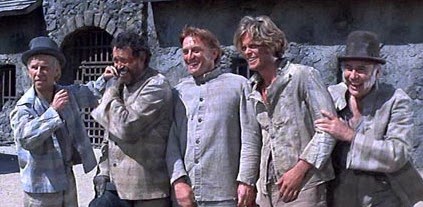




 Through the Shattered Lens