A Movie A Day #252: The Death Collector (1976, directed by Ralph De Vito)


Jerry Bolanti (Joe Cortese) is a cocky loud-mouth who has just returned to New Jersey after serving a prison sentence.  Jerry needs a work so a mid-level gangster named Tony (Lou Criscuolo) hires Jerry as a debt collector.  The problem is that Jerry is just not very good at his job.  His attempt to collect money from Bernie Feldshuh (Frank Vincent) leads to Bernie hiring a legendary hitman (Keith Davis) to kill Jerry.  Despite working with two experienced enforcers, Joe (Joe Pesci) and Serge (Bobby Alto), Jerry’s next job is just as unsuccessful and leads to even more unnecessary deaths.  Tony starts to wonder if maybe he made a mistake giving a job to Jerry and, unfortunately, no one simply gets fired from the Mafia.

A low-budget and nihilistic film, The Death Collector occupies a strange place in film history.  Though it was largely ignored when it was first released, one of the few people who did see it was actor Robert De Niro.  De Niro brought the film to the attention of Martin Scorsese, who was casting Raging Bull at the time.  Both Joe Pesci and Frank Vincent made their film debuts in The Death Collector and, after watching the movie, Scorsese cast both of them in Raging Bull.

The rest is history:

In Raging Bull, Pesci beats up Vincent.

In Goodfellas, Pesci kills Vincent.

In Casino, Vincent finally gets to kill Pesci.

If not for The Death Collector, Frank Vincent would never have told Joe Pesci to “get your fucking shinebox.”  If not for The Death Collector, Joe Pesci would never have thrown Frank Vincent in that trunk.  It all started with The Death Collector.

As for the film itself, The Death Collector was filmed on location in New Jersey and it occasionally has a raw and intense grittiness but it suffers because there’s never any reason to care about Jerry.  He starts the movie as an asshole and he ends the movie as an asshole and Joe Cortese’s bland performance fails to make Jerry into a compelling antihero.  The Death Collector works best whenever Vincent and Pesci are on-screen.  Pesci’s performance is slightly toned down version of the hyped-up maniacs that he became best known for playing while Vincent shows that, even in his first film, he was already a master at playing slightly ridiculous tough guys.

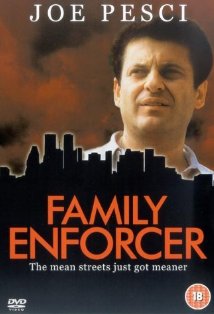
The Death Collector can also be found under the title, Family Enforcer.  It’s been released on DVD by several companies, all of which claim that the film “stars” Joe Pesci.  My copy has a picture of Pesci that was lifted from 8 Heads In A Duffel Bag on the cover.

Lisa Cleans Out Her DVR: Monsignor (dir by Frank Perry)


(Lisa is currently in the process of cleaning out her DVR!  It’s taking her longer than it took Saint Malachy to transcribe The Prophecy of the Popes!  She recorded the 1982 film, Monsignor, off of Retroplex on March 8th!)

Maybe it’s because I’m a fourth Italian and I was raised Catholic but Monsignor amused the Hell out of me.

See, Monsignor is a big, sprawling epic about the Church and the Mafia.  I don’t know much about the production of this film but, having watched it, I’m going to guess that it was made by people who were neither Catholic nor Italian.  This is one of those films that is so full of clichés and inaccuracies and yet so self-important that it becomes oddly fascinating to watch.

It tells the story of Father John Flaherty (Christopher Reeve, an Episcopalian who gives a performance so wooden that one worries about getting splinters just from watching it).  When we first meet Father Flaherty, he’s just taken his orders.  He’s a good Irish kid from Brooklyn.  The neighborhood’s proud of him, because he has volunteered to serve as a chaplain in the army.  (The film opens during World War II.)  The neighborhood is even prouder when he performs a Mafia wedding.  Don Appolini (Jason Miller), who may be a mobster but who still loves the Church, is especially impressed.  He expects big things from Father Flaherty.

(The father of the bride, incidentally, is played by Joe Spinell, who played Willy Chicci in Godfathers One and Two and who achieved a certain infamy when he starred in Maniac.)

Father Flaherty goes to war and discovers that it’s not easy to be a man of God in a war zone.  Everywhere around him, soldiers are either dying or losing their faith.  (Perhaps it would help if Father Flaherty knew how to properly conduct a Requiem Mass but the movie screws that up, with Flaherty saying, “”Requiescat in pace” when he clearly should have said, “Requiescant in pace.”)   After trying, in vain, to comfort a mortally wounded man, Flaherty snaps, picks up a machine gun, and starts blowing away Germans.

Having broken the Thou Shalt Not Kill Commandment and indulged in one of the seven deadly sins, Father Flaherty apparently decides to commit every other sin as well.  Or, at least, it seems like that’s his plan.  The thing is, Christopher Reeve’s performance is bland that it’s difficult to guess what could possibly be going on inside of Flaherty’s head.  Is he disillusioned with the church or does he still have faith?  When he says that he feels guilty over his transgressions, is he being sincere or is he lying?  It’s impossible to tell because, when it comes to Father Flaherty, there’s no there there.  He’s literally an empty vessel.

That, of course, doesn’t stop him from becoming a powerful man in the Church.  Through his Mafia connections, he makes a fortune on the black market and launders money for the church.  He also has sex with a cynical, nymphomaniac postulant nun, who is something of a stock figure in films like this.  In this case, the role is played by Genevieve Bujold.  Despite the stereotypical nature of her character, Bujold comes the closest of anyone in the cast to giving a nuanced performance but her character abruptly vanishes from the film.  One can literally hear the producers in the background saying, “Okay, we’ve indulged in the sexy nun thing.  Send her home now.”

Towards the end of the film, there’s a flash forward that is so abrupt that I didn’t even realize it had happened until I noticed that Christopher Reeve and Jason Miller now had a little gray in their hair.  The flash forward doesn’t really accomplish much.  Father Flaherty has lost a lot of the Mafia’s family and the Mafia’s not happy about it.  It’s kinda like the Vatican subplot in The Godfather Part III, just with less interesting actors.

Anyway, Monsignor obviously thinks that it has something to say about both the Church and the Mafia but it’s actually remarkably empty-headed.  Strangely enough, for an epic film that cost 10 million dollars to make (that’s in 1982 money), the whole film looks remarkably cheap.  If a community theater decided to put on a production of Otto Preminger’s The Cardinal, the end result would probably end up looking a lot like Monsignor.

And yet, I really can’t hate Monsignor.  It’s so bad that, as I said earlier, it’s also oddly fascinating.  You watch and you ask yourself, How many details can one film about Catholicism get wrong?  How many Italian stereotypes can be forced into a movie with a Mafia subplot?  Now, I should point out that, at no point, does Don Appolini say, “Mama mia!” but, if he had, I wouldn’t have been surprised.  It’s just that type of film.

Anyway, Monsignor is so sordid and stupid that it becomes entertaining for all the wrong reasons.  If you’re into that, you’ll enjoy Monsignor.

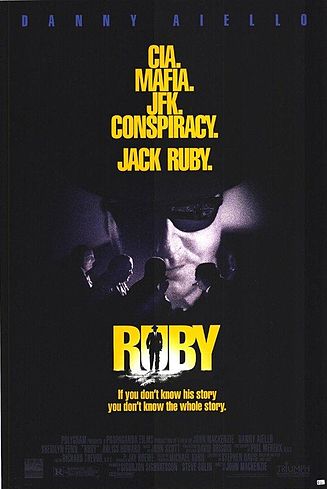
A Movie A Day #91: Ruby (1992, directed by John Mackenzie)


Of all the stars to come out of Twin Peaks, Sherilyn Fenn’s star briefly shined the brightest and sadly, she was the most misused by Hollywood.  While it is true that Fenn has worked regularly since Twin Peaks went off the air, she has rarely gotten the great roles that someone with her talent deserves.  Instead, her performances have far too often been the best thing about an otherwise mediocre film.

For example, Ruby.

In this very speculative biopic about the strip club owner who killed Lee Harvey Oswald and whose organized crime background has put him at the center of a thousand conspiracy theories, Danny Aiello plays Jack Ruby and Sherilyn Fenn plays his only friend, Sheryl Ann Dujean (or, when she’s stripping in the Carousel Club, Candy Cane).  The film portrays Jack Ruby as being a low-level mobster who is never as valuable or as important to his superiors as he thinks he is.  In this movie, Ruby is always on the outside looking in on the conspiracy and, when he kills Oswald, it is because he wants to prove that he is more than just a small time hood.  Candy, who was a composite of several Carousel Club dancers, maintains a strong platonic friendship with Jack and is always there for him to talk to, except for when she goes to Vegas to perform for and sleep with the President.

Ruby came out as the same time as JFK and it often seems like a fanfic based on Stone’s film.  Low budget and overwritten, Ruby never works as a movie but Danny Aiello is perfectly cast as the bombastic but insecure Jack Ruby.  Unfortunately, Ruby‘s screenplay often does not seem to know what it wants to say about its main character.  As Candy, Fenn is not given nearly enough to do but she still manages to show the same natural spark that made her a star on Twin Peaks.

Sherilyn Fenn is not the only Twin Peaks cast member to have a role in Ruby.  Keep an eye out for a post-Twin Peaks, pre-X-Files David Duchovny, playing the role of J.D. Tippit.