Doctor Who — Invasion of the Dinosaurs (1974, directed by Paddy Russell)


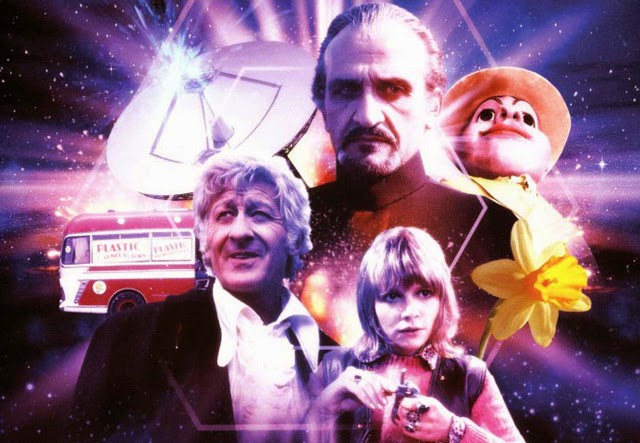
Fresh from defeating an attempt by a Sontaran to disrupt British history, the Third Doctor (Jon Pertwee) and his newest companion, reporter Sarah Jane Smith (Elisabeth Sladen), return to present-day London and discover that it has been transformed into a ghost town.  Dinosaurs are roaming the streets.  The Doctor teams up with UNIT to try to figure out who has been monkeying with time but what he doesn’t know is that the trusted Captain Yates (Richard Franklin) is working with the people responsible for the dinosaur invasion.

Invasion of the Dinosaurs was the second serial of the 11th season.  Like The Sea Devils, this was another case where I read the novelization long before I got a chance to see the actual serial.  Well-written by Malcolm Hulke, the novelization really got me excited to watch Invasion of the Dinosaurs.  It did not prepare me for how fake the dinosaurs would look.

It was to be expected, though.  Classic Doctor Who was never known for its wonderful special effects.  Instead, it was known for rubber monsters, torn costumes, and alien landscapes that were often made out of cardboard.  For many of us, that was a part of its charm.  The dinosaurs in this serial look like toys that have been unleashed on a still photo of London.  I’ve read that the serial was criticized for its bad dinosaur effects when it originally aired 1974 and that was long before Jurassic Park made everyone take the idea of seeing a realistic dinosaur for granted.


Despite the very fake dinosaurs, Invasion of the Dinosaurs still has one of the better scripts of the Pertwee era.  The villains aren’t the typical evildoers who usually showed up on Doctor Who.  Instead, they are people who have convinced themselves that the only way to save humanity is to dial back time to what they consider to be the “Golden Age,” before technology and industry blighted what they believe to be the ideal landscape.  Of course, they plan to take only the very best among the population to their golden age with them.  The villains are elitist environmentalists, convinced that they and only they know what is best.  This may be the first episode of Doctor Who where the main antagonist, Sir Charles Grover (Noel Johnson), is a member of Parliament.

Captain Yates’s betrayal of UNIT and the Doctor adds some emotional depth to this story.  While Yates was never as important a character as the Brigadier or Sgt. Benton, he was still present for almost all of the Third Doctor’s adventures and the small scenes where he would flirt with Jo Grant were some of the most awkward moments of the Pertwee era.  Captain Yates was a loyal member of the Third Doctor’s entourage and his betrayal was motivated not by greed or resentment but instead by a desire to make the world a better place.  The novelization made it clear that it was actually the terrible things that Yates saw as a member of UNIT that convinced him that time needed to be turned back.

This was the final Jon Pertwee story to be set entirely on Earth and, though Yates and the Brigadier would return for Pertwee’s final serial, it was the last true UNIT story of the Pertwee years.  Jon Pertwee had already decided that the 11th season would be his last.  The 12 season would feature a new Doctor.  And while the BBC considered actors like Graham Crowden, Bernard Cribbins, and Jim Dale for the role, the Fourth Doctor was ultimately be played by Tom Baker, an actor who was working as a construction worker when Invasion of the Dinosaurs first aired.

Doctor Who would never the same.

Doctor Who — The Three Doctors (1972-1973, directed by Lennie Manye)


For the tenth season of Doctor Who, the BBC knew that they needed to start things off with a bang.  The first serial of season ten, The Three Doctors, brought together the first three actors who had played the Doctor.

A crisis was needed to explain why the Time Lords would decide to break their owns laws by bringing the Second Doctor and then the First Doctor out of their respective time zones.  Writers Dave Martin and Bob Baker came up with a story about the Doctor’s homeworld having its energy drained through a black hole.  If Gallifrey is destroyed then all of time and space will unravel.  (Everyone who has seen an episode of the original Doctor Who knows the drill.)  The villain is Omega (Stephen Thorne, who also played Azal in The Daemons), the first Time Lord, who has never forgiven his fellow Time Lords for abandoning him in an anti-matter universe that looks like a quarry.  The story is silly in the way that Doctor Who often could be but I think anyone watching will understand that the story is not that important.  Omega, the black hole, the energy blob that is sent to Earth to capture the Third Doctor, all of it was really just an excuse to bring back Patrick Troughton and William Hartnell.
Hartnell does not get to do much.  He was in increasingly poor health when he returned as the First Doctor and was also suffering from memory problems.  Sadly, this prevented him from sharing the same physical space as Troughton and Jon Pertwee.  Instead, it’s explained that the First Doctor is caught in a time eddy and can only communicate via the TARDIS’s viewscreen.  Even if he isn’t physically present, the First Doctor reveals himself to be the smartest of the three Doctors.  When he isn’t scolding the Second and Third Doctors, he’s figuring out how to enter Omega’s universe.  It’s not always easy to watch Hartnell looking frail and clearly reading some of his lines from cue cards but, even when ill, he still had the natural authority that he brought to the first two and a half  seasons of Doctor Who.

Patrick Troughton and Jon Pertwee are a delight to watch.  Their bickering is one of the highlights of the serial and both Troughton and Pertwee appear to have really enjoyed their scenes together.  The show also gets mileage from including the Brigadier (Nicholas Courtney) and Sgt. Benton (John Levene) along with the three Doctors.  I’ve always enjoyed how both of them come to accept the strangest of things with barely a shrug.  This is the episode where Benton enters the TARDIS and, when the Third Doctor asks if Benton’s going to point out that it’s bigger on the inside than the outside, replies, “It’s pretty obvious, isn’t it?”

The Three Doctors is hardly a perfect Doctor Who adventure.  (If any adventure needed the presence of the The Master, it was this one.)  It is, however, a tribute to the men who played the first three Doctors and the role they all played in making the show an institution.  The Three Doctors was also the final acting role of William Hartnell, who passed away two years after the serial was broadcast.

Doctor Who — The Sea Devils (1972, directed by Michael Briant)


Having been captured by UNIT at the end of The Daemons, the Master (Roger Delgado) is now a imprisoned on a small island in the English channel.  He claims that he is reformed and he now spends most of his days watching the BBC.  (Has he not been punished enough?)

When the Doctor (Jon Pertwee) and Jo Grant (Katy Manning) visit the Master to try to learn the location of his TARDIS, they come up empty.  They do, however, learn that several ships have gone missing and, understandably, they suspect that the Master is involved.

They’re correct.  The Master has duped his warden, Trenchard (Clive Morton), into helping him steal electrical equipment so that he can contact The Sea Devils, a race of bipedal reptiles the live under the sea.  The Sea Devils, much like their cousins, the Silurians, were the original inhabitants of Earth.  They’ve now woken from hibernation to discover that mankind — who they last knew to be a collection of barely evolved monkeys — have taken over the planet.  And they’re not happy about it.

The Silurians and the Sea Devils appeared in three serials during the original run of Doctor Who and all of them followed the same basic plot.  The Silurians or the Sea Devils woke up from their hibernation.  The Doctor tried to broker a peace with humanity.  Humanity reacted by blowing them up.  The Sea Devils were usually more reluctant to make peace than the Silurians.  In The Sea Devils, the Doctor himself is forced to sabotage their base to keep them from attacking humanity but that’s nothing compared to the atomic bomb that the British government wanted to drop on them.  Whenever a Silurian or a Sea Devil shows up, it means that the Doctor is going to disappointed in humanity once again.

The Sea Devils is a serial of which I have fond memories because Malcolm Hulke’s novelization was the first Doctor Who book that I ever read.  (Malcolm Hulke also wrote the serial itself.)  I read the book before I even saw the show.  The novelization was my introduction to the Doctor, UNIT, and especially the Master.  Hulke was one of the best writers of the Doctor Who novelizations, taking the time to add depth to the characters.  This was especially true of Trenchard, who is portrayed far more sympathetically in the novel than he was on the show.

The Sea Devils also features one of Roger Delgado’s finest turns as the Master.  This was the Master’s first appearance during the ninth season of Doctor Who and Delgado shows that, even when imprisoned, the Master never stops manipulating and scheming.  This episode shows why Delgado’s Master was such a classic villain and truly a worthy opponent of the Doctor.  Delgado does such a good job in the scenes where The Master pretends to be reformed that it’s easy to understand how he managed to trick Trenchard.  At the end of the serial, The Master makes another escape, again by fooling the humans around him.  Delgado made The Master into a magnetic and compelling villain.

Roger Delgado appeared twice more as the Master before his untimely death in an auto accident.  Jon Pertwee later said that Delgado’s death was one of the reasons that he decided to step away from the role of the Doctor.  The Master would eventually return and he would be played by several different actors.  For me, the true Master will always be Roger Delgado.

Doctor Who — The Daemons (1971, directed by Christopher Barry)


When I was growing up and watching Doctor Who on PBS, I had a friend whose mother forbid him from watching the show because she thought that it promoted Satanism.

Her opinion was almost totally based on the cover of the novelization of one of the Third Doctor’s most popular adventures.

She took one look at that cover and decided that both the book and the show were promoting Satan.  I warned him that would happen when he first bought the book but, back in the day, it was nearly impossible to resist the temptation of the shelf of Doctor Who novels at Walden Books.  It was almost as if the books had been put there by you know who.

If my friend’s mother had read the book or even watched the serial when it eventually aired on PBS, she would have discovered that The Daemons did not feature the Devil.  Instead, it features Azal (Stephen Thorne), an evil horned alien who had spent centuries experimenting on humans and who had inspired many ancient myths and religions.  If my friend’s mother had watched the show, she would have seen that, rather than celebrate Satan, the show instead suggested that there was no Satan and that all of mankind’s Gods were actually visiting aliens.  She would have also seen that while The Master (played by Roger Delgado) disguised himself as a vicar, it fell to a local white witch to warn everyone in a quaint British village that the local archeological dig was a mistake.  Because of the Master’s religious disguise, everyone followed him when they should have been listening to the pagan…

In hindsight, it’s probably a good thing my friend’s mother never watched the show.

The Daemons has a reputation for being one of the best of the Third Doctor’s adventures and I’m inclined to agree.  The Doctor (Jon Pertwee) and his latest companion, Jo Grant (Katy Manning), try to stop the dig and instead find themselves trapped by a heat shield that has suddenly sprung  up over the village.  One of the defining images of this episode was a helicopter busting into flame when it hit the invisible barrier.  With the Brigadier and the majority of UNIT outside of the village, The Doctor, Jo, Sgt. Benton (John Levene), and Captain Yates (Richard Franklin) try to stop the plans of The Master and Azal.  Unfortunately, the villagers themselves have fallen under the sway of evil and are planning a special maypole sacrifice.


So many different actors have played The Master (and the character has become so overused) that it is easy to forget just how good Roger Delgado, the first Master, was in the role.  Delgado played the Master as being incredibly evil but he also played him as having a sense of humor and style about his evil, which is something that subsequent Masters have often failed to do.  Delgado’s Master appeared in every serial of the eighth series and he proved to be more than a worthy opponent for Pertwee’s Doctor.  Off-screen, Pertwee and Delgado were close friends and Pertwee later said that Delgado’s death in a traffic accident was one of the factors in Petwee’s decision to step away from the show.  The Daemons featured Delgado at his best as the Master did his worst and tried to claim the powers of someone who humans considered to be Satan.

The Daemons is also remembered for one of the best lines in the history of Doctor Who.  When confronted by Azal’s gargoyle servant, the Brigadier calls over a UNIT solider and orders, “Chap with wings there, five rounds rapid.”  I can only imagine how tired Nicholas Courtney got of having that line repeated to him over the years but his delivery of it is perfect.  The Brigadier was such a uniquely English character, imbued with the unflappable attitude of a country that had survived the collapse of an Empire, the Blitz, and the Suez Crisis.  Nicholas Courtney took a line that sounds like something Graham Chapman would have said on Monty Python and instead made it into an iconic piece of dialogue that reminded those of us American watching on PBS that, in Doctor Who, the entire universe was British.

Though it led to the show being forever banned in my friend’s house, The Daemons is a Doctor Who classic.

Doctor Who — Spearhead From Space (1970, directed by Derek Martinus)


Two meteorite showers have fallen in rural England and a poacher has come across a strange plastic polyhedron at one of the sites.  Brigadier General Alistair Lethbridge-Stewart (Nicholas Courtney), the head of the United Nations Intelligence Taskforce (UNIT), fears it could be the start of another alien invasion.  He explains to UNIT’s skeptical scientific advisor, Dr. Liz Shaw (Caroline John), that UNIT was specifically created to protect the Earth from such invasions.

Meanwhile, a bushy-haired man has collapsed in front of an old-fashioned blue police call box.  He’s been taken to a hospital, where the doctors are confounded by the fact that he appears to have two hearts.  The Brigadier, hearing the news, is convinced that the man is his old friend the Doctor and heads to the hospital.

The Brigadier is right.  The man (Jon Pertwee) is the Doctor but, as a result of being found guilty of stealing a TARDIS and breaking the Time Lord code of non-interference, the Doctor now looks and sounds completely different.  While the Doctor works to convince the Brigadier that he is who he says he is, a tentacled alien known as the Nestene is using the Autons, a race of plastic humanoids, to do its deadly bidding.

I’ve always really liked Jon Pertwee’s interpretation of the Doctor and the reasons why are to be found in his very first adventure.  While Pertwee’s Doctor was just as intelligent and egocentric as the two Doctors who came before him, he was also a man (or an alien, I guess) of action.  Rather than just stay cooped up in that hospital room, the Third Doctor is constantly trying to escape.  When the Autons show up and try to abduct him, the Third Doctor doesn’t go without a struggle.  Unlike the first two Doctors, this Doctor has no problem commandeering a car and then demanding one just like it in return for working with UNIT.  Pertwee combined intelligence with action and humor and that brought a unique feel to his five years in the role.  I’ve often seen Pertwee’s Doctor compared to James Bond.  I think a better comparison would be to Patrick McNee’s John Steed from The Avengers.  The Third Doctor was an intelligent, erudite gentleman who dressed well and knew how to throw a punch.

The majority of the Third Doctor’s adventure would involve UNIT in some way.  Exiled to Earth and with a locked-down TARDIS, the Third Doctor was the most Earth-bound of the Doctors but, as shown in Spearhead From Space, that worked well for Pertwee’s interpretation of the character.  Pertwee and Nicholas Courtney were a good team and, for Pertwee’s first season, Liz Shaw was a companion who was actually the Doctor’s equal.  (I had a huge crush on Caroline John when her episodes were first broadcast on PBS.)  The first Auton Invasion showed why UNIT was so necessary and also why it needed the services of the Doctor.

The Autons have a reputation for being the scariest of Doctor Who’s monsters.  They definitely were creepy, with their expressionless, plastic faces.  Imagine mannequins that can walk and who will also shoot you on a whim and you have an idea of why the Autons inspired many bad dreams in 1970.  (Like the Cyberman in Tomb of the Cybermen, the Autons were soon at the heart of a debate about whether or not Doctor Who was too scary for children.)  The Autons are certainly more scary than the Nestene, which was quite obviously a puppet and not very well-put together one at that.

Spearhead from Space was a wonderful introduction to Jon Pertwee’s Doctor and it remains a classic of the original series.  The first serial to be broadcast in color, it not only allows us to get to know the Third Doctor but it also introduces a classic new threat.  As this story ends, the Doctor is settling to his new role as an advisor to UNIT.  Waiting in the future are many more adventures and the Master.

Great Moments In Television History: The Autons Terrify The UK


In 1971, for the entire month of January, children across the UK were terrified of the Autons.

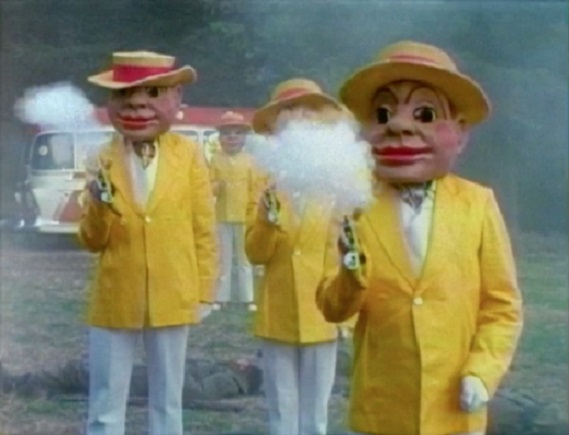
That was because Doctor Who began its eighth season with a four-part story called The Terror of the Autons.  Previously seen in Spearhead From Space, the Autons were plastic aliens who could disguise themselves as anything.  That mannequin in the store?  It might be an Auton.  That strange looking man handing out flowers?  Might be an Auton.  Your favorite plastic doll?  It might be an Auton waiting to kill you in your sleep.

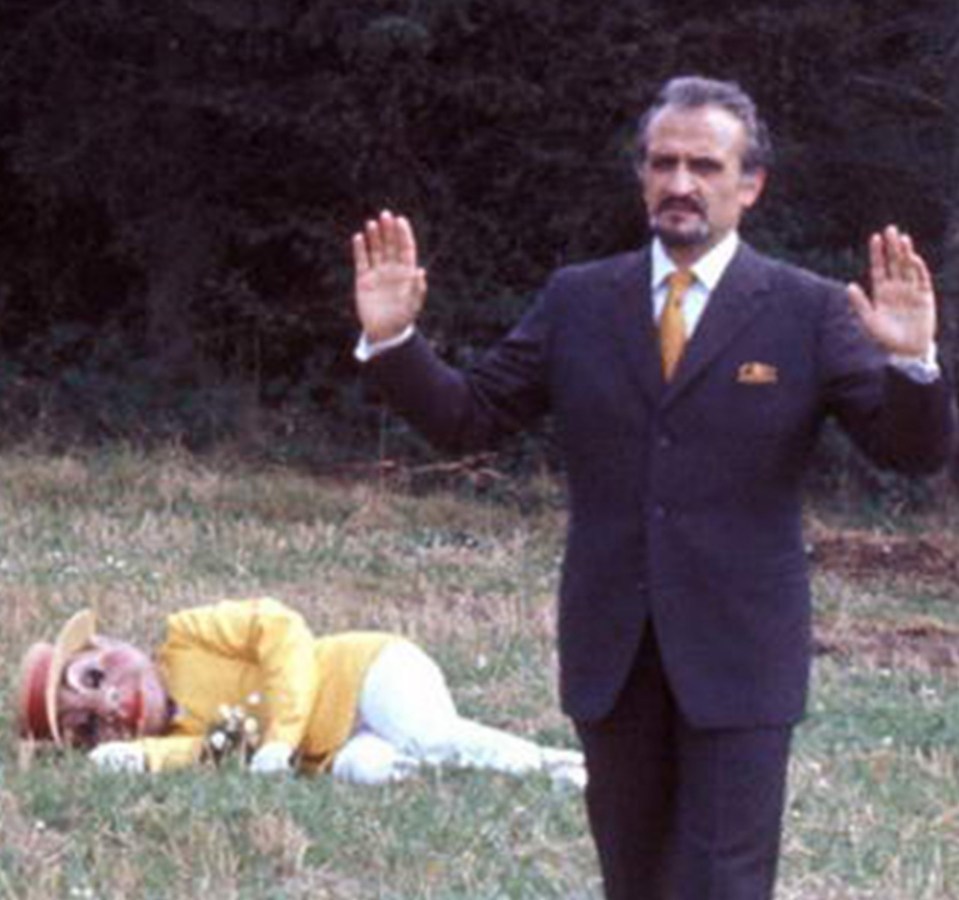
In this case, the Autons had returned to Earth because of the machinations of the Doctor’s greatest foe, The Master.  This serial featured the first appearance of The Master, with the Roger Delgado playing the role and becoming the series’s most popular villain since the Daleks.  (This serial also featured the first appearance of Katy Manning as Jo Grant, who went on to become popular for entirely different reasons.) But as evil as The Master was, it was the Autons who reportedly kept viewers awake at night.  Even after The Doctor (played, at that time, by Jon Pertwee) defeated them for a second time, you could never be sure whether that mannequin was harmless or if it was an Auton stalking you whenever your back was turned.

For modern viewers, it can seem strange to hear that people were ever scared by Doctor Who.  But the Autons are an exception.  The Autons are actually creepy.

The Master doesn’t seem to be too scared of them, though.

The Terror of the Autons would go on to be the first episode of Doctor Who to be cited in the House of Lords, when it was listed as a recent programme that might have a dangerous effect on the minds of the people watching.  But who knows?  Was that Lord Beaverbrook or was it…?

Previous Great Moments In Television History:

  1. Planet of the Apes The TV Series
  2. Lonely Water
  3. Ghostwatch Traumatizes The UK
  4. Frasier Meets The Candidate

The Airzone Solution? (1993, directed by Bill Baggs)


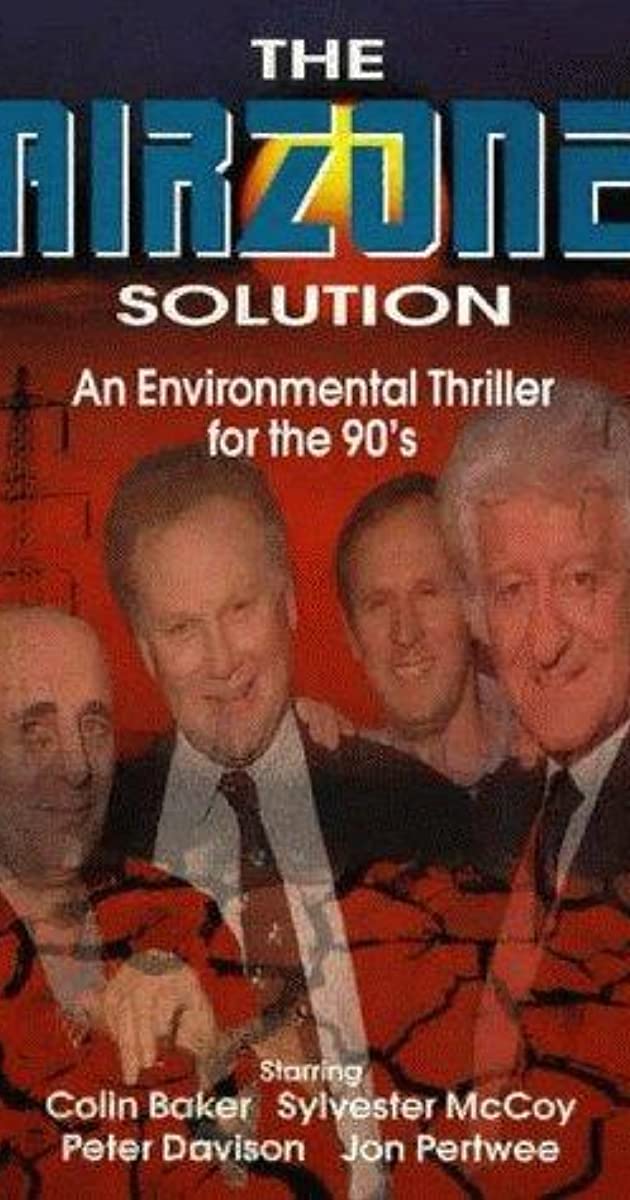
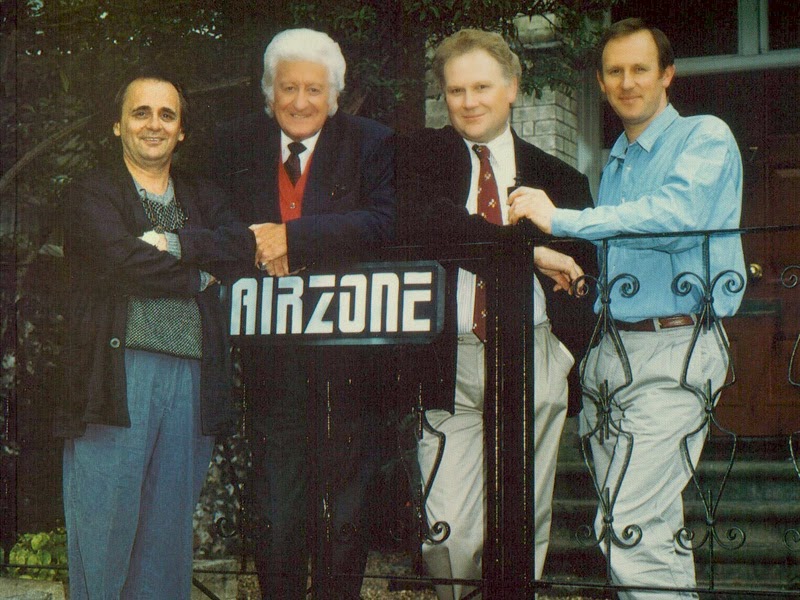
In the near future, the UK has become so polluted that people have to wear masks when they go outside.  (Save your COVID-19 jokes, the villain here is pollution not a pandemic.)  A mysterious corporation called Airzone claims that they have a solution but some are skeptical.  Journalist Al Dunbar (Peter Davison) and environmentalist Anthony Stanwick (Sylvester McCoy) are determined to investigate on their own and discover what’s actually going on at Airzone.  Unfortunately, Al discovers a bit too much and is murdered by the corporation.

However, Al is not prepared to let something like death get in the way of exposing Airzone.  His ghost appears to both his mentor, Prof. Oliver Threthaway (Jon Pertwee), and to local weatherman Arnie Davis (Colin Baker).  Freaked out by Al’s ghost, Arnie and his girlfriend, Ellie Brown (Nicola Bryant), launch their own investigation into the corporation and they discover that Airzone’s solution comes at a terrible cost.

This low-budget, straight-to-video production is best-known for featuring four actors who starred as the Doctor during the original run of Doctor Who.  In fact, when this film was first made, it featured every living Doctor with the exception of Tom Baker.  (Jon Pertwee would die just three years after the film’s release.)  Nicola Bryant, who played Colin Baker’s companion on Doctor Who, plays his girlfriend here while Michael Wisher, who played Davros, shows up as a duplicitous politician.  Even Alan Cumming, who was frequently mentioned as a possible Doctor should the series ever be renewed, has a small role.  If you’re a fan of Doctor Who, you almost have to watch this movie for the cast along.

But is the movie itself any good?  The special effects are cheap, the story is full of plot holes, and there’s a lot of dodgy acting from the supporting cast.  The movie never explains why Al Dunbar’s spirit appears to Arnie Davis instead of someone who could actually do something to stop Airzone.  Jon Pertwee’s role was reportedly added at the last moment and his appearances feel random.  In fact, the film is flawed in much the same way that Doctor Who was often flawed.  And like Doctor Who, it’s often fun despite those flaws.  It’s fast-paced and, despite its weighty environmental theme, it doesn’t take itself too seriously.

All of the former Doctors acquit themselves well in their roles.  Peter Davison and Sylvester McCoy, who were probably the best actors among the original Doctors, are the cast stand-outs but Colin Baker is far more sympathetic and likable here than he ever was on Doctor Who.  I’ve always felt that Colin Baker had the potential to be a good Doctor but he was sabotaged by some of the worst scripts and production decisions in the history of the series and The Airzone Solution? shows what Baker could have done with the role if he’d been given the opportunity.  Jon Pertwee was obviously not in good health when he appeared in The Airzone Solution? but he still hams it up with an entertaining gusto.

The Airzone Solution? will be best appreciated by fans of the original Doctor Who.  It’s not great but it’s worth it just to see everyone gathered together.

Mary Whitehouse’s Worst Nightmare: 8 Frightening Serials From Doctor Who’s Classic Era


“Tea time brutality for tots.”

That was the term that a woman named Mary Whitehouse used to describe Doctor Who in 1975.  Mary was the founder of the National Viewers and Listeners Association and, in her crusade to return Britain to decency, she often leveled her harshest criticism at Doctor Who, a show that she regularly claimed was too scary for television.

Did she have a point?  Of course not.  Even children who were scared of the Daleks when they were nine or ten eventually grew up to realize that all you had to do to escape those mutant bastards was run up a staircase.  Still, Doctor Who did occasionally have its memorable horror moments.

Here are eight frightening episodes from Doctor Who‘s classic era:

  1. State of Decay (4 episodes, 1980)

Everyone remembers this classic from the Tom Baker years.  The TARDIS materializes on a planet where the villagers live under the shadow of a dark tower.  Ruled over by three cruel lords, Zargo, Camilla, and Aukon, the villagers are forced to regularly sacrifice their young to appease their rulers.  The Doctor, Romana, K-9, and Adric investigate and discover that Zargo, Camilla, and Aukon are vampires!  After being defeated by the Time Lords, the vampires retreated into E-Space, where they found a new planet to rule.  Of course, that little tosser Adric wants to become a vampire.  Why Romana and the Doctor didn’t leave Adric behind on the vampire planet, I’ll never understand.

2. Horror of Fang Rock (4 episodes, 1977)

This underrated serial is also from the Tom Baker era.  The Doctor and Leela land on the Island of Fang Rock, just off the coast of England, in the early 20th century.   The inhabitants of an isolated lighthouse are being killed, one-by-one, by an alien known as a Rutan.  This episode is full of gothic atmosphere and, despite the Doctor’s best efforts, almost everyone dies.

3. The Talons of Weng-Chiang (6 episodes, 1977)

Of all the Tom Baker episodes, this is my personal favorite.  The Doctor and Leela find themselves in Victorian-era London, where they investigate a murder and discover that they are not the only time traveler in London.  When most people talk about this serial, they focus on the terrible giant rat and the wonderful supporting characters of Jago and Lightfoot.  What I always remember is the Peking Homunuculus, a psycho killer who looks like a puppet and squeals like a pig!

4. The Deadly Assassin (4 episode, 1976)

One final Tom Baker episode.  The Deadly Assassin is unique in that it features the Doctor with no companions.  When the Doctor travels to Gallifrey, he discovers that The Master (played by Peter Pratt) is still alive and determined to destroy the Time Lords.  Having used all of his regenerations, The Master is now not only at his most evil but also horribly disfigured and decaying, a sight to give nightmares to any impressionable viewer!

5/6. Kinda (4 episodes, 1982) and Snakedance (4 episodes, 1983)

Peter Davison was an underrated Doctor and never was he better than in Kinda and its sequel, Snakedance.  In both of these episodes, The Doctor must deal with the efforts of the Mara to possess his companion, Tegan.  Both of these episodes were more creepy than scary but, thanks to the performances of Peter Davison and Janet Fielding, they were effective nonetheless.

7. Spearhead From Space (4 episodes, 1970)

Jon Pertwee made his debut as the Third Doctor in this serial.  The Doctor is exiled to Earth just in time to deal with an invasion by the Nestenes.  Serving as the Nestenes’s invasion force are the Autons, life-size plastic dummies that come to life at inopportune times.  With their stiff movements and expressionless faces, the Autons were regularly cited as one of the Doctor’s creepiest enemies.

8. The Daemons (5 episodes, 1971)

The Third Doctor vs. The Devil!  The Master as a vicar!  A killer statue!  Not even the Brigadier’s order of “Chap with wings!  Six round rapid!” could lighten up the atmosphere of this Jon Pertwee classic.

The Doctor and friends

Halloween Havoc!: THE HOUSE THAT DRIPPED BLOOD (Amicus 1971)


gary loggins's avatarcracked rear viewer

drip1

Hammer Films wasn’t the only British company cranking out the horrors back in the 60’s and 70’s. American ex-pats producers Milton Subotsky and Max Rosenberg formed Amicus Films in 1962 and after a couple of films aimed at the teen audience (with American rockers like Chubby Checker, Del Shannon, Freddy Cannon, and Gene Vincent) began concentrating on horror. The team specialized in the anthology genre, or “portmanteau” as the intelligentsia call them. I’ll stick with anthologies!

THE HOUSE THAT DRIPPED BLOOD was a 1971 effort written by Robert Bloch, forever known as “The Guy Who Wrote PSYCHO”. The nail to hang Bloch’s four tales on concerns the disappearance of famous horror actor Paul Henderson, who was last seen at the old house in the countryside. Inspector Holloway (John Bennett) of Scotland Yard (where else?) arrives on the scene and speaks with the local constable, who warns Holloway about mysterious doings past:

drip2

In “Method for Murder”…

View original post 690 more words