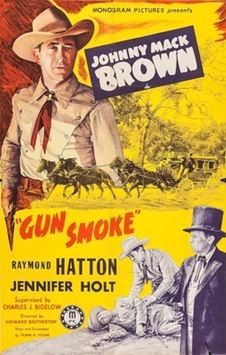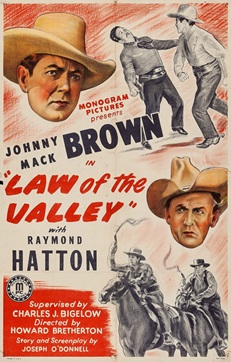
Gun Smoke (1945, directed by Howard Bretherton)


On the frontier, a stagecoach has been overturned and both the passenger and the driver have been killed by outlaws.  The passenger was Hinkley, an archeologist.  Who would want to kill a harmless archeologist?  That’s what Marshals Nevada Jack McKenzie (Johnny Mack Brown) and Sandy Hopkins (Raymond Hatton) set out to discover.  While Nevada Jack asks questions in the nearby town, Sandy disguises himself as a medicine man.

It all links back to an old Indian site that is said to be full of gold relics.  Jane (Jennifer Holt), the daughter of Hinkley’s partner, reveals that the only other person who knows the location of the site is an old Indian named Shag (Dimas Sotello).  Jack and Sandy have to try to track down Shag before he’s found the gang that killed Hinkley.

Yes, it’s another Johnny Mack Brown western.  Despite the title, this has nothing to do with the television series that featured James Arness and Amanda Blake.  Gun Smoke is still a solid western, featuring a determined performance from Johnny Mack Brown and some memorable villains from the usual poverty row western stock company.  Once again, Frank Ellis shows up as a henchman, though the identity of the main villain is actually a little more interesting than was typical for these films.  Johnny Mack Brown is a little more serious than usual, throwing punches with authority.  For fans of B-westerns, Gun Smoke is an above average entry in Johnny Mack Brown’s seemingly endless filmography.

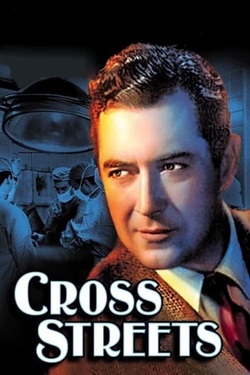
Cross Streets (1934, directed by Frank R. Strayer)


Having graduated from medical school, Dr. Adam Blythe (Johnny Mack Brown) is finally ready to marry his glamorous fiancée, Ann (Claire Windsor).  However, when Ann learns that Adam is going to have to spend years as an lowly paid resident, she ditches him and instead marries Dr. Jerry Clement (Niles Welch).  Blythe, heartbroken, becomes an alcoholic and, after a disastrous operation that leaves a patient dead, Blythe ends up on skid row.  Twenty years later, Blythe is spotted by his old friend Mort (Kenneth Thomson).  A self-made millionaire who dropped out of college, Mort takes Blythe to their 20-year reunion and talks him up as a brilliant surgeon.  When Blythe is pressured into performing a delicate piece of surgery, he is offered a position as the head of the college’s new research wing.  Blythe, meanwhile, meets and falls in love with June (Anita Louise), a young woman who reminds him of Ann.  It turns out that the resemblance is not a coincidence because June is Ann’s daughter!  Ann wants Blythe back and, when she discovers that Blythe is in love with June, she threatens to tell everyone that Blythe is actually June’s father!  All of the secrets and lies lead to the type of  sudden and tragic ending that only a pre-code film could get away with.

Cross Streets is a 65-minute soap opera that features Johnny Mack Brown in a non-western role.  Brown gives a likable performance but he’s less convincing when he has to be bitter.  One reason why Brown was such a successful B-western star is that he always came across as if he had never had a moment of self-doubt in his entire life.  Dr. Adam Blythe is all about self-doubt so he feels miscast in the role.  Claire Windsor is more convincing as the vampish Ann.  The movie has its slow spots and the plot requires a healthy suspension of disbelief but the ending still packs a punch.

Cross Streets is not easy to find but there is a not-great upload available on YouTube.

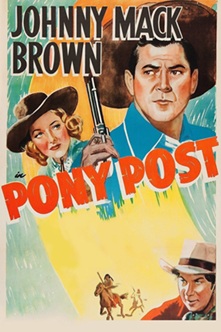
Pony Post (1940, directed by Ray Taylor)


In the days of the Old West, Griff Atkins (Stanley Blystone) manages a Pony Express station but, because of his gambling debts, he actually encourages the Indians and the outlaw Richard brothers (John Rockwell and Ray Teal) to attack the Pony Express riders and steal their horses.  Major Goodwin (Tom Chatterton) tries to put a stop to all this by firing Griff and putting Cal Sheridan (Johnny Mack Brown) in charge.  Griff and the Richard brothers continue their outlaw ways and eventually, the head of one of the relay stations is killed in one of their raids.  While the dead man’s daughter, Norma (Nell O’Day), investigates the murder, Cal works to bring peace the line and falls in love with Goodwin’s daughter, Alice (Dorothy Short).  Meanwhile, aspiring Pony Express rider Shorty (Fuzzy Knight) tries to invent a trampoline system that will help him to mount a horse.

No matter how bad things get in the west, you can always count on Johnny Mack Brown to bring some order and to get it done in less than an hour.  Johnny Mack Brown was always a good hero and that’s the case here.  Eventually this film has all of the horse riding and tough fighting that fans of the genre expect from these westerns but, for a short movie (it only runs for 59 minutes), it still seems to take a while for it to really get going.  The first half of the movie is more about Fuzzy Knight singing songs and trying to become a rider than it is about anything else.  I usually enjoy Fuzzy’s antics but, like the B-western themselves, they are definitely an acquired taste for most viewers.

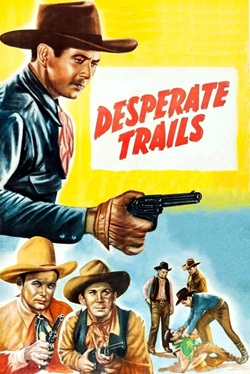
Desperate Trails (1939, directed by Albert Ray)


The frontier town of Denton has become lawless, plagued by murders, robberies, and cattle rustling.  The town’s sheriff (Russell Simpson) just cannot seem to bring peace to the streets.  That’s because the sheriff is secretly responsible for all the crime.  He’s working in cahoots with the town banker (Clarence Wilson) and he’s sets his sights on taking over a ranch owned by Frances Robinson.  As was so often the case with B-westerns, it all comes down to stealing someone else’s land.

The federal government sends Marshal Johnny Mack Brown to bring some order to the town.  Working undercover, Brown gets hired as Robinson’s ranch and he quickly chases off all of the bad ranchhands,  He brings his friend, singing cowboy Bob Baker, onboard to work as the ranch foreman.  With Fuzzy Knight providing comic relief, Brown sets out to thwart the next stagecoach robbery and to expose the evildoers of Denton.

This was the first western that Brown made with Universal Pictures.  Bob Baker, who had previously been the star of the studio’s B-westerns, was demoted to second lead and, eventually, he quit making films for Universal all together.  Unlike Baker, who was angry at being demoted, Fuzzy Knight was always happy to provide sidekick duty and would go on to co-star in all of Brown’s Universal westerns.  From the start, Brown and Knight had the chemistry that made them a good B-movie team.

Desperate Trails is a typical B-western but, as always, Brown elevates things with his performance.  From the minute that Brown rides into town, he screams authenticity.  He’s pretty tough in this film, which includes a scene where he coolly takes care of a gang of outlaws with just one rifle.  The best performance here comes from Russell Simpson, who gets angrier and angrier as the film goes on and all of his plans fall apart.

For fans of the B-western genre, Desperate Trails has a lot of entertainment to offer.

Fire Alarm (1932, directed by Karl Brown)


When their cat climbs to the top of a power pole, Pat (Noel Francis) and Gertie (Marjorie Beebe) call the entire fire department to come help them bring the kitty down.  The fire chief isn’t amused but two firemen, Charlie (Johnny Mack Brown) and Fishey (George Cooper), both catch the eye of Pat and Gertie.  Soon, Charlie is dating Pat and Fishey dating Gertie.  While Fishey and Gertie provide the comic relief, Charlie and Pat provide the drama.  Charlie thinks that Pat’s boss (Richard Tucker) is putting the moves on her and he responds by punching him.  Charlie and Pat break up but a fire that breaks out next door to Pat’s building brings them back together.

There’s not much to this programmer but it’s a chance to see western star Johnny Mack Brown in a “modern” role.  He’s convincingly tough as the headstrong Charlie while veteran actor George Cooper (who usually went uncredited in the 220 films that he appeared in) provides able support as his eccentric best friend.  Noel Francis and Marjorie Beebe are both likable as the two secretaries who end up with firefighter boyfriends and it’s had not to regret that neither had a bigger career in Hollywood.  As for the fire scenes, they are actually pretty effective for a 1930s film.  There are a few shaky shots but I imagine they were still good enough to thrill afternoon matinee audiences in 1932.

This film is often known as Flames, which provides a double meaning.  The characters fight flames while being flames themselves.  Personally, I think Fire Alarm is better.

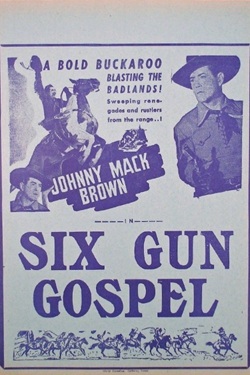
Six Gun Gospel (1943, directed by Lambert Hillyer)


Marshals Nevada Jack McKenzie (Johnny Mack Brown) and Sandy Hopkins (Raymond Hatton) are sent to the frontier mining community of Goldville to determine who is responsible for hijacking all of the gold that should be coming out of the town.  Not surprisingly, it’s all the work of another dastardly saloon owner (Kenneth MacDonald) who is planning on stealing all the gold, chasing off all the settlers, and then selling their land to the railroad company.  While Sandy goes undercover as the town’s new preacher, Jack agrees to ride shotgun on a gold shipment, along with with Dan Baxter (Eddie Drew).  Dan is in love with Jane Simms (Inna Gest), the daughter of honest miner Bill Simms (Kernan Cripps).

Johnny Mack Brown made a countless number of westerns for several different production companies but it seems like they always featured a crooked saloon owner and a plan to sell the land to a railroad company.  Luckily, nobody watches these movies for the plots and that was probably true even when they were first released.  People watch these movies for the nostalgia value of watching a movie where it’s good vs evil and good always triumphs without leaving any sort of lingering doubt about whether or not the heroes did the right thing.  Johnny Mack Brown is as authentic on a horse and carrying a gun as he ever was and there’s a scene where he manages to get a gun despite being tied up that’s pretty cool.  The appeal of Johnny Mack Brown was that he always seemed like he could do the things that he did in the movies in real life as well.  Raymond Hatton provides comic relief, pretending to know the hymns being sung by his congregation and providing some songs of his own.  There’s enough gun fights and horse chases to provide nostalgic happiness for fans of the genre and that’s the important thing.

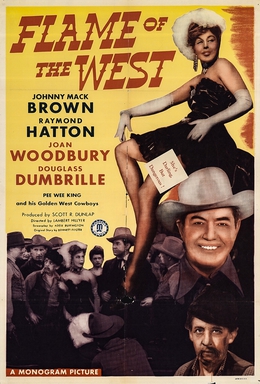
Flame of the West (1945, directed by Lambert Hillyer)


Marshal Tom Nightlander (Douglass Dumbrille) shows up in a lawless frontier town, tasked with bringing peace.  He could sure use the help of Dr. John Poole (Johnny Mack Brown), a former gunslinger who has set his weapons aside and now works as the town doctor.  Dr. Poole has sworn off guns but with corrupt businessman Wilson (Harry Woods) and his gang determined to keep their town lawless, Poole is soon forced to reconsider.

This B-western from Monogram is better than many of the other low-budget, poverty row westerns of the era.  While the plot is another example of a corrupt businessman and his gang making life difficult for peaceful settlers, the characters in Flame of the West are a little more complex than usual.  Brown stands out playing a character who, for once, doesn’t want to fight and believes that it’s better to talk than to shoot.  Of course, this being a B-western, he soon sees the error of his ways.  Dumbrille was usually cast as a villain so this film is a chance to see him in a likable and heroic role and he’s very convincing as a Wyatt Earp-style marshal.

Of course, even a serious B-western is still a B-western so songs and entertainment are provided by the gorgeous Joan Woodbury and Pee Wee King and his Golden West Cowboys.  (Don’t worry, I had never heard of them before, either.)  Joan Woodbury plays a saloon owner who wants to bring a higher class of entertainment to the frontier and she provides the film with enough sex appeal that 1945 audiences probably didn’t mind having to sit through the musical numbers before getting to the inevitable showdown between Johnny Mack Brown and Harry Woods.

Flame of the West is a good B-western that shows what dependable actors like Johnny Mack Brown and Douglass Dumbrille were capable of when given the opportunity.

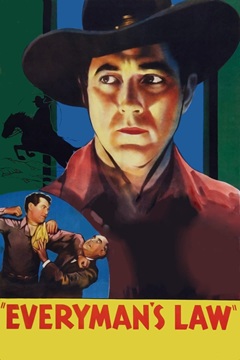
Everyman’s Law (1936, directed by Albert Ray)


Corrupt Sheriff Chris Bradley (Homer Murphy) sends letters to three outlaws, asking them to come to his town and to work for him.  Sheriff Bradley wants to use them to kick some homesteaders off their land.  What Sheriff Bradly didn’t count on was one of the outlaws being an undercover Texas Ranger!  Johnny Mack Brown plays Johnny, a.k.a. The Dog Town Kid.

The Kid takes a liking to homesteader Marian Henley (Beth Marion) and her infant son.  When the Kid and the other two outlaws don’t move out the homesteaders to the sheriff’s liking, Bradley hires fearsome outlaw Lobo Joe (Roger Gray).

This is a pretty typical Poverty Row western.  After you see enough of these, you realize that every plot is going to be about a corrupt sheriff and a businessman teaming up to try to steal the land away from the settlers.  What makes these film work (or not) is the quality of the stars and Johnny Mack Brown was one of the best, someone who seemed authentic when he was riding a horse or shooting a gun but who was also a good enough actor to bring some life to the familiar plots.  As usual, with this film, Johnny Mack Brown is better than his material.

Everyman’s Law is best-known for the scenes of Brown and the other two outlaws having to babysit Marian’s baby.  The “comedic” scene where the baby puts the barrel of Johnny’s six-shooter in his mouth probably had the audience rolling in 1936 but today, it would undoubtedly get the film banned.

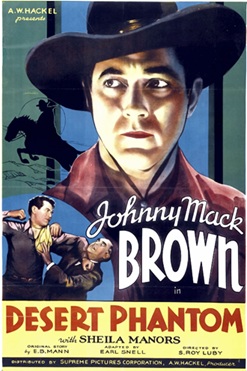
Desert Phantom (1936, directed by S. Roy Luby)


In a frontier town, rancher Jean Halloran (Sheila Bromley) has a big problem.  Someone is shooting and killing all of her ranch hands and sending her notes in which he tells her to give up her ranch and leave town.  When an ammunition salesman and trick shooter named Billy Donavon (Johnny Mack Brown), Jean hires him to serve as a bodyguard and to track down the mysterious Phantom.  Billy, however, has a secret of his own.

Desert Phantom is a remake of an old Harry Carey film.  I don’t know why Poverty Row did remakes since all of their films pretty much had the same plot regardless.  A stranger comes into town and gets involved with a female rancher and a bad guy who is trying to hide his actual identity.  In this one, Nelson McDowell gets to supply the comic relief as a befuddled veterinarian while familiar faces like Ted Adams and Karl Hackett are there to keep us guessing about how the Phantom could actually be.  If you’ve watched enough of these movies, though, you’ll always be able to guess who the bad guy is.

This isn’t the best of Johnny Mack Brown’s movies.  The Phantom’s story seems like it could have been interesting but that would have meant taking more risks than most of the Poverty Row studios were willing to do.  Johnny Mack Brown is as convincing a cowboy as always and is the film’s saving grace.  Brown was a western star precisely because he could make even something like Desert Phantom watchable.

Boss of Hangtown Mesa (1942, directed by Joseph H. Lewis)


The telegraph company has come to the frontier town of Hangtown Mesa and soon, the citizens will be connected to the rest of the world.  The wealthy men who run the town don’t want that to happen because then people might discover how corrupt they are.  They hire a gunman known as the Utah Kid (Hugh Prosser, not looking much like a kid) to come to town and kill the owner of the telegraph line, John Wilkins (Henry Hall).  The Utah Kid steals the clothes of engineer Steve Collins (Johnny Mack Brown) and frames him for Wilkins’s murder.  With the help Betty Wilkins (Helen Deverell) and traveling medicine man Dr. J. Willington Dingle (Fuzzy Knight), Steve sets out to clear his name.

This is a pretty good Johnny Mack Brown western.  The plot isn’t half-bad as far as Poverty Row westerns are concerned and director Joseph H. Lewis keeps things lively.  Lewis not only gets good performances from his cast but he also makes Hangtown Mesa seem like an actual, growing frontier town.  Lewis even manages to create some suspense as The Utah Kid and Steve Collins switch identities.  Comparing Lewis’s westerns to the ones directed by Sam Newfield shows how much difference a good director can make, even within the confines of a poverty row production.  Even Fuzzy Knight is used well!

Boss of Hangtown Mesa is one of the better Johnny Mack Brown westerns, featuring a good story and an interesting idea behind it as it shows how far the bad guys will go to keep their own private fiefdom from connecting with the rest of the world.  Brown is convincing, whether he’s riding a horse or holding a gun.  He’s playing an educated man here, an engineer, but Brown is still a cowboy through-and-through.