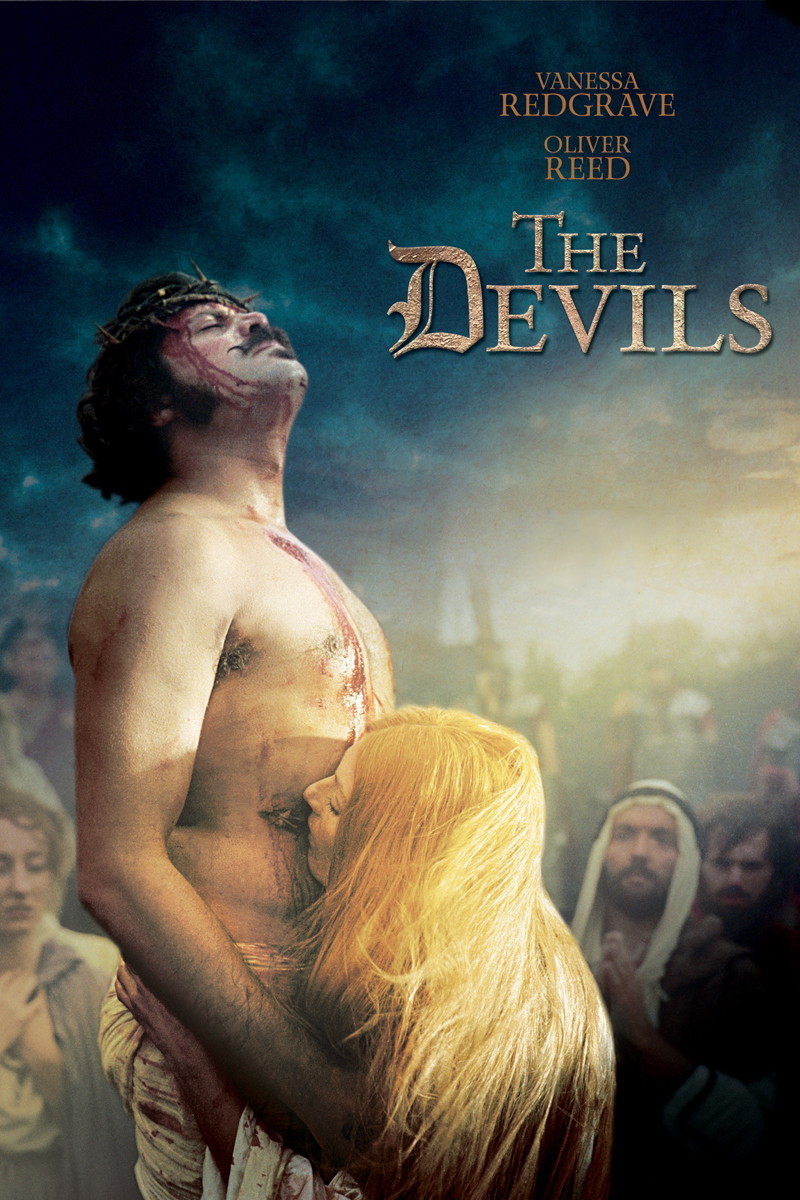
Review: The Devils (dir. by Ken Russell)


“I have been a man. I have loved women. I have enjoyed power.” — Father Urbain Grandier

Ken Russell’s The Devils (1971) stands as one of the most provocative and polarizing films in cinema history, a visceral plunge into the hysteria of religious fanaticism and political intrigue set against the backdrop of 17th-century France. Adapted loosely from Aldous Huxley’s historical account The Devils of Loudun and John Whiting’s play The Devils, the film dramatizes the real-life case of Father Urbain Grandier, a charismatic priest accused of witchcraft amid a scandal of supposed demonic possessions at a Loudun convent. Directed with unbridled fervor by Russell, who infuses every frame with operatic excess, the movie challenges viewers to confront the grotesque intersections of faith, sexuality, power, and repression. While its boldness earns admiration for unflinching social commentary, its stylistic indulgences can overwhelm, making it a work that demands both endurance and reflection.

The story unfolds in the walled city of Loudun, a Protestant stronghold under threat from Catholic forces led by the cunning Cardinal Richelieu. Oliver Reed delivers a towering performance as Grandier, portraying him not as a saintly martyr but as a flawed, hedonistic figure—a womanizer who preaches liberty while bedding Madeleine (Gemma Jones), a young Protestant whose quiet devotion contrasts sharply with the surrounding debauchery. Grandier’s defiance of Richelieu’s edict to demolish the city’s walls marks him as a target, but his downfall accelerates through the hysterical claims of Sister Jeanne (Vanessa Redgrave), the hunchbacked prioress of the Ursuline convent. Twisted by unrequited lust for Grandier, Jeanne accuses him of sorcery, sparking a wave of mass possession among the nuns that spirals into public spectacle. Russell draws from historical records to depict these events, emphasizing how personal pathologies fueled institutional corruption.

Visually, The Devils is a tour de force of baroque horror, with production designer Derek Jarman crafting sets that evoke a pristine white monastery defiled by filth and frenzy. Cinematographer David Watkin employs distorted wide-angle lenses and frenetic camera movements to mirror the characters’ unraveling psyches, turning sacred spaces into nightmarish arenas. The infamous “nunsploitation” sequences—where possessed sisters writhe in orgiastic fits, desecrate crucifixes, and simulate blasphemous acts—remain shocking even today, not merely for their explicitness but for their raw psychological intensity. These scenes serve Russell’s thesis: repressed desires, when twisted by authority figures like the witch-hunting Father Barre and Father Mignon, erupt into collective madness. Fairly assessed, these choices underscore Russell’s intent: to expose how power structures weaponize female hysteria, a theme resonant in historical witch hunts and modern reckonings with abuse.

Russell’s direction amplifies this through rhythmic editing and a pounding score by Peter Maxwell Davies, which blends liturgical chants with dissonant percussion to evoke a descent into hell. The film’s opening, with its ritualistic execution of a wise woman amid fireworks and folk rituals, sets a tone of pagan vitality clashing against ecclesiastical oppression. Midway, hallucinatory visions plague Grandier, blurring reality and delusion in a style reminiscent of Russell’s later explorations of ecstatic breakdown. The film unflinchingly depicts torture scenes—a burning at the stake, an afternoon in the rack, headscrews, a douche with boiling water—highlighting its raw confrontation with human cruelty. However, this excess risks tipping into self-parody; moments like the nuns’ simulated levitations or Jeanne’s contortions can strain credulity, prompting questions of balance between provocation and restraint.

Performances anchor the chaos, with Reed’s Grandier embodying defiant charisma undercut by hubris. His courtroom defiance and final quartering—nailed alive to a burning cross—culminate in a crucifixion scene of harrowing power, rivaling traditional passion narratives in emotional weight. Redgrave’s Jeanne is a revelation, her physical deformity symbolizing inner torment; she veers from pitiable to monstrous without caricature. Supporting turns shine too: Dudley Sutton as the impish Baron de Laubardemont, scheming for Richelieu; Max Adrian as the syphilitic priest whose decaying face mirrors moral rot; and Christopher Logue as the predatory Cardinal, whose urbane cruelty chills. The ensemble’s conviction elevates the material, ensuring characters feel flesh-and-blood rather than allegorical pawns.

Thematically, The Devils indicts institutional religion not as anti-faith but as a critique of its perversion by human ambition. Russell draws parallels to scandals where church power intertwines with politics, arguing that true devilry lies in hypocrisy. The film posits sexuality as a battleground: Grandier’s libertinism versus Jeanne’s repression, with the church exploiting both for control. This aligns with Huxley’s original thesis, expanded by Russell into a broader assault on authoritarianism. Politically, it skewers absolutism; Richelieu’s agents manipulate “possessions” for territorial gain, much as witchfinders historically profited from purges. Balanced against this, the film acknowledges Grandier’s flaws—he fathers a child out of wedlock and mocks piety—preventing hagiography. Upon release, it faced cuts in various countries, its controversial rating reflecting discomfort with its uncompromised vision.

Stylistically, Russell risks the “ridiculous” for the sublime. The white-tiled convent, pristine yet prone to vomit and excrement, symbolizes false purity; smashing it in the finale cathartically liberates Loudun from fanaticism. Influences from montage masters appear in crowd scenes, synthesized into a singular fever dream. Pacing falters in the trial’s verbosity, and some anachronistic flourishes—like Louis XIII’s cross-dressing ballet—inject campy levity, diluting gravity at times. Yet these quirks humanize the director’s bombast, reminding us of cinema’s power to provoke laughter amid horror. Compared to Russell’s Women in Love or TommyThe Devils stands as his most structurally coherent assault on repression.

Historically contextualized, the Loudun possessions of 1634 involved Urbain Grandier, executed for allegedly bewitching Ursuline nuns via a pact with Satan. Huxley documented the hysteria, linking it to political machinations under Richelieu, who sought to crush Huguenot resistance. Russell amplifies the carnality for dramatic effect, prioritizing emotional truth over literalism. Restored versions reveal its full ferocity, influencing not just cinema but broader media, including comics like Argentinian artist Ignacio Noé’s The Convent of Hell, which echoes its themes of convent-based depravity and demonic intrigue in vivid, explicit sequential art.

Ultimately, The Devils endures as a lightning rod: a moral film cloaked in immorality, pro-religion by exposing its distortions. Its ugliness—filth-smeared faces, ruptured bodies—serves illumination, urging viewers toward wisdom. For every viewer repulsed by its excesses, another finds genius in its candor. Russell’s gamble pays off; in risking the absurd, he achieves a sublime confrontation with our shadowed souls. At around 109 minutes in its uncut form, it repays multiple viewings, rewarding the brave with insights into faith’s fragility and power’s perils. Not flawless—its hysteria occasionally exhausts—yet undeniably vital, The Devils remains essential cinema, a shattered lens on humanity’s eternal dance with darkness.

Doctor Who — The Ribos Operation, The Pirate Planet, The Stones of Blood, The Androids of Tara, The Power of Kroll, The Armageddon Factor


The sixteenth season of Doctor Who featured the usual six serials but, for once, they were all a part of a much bigger story.  Season 16 would open with the Doctor being assigned to find the six segments of the Key of Time and it would end with an appearance from Lalla Ward, who would not only play one of the Doctor’s companion but who would (albeit briefly) become a companion to Tom Baker himself.

The Ribos Operation (1978, directed by George Spenton-Foster)

The Ribos Operation begins with the White Guardian (Cyril Luckham) materializing in the TARDIS.  He has come to give the Doctor (Tom Baker) and K-9 (voiced by John Leeson) a mission.  The balance of the universe is maintained by the White Guardian and the Black Guardian.  The balance is at risk of collapsing unless the Doctor can track down the six segments of the Key of Time.  Each segment has been hidden on a different planet, disguised as something native to that world.  The White Guardian gives the Doctor a locater to help him find each planet.  He also gives the Doctor a new assistant, a Time Lady named Romanadvoratrelundar (Mary Tamm).  The Doctor calls her Romana.

And so stars the Key of Time saga.  As played by Mary Tamm, Romana was a new type of assistant for the Doctor.  As a fellow Time Lord (though referred to as being a “Time Lady” because this serial was filmed in 1978), Romana has just as much knowledge as the Doctor and she does not view him with the awe that other companions viewed him.  The sophisticated and almost haughty Romana is not with the Doctor for adventure.  She is there to complete their assignment.

Their first mission takes them to the icy planet Ribos and finds them getting involved with a scheme by a human named Garron (Ian Cuthbertson) to sell the largely worthless planet to an exiled tyrant named Graff Vynda-K (Paul Seed).  (In this case, “operation” means swindle.)  When Graff discovers that he’s been cheated, he comes after both Garron and the Doctor.

The Ribos Operation is an enjoyable story.  Graff is a great megalomaniacal villain and I liked the idea of trying to trick him into buying a worthless planet.  It was the future equivalent of selling swampland.  Mary Tamm also makes a strong impression as Romana.  The Key to Time saga got off to a good start.

As for the first segment of the Key to Time, it was a piece of the fake crown jewels of Ribos.

The Pirate Planet (1978, directed by Pennant Roberts)

The Doctor and Romana are next directed to a planet called Calufrax that is known for being cold and boring.  When they land, they find themselves in an apparent paradise.  It turns out that they are actually on a hollowed-out planet called Zanak that materializes around other planets and, in the style of Galactus, plunder their resources.  Zanak is apparently controlled by the one-eyed Captain (Bruce Purchase) but the Doctor and Romana discover that it is actually the Captain’s nurse (Rosalind Lloyd) who is calling the shots.

The Pirate Planet is famous for being one of the serials written by Douglas Adams.  The loud but stupid Captain and his long-suffering assistant, Mr. Fibuli (Andrew Robertson), certainly do seem like they would be at home in one of Adams’s novels and the story overall has more humor than even the typical Tom Baker episode.  It’s a clever script, though and both Purchase and Robertson give good performances as the two pirates.

The entire planet of Calufrax turns out to be a segment of the Key to Time.  When I first saw this episode as a kid, that struck me as being very weird.  It still seems weird but that’s Doctor Who.

The Stones of Blood (1978, directed by Darrol Blake)

The Doctor, Romana, and K-9 are brought to modern-day Cornwall, where Prof. Emilia Rumford (Beatrix Lehmann) and her friend Vivien Fay (Susan Engel) are studying a stone circle.  For the first two episodes of this serial, it appears that the main villains are going to be a group of modern-day druids but it turns out that the stones are actually aliens who feed on blood, and Vivien Fay is a galactic war criminal named Cessair and that she has stolen the Great Seal of Diplos, which also happens to be the third segment of the Key of Time.

This serial sees the Doctor returning to Earth for the first time since Image of Fendahl.  The first two episodes have an almost gothic horror feel to them before the serial heads in a different, more intergalactic direction during its second half.  In a clever twist, it turns out that the “stones of blood” were actually just red herrings.  After spending four episodes convincing the viewers that the key would be one of the stones, it instead turned out to be the Great Seal of a planet that no one had ever heard of.  This was another enjoyable serial, featuring a memorable villainess and a clever story.

The Androids of Tara (1978, directed by Michael Hayes)

Romana finds the next segment within minutes of landing on the planet Tara but the Doctor wants to take a break and do some fishing.  While he is doing that, Romana is attacked by a bear and rescued by Count Grendel (Peter Jeffrey).  Grendel takes Romana back to his castle, where he soon reveals that he’s not as kind as he seems.

The Androids of Tara is an adventure story that takes place on a planet where a feudal society is matched with androids and electronic weapons.  This episode gives Mary Tamm quite a lot to do as she plays not only Romana but also the Taran Princess Strella and the android versions of Strella and Romana.  Grendel hopes to marry Romana-as-Strella and become the ruler of Grendel.  The Doctor, along with Price Reynart (Neville Jason) and the swordsmen Zadek (Simon Lack) and Farrah (Paul Lavers), works to rescue Romana.  The Doctor even fights a duel with Grendel.

The Androids of Tara is a bit silly but it’s all in good fun.  Tom Baker seems to enjoy playing the swashbuckler and Peter Jeffrey, a familiar character actor, is an appropriately melodramatic villain.  This serial allows Mary Tamm her chance in the spotlight and she makes the most of it, reminding us that Romana could be just as strong as the Doctor.

The Power of Kroll (1978-1979, directed by Norman Stewart)

The TARDIS travels to a swamp planet where a crew of humans are running a methane refinery and the planet’s inhabitants (called Swampies, by the humans) worship a giant squid named Kroll.  Kroll is giant because it ate a segment of the Key of Time.  Kroll attacks both humans and Swampies until the Doctor manages to extract the Key of Time.  Kroll explodes and, since Kroll was also the main source of methane on the planet, the refinery closes.

This serial made the mistake of focusing on Kroll.  Like so many Doctor Who giant monsters, Kroll is not at all convincing.  That and some poor acting from the guest cast and a largely humorless script all combine to make this the most forgettable part of the Key to Time saga.

The Armageddon Factor (1979, directed by Michael Hayes)

The search for the final segment leads the TARDIS to the warring plants of Atrios and Zeos.  Atrios and Zeos have both been scarred by nuclear weapons.  Princess Astra (Lalla Ward) of Atrios wants end the war but the fanatical Marshal (John Woodvine) is determined to continue the war.  A mysterious figure known as The Shadow (William Squire) steals the TARDIS and abducts Princess Astra, who is revealed to also be the sixth segment of the Key of Time.  The Shadow is working for the Black Guardian (Valentine Dyall).  In pursuing The Shadow, the Doctor meets yet another renegade Time Lord and classmate, Drax (Barry Jackson).

The Armageddon Factor is about two episodes too long and is often needlessly complicated but there were a few clever moments, like the discovery that Zeos was no longer inhabited by humans and that the missiles were being launched by a super computer.  (K-9 was able to communicate with it and broker a peace.)  For viewers of the series, The Armageddon Factor is best-remembered for introducing Lalla Ward.  Dissatisfied with the way Romana was developing, Mary Tamm announced that she was leaving at the end of the season.  When Romana regenerated in the following season, she ended up looking a lot like Princess Astra of Atrios.

On-Stage With The Lens: MacBeth (dir by Phillip Casson and Trevor Nunn)


In 1978, Trevor Nunn staged what would become a legendary production of William Shakespeare’s Macbeth.  The play was produced in a small studio theatre, with the actors working in the round were minimum sets and costuming.  Shifts in location or mood were indicated are by lighting changes.  It was a production that captured both the intensity of the play but also the horror of Shakespeare’s play about ambition, guilt, fate, and multiple murders.  Macbeth and Lady Macbeth were played by Ian McKellen and Judi Dench.

This production was filmed and, in 1979, broadcast on Thames Television in the UK.  Here, for today’s staged horror, is the Trevor Nunn production of MacBeth, starring Ian McKellen and Judi Dench.