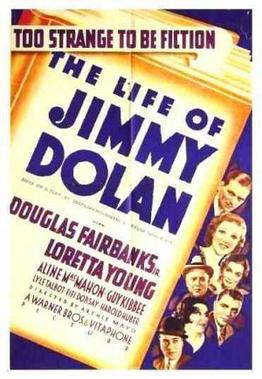
The Life of Jimmy Dolan (1933, directed by Archie Mayo)


Jimmy Dolan (Douglas Fairbanks Jr.), the light heavyweight champion of the world, goes out of his way to present himself as being a wholesome boxer who loves his mom and is as saintly outside the ring as he’s fearsome inside.  Instead, in private, Jimmy is a hard-drinking cynic with a corrupt manager (Lyle Talbot) and a wild girlfriend (Shirley Grey).  When a reporter (George Meeker) threatens to reveal the truth, Jimmy’s manager punches him and accidentally kill him.  The manager frames Jimmy for the crime and then flees with Jimmy’s girlfriend, just to suffer a fiery end in a car accident.

Everyone except for weary Inspector Phalanxer (Guy Kibbee) thinks that Jimmy is dead.  Jimmy goes on the run, hitching rides on freight trains and nearly starving to death before he stumbles over a home for orphans.  Peggy (Loretta Young) takes Jimmy in and gives him food and a place to live.  Jimmy helps with the kids (including Mickey Rooney).  When Jimmy learns that the orphanage might be shut down, he agrees to fight in a charity boxing match against the fearsome King Cobra (Sammy Stein).  King Cobra is so tough that even John Wayne (playing a boxer named Smith) is scared to get in the ring with him.  Jimmy risks his life and his freedom for the orphanage.

This is a good pre-code melodrama.  Because this was a pre-code film, it doesn’t have to shy away from portraying Jimmy’s decadent lifestyle outside of the ring.  Douglas Fairbanks, Jr. was a likable actor and easy to root for.  He was athletic enough to be convincing as someone who could handle himself in a fight.  When he finds himself down-and-out, he’s standing in for everyone who was struggling during the Depression.  The great character actor Guy Kibbee also has some great moments as the inspector, especially towards the end of the film.  Fans of John Wayne won’t see much of him here but it’s still interesting to see Wayne play a character who is frightened of something.

All in all, The Life of Jimmy Dolan is a good, pre-code boxing movie.

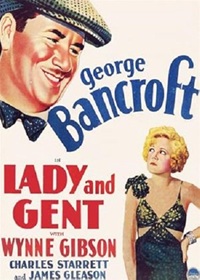
Lady and Gent (1932, directed by Stephen Roberts)


When veteran prize fighter Stag Bailey (George Bancroft) gets cocky and doesn’t bother to properly train for the big fight, he is knocked out by a young up-and-comer named Buzz Kinney (John Wayne).  Stag’s manager, Pin (James Gleason), had all of his money riding on Stag winning.  Now broke and with the mob after him, Pin tries to steal the cash from the boxing arena and ends up getting shot by a security guard.  Stag and his girlfriend, Puff (Wynne Gibson), take in Pin’s young son, Ted, and they devote themselves to raising him.  Years later, Ted (Charles Starrett) wants to become a prizefighter but Stag and Puff, who know what years of getting punched in the head can do to someone, try to convince him to go to college instead.

This boxing film is of interest to western fans because of some of the faces in the cast.  This was an early John Wayne role and he’s only seen in the ring and then in one brief scene where he confronts Stag and Puff in a bar.  Wayne still plays an important role, though, because Buzz’s transformation from being a fresh-faced boxer to being a bitter, punch-drunk bully serves as a warning for what waits for Ted if his adoptive parents can’t keep him out of the fight game.  Charles Starrett, of course, would go on to find greater fame as the Durango Kid.

Otherwise, Lady and Gent is a standard pre-code melodrama.  It’s a little more realistic than some of the other boxing films that came out in the 30s.  Boxing is portrayed as a dirty business that leaves its participants with struggles that all of the prize money in the world can’t make up for.  Puff sacrifices her carefree life to raise Ted but it’s worth it in the end.  You can tell this was a pre-code film because Stag and Puff are a couple but they only decide to get married so they can adopt Ted.

George Bancroft was a star in the late 20s and early 30s but eventually, he transitioned to character parts.  He retired from acting 1942 and became a full-time rancher.  One of his final films was 1939’s Stagecoach, starring his Lady and Gent co-star, John Wayne.


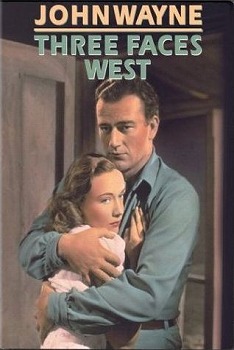
Three Faces West (1940, directed by Bernard Vorhaus)


When a small farming community in the Dakotas gets hit by an outbreak of the flu, farmer and community leader John Phillips (John Wayne) invites a Dr. Karl Braun (Charles Coburn) to come and be the town’s doctor.  A refugee from Austria, Dr. Braun arrives with his daughter, Leni (Sigrid Gurie).  At first, Leni is not happy living in the heart of the Dust Bowl but then she falls for John Phillips. However, Leni is still mourning his ex-fiancé (Roland Varno), who Leni and Braun believe sacrificed his life to help them reach America.

Eventually realizing that the town cannot prospers in the heart of the Dust Bowl, John suggests that everyone pack up and move to Oregon.  Almost everyone agrees and the one person who wants to go to California gets his van driven off the side of the road.  But Leni and Dr. Braun still take a detour to San Francisco because it turns out that Leni’s ex is not dead after all.  She and her father meet up with him and discover, to their horror, that he has become a fully committed Nazi.

This is an interesting change-of-pace for John Wayne.  Though the film is a western (and even features its own version of wagon train), it’s set in what was then contemporary times and it deals with issues like the Great Depression and the rise of Nazism in Germany.  The times may be hard but John Wayne isn’t going to let his community fall apart and, even more importantly, he’s not going to give up his beliefs or his ideals.  Even though the movie was made at a time when the United States was still officially neutral, the film is strongly anti-Nazi.  John Wayne, giving a strong performance, stands in for America while those who would collaborate with or make excuses for the Nazis represented by the weaselly Roland Varno.  Leni’s ex-fiancé had no problem selling out his beliefs and embracing Nazism.  Naturally, Leni and her father have no problem telling him off and then rejoining John Wayne in Oregon.  The United States may have officially been neutral but this movie had no problem letting everyone know where it stood.

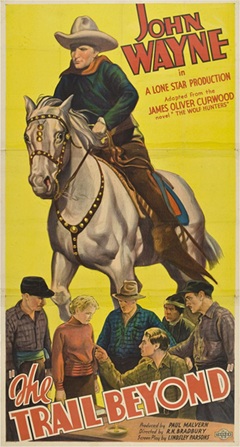
The Trail Beyond (1934, directed by Robert N. Bradbury)


Falsely accused of murder, Rod Drew (John Wayne) and his buddy Wabi (Noah Beery, Jr.) jump off a train and end up in the Canadian wilderness, where they eventually find a deserted cabin, a map to a gold mine, and plenty of trouble when French-Canadian outlaw Jules LaRocque (Robert Frazer) decides that he wants the map and kidnaps Wabi’s girlfriend, Felice (Verna Hillie), to get it.

This was one of the many B-westerns that John Wayne made in between 1930’s The Big Trail and 1939’s Stagecoach.  The film finds the youngish Wayne playing a slightly less upright character than usual.  He’s still the hero but he’s also wanted by the police and spends much of the film fleeing from them.  The movie is only 55 minutes long and the action moves quickly.  The film’s Canadian locations and Robert Frazer’s over-the-top villain gives The Trail Beyond a slightly different and quirkier flavor than most the Duke’s 1930s output.  I think this might be the only film to feature Wayne working with the Mounties.  Even in this low-budget production, John Wayne is a strong hero who just looks like he belongs on a horse and traveling across the frontier.  For someone who was the president of his high school’s Latin Club., Wayne had an automatic authenticity when it came to playing cowboys, even in the years before Stagecoach made him one of the biggest stars in the world.  This is also one of the few films to feature both Noah Beery Sr. and Noah Beery Jr.  While Beery Jr. plays Wayne’s sidekick and is in the film almost as much as John, Berry Sr.’s role is much smaller.  He’s the store owner who is also Felice’s father.

Obviously, this is a film for fans of the genre only but it’s a good example of how John Wayne could make even his Poverty Row productions entertaining and watchable.

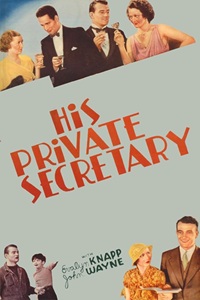
His Private Secretary (1933, directed by Phil Whitman)


Business tycoon Mr. Wallace (Reginald Barlow) is sick and tired of his hard-drinking, hardy-partying son refusing to act in a responsible manner.  Hoping to teach Dick Wallace about the value of hard work, Mr. Wallace sends Dick to a small town with instructions to collect a debt from the local preacher (Alec B. Francis).  Dick, however, is more interested in the preacher’s daughter, Marion (Evelyn Knapp).  After Dick finally convinces Marion that he’s not as bad his reputation, they got married.  Mr. Wallace is disgusted and refuses to meet his new daughter-in-law, convinced that she’s a golddigger.  Without revealing his true identity, Marion gets a job as Mr. Wallace’s private secretary and attempts to repair the relationship between father and son.

This is a creaky romantic comedy from the early days of sound film and it would probably be forgotten if not for the fact that Dick Wallace is played by John Wayne.  Wayne was 26 when he played Dick Wallace and already a screen veteran, though most of his roles had been in B-westerns and had featured Wayne riding a horse and carrying a gun.  Wayne actually gives a pretty good performance as Dick.  He’s better and more natural here than he was in many of the singing cowboy films that he was making at the time and this film suggests an alternate timeline where Wayne become known as a romantic comedy star instead of a screen cowboy.  Wayne is especially good in the early scenes, when he’s still a no-good, hard-drinking, no-account lout.  I get the feeling he enjoyed not having to be the upright hero for once.

His Private Secretary definitely shows its age but it’s worth watching for a chance to see a young John Wayne in an unexpected role.

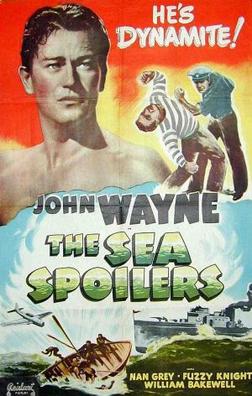
The Sea Spoilers (1936, directed by Frank R. Strayer)


Bob Randall (John Wayne) is a coast guard boatswain, headquartered in Alaska where he and the members of his crew battle evil seal poachers like oily Phil Morgan (Russell Hicks).  When Randall returns to port after his latest patrol, he has to deal with two disappointments.  First off, he is passed over for a promotion to commanding officer, even though everyone knows that he deserves it.  Instead, the promotion goes Lt. Commander Mays (William Blakewell), the son of a commander (George Irving).  Mays doesn’t even want the job.  He’s scared of the water and he’d rather fly airplane as a part of the Coast Guard’s aviation force.  Bob is disappointed but he’s a professional and he’s going to support Mays.  Secondly, Bob’s girlfriend (Nan Grey) witnesses a murder and is kidnapped by Phil Morgan.  Bob and his sidekick (dependable western mainstay Fuzzy Knight) go undercover as fisherman to try to find her.

The Sea Spoilers was the first of six B-movies that John Wayne did for Universal.  Wayne, who had been stuck in the B’s for a while, was trying to prove that he was more than just a singing cowboy so, in this one, he plays a tough and ready sailor.  Wayne is convincing in the role, even if the movie is really just a western set in what was then modern day Alaska.  Though only 30, Wayne shows the no-nonsense professionalism that would become his trademark once he became one of the world’s biggest movie stars.  Unlike some of Wayne’s early films, it’s possible to see the icon that John Wayne would eventually become while watching him here.  The Sea Spoilers is only 66 minutes long but fans of the Duke should enjoy it.

Finally, The Sea Spoilers was written by George Waggner.  Waggner would later go on to direct the original Wolf Man.

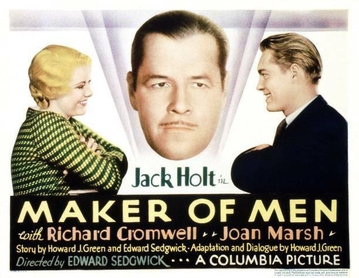
Maker Of Men (1931, directed by Edward Sedgwick)


Bob Dudley (Richard Cromwell) is the wimpy son of Coach Dudley (Jack Holt), who is in charge of the local college’s football team.  Bob joins the team out of a sense of family obligation but he turns out to be a cowardly player who would rather fumble the ball than take a hard hit.  Coach Dudley is disgusted with his son.  Bob’s girlfriend (Joan Marsh) dumps him.  Bob drops out of school and disappears for two years and no one seems to care. Then, on the day of a big game, Bob reappears playing for another college.  Despite Coach Dudley’s team being led by All-American Dusty Rhoades (John Wayne!), Bob leads the rival team to victory.  He’s won Coach Dudley’s respect.  Coach Dudley is probably going to get fired.

This was one of the weirdest sports films that I’ve ever seen.  Usually, you would expect Coach Dudley to bring out the best in his son or to understand that his son is just not meant to be a football player.  Instead, Bob is forced to drop out of college!  Bob returns just so he can defeat his father.  The slight Richard Cromwell is not a convincing football player.  On the other hand, John Wayne is a convincing football player but his role is tiny.  The movie is a little over an hour long and 20 minutes of that running time is taking up with grainy footage of an actual football game.

The best thing about the film?  It reminds us that everyone, even John Wayne, had to start somewhere.

Happy Birthday in heaven to the great Paul Fix! A “4 Shots From 4 Films” special edition…


If you love movies, then there’s no doubt you’ve seen the work of the great movie and TV character actor Paul Fix. With over 340 acting credits to his name, including 26 with John Wayne, Fix co-starred in some of the best movies and TV shows ever made. Born on March 13th, 1901, Fix passed away on October 14th, 1983, leaving behind a tremendous legacy of superior performances. I just wanted to take a moment to remember this amazing actor who’s provided me with so much great entertainment over the years!! 

THE RIFLEMAN T.V. Series (1958-1963)

TO KILL A MOCKINGBIRD (1962)

STAR TREK: WHERE NO MAN HAS GONE BEFORE (1966)

EL DORADO (1967)

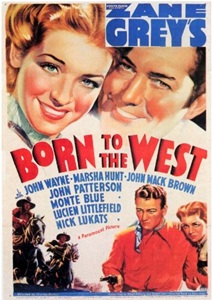
Born To The West (1937, directed by Charles Barton)


John Wayne plays Dare Rudd, a friendly rogue who aspires to be the best poker player west of the Mississippi.  When he and his sidekick, Dinkey Hooley (Syd Saylor), ride into Montana, they meet up with Dare’s cousin, Tom Filmore (Johnny Mack Brown, billed as John here).  Filmore needs some help on his cattle drive and Dare sure does like Tom’s girl, Judy (Marsha Hunt).  Dare replaces Lynn Hardy (John Patterson) as head of the cattle drive and Lynn teams up with rustler Bart Hammond (Monte Blue) to try to get revenge.  While Dinkey tries to sell lightning rods, Dare moves the herd and even finds time to play poker with notorious gambler Buck Brady (James Craig).

This is another one of the B-westerns that John Wayne made before John Ford made him a stars by casting him in Stagecoach.  This one is interesting because Wayne is not playing his usual stolid do-gooder or even an expert marksman.  Instead, Dare is impulsive and reckless and he’s ultimately not as smart a card player as he thinks he is.  It’s rare to see John Wayne need help from anyone but that’s what he gets from Johnny Mack Brown, who shows up in time to reveal that Dare is getting cheated in his poker game.  For fans of the genre, this short oater is worth watching for the chance to see two western icons acting opposite each other.  Johnny Mack Brown and John Wayne would both go on to appear in a countless number of westerns.  Wayne became a superstar, appearing in big budget studio films.  Brown remained a mainstay on the B-circuit.  They’re amusing to watch in this film as they bounce dialogue off of each other and continually try to steal scenes from one another.  Brown is playing the type of no-nonsense, hard-working westerner who would later become John Wayne’s trademark character.

Based on a novel by Zane Grey, Born to the West is a fast-paced western featuring two of the best to ever ride a horse.

Song of the Day: The Man Who Shot Liberty Valance, performed by Gene Pitney


Since I already shared a scene from my favorite John Ford film, it seems only right that today’s song of the day should pay some respect to Mr. Ford as well.  Here is the theme song from 1962’s The Man Who Shot Liberty Valance, performed by Gene Pitney.

When Liberty Valance rode to town
The womenfolk would hide, they’d hide
When Liberty Valance walked around
The men would step aside

‘Cause the point of a gun was the only law
That Liberty understood
When it came to shooting straight and fast
He was mighty good

From out of the East a stranger came
A law book in his hand, a man
The kind of a man the West would need
To tame a troubled land

‘Cause the point of a gun was the only law
That Liberty understood
When it came to shooting straight and fast
He was mighty good

Many a man would face his gun
And many a man would fall
The man who shot Liberty Valance
He shot Liberty Valance
He was the bravest of them all

The love of a girl can make a man stay on
When he should go, stay on
Just trying to build a peaceful life
Where love is free to grow

But the point of a gun was the only law
That Liberty understood
When the final showdown came at last
A law book was no good

Alone and afraid, she prayed that he’d
Return that fateful night, oh that night
When nothing she said could keep her man
From going out to fight

From the moment a girl gets to be full grown
The very first thing she learns
When two men go out to face each other
Only one returns

Everyone heard two shots ring out
One shot made Liberty fall
The man who shot Liberty Valence
He shot Liberty Valance
He was the bravest of them all

The man who shot Liberty Valance
He shot Liberty Valance
He was the bravest of them all

Songwriters: Burt F. Bacharach / Hal David