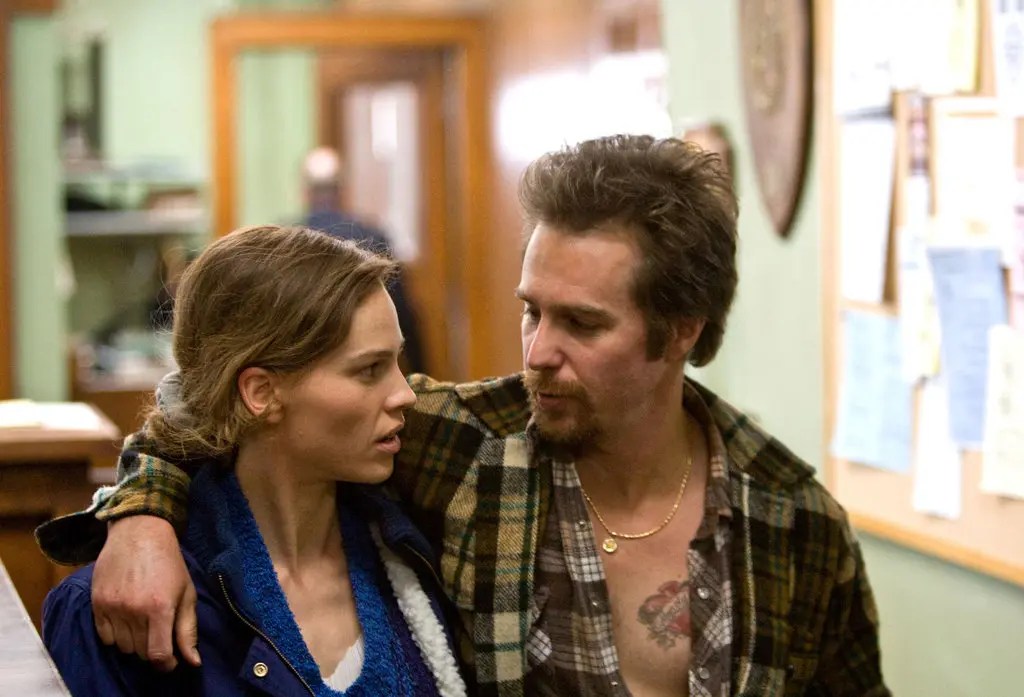
CONVICTION (2010) – Hilary Swank and Sam Rockwell star in the real-life story of a sister who saves her brother from a wrongful conviction!


My wife and I love movies based on real-life stories. We were looking for something to watch this afternoon on the MAX app and came across their “Real Life Dramas” section. One of the movies we saw listed was CONVICTION (2010) starring 2-time Oscar winner Hilary Swank. My wife loves Hilary Swank so we decided to give it a spin.

Betty Anne Waters (Hilary Swank) watches as her brother Kenny (Sam Rockwell) is convicted of the murder of Katherine Brow on May 21st, 1980 in Ayer, Massachusetts and sentenced to life in prison. Even though she knows he’s a troublemaker, Betty Anne is convinced that he’s not a murderer, so she gives up everything in her life to try to prove his innocence, especially after she learns that he tried to kill himself while in custody. Her husband (Loren Dean) divorces her and takes their kids with him. This doesn’t stop her. She goes back to school, eventually making her way to law school for the sole purpose of helping to exonerate her brother. In a positive turn of events, Betty Anne realizes that the new field of DNA testing could be the key to overturning her brother’s conviction. She contacts attorney Barry Scheck (Peter Gallagher) from the “Innocence Project” who assists those who believe DNA testing can help overturn previous convictions. Will Betty Anne finally be able to prove Kenny’s innocence, or will he have to spend the rest of his life in jail for a crime she doesn’t think he’s capable of committing?

Movies like CONVICTION are such an interesting watch for me, especially since we can know how these stories play out with a simple google search. When I see a movie is based on a real story, I purposefully avoid the facts of the actual events so I can see the events depicted on screen without my own internal bias taking front and center. I enjoyed watching how the events unfolded in CONVICTION. Hilary Swank and Sam Rockwell are such good actors, and I appreciate the work they put in here. I don’t pretend that everything depicted on screen is exactly how it was in real life, but I do believe that the actors portray the essence of truth, and I must admit to a tear in my eye when that truth is finally acknowledged for Kenny Waters at the end of the film. I also enjoyed telling my wife that the director of CONVICTION is Tony Goldwyn, the bad guy in the blockbuster film, GHOST. I just thought that was kind of cool, and so did she.

The real truth of Betty Anne Waters and Kenny Waters is ultimately bittersweet, but their story is both a testament to, and an indictment of, the American judicial system. As a person who truly loves our country, I think it’s important to realize that things aren’t always perfect, even in the United States of America!

See the trailer for CONVICTION below:
Lisa Reviews An Oscar Winner: Unforgiven (dir by Clint Eastwood)


The 1992 Best Picture winner, Unforgiven, begins as a story of frontier justice.

In Kansas, a young and cocky cowboy who calls himself the Schofield Kid (Jaimz Woolvett) rides up to an isolated hog farm.  He’s looking for Will Munny (Clint Eastwood), a notorious outlaw with a reputation for being a ruthless killer.  Instead, he just finds a broken down, elderly widower who is trying to raise two young children and who can barely even manage to climb on a horse.  Will Munny, the murderer, has become Will Munny the farmer.  He gave up his former life when he got married.

The Schofield Kid claims to be an experienced gunfighter who has killed a countless number of men.  He explains that a group of sex workers in Wyoming have put a $1,000 bounty on two men, Quick Mike (David Mucci) and his friend, Davey Bunting (Rob Campbell).  Quick Mike cut up one of the women when she laughed at how unimpressively endowed he was.  While Davey didn’t take part in the crime, he was present when it happened and he didn’t do anything to stop it.  The local sheriff, a man named Little Bill Daggett (Gene Hackman), had Davey give the woman’s employer several horses as compensation.  The Kid wants Munny to help him collect the bounty.

At first, Munny refuses to help the Kid.  But, when he realizes that he’s on the verge of losing his farm, Munny changes his mind.  He and his former partner, Ned Logan (Morgan Freeman), join with the Kid and the three of them head to Wyoming.  Along the way, they discover that the Kid is severely nearsighted and can hardly handle a pistol.

Meanwhile, in the town of Big Whiskey, Wyoming, Little Bill ruthlessly enforces the peace.  He’s a charismatic man who is building a house and bringing what many would consider to be civilization to the Old West. When we first meet Little Bill, he seems like a likable guy.  The town trusts him.  His deputies worship him.  He has a quick smile but he’s willing to stand his ground.  But it soon becomes apparent that, underneath that smile and friendly manner, Bill is a tyrant and a petty authoritarian who treats the town as his own personal kingdom.    Little Bill has a strict rule.  No one outside of law enforcement is allowed to carry a gun in his town.  When another bounty hunter, English Bob (Richard Harris), comes to town to kill the two cowboys, Little Bill humiliates him and sends him on his way but not before recruiting Bob’s traveling companion, writer W.W. Beauchamp (Saul Rubinek), to write Bill’s life story.  Bill’s not that much different from the outlaws that he claims to disdain.  Like them, Bill understands that value of publicity.

Unforgiven starts as a traditional western but it soon becomes something else all together.  As the Schofield Kid discovers, there’s a big difference between talking about killing a man and actually doing it.  Piece-by-piece, Unforgiven deconstructs the legends of the old west.  Gunfights are messy.  Gunfighters are not noble.  Davey Bunting is the only man in town to feel guilty about what happened but, because he’s included in the bounty, he still dies an agonizing death.  Quick Mike is killed not in the town square during a duel but while sitting in an outhouse.  Ned and Munny struggle with the prospect of going back to their old ways, with Munny having to return to drinking before he can once again become the fearsome killer that he was in the past.  And Little Bill, the man who says that he’s all about taming the west and bringing civilization to a lawless land, turns out to be just as ruthless a killer as the rest.  A lot of people are dead by the end of Unforgiven.  Some of them were truly bad.  Some of them were good.  Most of them were in the wrong place at the wrong time.  Everyone’s got it coming, to paraphrase Will Munny.

With its violent storyline, deliberate pacing, and its shots of the desolate yet beautiful western landscape, Clint Eastwood’s film feels like a natural continuation of the Spaghetti westerns that he made with Sergio Leone.  (Unforgiven is dedicated to both Leone and Don Seigel.)  Unforgiven was the first of Eastwood’s directorial efforts to be nominated for Best Picture and also the first to win.  It’s brutal meditation on violence and the truth behind the legends of the American frontier.  Eastwood gives one of his best and ultimately most frightening performances as Will Munny.  Gene Hackman won his second Oscar for playing Little Bill Daggett.

Unforgiven holds up well today.  Hackman’s Little Bill Dagget feels like the 19th century version of many of today’s politicians and unelected bureaucrats, authoritarians who claims that their only concern is the greater good but whose main interest is really just increasing their own power.  Unforgiven remains one Clint Eastwood’s best films and one of the best westerns ever made.  Leone would have been proud.

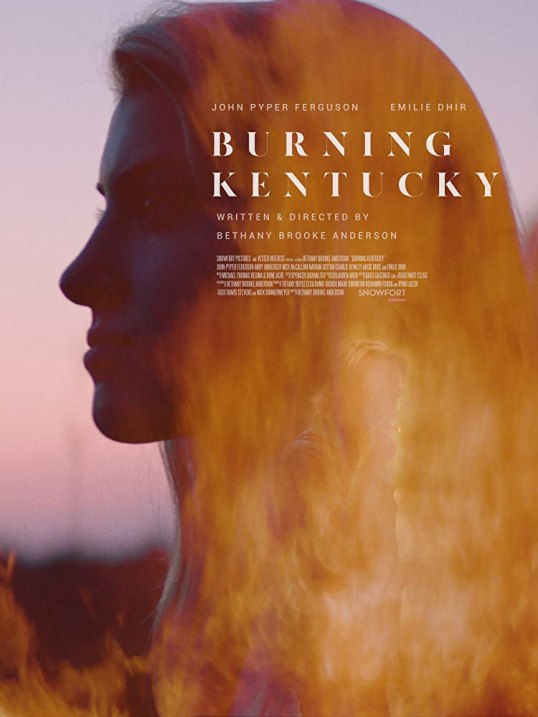
Film Review: Burning Kentucky (dir by Bethany Brooke Anderson)


Burning Kentucky, which I just finished watching on Prime, is a film that has its own unique vibe.  You’re either going to connect with this frequently surreal film or you’re not.  If you do connect with it, you’re going to be aware that, while the film has its narrative flaws, it also has moments of visual brilliance.  If you don’t connect with it, you’ll probably dismiss it as just being another pretentious revenge thriller.  Burning Kentucky currently has a rating of 4.1 over that imdb, not because it’s a bad film but because it’s just not a film for everyone.  It’s not a crowd pleaser but it we’ve learned anything recently it’s that crowds suck.

Burning Kentucky takes place in the hills of Harlan County, Kentucky.  We find ourselves observing two families.  One family lives in a shack and brews moonshine.  They eat whatever animals they catch in the wilderness and about the only thing that’s vaguely modern about them is the camera that their daughter, Aria (played, in her film debut, by Emilie Dhir), carries with her.  (And even that camera appears to be from the mid-20th century.)  Aria also narrates the film, musing about life and death.  In the country, she explains, people understand that death is a part of life.  Regardless of any sentimental feelings, everything dies.

The other family is headed by an man named Jaxson (John Pyper-Ferguson).  Jaxson is the country sheriff, so he’s a man of some importance.  However, it’s also obvious that he’s a man who has long been on a downward spiral.  He drinks too much and he spends most of his time cursing God and complaining about the local preacher, Abe (Andy Umberger).  Jaxson has two sons.  Wyatt (Nick McCallum) appears to be relatively stable.  Rule (Nathan Sutton), on the other hand, is a junkie who lives in a shack that he shares with Jolene (Augie Duke).  Jolene wants to be a singer.  She wants to get off drugs.  Rule, on the other hand, appears to be content to just slowly kill himself.

Whenever Wyatt can get away from his drunk father and his wasted brother, he spends his time with Aria.  They’ve been in love for several years, ever since the night that Aria discovered Wyatt trapped in one of the traps that her family had set around their land.  When we first see Aria and Wyatt together, they talk about how they met on the same night that they each lost their mother.

It takes a while to figure out just what exactly is going on in Burning Kentucky.  The deliberately paced first half of the film freely hops from the past to the present and then back again.  The camera glides over the misty mountains of Kentucky, stopping to linger on deserted houses and crumbling buildings.  Everything seems to be suspended in a state of permanent decay.  The wilderness appears to be both beautiful and threatening at the same time and the imagery, when combined with Aria’s narration, is often surreal.  The first half of the film plays out as if we’re watching a filmed dream.

Unfortunately, the second half of the film is a bit more conventional.  Once we finally discover who everyone is relative to everyone else and after we learn what happened in the past, the film settles down to become a standard revenge thriller, albeit one that’s very much concerned with the concepts of guilt, redemption, and human nature.  Still, the Kentucky hills remains atmospheric and dream-like and the well-selected performers — particularly Augie Duke and John Pyper-Ferguson — continue to bring their haunted characters to life.

As I said, this isn’t necessarily a film for everyone.  The film’s ending will leave a lot of people feeling perplexed but that’s okay.  A story like this doesn’t need a neat ending.  In fact, Burning Kentucky is a film that demands to end on a hint of messiness and ambiguity.  I liked Burning Kentucky.  You might like it too.