For today’s horror on the lens, we have one of Vincent Price’s most popular films, 1971’s The Abominable Dr. Phibes!
This is Price at his considerable best. Be sure to read Gary’ review.
And watch the film below!
Enjoy!
For today’s horror on the lens, we have one of Vincent Price’s most popular films, 1971’s The Abominable Dr. Phibes!
This is Price at his considerable best. Be sure to read Gary’ review.
And watch the film below!
Enjoy!
(With the Oscars scheduled to be awarded on March 4th, I have decided to review at least one Oscar-nominated film a day. These films could be nominees or they could be winners. They could be from this year’s Oscars or they could be a previous year’s nominee! We’ll see how things play out. Today, I take a look at the 1948 best picture winner, Hamlet!)
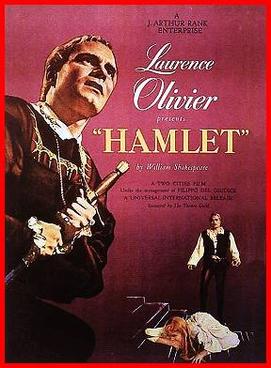
Hamlet is a film of firsts.
It was the first British production to win the Oscar for Best Picture. In winning, it beat out three American films (Johnny Belinda, The Snake Pit, and The Treasure of the Sierra Madre) and one other British film (The Red Shoes).
It was also the first adaptation of Shakespeare to win Best Picture. Of course, it wasn’t the first Shakespeare adaptation to be nominated. That honor would go to 1935’s A Midsummer Night’s Dream. Adaptations of Romeo and Juliet would be nominated in 1936, 1961, and 1968. Henry V (which, like Hamlet, was directed by and starred Laurence Olivier) was a 1946 nominee. Then there was 1953’s Julius Caesar. The Dresser featured scenes from Shakespeare. Shakespeare in Love imagined the circumstances behind the writing of Romeo and Juliet. However, Hamlet was the first to win.
It also remains the only traditional Shakespearean adaptation to win. West Side Story updated Romeo and Juliet while Shakespeare in Love … well, let’s just not get into it.
It was the first Best Picture winner to be directed by the man starring in the movie. Laurence Olivier was nominated for both Best Director and Best Actor. He lost the directing Oscar to John Huston but he won for his performance as Hamlet. In winning, he became the first actor to direct himself to an Oscar.
Finally, Hamlet was the first of 24 films to feature both Peter Cushing and Christopher Lee! In fact, this was Lee’s film debut. Now, before anyone gets too excited, I should point out that Cushing and Lee don’t actually interact. In fact, Lee doesn’t even speak in the film. He appears in the background as a Spear Carrier and it’s pretty much impossible to spot him. He has no dialogue and wasn’t even listed in the final credits. From what I’ve read, I don’t think Lee and Cushing even knew each other at the time and, when they later met, they were surprised to learn that they had both appeared in the film. For his part, Cushing plays Osiric, the courtier who everyone remembers because he had such a cool name.
It’s always fun to play “what if.” Rosencrantz and Guildenstern do not appear in Olivier’s adaptation of the play. To modern audiences, that might seem strange but, really, that’s just because we’re all familiar with the two characters from Tom Stoppard’s Rosencrantz and Guildenstern Are Dead. When Olivier filmed Hamlet, he excised portions of the play in the interest of time. (Hamlet uncut runs over four hours. Olivier’s version clocks in at nearly three.) Rosencrantz, Guildenstern, Fortinbras, and the second gravedigger are all dropped from Olivier’s version and, to be honest, none of them are particularly missed.
And yet … as I watched Hamlet, I found myself wondering what would have happened if Olivier had kept Rosencrantz and Guildenstern around and had cast Cushing and Lee in those roles. It probably wouldn’t have happened, of course. Cushing maybe but Lee was a total unknown at the time. Still, how amazing would that have been?
As for the actual film, Olivier’s Hamlet turned out to be far more cinematic than I was anticipating. Olivier’s camera snakes through the darkened hallways of Elsinore Castle while Olivier’s Hamlet veers between self-righteous fury and apparent madness as he seeks revenge on his Uncle Claudius (Basil Sydney). As Hamlet grows more obsessed with death and vengeance, the castle seems to grow darker and the hallways even more maze-like, as if the castle’s changing shape to conform with the turmoil in Hamlet’s mind. Among the cast, Jean Simmons is poignantly fragile as Ophelia while Eileen Herlie is the perfect Gertrude, despite being 12 years younger than the actor playing her son. Olivier gives a wonderfully physical performance as Hamlet, killing Polonious with a demented gleam in his eye and literally leaping towards his uncle at the end of the film.
If you’re one of those people who thinks that Shakespeare is boring … well, Olivier’s Hamlet probably won’t change your mind. One thing I’ve noticed about the “Shakespeare is boring” crowd is that nothing can change their minds. But, for the rest of us, Olivier’s Hamlet is an exciting adaptation of Shakespeare’s more difficult play.
You won’t miss Rosencrantz and Guildenstern at all. And seriously, Fortinbras who?
It’s really not October until you’ve watched at least one Vincent Price film and, for today’s horror on the lens, we have one of his most popular films, 1971’s The Abominable Dr. Phibes!
This is Price at his considerable best. Be sure to read Gary’ review.
And watch the film below!
Enjoy!

The 26th film in Mill Creek’s Fabulous Forties box set was the 1944 British film, The Way Ahead (or, as it was retitled when it was released in America, The Immortal Battalion).
Directed by Carol Reed (who was five years away from directing the great The Third Man), The Way Ahead is a British propaganda film that was made to boost the morale of both a weary British public and the army during the final days of World War II. Usually, when we call something propaganda, it’s meant as a term of disparagement but The Way Ahead is propaganda in the best possible way.
The film follows a group of British soldiers, from the moment that they are conscripted through their training to their first battle. (In many ways, it’s like a more refined — which is another way of saying “more British” — version of Gung Ho!) As usually happens in films like this, the newly conscripted soldiers come from all sections of society. Some of them are poor. Some of them are rich. Some of them are married. Some of them are single. In fact, when the film first begins, the only thing that they all have in common is that they don’t want to be in the army.
As they begin their training, they resent their tough sergeant, Fletcher (William Hartnell), and are upset that Lt. Jim Perry (David Niven, giving a very likable performance) always seems to take Fletcher’s side in any dispute. However, as time passes by, the soldiers start to realize that Fletcher is looking out for them and molding them into a cohesive unit. Under his training, they go from being a group of disorganized and somewhat resentful individuals to being a tough and well-organized battalion.
Though they’re originally skeptical that they’ll ever see combat, the battalion is eventually sent to North Africa. However, their ship is torpedoed and, in a scene that remains genuinely impressive even when viewed today, the men are forced to abandon ship while explosions and flames light up the night sky. By the time that they do finally reach North Africa, they are more than ready to fight…
The Way Ahead plays out in a semi-documentary fashion (it even features a narrator who, at the end of the film, exhorts the audience to stay firm in their commitment) and it’s a fairly predictable film. If you’ve ever seen a war film, you’ll probably be able to predict everything that happens in The Way Ahead. That said, The Way Ahead is a remarkable well-made and well-acted film. The cast is well-selected (and features a lot of familiar British characters actors, some making their film debut) and David Niven is the perfect choice for the mild-mannered but firm Lt. Perry. Even though I’m not a huge fan of war films in general, I was still impressed with The Way Ahead.
And you can watch it below!
 Through the Shattered Lens