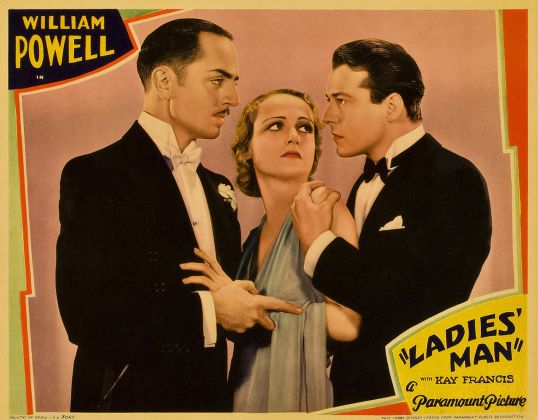
In the 1931 film Ladies’ Man, the always suave William Powell plays Jamie Darricott.
Jaimie may be suave but, when we first meet him, he’s faking it. He lives in a tiny broom closet in a grand hotel and he only has two suits to his name. The only thing that Jamie has going for him is that he’s charming and he’s handsome, in the way that only William Powell could be. He’s like a much sleazier and far less likable version of Nick Charles. Unfortunately, Jamie doesn’t have Nora Charles or Asta in his life. He just has one valet and a lot of ambition. It’s strange to see Powell play a bitter man but that’s what he does here.
Jamie starts spending time with the wealthy Mrs. Fendley (Olive Tell), despite the fact that she’s married to wealthy businessman Horace Fendley (Gilbert Emery). Jamie starts to move up in the world. He gets a much better room. He gets a few more suits of clothes. Soon, Jamie is also spending time with Mrs. Fendley’s daughter, the wild Rachel (Carole Lombard). Rachel doesn’t care if prohibition is the law of the land. She’s going to get as drunk as she wants every night. And Rachel doesn’t care if society judges her for sleeping over in another man’s room despite not being married to him. Rachel does what she wants! And I have to admit that, at first, I liked Rachel. She was a rebel and she made no apologies for her behavior and good for her! (It helped she was also played by Carole Lombard, who was just starting her career but already had a lively screen presence.) What’s interesting is that both Mrs. Fendley and Rachel seem to know that the other is seeing Jamie and they’re both pretty much okay with that. And since Jamie is getting paid by both of them, he’s okay with it too.
This might sound a bit racy for a 1931 film and I suppose it is. However, this is also a pre-code film. Before the Production Code was instituted, films always portrayed New York society as being filled with gigolos and people who got drunk at nightclubs. Pre-code films had the advantage of not only knowing what people wanted to see but also the freedom to give it to them. Ladies’ Man is pretty open, if not particularly explicit, in detailing how Jamie makes his money. And the message seems to be that no one can blame him. There’s a depression going on! Jamie has to do something to survive! At least he’s not killing people Jimmy Cagney or Paul Muni!
However, when Jamie meets and falls for the kindly Norma Page (Kay Francis), he starts to reconsider his lifestyle. And when Rachel finds out that Jamie is actually falling in love with Norma, she lets her father know about what’s going on. It all leads to a rather sudden and surprisingly dark ending. The film may have been pre-code but it was still a film from the era of DeMille and hence, all sinners had to be punished.
Seen today, Ladies’ Man is definitely a relic of a previous time. It was made early enough in the sound era that it’s obvious that some members of the cast were still learning how to act with sound. For a film with a 70-minute run time, it has a surprisingly large numbers of slow spots. This is not the film to use if you want to introduce someone to the wonders of the pre-code era. That said, I love William Powell and I love Carole Lombard. This film was made before their brief marriage and it’s nowhere near as fun as their later collaboration, My Man Godfrey. But it’s still enjoyable to see them together, bringing some much needed life to this scandalous tale.

 Through the Shattered Lens