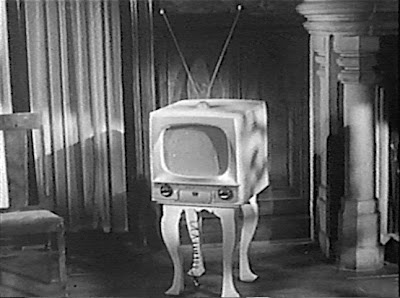
Tonight’s episode of Hammer House of Horror features antiques and cults! It’s a like a very British version of Friday the 13h: The Series. This episode is not necessarily one of my favorite episodes of this series. I always find the ending to be disappointing. The said, it does feature an intriguing story and a cast of Hammer veterans.
This episode originally aired on November 15th, 1980.
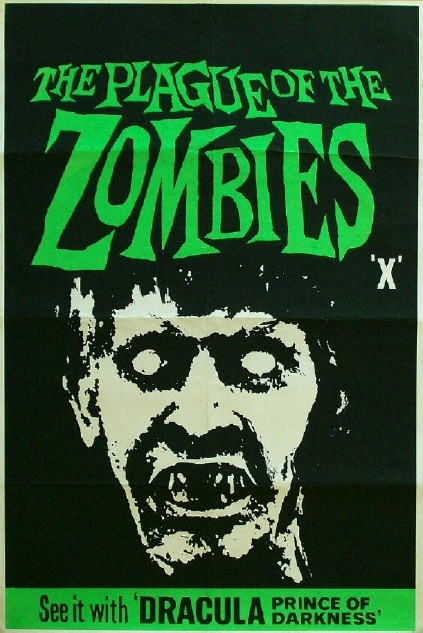
One of the best (and scariest) zombie films of all time came to us from Hammer Studios.
The 1966 film, The Plague of the Zombies, takes place in a small, fog-filled English village. The village has been hit by a plague, one that is wiping out all of the inhabitants. Unable to combat or even diagnose the mysterious illness, Dr. Peter Tomlinson (Brook Williams) calls in his friend, Sir James Forbes (Andre Morrill) for help. Sir James arrives with his daughter, Sylvia (Diane Clare) and suggests that the graves of the recently deceased should be dug up so that he can examine the bodies himself.
Sounds like a reasonable idea, right? There’s only one problem. ALL OF THE COFFINS ARE EMPTY! Now, before anyone asks, they weren’t empty when they went into the ground. There were dead bodies in them when they were originally buried. But now the coffins are empty, the bodies are missing, and that can mean only one thing — ZOMBIES!
And since this is a Hammer film, that also means that a squire is to blame! Seriously, if there’s anything that I’ve learned from watching British horror films, it is to never trust a squire. Squires always seem to end up practicing some sort of black magic. In this case, Squire Clive Hamilton (Jack Carson) has just returned from Haiti, where he apparently spent some time researching the art of zombie creation. Squire Hamilton has a tin mine to manage and undead workers are apparently far less demanding than living workers.
(Of course, today, Squire Hamilton could have just automated the mine and brought in robot workers, who would probably be even less demanding than zombie workers. In fact, with the march of progress, there may soon be no need for zombie workers at all.)
This is a Hammer film so, needless to say, Sylvia eventually gets kidnapped and it’s up to Dr. Tomlinson and Sir James to put an end to the Squire’s evil plans before Sylvia is transformed into a zombie herself. That’s not going to be as easy as it seems, because there’s zombies everywhere!
The Plague of the Zombies is one of Hammer’s best films and it’s also one of the few that, even to a modern viewer, remains frightening. The village is a wonderfully atmospheric location, mixing all of the usual gothic tropes that we’ve come to expect with Hammer films with a very real feeling of decay. Even before the whole zombie plague started, one gets the feeling that the village was already dying a slow, economic death. The tin mine may be the only way to keep the village alive but, at the same time, killing the village is also the only way to keep the tin mine open. The Plague of the Zombies is a moody and rather sad film, one that has a bit more on its mind than just supplying the usual Hammer combination of cleavage and blood.
Speaking of blood, Plague of the Zombies has one of the scariest zombie scenes of all time, in which one of our heroes finds himself wandering through a mist-covered cemetery while the dead rise around him. At one point, he literally steps over a pool of blood. Of course, the scene itself turns out to be a dream but it’s still effectively frightening. Also frightening are the zombies themselves, with their pasty, decaying flesh and their blankly hostile faces. It has been suggested that Plague of the Zombies was an influence on Romero’s Night of the Living Dead and you can definitely see that in its portrayal of the zombies as being a threat not because they’re fast but because they’re so relentless and pitiless.
The Plague of the Zombies is one of the best Hammer films out there so watch it this Halloween!
Two years after being temporarily destroyed at the end of Dracula Has Risen From The Grave, Dracula returned in 1970’s Taste The Blood of Dracula! Returning in the role and uttering only a handful of lines, Christopher Lee gave one of his most intimidating performances in the role of everyone’s favorite vampire.
Picking up where Dracula Has Risen From The Grave ended, Taste the Blood of Dracula opens with a sleazy merchant named Weller (Roy Kinnear) upsetting his fellow passengers during a carriage ride through Eastern Europe. After they forcefully toss him out of the carriage, Weller comes across a crucifix-impaled Dracula. Weller watches as Dracula dissolves into red dust. Weller gathers up the dust and Dracula’s ring and brooch.
A few months later, the plot picks up with three wealthy men in England. Hargood (Geoffrey Keen), Paxton (Peter Sallis), and Secker (John Carson) pretend to be charitable church goers but, in reality, they spend most of their spare time down at a wonderfully ornate brothel. One night, at the brothel, they meet a disgraced nobleman named Courtley (Ralph Bates), who was disinherited for attempting to hold a black mass. Intrigued by Courtley’s promise to give them an experience that they’ll never forget, the three men agree to purchase Dracula’s blood from Weller.
When they go to meet Courtley in a desecrated church, things suddenly go wrong. Courtley attempts to force the three men to drink from a goblet containing a mix of his and Dracula’s blood. After all three of the men refuse, Courtley himself drinks the blood. The men respond by beating Courtley to death and then fleeing from the church. After the men are gone, Courtley’s dead body transforms into a now living Dracula. Dracula announces that those who have destroyed his servant will now be destroyed themselves.
And he proceeds to do just that, turning the men’s children into vampires and then commanding them to kill their parents. Among those possessed are Alice (Linda Hayden), Hargood’s daughter for whom the film suggests Hargood may have incestuous feelings. Alice is in love with Paul (Anthony Corlan), the son of Paxton. When both Alice and his sister Lucy (Isla Blair) disappear, Paul sets out to find them and instead, comes across Dracula…
Taste the Blood of Dracula features Dracula at his cruelest (which, of course, makes it all the more ironic that his main motivation here is to avenge the death of his servant). Whereas Dracula could probably very easily kill all three of the men himself, his decision to use their children to get his revenge adds a whole new level of horrific ickiness to the film. Fortunately, none of the three men are particularly likable but still, it’s hard not to be disturbed when you’re confronted by the image of a vampirized daughter driving a stake into her own father’s heart.
But then again, that’s a part of the appeal of the old Hammer films, isn’t it? Hammer films actually “go there” in a way that the period’s American horror films would probably never quite dare.
As for Taste the Blood of Dracula, there’s a lot to recommend it. Director Peter Sadsy keeps the action moving, both the sets and the supporting cast are properly baroque, and how can you go wrong with Christopher Lee playing Dracula? Christopher Lee is one of those actors who could do so much with just a glare and the fact that his Dracula says very little only serves to make him all the more intimidating and frightening.
Christopher Lee, of course, has never made a secret of the fact that he didn’t particularly care much for the Hammer Draculas, often complaining that the films failed to stay true to the spirit of Bram Stoker’s conception of the character. Undoubtedly, Lee does have a point and the Hammer Draculas did decline in quality over the years. (Just wait until we get to Dracula A.D. 1972.) But Taste the Blood of Dracula is still a pretty effective vampire film. Hammer’s Dracula may not have been Stoker’s Dracula but, as played by Lee, he still dominates our dreams and nightmares.

 Through the Shattered Lens