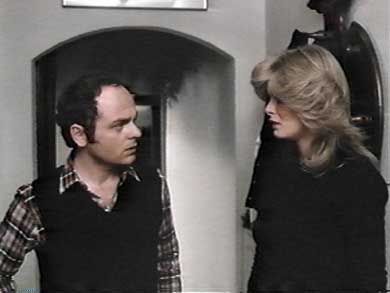
Film Review: The Great Smokey Roadblock (dir by John Leone)


First released in 1977, The Great Smokey Roadblock tells the story of Elegant John Howard (Henry Fonda).

Elegant is not really his first name.  It’s a nickname, one to let us know that, in the world of independent truckers, John Howard was one of the good guys.  He never crashed his rig.  He never overcharged for a job.  He always arrived on time and in good shape.  John Howard was a good man but then he turned 60 and he got sick.  He spent months in the hospital, unable to work.  His truck was repossessed.  The movie starts with John sneaking out of his hospital room, stealing back his truck, and hitting the road in search of one final job.  Though John says he just wants to make enough money to get his truck back, the truth is that John is terminally ill.  If he’s going to die, he wants to die doing what he loves.  Of course, dying while driving could lead to some trouble for anyone else who happens to be on the road at the time but still, you have to respect John’s determination.  He’s a true American, independent to his core.

(My Dad occasionally made a living driving a truck so perhaps that’s why I’m partial to films like this one.)

John picks up a hitchhiker, a religious young man named Beebo Crozier (Robert Englund).  John picks Beebo up because Beebo was walking through the desert in a suit.  Beebo claims that he’s walking to Florida but John tells him that he can’t do that.  John will drive Beebo to Florida.  Of course, John also expects Beebo to pay for the gas that his truck uses because it’s not like John has any money.  At first, Beebo accuses John of cheating him.  (Henry Fonda cheating someone!?  Perish the thought!)  Soon, however, John has become Beebo’s mentor.

Everyone respects John but no one wants to hire him.  The only offer that John gets is from sleazy Charlie Le Pere (Gary Sandy), who has an agenda of his own.  Finally, John visits his old friend, Penelope (Eileen Brennan).  Penelope is a madam whose brothel has just been closed down.  John agrees to transport Penelope and her girls (including Susan Sarandon) to a new location on the East Coast.  Penelope offers to help John pay the bills.  Elegant John’s a pimp now!  (I was about to say that this seemed like an odd turn-of-events for Henry Fonda but then I remembered that he starred in The Cheyenne Social Club with Jimmy Stewart.)

There’s not really much of a plot to The Great Smokey Roadblock.  John, Beebo, Penelope, and the girls travel from one location to another.  They get thrown in jail by a notoriously corrupt deputy named Harley Davidson (Dub Taylor).  After they escape, they become minor celebrities.  Two counterculture journalists (played by Austin Pendleton and John Byner) show up and help them broadcast their story and the film comes to a halt while Pendleton and Byner exchange what sounds like improvised dialogue.  The police attempt to set up a roadblock to stop Elegant John and his Six Mystery Women.  I guess that’s the Great Smokey Roadblock of the title.

It’s a weird movie, in that the humor is extremely broad and often crude but Henry Fonda is playing a man who is not only terminally ill but who actually looks like he’s terminally ill.  (Henry Fonda himself was reportedly very ill during the filming of The Great Smokey Roadblock.)  As such, it’s a rather melancholy comedy, one in which every joke seems like it might be the last one that Elegant John will ever hear.  In the 70s, not even a trucker comedy could have a happy ending and, as such, The Great Smokey Roadblock feels like a drive-in film for the existential set.  The film’s plot doesn’t really add up to much and is full of plot holes that serve as evidence of a troubled production.  That said, there’s something rather charming about seeing a pre-Nightmare On Elm Street Robert Englund playing a gentle guy who ends up as Henry Fonda’s protegee.  Fonda and Englund play off each other well and their scenes together are the best thing about The Great Smokey Roadblock.

Late Night Retro Television Review: Friday the 13th 2.8 “Read My Lips”


Welcome to Late Night Retro Television Reviews, a new feature where we review some of our favorite and least favorite shows of the past! On Fridays, I will be reviewing Friday the 13th: The Series, a show which ran in syndication from 1987 to 1990. The show can be found on YouTube!

This week, Oscar will haunt your nightmares….

Episode 2.8 “Read My Lips”

(Dir by Francis Delia, originally aired on November 21st, 1988)

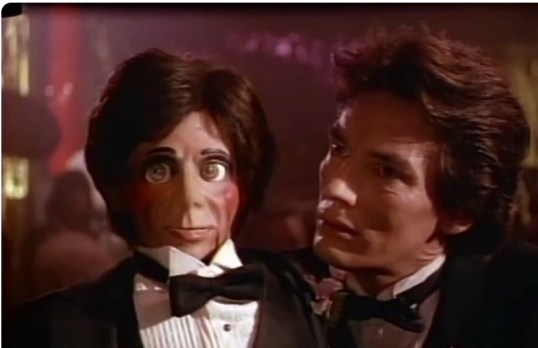
When you watch as much horror as I do, you automatically assume that anyone who is a ventriloquist is going to have an unhealthy relationship with their dummy.  Sometimes, the dummy is alive.  Sometimes, the dummy is possessed.  Sometimes, the dummy is just a dummy but the ventriloquist has decided that it’s alive and urging him to kill.  (For some reason, evil ventriloquists are always male.)  I’ve seen a lot of creepy ventriloquist dummies but nothing quite compared me for Oscar….

AGCK!  I mean …. LOOK AT THAT THING!

Oscar is at the center of this week’s episode of Friday the 13th.  Oscar is wearing a boutonniere that once belonged to the noted ventriloquist, Adolf Hitler.   The boutonniere not only brings Oscar to foul-mouthed life but it also inspires whoever owns Oscar to commit countless murders.  When we first see Oscar, he is owned by Edgar Van Horne (played by a youngish Billy Drago).  After Edgar attempts to break his bond with Oscar, Oscar drives Edgar crazy and then invites another ventriloquist, Travis Plunkett (John Byner), to be his owner.  Things don’t turn out well for Travis either.

Sadly, Jack is not in this episode.  With its emphasis on desperate nightclub performers and Oscar’s corny sense of humor, it’s hard not to feel that this storyline would have been right up Jack’s alley.  Instead, it’s left to Micki and Ryan to deal with Oscar and the ventriloquists.  Micki’s best friend from high school, Gabriella Montrose (Linda Griffiths), is planning on marrying Edgar but, needless to say, that all goes out the window once Edgar loses his mind and end up in a mental hospital.  For the most part, Micki and Ryan are largely bystanders in this episode.  All of the action revolves around Oscar and his unfortunate owners.

Billy Drago gives a wonderful performance as Edgar, making him both frightening and, in the end, surprisingly sympathetic.  Edgar is desperate to escape the clutches of Oscar but, in the end, it turns out that he’s grown addicted to performing with Oscar and the attempt to quit cold turkey leads to him losing his mind.  (Many episodes of Friday the 13th feature storylines that felt as if they were meant to be a metaphor for drug addiction and that’s certainly the case here.)  John Byner plays his role a bit more broadly than Drago but still, it’s hard not to feel bad for Travis as he comes to realize that he’s in over his head with Oscar.

This was an effectively creepy episode, even if it did owe an obvious debt to the 1978 film Magic.  Oscar makes for a memorable monster.  Hopefully, he’ll never be seen again.

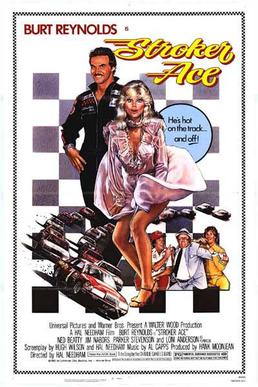
Stroker Ace (1983, directed by Hal Needham)


In 1983, Burt Reynolds had the choice of appearing in two films.

He was offered the role of former astronaut Garrett Breedlove in Terms of Endearment, a role that director/screenwriter James L. Brooks wrote specifically with Reynolds in mind.  The role was designed to play to all of Reynolds’s strengths and none of his weaknesses.  It was also a key supporting role in a film that was widely expected to be an Oscar contender.

Or, Reynolds could star in Stroker Ace, another car chase film that was going to be directed by his old friend, Hal Needham.  No one was expecting Stroker Ace to be an Oscar contender but Needham and Reynolds had made three similar films together and all of them had been hits at the box office.

Reynolds decided to star in Stroker Ace.  Jack Nicholson received the role of Garrett Breedlove and went on to win his second Oscar.  As for Burt, he later called Stroker Ace “the beginning of the end.”

The title character of Stroker Ace is a good old boy race car driver.  He’s a typical Reynolds character.  He grew up in the South and learned how to race cars by watching moonshiners outrun the police.  Now, he’s a star on the NASCAR circuit but he’s also arrogant and needlessly self-destructive.  Because this is a Hal Needham car chase movie, those are portrayed as being good traits.  When Stroker loses his former sponsor after pouring wet concrete on him, he’s forced to accept sponsorship from a crooked chicken mogul (played by Ned Beatty, who deserved better).  When Stroker’s not driving his car while dressed as a chicken, he’s romancing the prudish Pembrook Feeney (Loni Anderson).

It’s hard to describe the plot of Stroker Ace because it really doesn’t have a plot.  There’s a few scenes where Burt looks directly at the camera and smirks.  It’s supposed to remind us of Smoky and the Bandit but Stroker Ace doesn’t have the spectacular stunts that the first film had nor does it have the comedic energy of Jackie Gleason.  Instead, it’s got Jim Nabors as a mechanic named Lugs.  The former star of Gomer Pyle does say “Golly” but he doesn’t sing.

The main problem with Stroker Ace is that there’s no reason to root for Stroker Ace.  The Bandit was good at his job and cared about his car.  The same thing is true about the stuntman that Burt played in Hooper.  Stroker is a racer who would rather destroy his car than come in second and who loses his sponsorships because of his own stupid behavior.  Stroker Ace doesn’t care about anything so it’s difficult to get outraged over him having to wear a chicken suit while racing.

Reynolds later described turning down Terms of Endearment for Stoker Ace as being one of the biggest mistakes of his career.  When he talked about how the Terms of Endearment role won Nicholson an Oscar, Reynolds added that he didn’t win anything for Stroker Ace because “they don’t give awards for being stupid.”  It was a missed opportunity for sure and Reynolds would have to wait another fourteen years before Boogie Nights finally proved that he could do more than drive cars and smirk at the camera.

Despite the failure of Stroker Ace, Reynolds and Needham remained friends and even made two more film together (Cannonball Run II and Hostage Hotel).  Their friendship later served as the basis for the relationship between the characters played by Leonardo DiCaprio and Brad Pitt in Quentin Tarantino’s Once Upon A Time In Hollywood.

Holiday Sweets: Fred Astaire in THE MAN IN THE SANTA CLAUS SUIT (NBC-TV 1979)


gary loggins's avatarcracked rear viewer

Eighty year old Fred Astaire takes on nine different roles in THE MAN WITH THE SANTA CLAUS SUIT, his next to last film. Fred is as charming and debonair as ever, and his presence is what carries the saccharine script, with three varied tales of romance, comedy, and drama interwoven and played by a cast of Familiar TV and Movie Faces, kind of like a “very special Christmas episode” of THE LOVE BOAT.

Gary Burghoff (M*A*S*H’s Radar) is a nerdy math teacher in love with his neighbor, a beautiful (are there any other kind?) fashion model (Tara Buckman, THE CANNONBALL RUN). The model secretly digs him too, but the nerd’s too shy to express his feelings, until a chance encounter with a jeweler (Fred) leads him to rent a Santa suit and propose before she makes the mistake of marrying a rich, handsome playboy (again, are there any other kind?)…

View original post 449 more words